
What Is a Statute of Repose and How Does It Affect Your Legal Rights
Understand what is a statute of repose and how this absolute deadline differs from a statute of limitations, especially in personal injury cases.
Ever heard of a legal deadline that starts ticking before you even get hurt? It sounds strange, but that's exactly what a statute of repose is. Think of it as a hard cutoff, an absolute final deadline that can wipe out your right to file a lawsuit, no matter when your injury actually happened.
The Final Deadline on Your Legal Rights
Most of us know about legal deadlines, but the statute of repose works differently than you might expect. It’s not like a stopwatch that someone starts the moment you're injured. Instead, it’s more like a time bomb set by a manufacturer, builder, or professional the day they finished their work, long before you ever entered the picture.
This is the key difference that separates it from its more famous cousin, the statute of limitations. A statute of limitations kicks in when the injury happens. That clock starts ticking when you find out you’ve been harmed, or reasonably should have. But a statute of repose is triggered by a completely separate, fixed event in the past—one that has nothing to do with you or your injury.
Understanding the Triggering Event
The "triggering event" for a statute of repose is totally independent of when you get hurt. Grasping this concept is crucial because it’s what makes this law so powerful and, frankly, so unforgiving.
Common triggers include:
- The day a product was first sold or delivered.
- The date a construction project was considered substantially complete.
- The day a professional service was officially finished.
Since the clock starts from a fixed point years ago, a decade or more can easily pass before an accident even occurs. This is where you can really see the law’s true bite.
A statute of repose is a law that sets an absolute deadline by which a legal action must be initiated, completely cutting off the right to bring a claim after a specified period regardless of whether an injury has occurred or been discovered.
A statute of limitations might have exceptions for things like fraud or a delayed discovery of the injury. A statute of repose is much stricter. It’s designed to be a final cutoff, protecting potential defendants from the threat of being sued forever for something they did a long, long time ago. You can find more detail on the strict legal definitions of these laws at uslegalforms.com.
Why This Distinction Matters
So why do these laws exist? They were created to give businesses and professionals some finality. Lawmakers decided that after a certain amount of time—often 10, 12, or 15 years—it’s just not fair to hold a company liable for a product that’s been out in the world for decades. Over time, records disappear, witnesses' memories get fuzzy, and technology moves on, making it incredibly hard to defend against old claims.
But for the person who gets hurt, this means your legal rights could be gone before you even knew you had them. Imagine getting injured by a faulty part in your 16-year-old car. Even if the manufacturer was clearly at fault, you might discover that the statute of repose has already slammed the door on your case for good. Understanding this is the first, most important step toward protecting yourself.
Statute of Repose vs. Statute of Limitations
It's incredibly easy to confuse the statute of repose with the statute of limitations. They both act as legal clocks, putting a hard deadline on your right to file a lawsuit. But the real story is in when those clocks start ticking, and confusing them can be a fatal mistake for a personal injury claim.
Think of it like this. The statute of limitations is a race where the starting gun fires the moment you get hurt or realize you've been injured. The clock is all about your experience. From that day of discovery, you have a set amount of time—usually two years for a personal injury claim in Texas—to get your lawsuit filed.
A statute of repose, however, is a much stricter race. The starting gun goes off on a specific date that has nothing to do with you or your injury. It could be the day a car rolled off the assembly line or the day a construction crew finished a building. That means the clock could have been running for years, and could even run out, before you ever had a chance to get hurt.
The Core Difference: What Triggers the Clock?
The trigger—the event that starts the countdown—is what truly sets these two legal deadlines apart. One is tied directly to the injured person's awareness, while the other is tied to a fixed event in the past, designed to protect potential defendants.
- Statute of Limitations Trigger: The clock starts when your cause of action "accrues." In plain English, this is usually the date your injury happens or the day you reasonably should have discovered it. It’s a plaintiff-focused deadline.
- Statute of Repose Trigger: The countdown begins on a fixed, predetermined date, like the day a product was first sold or a construction project was considered complete. This is a defendant-focused deadline, created to give them an ultimate end date for their liability.
This timeline shows how a statute of repose works in the real world, where the clock starts ticking long before an accident ever happens.
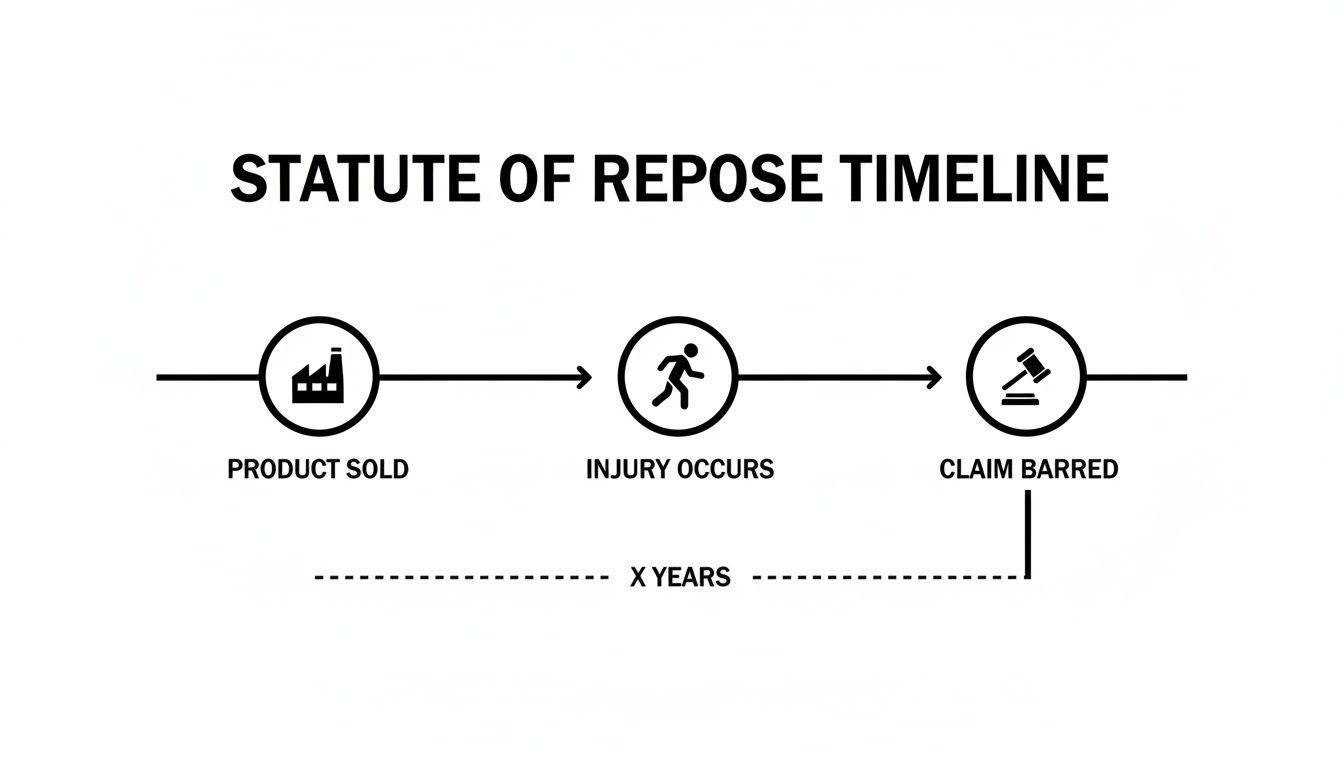
As you can see, an injury might happen very late in the repose period, leaving you with a tiny window—or sometimes, no window at all—to seek justice.
Legal Impact: Procedural vs. Substantive Rights
This isn't just about timing; it's about the very nature of your legal rights. The difference between "procedural" and "substantive" sounds like dry legal jargon, but it has huge practical consequences.
A statute of limitations is considered procedural. It doesn't wipe out your underlying legal right to compensation. It just bars the "remedy"—it closes the courthouse doors, preventing you from using the legal system to enforce your right. In theory, the right still exists, but you can no longer act on it.
A statute of repose, on the other hand, is substantive. It completely extinguishes your legal right to bring a claim. Once that deadline passes, the law treats your claim as if it never existed in the first place.
The statute of repose acts as an absolute barrier. It doesn't just prevent you from filing a lawsuit; it legally declares that the basis for your lawsuit no longer exists once the time limit expires.
A Tale of Two Timelines: Flexibility and Exceptions
Here’s another key distinction: flexibility. Statutes of limitations are often built with exceptions that can pause, or "toll," the clock. For instance, if the injured party is a minor, the clock might not start until they turn 18. The "discovery rule" is another common exception, delaying the start until an injury is reasonably discovered. You can see how these rules play out by reading our guide on the statute of limitations for car accidents in Texas.
Statutes of repose are the opposite. They are designed to be rigid, providing a final, immovable end date. The clock starts on a set day and runs out on another, no matter the claimant's age, location, or awareness of their injury. While some jurisdictions might allow for a very narrow exception, like proving a manufacturer fraudulently concealed a defect, these are incredibly rare and notoriously difficult to prove. For all intents and purposes, you should treat the statute of repose as a concrete, non-negotiable deadline.
Why These Strict Legal Deadlines Exist
It’s completely understandable to feel a sense of unfairness when you learn that a statute of repose can wipe out your legal rights before you even know you have a claim. So, why do these laws even exist? It turns out they were created to solve a very real-world problem for the businesses and professionals who design and build things meant to last for years, even decades.
At its heart, the statute of repose is a legislative attempt to strike a difficult balance between individual rights and economic reality. The core idea is to provide finality.
Imagine you’re a car manufacturer. Without a statute of repose, you could theoretically be sued over a vehicle you built 50 years ago. Think about trying to defend that case. Key evidence would be long gone, company records would be lost, the engineers who designed it might have retired or passed away, and who knows what modifications or poor maintenance the car has undergone in the five decades since it left the factory.
Creating Economic Predictability
State legislatures passed these laws to put an end to what they call an endless "long-tail" of liability. By setting a hard deadline, they give industries that are vital to our economy a degree of certainty.
This legal backstop allows companies to:
- Manage Risk: Businesses know there's a final date when their legal exposure for old projects officially ends.
- Secure Insurance: It’s much easier (and cheaper) to get liability insurance when the risk doesn't stretch on forever. This keeps business costs down for everyone.
- Encourage Innovation: A company is more likely to invest in new products if it isn't constantly worried about defending lawsuits from projects that are decades old.
A statute of repose essentially tells a manufacturer, architect, or even a doctor, "After this many years, your legal responsibility for this specific act is over." It’s a pragmatic, if sometimes harsh, solution to the problem of defending against stale claims where a fair trial is all but impossible.
The Constitutional Controversy
This balancing act isn't without its critics, and for good reason. Because a statute of repose can extinguish a claim before someone is even aware they've been injured, these laws are constantly challenged in court as being unconstitutional.
The main argument is that these statutes can violate a person's fundamental right to due process by denying them their day in court. Opponents argue that the law unfairly prioritizes a company's financial interests over the rights of an individual who was seriously hurt. It just doesn't seem right that someone could suffer an injury from a defective product, only to be told a legal technicality has already slammed the courthouse door shut.
Statutes of repose have been the subject of significant constitutional litigation across the United States. A handful of courts have struck down repose statutes on constitutional grounds, citing theories including due process violations and equal protection clause violations under their state constitutions.
Despite these frequent challenges, most statutes of repose have been upheld. The courts typically rule that state legislatures have the power to weigh these competing interests and decide that, for the greater public good of economic stability, legal rights must have an endpoint. You can dig into the history of these legal fights and see how they often withstand constitutional attacks in research from Vanderbilt Law School.
This ongoing tension really highlights the difficult trade-offs the law is forced to make, pitting the justice sought by one person against the economic predictability needed by society as a whole.
How Statutes of Repose Affect Texas Product Liability Claims
Let’s move away from legal theory and talk about how these deadlines play out in the real world for Texans. The statute of repose often has its most significant, and sometimes harshest, impact in the realm of product liability law. Texas has a very specific rule here that every consumer should be aware of.
Under the Texas Civil Practice and Remedies Code § 16.012, there is an absolute 15-year statute of repose for most product liability claims. In plain English, this means a lawsuit against a manufacturer for a defective product generally has to be filed within 15 years from the date the product was first sold.
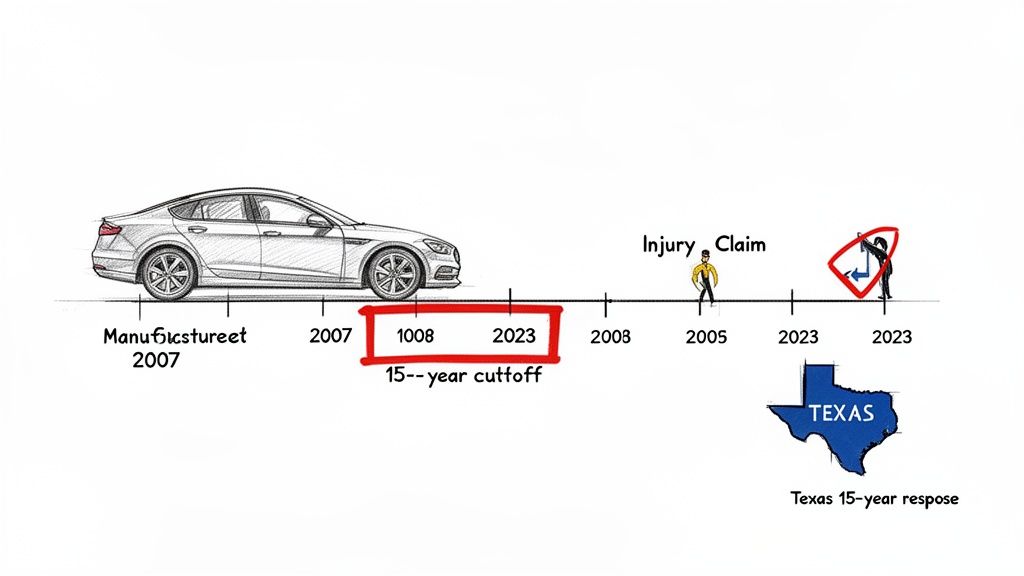
This isn’t 15 years from when you got hurt; it's 15 years from the day that product first hit the market. Once that window slams shut, your right to sue the manufacturer for that defect is gone, usually for good.
A Real-World Car Accident Example
To see just how unforgiving this can be, let's walk through a common scenario. Imagine a family in Dallas buys a brand-new sedan in January 2008. For the next 16 years, they take great care of it, and it runs perfectly.
Then, in March 2024, the driver gets into a serious accident. An investigation reveals that the crash was caused by a sudden failure of the steering column—a part that had a hidden manufacturing defect since day one. The driver is left with major injuries, facing a mountain of medical bills and lost income.
Normally, this looks like a straightforward product liability case. The driver has two years from the crash date to file a personal injury claim under the statute of limitations.
But here’s the brutal truth: the 15-year statute of repose started its countdown way back in January 2008, when the car was first sold. That clock expired in January 2023, more than a year before the accident even occurred.
So, even with a fresh injury and clear evidence of a defect, the driver's claim against the automaker is likely dead on arrival. The law essentially says the claim is too old to exist, all because that 15-year cutoff passed. This is the harsh reality of a statute of repose.
Juggling Two Different Timelines
This example shows why it’s so critical to understand that two separate legal clocks can be ticking on your potential claim at the same time.
- The Statute of Limitations Clock: This one starts on the day you are injured. For most personal injury cases in Texas, you have two years.
- The Statute of Repose Clock: This one started ticking the day the product was originally sold. For Texas product liability, it’s a 15-year countdown.
For a lawsuit to move forward, it must be filed before both of these deadlines expire. It makes no difference if you're well within your two-year statute of limitations if the 15-year statute of repose has already passed. The first clock to run out is the one that matters, and when older products are involved, it's almost always the statute of repose. This strict rule is designed to protect manufacturers from endless liability, but it can leave innocent people with very real injuries and no path to justice.
Are There Loopholes? Exploring Potential Exceptions
While statutes of repose are meant to be a hard stop, the law isn't completely blind to extreme situations. Courts recognize that a rigid, absolute deadline can sometimes create a profound injustice, especially when a defendant has acted in bad faith.
Think of these exceptions less as common loopholes and more as rarely used safety valves. They are narrowly defined and notoriously difficult to prove, but they can be a claimant's only path forward when the facts are particularly outrageous. If you think your situation might fit one of these, talking it over with a seasoned attorney is a critical next step.
Fraudulent Concealment: Hiding the Truth
The most common exception, and the one that makes the most intuitive sense, is fraudulent concealment. This isn't about a company simply being unaware of a problem; it's about a company knowing about a dangerous defect and then deliberately burying the evidence. The courts won't let a wrongdoer benefit from their own deception.
To successfully argue fraudulent concealment, you generally have to prove a few key things:
- The defendant had actual, concrete knowledge of a serious defect.
- They intentionally took steps to hide or cover up the facts.
- They had a legal or ethical duty to tell the public what they knew.
Let’s say a car company’s own engineers produce a report showing a faulty ignition switch can shut off the engine while driving. Instead of issuing a recall, a senior executive orders the report destroyed. Years later, after the statute of repose has run out, someone is injured in a crash caused by this exact issue. Their lawyer could argue the company’s intentional cover-up prevents them from using the statute of repose as a shield.
When a Warranty Outlasts the Law
Another potential pathway around the deadline involves explicit written warranties. If a manufacturer puts in writing that their product is guaranteed for a period longer than the statute of repose, their own promise can sometimes override the law.
For example, a company might sell a critical vehicle component with a "25-year powertrain guarantee" in a state with only a 15-year statute of repose for products. In that scenario, a court could decide that the manufacturer voluntarily agreed to be on the hook for a longer period. The company's own marketing and promises created a new, extended timeline.
While statutes of repose are designed to offer finality, courts may refuse to enforce them when it would allow a defendant to benefit from their own intentional misconduct, such as hiding a known danger from consumers.
The Problem of Hidden Illnesses
Some states have also created special exceptions for injuries that don't show up for decades. These are known as latent diseases, and they're most often associated with exposure to toxic materials like asbestos or certain industrial chemicals.
The reasoning is simple: You can't be expected to file a claim for an injury you couldn't possibly know you had. It would be fundamentally unfair to bar a claim for a disease that was impossible to discover before the repose period ended. Texas law, for instance, specifically addresses this for latent diseases caused by product exposure. The legal clock doesn't start ticking on the date the product was sold, but on the date the disease is—or should have been—discovered. These exceptions are highly specific and vary greatly from state to state, which is why getting specialized legal advice is so important.
What To Do If A Statute Of Repose Affects Your Case
Realizing a statute of repose might apply to your case can be a gut-wrenching moment. It's an absolute, unforgiving deadline. If you have even a slight suspicion this rule is a factor, your most valuable resource is time, and you need to act fast. Hesitating could mean the difference between getting justice and having the door to the courthouse slammed shut forever.
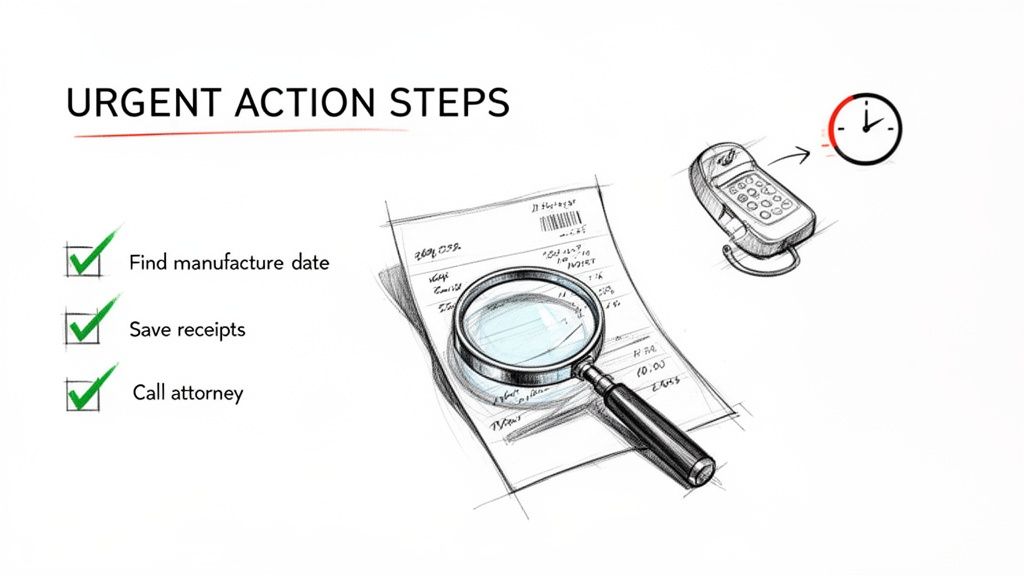
Your very first move should be to contact an experienced personal injury attorney immediately. These deadlines are a legal minefield, and trying to figure them out on your own is incredibly risky. A good attorney can quickly analyze the specific dates, look at the relevant Texas laws, and determine if any of the rare exceptions—like fraudulent concealment—might give you a fighting chance.
Prepare For Your Legal Consultation
To get the most out of that first call with a lawyer, you need to put on your detective hat. The more information you can bring to the table, the quicker your attorney can size up your situation against that ticking clock.
Before you dial, try to gather these key pieces of evidence:
- Product Information: Find the exact manufacturing date, model number, and any serial numbers on the product that hurt you. For a car, you can usually find this on a sticker inside the driver’s side doorjamb.
- Proof of Purchase: Dig up any receipts, invoices, or sale documents showing when the product was first sold. This is the moment that likely started the repose clock.
- Injury and Accident Details: Write down a clear timeline of what happened, including the precise date of your injury. Gather all your medical records and any accident reports.
- Maintenance and Repair History: If you have records showing how the product was maintained or repaired over its life, grab them. This can be critical for proving the defect was there from the beginning.
Your main goal is to nail down two key dates: the day the product was first sold and the day you were injured. The gap between these two dates will show whether the statute of repose has already expired.
Your Action Checklist
The pressure of a looming deadline is intense. To help you focus, here is a clear checklist of what to do right now.
| Step | Action to Take | Why It's Important |
|---|---|---|
| 1. Stop Using the Product | Immediately put the product that caused the injury in a safe place. Do not repair, change, or throw it away. | This preserves the most important piece of evidence your legal team needs to prove the defect. |
| 2. Document Everything | Take clear photos and videos of the product, your injuries, and where the accident happened. | Visual proof is powerful. It locks in the facts of your case before memories get fuzzy or the scene changes. |
| 3. Contact an Attorney | Do not wait. Find and speak with a personal injury lawyer who has experience with product liability cases. | An attorney can give you an immediate answer on your deadlines and file the right paperwork to stop the clock. |
Choosing the right legal help is a crucial step in this process. For more on what to look for, check out our guide on hiring a personal injury attorney. Just remember, when a statute of repose is involved, every single day matters.
Common Questions About the Statute of Repose
It's one thing to understand the textbook definition, but how does the statute of repose play out in the real world? Let's tackle some of the most common questions that come up.
Can You "Pause" the Clock on a Statute of Repose?
Almost never. This is the single biggest difference between a statute of repose and a statute of limitations. It’s designed to be an absolute, final deadline.
Think of it this way: a statute of limitations can often be tolled (paused) if the injured person is a minor or was somehow unaware of their injury. But the statute of repose clock keeps ticking regardless of those circumstances. While there are a few razor-thin exceptions, like proving a manufacturer actively and fraudulently concealed a defect, these are incredibly rare and notoriously hard to win. For all practical purposes, assume the deadline is set in stone.
Does a Statute of Repose Apply to My Car Wreck Case?
Probably not, but it depends on why the wreck happened. Statutes of repose are very specific and don't cover every type of injury claim in Texas.
You'll most often see them come into play in cases involving:
- Product Liability: Lawsuits over a defective product, like a faulty airbag or a tire that blew out.
- Construction Defects: Claims against builders or architects for problems with a building.
- Medical Malpractice: Actions against doctors or hospitals for mistakes made years ago.
So, if your accident was caused by another driver running a red light, you’re dealing with a standard statute of limitations. But if it was caused by a brake failure on a 15-year-old car, the manufacturer might be protected by the statute of repose.
The statute of repose is there for a specific reason: to give certain industries, like manufacturing and construction, a clear end date for their liability. It’s not a catch-all rule for every personal injury claim.
What Happens If the Deadline Has Already Passed?
If the statute of repose has expired, your ability to sue the party it protects—like the original car manufacturer or the engineer who designed a bridge—is likely gone for good. The claim is legally extinguished.
But that doesn't automatically mean your entire case is dead in the water. This is where a sharp legal eye becomes critical. For instance, maybe a mechanic who recently worked on the car's brakes was negligent, or a dealership sold the vehicle without disclosing a known issue. Those parties aren't protected by the original manufacturer's statute of repose and could still be held responsible under different deadlines. Exploring every angle is key.
Knowing your legal deadlines is half the battle. The other half is knowing what your claim is truly worth. Verdictly gives you AI-powered access to real motor vehicle case outcomes in Texas, so you can benchmark your claim against actual settlements and verdicts. See what cases like yours are worth before you start negotiating.
Related Posts

What Is a Settlement Agreement? A Guide (what is a settlement agreement)
Discover what is a settlement agreement and how it may affect your personal injury claim. Learn key clauses and negotiation tips for fair resolution.

A Guide to Medical Records Reviews in Personal Injury Claims
Learn how medical records reviews can strengthen your Texas injury claim. This guide explains the process, key findings, and how to build a stronger case.

Why Insurance Companies Deny Claims: why insurance companies deny claims
Learn why insurance companies deny claims and how to overcome common denials with proven appeals and tips to maximize your compensation.