

A Guide to Medical Records Reviews in Personal Injury Claims
Learn how medical records reviews can strengthen your Texas injury claim. This guide explains the process, key findings, and how to build a stronger case.
A medical records review is the process of taking a mountain of scattered, often confusing, medical documents and turning them into a clear, chronological story of your injury and recovery. In a personal injury case, this isn't just administrative work. It's about building the factual bedrock of your claim, drawing a straight line from the accident to the injuries you've suffered.
Think of it as the blueprint for proving your case's value.
Understanding Medical Records Reviews and Their Importance
Imagine trying to convince someone you built a house by just showing them a messy pile of lumber, pipes, and wires. That's what a personal injury claim looks like without a proper medical records review. All those documents—from the ER, your family doctor, specialists, and physical therapists—are just raw materials. The review organizes them into a coherent structure that tells a story your attorney, the insurance adjuster, and even a jury can follow.
A good review does far more than just list dates and diagnoses. It skillfully weaves together every piece of your medical journey to show cause and effect. It lays out, in no uncertain terms, how the accident happened and the real-world impact it has had on your health and your life ever since.
Transforming Data into a Compelling Story
The real magic of a medical records review is in how it builds that chronological story. It's designed to answer the make-or-break questions at the heart of any personal injury claim:
- Causation: How does the paper trail prove the accident is what caused these specific injuries?
- Severity: What do the doctor's notes, X-rays, and MRI reports reveal about how badly you were hurt?
- Treatment: Was the care you received necessary and directly tied to the injuries from the accident?
- Prognosis: What does the future look like? Will you need more treatment, and what are the long-term costs?
By finding the documented answers to these questions, the review transforms a stack of intimidating medical jargon into a powerful, persuasive narrative. This organized account is absolutely essential for proving the full extent of your damages, making sure nothing gets missed—from a small symptom mentioned in the ER to the future costs of physical therapy.
The Foundation of Your Personal Injury Claim
Legally speaking, your medical records are the primary evidence used to establish damages. They are the proof behind every dollar you ask for in medical bills, lost income, and future care. Without this solid documentary foundation, your claim is just your word against theirs. But with it, your claim becomes a fact-based argument that is much, much harder for an insurance company to tear down.
A well-executed medical records review provides the objective proof needed to validate your subjective experience of pain and suffering. It translates your personal ordeal into a language that the legal system and insurance companies can measure and value.
The demand for this kind of detailed analysis is exploding. The global market for medical records retrieval, which serves legal and insurance professionals, was valued at USD 1.1 billion and is expected to hit USD 2.8 billion by 2034. This trend points to a simple truth: in the world of personal injury law, the quality of your medical evidence can make or break your case. You can explore more data on the importance of medical record retrieval in legal settings to see just how critical this has become. The takeaway is clear—the strength of your documentation directly impacts the fairness of your settlement.
The Step-by-Step Medical Records Review Process
Looking at a mountain of medical paperwork can feel overwhelming, but a systematic review turns that chaos into your most powerful asset. Think of it like a detective piecing together clues. Each document—from an ambulance report to a physical therapy note—is a piece of the puzzle. The review process is how your legal team puts those pieces together to reveal the complete, undeniable story of your injury.
It’s a methodical journey, not a quick skim. The entire process generally unfolds in three core stages, each one building on the last to construct a rock-solid foundation for your personal injury claim.
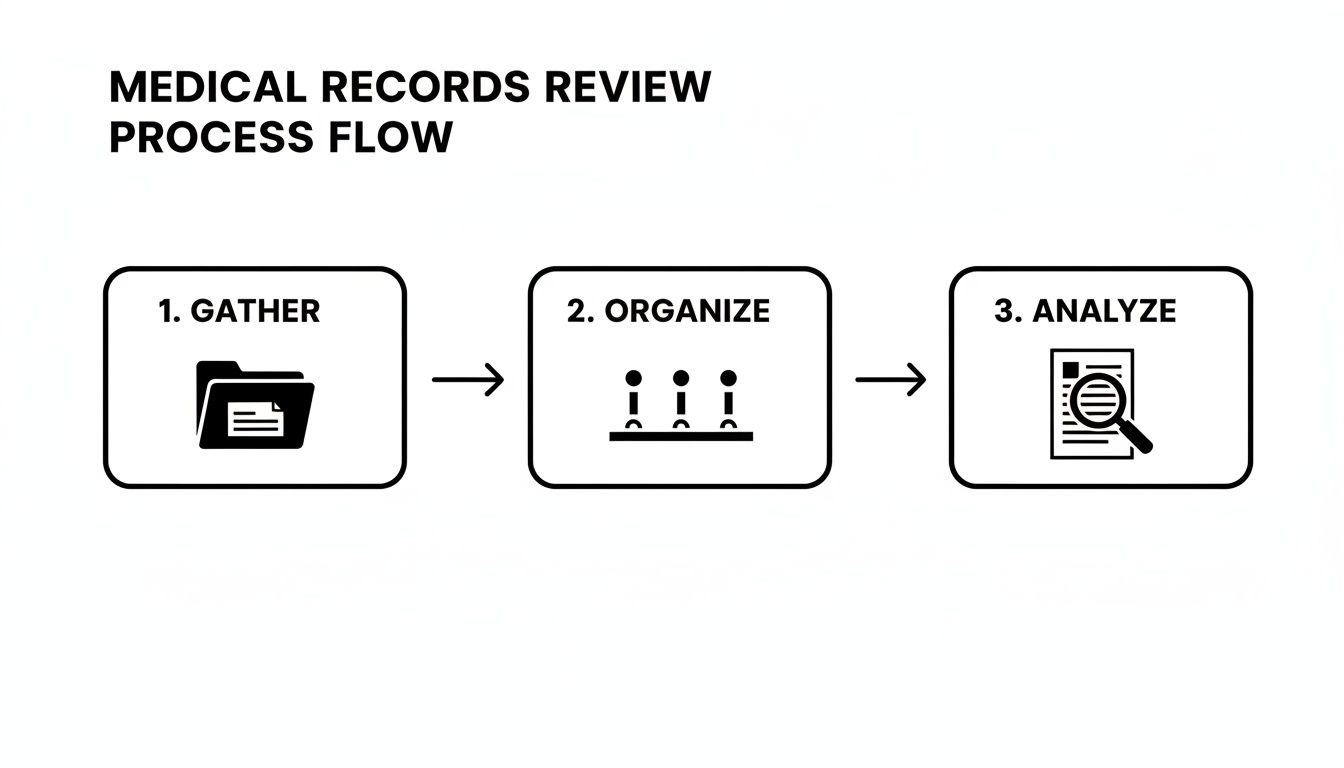
Step 1: Gathering Every Last Document
This first step is all about casting a wide net. It's an exhaustive hunt for every single piece of paper related to your medical care following the accident. We're not just talking about the major hospital bills; your legal team needs to track down records from every provider you’ve seen.
This includes documentation from:
- First Responders: Ambulance run sheets and initial ER intake forms.
- Hospitals: Admission records, doctor's orders, nursing notes, and discharge summaries.
- Your Family Doctor: Notes from follow-up visits and any referrals they made.
- Specialists: Reports from neurologists, orthopedic surgeons, or pain management experts.
- Therapists: Progress notes from physical, occupational, or even psychological therapy sessions.
- Pharmacies: A full history of prescriptions filled after the incident.
Rounding up all these documents can easily take weeks, sometimes months. That’s why it's so important to get this process started as soon as possible. Every page adds another layer of detail to your story.
Step 2: Organizing the Paper Trail
Once the records start pouring in, the next step is to create order. This isn't just about stacking papers neatly. A reviewer will organize what could be hundreds or even thousands of pages into a single, chronological master file.
This critical process often involves Bates stamping—assigning a unique, sequential number to every single page. Think of it as creating a permanent index for your entire medical history.
This meticulous organization is the backbone of a successful review. It creates a clear timeline that allows anyone—your attorney, an insurance adjuster, or a jury—to follow the progression of your care from the moment of injury to your current condition.
Step 3: Analyzing and Summarizing the Story
With everything perfectly organized, the real detective work begins. A trained professional, like a paralegal or a legal nurse consultant, dives deep into the file. They scrutinize every entry, looking for the crucial details that connect your injuries directly to the accident and demonstrate their full impact.
During this analysis, the reviewer isn't just reading medical charts; they are interpreting the story hidden within the clinical data. They're hunting for the evidence that proves causation, documents your pain, and justifies the need for ongoing care.
Take a car accident, for example. The reviewer connects the dots—from the ER report noting "neck pain on arrival" to the MRI results confirming a "C5-C6 disc herniation," and finally, to the specialist’s notes recommending surgery. This creates an unbroken chain of evidence.
The final output is a powerful summary, often called a medical chronology or a narrative report. This document translates complex medical jargon into a clear, persuasive story your attorney can use to:
- Explain your injuries to an insurance adjuster.
- Draft a compelling settlement demand letter.
- Prepare for negotiations, mediation, or even trial.
This summary becomes the factual bedrock for calculating and demanding the fair settlement you deserve.
What Are Reviewers Actually Looking For? Key Findings and Red Flags
A medical records review is much more than just putting documents in chronological order. It's a deep-dive investigation into the story your medical history tells. Think of the person reviewing your records as a detective meticulously sifting through evidence. They're trained to spot the clues—both good and bad—that will ultimately define the strength of your personal injury claim.
The whole point is to separate the signal from the noise. This means highlighting the documented facts that bolster your case while also identifying the potential weaknesses the other side will surely try to exploit. Knowing what these findings and red flags look like is the key to understanding how an insurance adjuster will view your case.

Uncovering The Evidence That Strengthens Your Claim
The positive findings are the bricks and mortar of a solid personal injury case. They create a clear, undeniable link between the accident and the harm you've suffered. A reviewer is hunting for consistent, objective proof that leaves little room for argument.
Some of the most powerful findings include:
- Immediate and Consistent Medical Care: Records that show you went to a doctor or ER right after the accident (or very soon after) are huge. Following up with all recommended appointments shows you took your injuries seriously from day one.
- Clear Diagnostic Proof: It’s one thing to say your back hurts; it’s another to have an MRI that shows a herniated disc. Objective tests like X-rays, MRIs, and CT scans provide hard evidence that an insurance company can't easily dismiss.
- Doctor’s Notes on Causation: A golden nugget in any medical record is a note where the doctor explicitly links your injury to the accident. A simple sentence like, "Patient's shoulder pain is a direct result of the recent MVA," is incredibly persuasive.
- A Consistent Story of Your Symptoms: Your records should reflect a consistent pattern of you reporting pain, limited mobility, and other symptoms over time. This ongoing documentation is critical when you need to prove your pain and suffering to an adjuster or jury.
When these elements align, they paint a compelling picture that makes it very difficult for the defense to poke holes in the legitimacy of your claim.
Spotting The Potential Red Flags That Can Weaken It
Just as crucial as finding the good stuff is identifying the red flags. These are the parts of your medical history that an insurance adjuster will seize upon to question the severity of your injuries or argue they shouldn't have to pay for them.
A red flag doesn’t kill your case, but it's a hurdle you have to be ready to clear. Identifying these issues early lets your attorney build a strategy to tackle them head-on.
Here are the most common red flags:
- Gaps in Treatment: If you stopped going to physical therapy for a month without a good reason, the defense will argue your injuries must not have been that bad or that you had already recovered.
- Pre-existing Conditions: Did you have back pain before the car wreck? You can bet the adjuster will try to blame your current problems on the old condition, not the new accident.
- Notes on "Patient Non-Compliance": If a doctor writes that you missed appointments or didn't follow medical advice, the other side will argue that you're responsible for your own poor recovery.
- Conflicting Stories: Inconsistencies between what you told your family doctor, the ER physician, and the insurance company can be used to attack your credibility.
- Delayed Onset of Symptoms: Waiting a week or two to see a doctor is common, especially with soft tissue injuries. But adjusters will often argue that if you were truly hurt, you would have sought care immediately.
The table below gives a quick snapshot of how a single piece of information in your records can be viewed from two very different perspectives.
Positive Indicators vs. Potential Red Flags
A single entry in your medical records can be interpreted in wildly different ways depending on who is reading it. Here’s a look at how a finding can be framed to either strengthen or weaken your personal injury claim.
| Finding | Positive Interpretation (Strengthens Claim) | Negative Interpretation (Weakens Claim) |
|---|---|---|
| Prior Injury to Same Body Part | Establishes a baseline of health; the new injury clearly aggravated a stable, pre-existing condition, causing new and distinct harm. | The current symptoms are just a flare-up of an old problem, and the accident is not the primary cause of the pain or medical bills. |
| Gap in Treatment | The patient was following medical advice to rest, or symptoms temporarily subsided before returning, indicating the injury's chronic nature. | The patient must have recovered during this time, so any treatment after the gap is for a new, unrelated issue. The injury wasn't serious. |
| Subjective Pain Complaints | Consistent, documented complaints over multiple visits validate the patient's ongoing pain and suffering and its impact on their life. | Without objective findings (like an MRI), these are just "subjective" complaints that cannot be proven and may be exaggerated. |
| Delayed Medical Treatment | The adrenaline from the accident masked the pain initially, a common medical phenomenon. The patient sought care as soon as the true extent of the injury became clear. | The injury wasn't caused by the accident. If it were, the patient would have sought immediate medical attention. Something else must have happened in the days following. |
Understanding these dual interpretations is why a professional review is so critical. A good review doesn't just list the facts; it anticipates the arguments.
By bringing these issues to light early, a thorough review gives your attorney the time and insight needed to prepare strong counterarguments. This proactive approach ensures a potential weakness doesn't end up derailing your fight for a fair settlement.
How Professionals Interpret Your Medical Records
A stack of medical records is a story, but it’s written in a language most people don’t speak. It's packed with clinical shorthand, complex terms, and subtle details that are incredibly easy to miss. This is precisely why a professional review isn't just a simple read-through; it requires a specialized skill set to translate that medical story into a powerful legal argument.
Think of it as a multi-layered investigation. The interpretation of your records is often a team effort, with different experts brought in to analyze the evidence from their unique perspectives. Each professional adds a crucial piece to the puzzle.
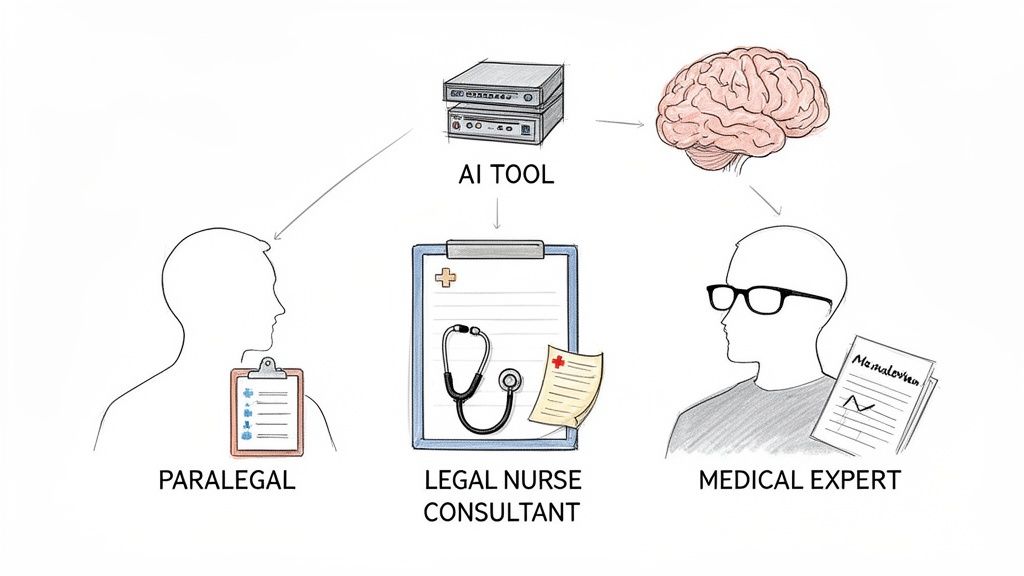
The Key Players in a Medical Records Review
Your legal team will assemble the right group of professionals for the job, depending on how complex your injuries are and what your case specifically needs.
Here are the key players you'll often find on that team:
- Paralegals: These folks are the organizational backbone. They're experts at gathering, sorting, and Bates stamping what can be thousands of pages of records to build a clean, chronological timeline. Their main job is to get the documents whipped into shape for the legal strategy.
- Legal Nurse Consultants (LNCs): An LNC is a registered nurse who also has legal training—a potent combination. They don't just organize; they decode the medical jargon, spot inconsistencies in treatment, and flag any time the care you received might have strayed from the accepted standard. Their clinical eye allows them to catch nuances that a purely legal professional might not.
- Medical Experts: When a case gets really complex, an attorney will bring in a practicing physician or a specialist in the relevant field, like an orthopedic surgeon for a spinal injury case. This expert provides the authoritative opinion on what caused the injury, what future treatment is necessary, and what your long-term prognosis looks like.
As they dig into your records, these professionals also have to consider the legal framework surrounding medical choices, such as those made under Texas law concerning guardianship and medical decisions.
The Irreplaceable Value of Human Expertise
Technology is definitely changing how legal teams handle massive amounts of data. With 96% of U.S. hospitals now using certified Electronic Medical Records (EMRs), sifting through documents has become a digital task. The EMR systems industry is even projected to hit $19.4 billion in revenue by 2025, which helps make reviewing injuries from events like Texas highway wrecks much more manageable.
AI-powered tools can now scan and flag keywords across thousands of pages in minutes, a job that would take a human reviewer days. These tools are fantastic for that initial heavy lifting of data extraction and organization.
But AI simply cannot replace the nuanced, critical thinking of a human expert. Technology can find a word, but a person understands its context, its intent, and its true meaning within the larger story of your medical care.
For example, an AI tool might flag every single mention of "pre-existing arthritis." A skilled legal nurse consultant, however, can analyze the records to demonstrate that the arthritis was completely asymptomatic before the crash and that the trauma of the accident caused a significant, painful aggravation.
That distinction—something only human expertise can deliver—is often the very detail that wins a case.
Using the Review to Negotiate a Fair Settlement
A thorough medical records review does more than just get your paperwork in order. It turns your personal injury claim from a simple "he said, she said" story into a powerful, data-driven argument for the compensation you deserve.
This is the key to negotiating from a position of strength, not desperation. It allows your attorney to build a demand letter based on cold, hard facts, not just educated guesses. The organized narrative from the review connects the dots—from the moment of the accident to the long-term impact on your life—making sure every ounce of your suffering is documented and, most importantly, proven.
Calculating Damages with Precision
The most immediate use for a review is building a rock-solid foundation for your damages. Your attorney will use the verified timeline and medical evidence to calculate a comprehensive, line-by-line valuation of your claim.
This valuation breaks down into a few key areas:
- Past Medical Expenses: The review gives you an exact, verifiable total of every bill. ER visits, specialist consultations, physical therapy sessions, prescriptions—it’s all there, directly linked to the accident.
- Future Medical Costs: Let's say the records show a "C5-C6 disc herniation" and the doctor’s notes recommend surgery down the road. That’s the evidence needed to project and demand compensation for that future care. Without it, you’re just asking for money you can’t prove you’ll need.
- Lost Wages and Earning Capacity: The documentation of your injuries, the frequency of your treatments, and the official work releases from your doctor all combine to directly support your claim for lost income.
- Pain and Suffering: This is where the review truly shines. It provides the objective proof to back up your subjective experience. Consistent notes from doctors and therapists about your pain levels, your struggles with daily activities, and the need for invasive procedures give real weight to your non-economic damages.
This detailed, evidence-based approach forces the conversation away from emotional pleas and grounds it in undeniable facts. It makes it much, much harder for an insurance adjuster to argue with the numbers you’re presenting.
Benchmarking Your Case for a Stronger Demand
One of the most powerful strategies your attorney can use is benchmarking your case against similar ones, and a detailed medical review makes this possible. With a specific, documented injury like a "lumbar spine fusion," your lawyer can research what juries and insurance companies in your area, like Dallas County, have actually paid out for similar injuries.
This data gives you an objective settlement range. It’s no longer about what you feel your case is worth; it’s about what comparable cases have proven to be worth. This is your ultimate defense against the lowball offers that insurance companies almost always start with.
When an adjuster tries to tell you your demand is unreasonable, your attorney can fire back with concrete data from similar local cases, all supported by the detailed medical proof from your own file. This completely changes the dynamic of the negotiation.
This process is only getting more sophisticated. The Electronic Health Records (EHR) market, which was valued at USD 30.71 billion, is projected to keep growing as both sides use this data to value claims. Considering medical costs often make up 60-70% of the total payout in personal injury cases, getting this analysis right is critical.
Fortifying Your Position Against Insurance Tactics
Insurance companies are experts at finding weaknesses and exploiting them. A comprehensive medical records review helps you build a fortress around your claim, presenting a complete and consistent story that leaves no room for doubt. It helps you get ahead of potential red flags, like gaps in your treatment or pre-existing conditions, before the adjuster can use them against you.
The key findings from the review are often summarized in a specialized document. Understanding the role of a medico-legal report shows how this evidence is formally packaged to support your case. Think of it as the official, expert-backed summary of your medical journey, ready to be deployed in any negotiation or court proceeding.
In the end, a strong review allows your attorney to negotiate with informed confidence. It transforms your medical file from a disorganized stack of papers into a strategic asset that proves the true value of your case, justifies every dollar you demand, and empowers you to fight for the full compensation you are owed.
For more on maximizing your recovery, check out our guide on negotiating medical bills after a settlement.
Practical Steps for Texas Plaintiffs After an Injury
If you've been hurt in an accident in Texas, what you do in the following hours, days, and weeks is absolutely crucial. These actions aren't just about your physical recovery; they’re about building the official record that will become the foundation of your personal injury claim. Making sure that record is accurate and complete is the best thing you can do to secure fair compensation.
Think of it this way: your actions create the story your medical records will eventually tell. By being diligent from day one, you ensure that story is a clear and powerful account of what you've endured, giving insurance companies very little room to argue.
Seek Immediate and Consistent Medical Attention
First things first: see a doctor immediately. It doesn't matter if you think you feel okay. Adrenaline is a powerful pain-masker and can hide serious injuries. Waiting to get checked out is a huge red flag for insurance adjusters, who will use any delay to argue your injuries weren't that serious.
After that first visit, following your doctor's treatment plan is non-negotiable.
- Attend All Appointments: Never miss a follow-up, specialist visit, or physical therapy session.
- Fill Your Prescriptions: Pick up your medications right away. This shows you're taking the doctor's advice seriously.
- Follow Doctor’s Orders: If you're told to stay off your feet or avoid certain activities, listen. Don't give an insurance company an excuse to say you made your own injury worse.
Any gaps in your treatment or a note in your file about "patient non-compliance" can torpedo your claim. Consistency is key—it proves you were committed to your recovery from the start.
Communicate Clearly and Keep Your Own Records
When you speak with your healthcare providers, be honest and specific. Don't try to tough it out or exaggerate your pain. Instead, clearly explain how the injury is impacting your day-to-day life. Can you still lift a grocery bag? Does it hurt to sit at your desk? These details paint a vivid picture in your medical chart.
On top of what your doctor writes down, keep your own pain journal. Each day, note your pain on a 1-to-10 scale, list activities that were difficult, and track any new symptoms. This personal log can be incredibly valuable for filling in the blanks and giving context to the formal medical records.
Remember, you have a right under HIPAA to request copies of your own medical records. It’s a good idea to review them for accuracy. For anything more than a minor fender-bender, working with a legal professional is a smart move. You can learn more about hiring a personal injury attorney who can take charge of this process and make sure your case is built on the strongest possible evidence.
Your Questions Answered: Medical Records Reviews
When you're dealing with a personal injury claim, it's natural to have questions. Let's walk through some of the most common ones plaintiffs ask about the medical records review process so you can feel more confident about this crucial step in your case.
How Much Does a Professional Medical Records Review Cost?
The price tag for a professional review can swing from a few hundred dollars to several thousand. The biggest factors are the size and complexity of your medical file. A straightforward case with 50 pages of records is going to be on the lower end, while a case involving multiple specialists and thousands of pages will naturally cost more to analyze.
The good news? In almost every personal injury case, your lawyer pays for this upfront as a case expense. You won't see a bill. The cost is simply reimbursed from the settlement or award at the end, so you don't have to worry about paying out of pocket to get this vital work done.
Will My Pre-existing Conditions Tank My Personal Injury Claim?
This is a huge source of anxiety for many people, but the short answer is no—a pre-existing condition doesn't automatically kill your claim. Texas law follows the "eggshell skull" rule. Think of it this way: if you have a condition that's like a fragile eggshell, and someone negligently breaks it, they are responsible for the damage they caused.
If a car accident took your manageable, low-level back pain and turned it into a crippling injury that needs surgery, the at-fault party is on the hook for that escalation.
This is where a sharp medical records review becomes your best friend. An expert can pinpoint exactly where your old condition ended and the new, accident-related harm began, drawing a clear, undeniable line for the insurance company to see.
How Long Does a Medical Records Review Actually Take?
The timeline really has two phases: gathering the documents and then analyzing them. Honestly, the first part—collecting every single record from every doctor, clinic, and hospital—is often what takes the most time. This can drag on for weeks or even months, all depending on how responsive each provider's office is.
Once your attorney has the complete file, the actual review and summary usually takes another two to six weeks. Because of how long the collection process can take, it's absolutely critical to get started on it right away. The sooner you start, the sooner you can keep your case moving forward.
At Verdictly, we're all about putting powerful information in your hands. Our AI-powered platform gives you and your attorney a clear look at what real Texas motor vehicle cases like yours are actually worth. Stop guessing and start negotiating with data-backed confidence by exploring what your case could be worth.
Related Posts

Why Insurance Companies Deny Claims: why insurance companies deny claims
Learn why insurance companies deny claims and how to overcome common denials with proven appeals and tips to maximize your compensation.

How Much Can I Get From a Car Accident Settlement?
Wondering how much can I get from a car accident? This guide breaks down settlement factors, damages, and claim values to help you estimate your compensation.

Can You Sue Someone in a Car Accident? A Guide to Your Rights
Can you sue someone in a car accident? Learn the critical steps for filing a claim and what it takes to secure fair compensation for your injuries and damages.