
What Is Mediation in a Lawsuit? Learn what is mediation in lawsuit
Understand what is mediation in lawsuit and how this process helps Texans resolve motor vehicle accident cases without trial.
When you’re in the middle of a lawsuit, mediation is a confidential meeting where a neutral third party, called a mediator, helps you and the other side try to work out a settlement. Instead of a judge or jury making the final call, you and the other party control the outcome.
Decoding the Mediation Process in a Lawsuit
Think of your legal journey as having a major fork in the road. One path leads to the uncertainty and expense of a public trial. The other path leads to a private conference room where you get a real say in how your case is resolved. That second path is mediation.
Mediation is a popular form of Alternative Dispute Resolution (ADR) that puts you in a much stronger position to control your own destiny. It’s far less formal than a courtroom showdown. The mediator isn't there to pass judgment or pick a winner; their entire job is to act as a skilled and impartial guide, helping both sides find a way to meet in the middle. They listen, they clarify, and they work to close the gap between what you want and what the other side is willing to offer.
Why Choose Mediation?
This collaborative approach has some serious advantages over slugging it out in court, particularly in Texas motor vehicle accident cases.
- You Maintain Control: At the end of the day, you have the final word. You can accept or reject any settlement offer on the table. The decision is yours, and yours alone.
- It’s Confidential: What happens in mediation, stays in mediation. This privacy is crucial because it allows everyone to speak freely and honestly without worrying that their words will come back to haunt them if the case later goes to trial.
- It Saves Time and Money: A full-blown trial can drag on for months, sometimes years, piling up staggering legal fees along the way. In contrast, most mediations are wrapped up in a single day, which dramatically cuts down on both the time and the cost.
To help you get a quick grasp of these core ideas, here's a simple breakdown of the key concepts.
Mediation at a Glance Key Concepts
| Concept | Brief Explanation |
|---|---|
| Voluntary Process | Both parties agree to participate and work toward a resolution. No one can be forced to settle. |
| Neutral Mediator | An impartial third party who facilitates communication but does not make decisions or issue rulings. |
| Confidentiality | All discussions and offers made during mediation are private and cannot be used in court. |
| Self-Determination | The parties involved have the ultimate authority to accept or reject a proposed settlement. |
| Cost-Effective | Generally much less expensive and faster than proceeding to a full trial. |
Ultimately, mediation is a practical tool designed to resolve disputes efficiently and on your own terms.
The Goal of the Process
The main goal is to find a mutually acceptable resolution that allows both sides to avoid the gamble and high costs of a trial. It’s less about a knockout legal victory and more about reaching a practical, final agreement.
The core idea is simple: find a middle ground that both parties can accept to avoid the risks and costs of a trial. It’s about reaching a practical resolution rather than a legal victory. This process is a key part of the broader litigation process, which you can learn more about in our detailed guide.
A Step-by-Step Guide to the Mediation Process
So, what actually happens on the day of mediation? Forget what you've seen in courtroom dramas; it’s far more like a structured, high-stakes business negotiation. The whole point is to guide everyone from a broad, messy disagreement toward a concrete, acceptable solution—ideally, all in a single day.
While no two mediations are exactly alike, they almost always follow a well-worn path. Knowing the steps ahead of time can take a lot of the mystery and anxiety out of the day. It lets you and your lawyer focus on what matters: the substance of your case.
This flow chart gives you a bird's-eye view of the journey from conflict to resolution.
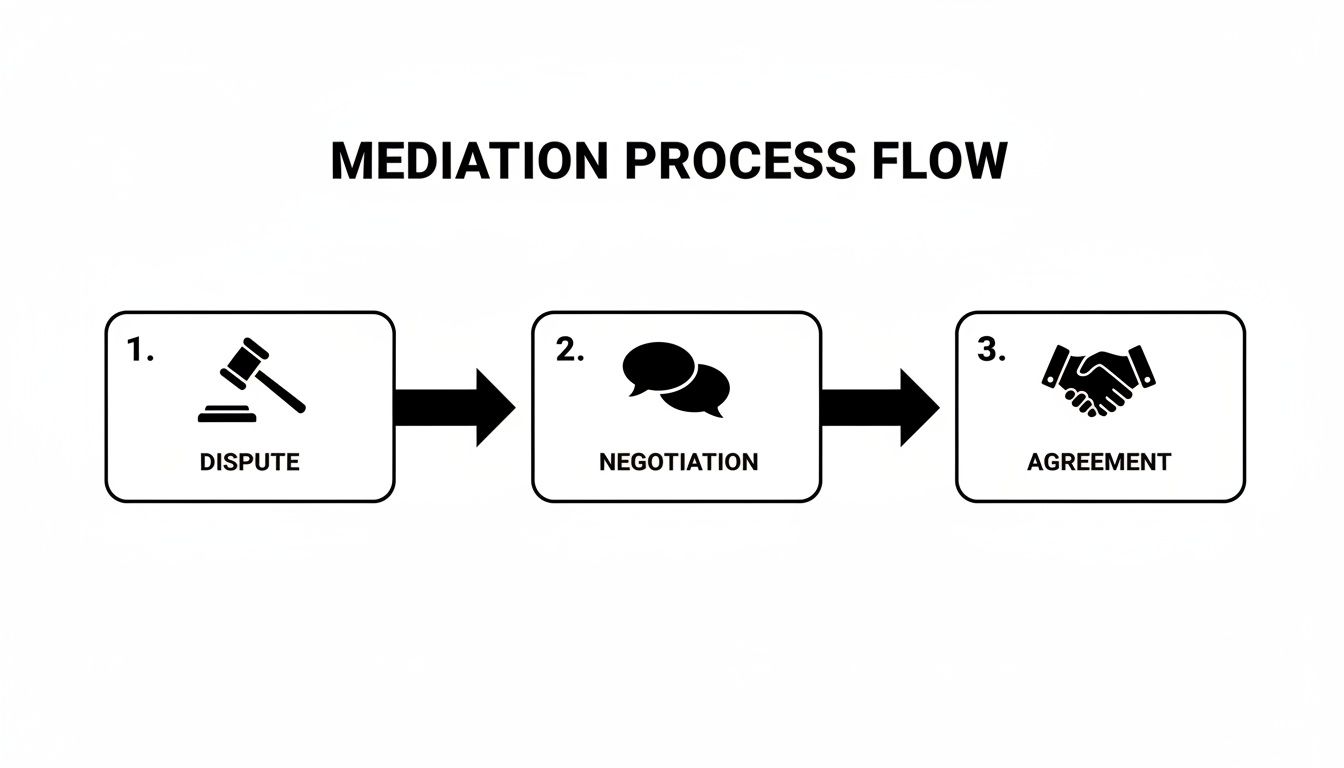
As you can see, mediation is designed to take a raw dispute, channel it into a productive negotiation, and hopefully land on a final agreement everyone can live with.
Step 1: The Opening Session
The day kicks off with everyone together in one room: you, your lawyer, the person you’re suing (or their insurance representative), their lawyer, and the mediator. The mediator takes the lead, laying out the ground rules for the day. They'll emphasize that everything said is confidential, that their role is completely neutral, and that nobody can be forced to settle.
Next, your attorney will give a brief opening statement. They’ll hit the high points of your case—what happened in the accident, the extent of your injuries, and the legal basis for why the other side is responsible. Then, the defense attorney gets their turn to present their side of the story. It’s a crucial moment because it’s often the only time each party hears the other side’s argument directly from their lawyer.
Step 2: The Private Caucuses
After the joint session, the group splits up. This is where the real negotiation begins. You and your attorney will go to your own private conference room, and the other party will go to theirs. The mediator then starts moving between the two rooms, acting as a shuttle diplomat.
These private meetings, or caucuses, are the engine of mediation. In your room, you can speak candidly with the mediator and your lawyer, sharing sensitive information or concerns you wouldn't want the other side to hear. The mediator uses these confidential talks to get a real sense of each party's bottom line, their motivations, and the weak spots in their case.
The caucus is where the magic happens. A good mediator will use this time to challenge assumptions, explore creative solutions, and gently push both sides toward common ground.
The mediator will carry offers and counteroffers back and forth. For instance, your lawyer might open with a settlement demand of $100,000. The mediator takes that number to the defense, who might come back with an offer of $30,000, along with their reasons for that figure. This shuttle diplomacy continues, with the mediator working to close the gap with each trip.
Step 3: Reaching an Agreement (or Not)
If the back-and-forth is successful, the gap between what you're asking for and what they're offering will eventually close. Once you and the other party agree on a number and any other terms, the mediator helps finalize the deal.
A formal, binding settlement agreement is drafted right then and there. Your lawyer will read every word to make sure it perfectly matches the terms you've agreed to. Once everyone signs on the dotted line, it’s a done deal. The lawsuit is effectively over, and the agreement becomes a legally enforceable contract. All that’s left is for the lawyers to file the dismissal paperwork and for the settlement check to be processed.
Understanding the Key Players in the Room
Walking into mediation can feel like stepping onto a stage where you don't know the cast. Getting a handle on who’s who and what they do is the first step to feeling in control. Each person plays a specific part, and once you understand their role, the entire negotiation process makes a lot more sense.
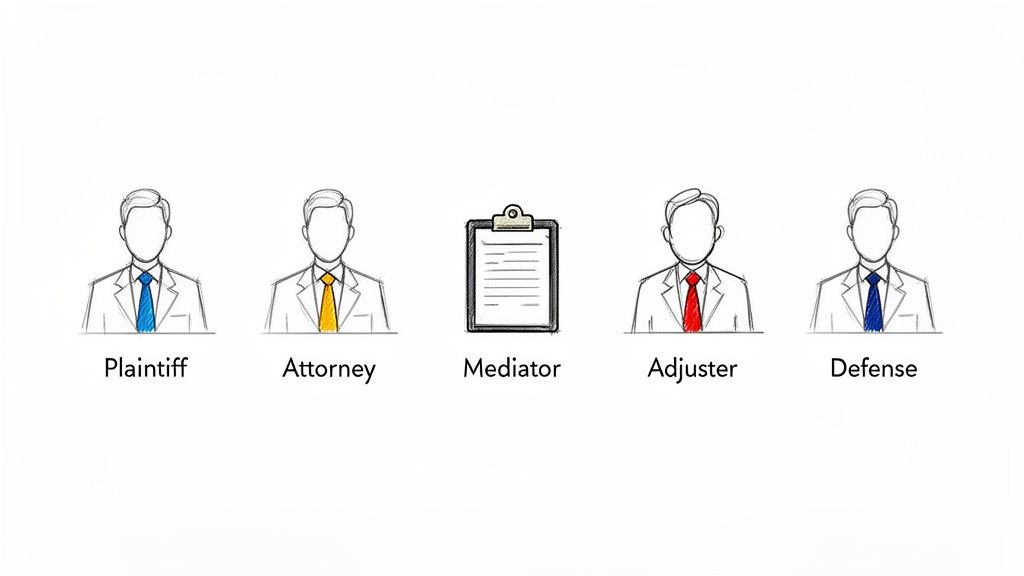
While the room might feel crowded, the dynamic is carefully structured. Everyone there has a purpose, and it's all designed to steer the conversation toward a resolution.
Your Team: The Plaintiff and Your Attorney
As the plaintiff, you are the heart of your case. Your job is to make sure your attorney and the mediator understand exactly what happened and how it has affected you. Ultimately, you hold the power—you’re the one who makes the final call on whether to accept a settlement offer.
Your attorney is your champion and guide. They'll lay out the legal arguments, take the lead in negotiations, and give you the unvarnished truth about the pros and cons of every offer. Think of them as your legal shield, there to protect your interests from start to finish.
The Opposing Side: The Defendant and Their Counsel
On the other side of the table, you’ll find the defendant's representatives. In most Texas car wreck cases, you won't actually see the other driver. Instead, you'll be negotiating with an insurance adjuster, the person who holds the checkbook and has the authority to settle your claim up to a certain dollar amount.
Alongside the adjuster will be the defense counsel, the lawyer the insurance company hired to fight your claim. Their goal is simple: defend their client and pay out as little as possible. They’ll challenge your case and negotiate hard on the insurance company's behalf.
The most important person to understand is the mediator. They are not a judge, and they have no power to force a decision on anyone. Think of them as a neutral facilitator—a communication expert whose only goal is to guide both sides toward a voluntary agreement.
The Neutral Facilitator: The Mediator
The mediator is the impartial guide steering the ship. This person is a trained, neutral third party—often a retired judge or a seasoned lawyer—who has been chosen and agreed upon by both sides.
A good mediator has a deep understanding of both legal strategy and human psychology. They'll listen intently, ask tough questions, and carry offers and messages back and forth between the two rooms. Their real job is to help everyone find common ground, get creative with solutions, and realistically assess the risks of taking the case to trial. In complex cases, the clarity they bring can be as crucial as understanding what is expert witness testimony in a courtroom.
Mediation vs. Arbitration vs. Trial: Choosing Your Path
When you're caught in a legal dispute, it's easy to think a full-blown trial is your only option. But that’s not the case. You actually have a few different routes you can take to resolve your claim, and each one works very differently.
Think of it this way: you can take a collaborative, private drive toward a solution (mediation), hire a private judge to decide the outcome for you (arbitration), or head to the public courthouse for a formal showdown (trial). Knowing the pros and cons of each path is one of the most important strategic decisions you and your attorney will make.
Who Is in Control?
The single biggest difference between these options comes down to one simple question: who gets to make the final decision?
- Mediation: You do. Mediation is completely voluntary, meaning no one can force you to accept a settlement. You and your lawyer are in the driver's seat. If you don't like the final offer, you can simply say "no" and walk away, continuing with your lawsuit. The process is non-binding until the moment you sign a settlement agreement.
- Arbitration: A neutral third party, called an arbitrator, is in control. Both sides present their case, and the arbitrator acts like a private judge, issuing a decision. In most cases, that decision is binding, making it legally enforceable with very limited options for an appeal.
- Trial: The judge or jury has all the power. After hearing all the evidence and arguments, they will render a verdict. This verdict is legally binding, and while appeals are possible, they are notoriously difficult, expensive, and time-consuming to win.
The bottom line is this: in mediation, you are an active architect of your own resolution. In arbitration and at trial, a decision is handed down to you by someone else. That fundamental difference in control is why so many personal injury cases head to mediation first.
Comparing Dispute Resolution Methods
To really see the differences in action, it helps to put the three methods side-by-side. The table below breaks down the key factors that matter most to plaintiffs, from cost and privacy to how long the process takes. This comparison makes it clear why one approach might be a much better fit for your case than another.
| Feature | Mediation | Arbitration | Trial |
|---|---|---|---|
| Decision-Maker | You and the other party (the litigants). | A neutral third-party arbitrator. | A judge or a jury. |
| Outcome | Non-binding until a settlement is signed. | Usually binding and legally enforceable. | Binding and legally enforceable. |
| Privacy | Completely confidential and private. | Private, but less formal than court. | Public record and open to spectators. |
| Cost | Generally the least expensive option. | Moderately expensive; cheaper than trial. | The most expensive and time-consuming. |
| Timeline | Typically resolved in a single day. | Can take weeks or months. | Can drag on for a year or more. |
When you look at it this way, mediation stands out. It offers a powerful blend of flexibility, confidentiality, and client control that you just can't get from the other methods. It's your best opportunity to resolve your case on your own terms, avoiding the high stakes, high costs, and public nature of a courtroom battle.
How to Prepare for a Successful Mediation
Success in mediation isn't about luck—it's about doing the homework. Showing up prepared changes the entire dynamic of the day. Instead of reacting to whatever the other side throws at you, you and your attorney can proactively drive the conversation toward a fair resolution.
The first step is getting your story straight and backing it up with solid evidence. This isn’t just about proving what happened in the crash; it's about painting a clear picture of how those few moments have impacted every aspect of your life since.

When every claim you make is supported by proof, you leave very little room for the defense to argue or cast doubt on your case.
Gather Your Essential Documents
While your lawyer will do the heavy lifting, they need your help to gather all the necessary paperwork. A complete, well-organized file tells a story that is both compelling and hard to ignore.
Here's a quick checklist of what you'll typically need to pull together:
- Medical Records and Bills: Every single document, from the first ER visit to your most recent physical therapy session.
- Proof of Lost Income: This can include recent pay stubs, past tax returns, or an official letter from your employer confirming missed time and lost pay.
- Repair Estimates: All quotes and receipts related to your vehicle's damage.
- Out-of-Pocket Expenses: Don't forget the small things—receipts for prescriptions, crutches, or even mileage to and from doctor's appointments add up.
Having all this organized helps your attorney build a clear, itemized demand that’s grounded in fact.
Develop a Data-Driven Strategy
Organizing your own documents is crucial, but the real power move is to understand what cases like yours are actually worth. Knowing what Texas juries have awarded and what insurance companies have paid in similar car wreck cases gives you a realistic and powerful starting point for negotiations.
Your personal story provides the "why," but hard data provides the "how much." It elevates your settlement goal from a wish into a rock-solid, evidence-based valuation.
This is where a tool like Verdictly can make all the difference. By analyzing public data on case outcomes from 2015-2025, your attorney can benchmark any offer against what's actually happening in Texas courtrooms and mediations. It’s the perfect way to shut down a lowball offer.
This data-backed approach is more important than ever. Even in virtual mediations, success rates often fall between 70-90%. Industry insights reported by sources like IBISWorld show that strong settlement demands are a key driver, and 35% of professionals expect to see more regulation in this area soon.
When you walk into that mediation room fully prepared, you’re not just hoping for a fair outcome—you’re armed with the facts and figures to demand it.
The Power of Data in Reaching a Fair Settlement
In any negotiation, information is power. That’s a simple truth, but it’s absolutely critical when you’re heading into mediation for a lawsuit. A successful outcome isn't just about telling a good story—it’s about backing that story up with cold, hard facts that show why your position makes sense.
A ‘good’ result in mediation means walking away with a fair agreement, letting you avoid the huge risks and costs that come with a trial. This is where objective data changes the game, turning your case from one of hope into one of solid evidence.
From Guesswork to Evidence-Based Negotiation
Think about it: insurance adjusters do this all day, every day. They have massive internal databases telling them what cases like yours have settled for in the past, which gives them a huge advantage. Your job is to level that playing field.
By digging into data from thousands of real Texas motor vehicle cases, you and your attorney can see how any settlement offer stacks up against real-world outcomes. This approach gives you a confident answer to the single most important question: "Is this offer fair?"
Data is the objective reality check that cuts through all the negotiation tactics. It replaces emotional appeals with a logical, fact-based value for your claim, making it incredibly difficult for the insurance company to defend a lowball offer.
This data-driven strategy is a big reason why mediation works so well. The process has impressively high success rates, with 80-90% of cases often settling and letting people move on without the stress of a trial. To give you an idea, recent federal court data shows that even in complicated cases, 62% of matters sent to mediation in 2024 were resolved successfully. You can explore more about these mediation statistics and trends in this detailed report.
Anchoring Your Settlement Demand in Reality
Imagine walking into the room already knowing the median settlement value for a herniated disc injury from a rear-end crash in Dallas County. That number becomes your anchor. It keeps you grounded and prevents you from even considering an offer that's way below what similar cases are actually worth.
- Validate Your Demand: It proves to the other side that your settlement figure isn't just a number you pulled out of thin air.
- Spot Lowball Offers: You can instantly recognize when an offer is unreasonable and push back with concrete proof.
- Build Confidence: Knowing the numbers removes the fear of the unknown and puts you in a position of strength.
Using a comprehensive personal injury lawsuit calculator can help you put all these figures together and understand how different factors might affect your case's value. At the end of the day, using hard data ensures the final agreement isn't just a compromise—it's a fair and just resolution grounded in reality.
Answering Your Top Mediation Questions
It's completely normal to have questions as you head into mediation. In fact, it's a good sign—it means you're thinking strategically. Let's tackle some of the most common things plaintiffs ask before sitting down at the negotiation table.
What Happens If We Don’t Reach an Agreement?
This is the number one question, and the answer is simple: nothing happens, at least not in a bad way. If you can’t find common ground and strike a deal, your lawsuit just keeps moving forward.
Mediation is non-binding, which means you never give up your right to a trial. Think of it as a serious, structured attempt to resolve the case, but it's not the final stop. Your case simply gets back on the litigation track, and you can still settle later on or let a jury decide the outcome.
Is Everything Said in Mediation Confidential?
Yes, and this is a crucial part of what makes mediation work. Everything discussed during the session—offers, counter-offers, admissions, arguments—is 100% confidential.
This confidentiality is legally protected. It means nothing said in that room can be brought up in court later if your case proceeds to trial. The goal is to create a safe space where both sides can be candid and negotiate honestly without worrying that their words will come back to haunt them.
How Much Does Mediation Typically Cost?
The cost really depends on two things: the mediator's hourly rate and how long the session lasts. In Texas personal injury cases, the fee is almost always split right down the middle between the plaintiff and the defendant.
For a half-day mediation, you can expect it to cost anywhere from several hundred to over a thousand dollars for your side. A full-day session will naturally cost more. Don't worry, though—your attorney will walk you through the exact costs and get your approval long before you ever commit.
Related Posts

A Guide to Medical Records Reviews in Personal Injury Claims
Learn how medical records reviews can strengthen your Texas injury claim. This guide explains the process, key findings, and how to build a stronger case.

What to Do After a Hit and Run Car Accident in Texas
A complete guide on what to do after a hit and run car accident in Texas. Learn the critical first steps, your legal options, and how to file a claim.

8 Critical Signs of a Bad Attorney in 2025 You Can’t Afford to Ignore
Are you getting the best legal help? Learn the top signs of a bad attorney and how to verify their competence with these actionable steps and warning signs.