
What Is a Personal Injury Claim and How Does It Work
Wondering what is a personal injury claim? This guide explains the process, your legal rights, and the steps to take after an accident.
At its core, a personal injury claim is a formal process for getting financial compensation when someone else’s carelessness hurts you. It’s the legal system’s way of holding a person or company accountable for the harm they’ve caused, whether it was through a reckless action or a failure to act.
Decoding a Personal Injury Claim

Think about it like this: if your neighbor accidentally broke your expensive laptop, you’d expect them to pay for a new one. A personal injury claim follows the same logic, but the stakes are much higher because we’re talking about your health and livelihood, not just property.
Instead of a broken laptop, the damage involves physical pain, emotional trauma, and the financial chaos that follows—piling medical bills, lost paychecks, and future treatment costs. The entire point of the claim is to get you back to the position you were in before the accident, at least financially. It’s about securing the money needed to cover every single loss that stems from your injury.
The Key Players and Their Roles
To really understand a personal injury claim, you first have to know who’s involved. While the details of every incident are different, you’ll almost always find these three central figures.
- The Plaintiff: That’s you, the person who was injured. You are the one who files the claim to get compensation for your suffering and losses.
- The Defendant: This is the person, business, or organization you’re holding responsible for your injuries. Their negligence or wrongful act is the reason you’re filing the claim.
- The Insurance Company: Most of the time, the defendant has an insurance policy to cover these kinds of situations. It's the insurance company’s adjusters and attorneys who will handle the claim, negotiate a potential settlement, and ultimately pay out if their client is found to be at fault.
At its heart, a personal injury claim is a formal demand for justice. It's a structured process designed to restore an injured person's financial stability after an accident upends their life.
The whole system is built on proving legal responsibility. To succeed, you have to clearly show that the defendant owed you a duty of care, they failed in that duty, and that specific failure directly caused your injuries and all the costs that came with them. Making that connection with solid evidence is what the process is all about.
To simplify, let's break down the main components in a typical case.
Key Components of a Personal Injury Claim
This table provides a quick summary of the essential elements and parties involved in a typical personal injury claim.
| Element | Description | Example |
|---|---|---|
| Plaintiff | The injured party who initiates the legal claim. | A driver who was rear-ended at a stoplight. |
| Defendant | The party accused of causing the injury through negligence. | The distracted driver who caused the rear-end collision. |
| Insurance Company | The entity that provides liability coverage for the defendant. | The at-fault driver's auto insurance provider. |
Seeing these roles laid out makes it easier to understand how the pieces of a claim fit together. It’s a formal but logical process for ensuring the responsible party covers the damage they caused.
The Four Legal Pillars of a Successful Claim
So, what exactly makes a personal injury claim stick? It's not as simple as just getting hurt. For a claim to be successful, it has to be built on a solid legal foundation, and that foundation rests on four key pillars.
Think of it like building a table. If you only have three legs, it's going to wobble and fall. You need all four for it to be stable. In the legal world, these four "legs" are Duty, Breach, Causation, and Damages. Let’s walk through what each one really means using a common car wreck scenario.
Pillar 1: Duty of Care
First up is Duty. In plain English, a duty of care is the basic responsibility we all have to act in a way that doesn’t put others in danger. It’s a concept that applies everywhere, but it's crystal clear on the road.
The moment someone gets behind the wheel of a car, they automatically accept a duty to everyone else out there. This means they have to follow traffic laws, pay attention, and generally operate their vehicle like a reasonably careful person would. It’s not just a nice idea—it’s a legal obligation to obey speed limits, stop at red lights, and watch out for others.
Pillar 2: Breach of Duty
Okay, so the other person had a duty. The next question is, did they fail to live up to it? That failure is the second pillar: Breach. A breach is simply the act of breaking that duty of care.
Let's go back to our driving example. A driver is approaching an intersection with a red light. Their duty is to stop. If they’re texting and blow right through it, they have clearly breached their duty to drive safely. It’s that simple.
A breach can take many forms on the road:
- Driving Drunk: Getting behind the wheel while intoxicated is a massive breach of the duty to drive soberly.
- Speeding: Flying down the road well over the speed limit is a clear violation of the duty to drive at a safe speed.
- Distracted Driving: Staring at a phone instead of the road means a driver isn't fulfilling their duty to be attentive.
Proving this breach is where the real work begins. This is the specific action (or lack of action) that caused the problem. Evidence like police reports, witness testimony, or traffic camera footage becomes absolutely essential here.
The heart of a negligence claim is showing that someone had a responsibility to act with caution and chose not to. That failure—the breach—is what connects their bad decision to your injuries.
Pillar 3: Causation
The third pillar, Causation, is all about connecting the dots. It’s not enough to show that a driver was texting and that you got hurt. You have to prove that their texting is what caused the crash that injured you. You’re drawing a direct, unbroken line from their mistake to your harm.
If a driver runs a red light and T-bones your car, causation is pretty straightforward. But insurance companies love to attack this link. They might try to argue that something else was the real cause—maybe you were speeding, or the road was slick, or your brakes failed.
To build a solid case for causation, you have to prove two things:
- Actual Cause: This is the "but for" test. "But for" the other driver running the red light, the accident would not have happened.
- Proximate Cause: This means your injuries were a foreseeable outcome of their action. It’s no surprise that running a red light could cause a serious car crash.
Pillar 4: Damages
Finally, we arrive at the fourth pillar: Damages. This pillar represents the real-world harm you’ve suffered. If you can prove the other three pillars but can’t show any actual losses, there’s no claim to be made.
Damages are the tangible and intangible costs of the incident. This is what you’re seeking compensation for. It’s not just one thing; it’s a whole collection of losses, including:
- Medical expenses (ER visits, doctor’s appointments, physical therapy)
- Lost income from being out of work
- The cost of any future medical treatment you’ll need
- Physical pain and emotional suffering
- Property damage, like the cost to repair or replace your car
Each of these four pillars must be firmly proven with evidence. They all work together, building on one another to paint a clear picture of who was at fault and what you’re owed as a result.
Navigating the Personal injury Claim Timeline
Trying to understand what happens after an injury can feel overwhelming, but the process follows a fairly predictable path. Think of it as a journey with several key stops along the way—from the scene of the accident to the final resolution.
Knowing this roadmap helps you set realistic expectations for what’s ahead. It’s not just a bunch of legal hoops to jump through; it's a structured process designed to gather the facts, figure out who’s responsible, and determine what fair compensation looks like for you.
The Immediate Aftermath First Steps Matter
The clock really starts ticking the moment an accident occurs. What you do in those first few hours and days is absolutely critical and can make or break your claim down the road.
-
Seek Immediate Medical Attention: Your health comes first, always. Even if you think you're okay, some injuries—like concussions or internal damage—don't show symptoms right away. Getting checked out creates an official medical record that directly links your injuries to the accident.
-
Document Everything at the Scene: If you're able, start gathering evidence on the spot. Use your phone to take plenty of pictures and videos of the accident scene, any property damage, your injuries, and even things like weather conditions or broken traffic signs.
-
Gather Witness Information: Get the names and contact info for anyone who saw what happened. An independent witness who can back up your side of the story is incredibly powerful.
These first moves lay the foundation for everything else, giving you the raw material needed to build a solid case.
Building Your Case From Investigation to Demand
Once the initial shock wears off, the focus shifts to formally putting your claim together. This is all about organizing your evidence and officially letting the at-fault party know you’re seeking compensation.
This is usually when you'll want to speak with a personal injury attorney. A good lawyer takes the weight off your shoulders by handling the complex paperwork, dealing with insurance companies, and making sure you don’t miss any crucial deadlines.
The next major milestone is sending a demand letter. This isn't just a simple note; it's a formal, detailed document that your attorney will draft. It clearly lays out:
- The facts of what happened.
- The legal reasons the other party is at fault (their negligence).
- A complete list of your injuries and all the medical treatment you've received.
- A thorough calculation of your damages—medical bills, lost income, and pain and suffering.
- The specific dollar amount you are demanding to settle the claim.
A demand letter is your opening argument. It’s a comprehensive legal document that tells the insurance company you’re serious and have the evidence to prove your case.
For the claim to be successful, that letter—and your entire case—has to prove four key legal elements.
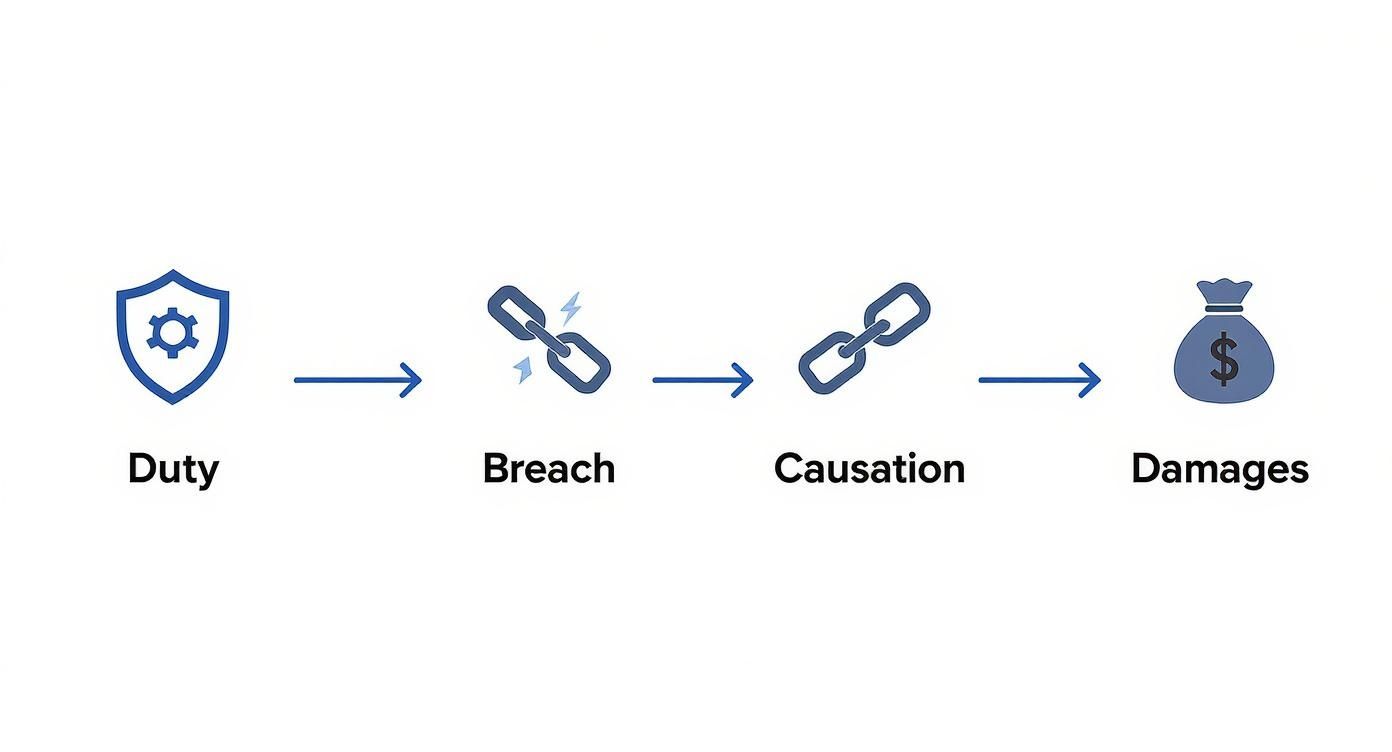
As you can see, each piece builds on the one before it, creating the strong legal foundation you need.
Negotiation and Resolution The Final Stages
Once the insurance company gets your demand letter, an adjuster will review everything and come back with a response. This officially kicks off the negotiation phase, which is where the vast majority of personal injury cases get resolved. Just be prepared: their first offer will almost always be a lowball.
From there, your attorney will start a back-and-forth negotiation, presenting counterarguments and highlighting evidence to justify your demand. This dance can take weeks or even months, depending on how complex the case is and how reasonable the insurance company is willing to be. If you want a deeper dive, you can learn more about the factors that influence how long a personal injury settlement takes.
If you both agree on a fair number, you’ll sign a release, and the case is closed. But what if negotiations hit a wall? If the insurance company simply won't offer a fair amount, the next step is to file a lawsuit.
Keep in mind, though, that this is rare. Over 95% of personal injury cases are settled before ever seeing the inside of a courtroom. It’s a massive field—the U.S. market is valued at over $50 billion annually—and this structured negotiation process is a big reason why. With roughly 39.5 million Americans needing medical care for injuries each year, this well-defined timeline provides an essential framework for getting disputes resolved fairly.
Common Types of Claims and What You Can Recover
A "personal injury claim" isn't one specific type of case. Instead, it's a broad term for any situation where someone else's carelessness, or negligence, causes you harm. These incidents are a huge part of our legal and healthcare systems—in fact, about 62 million Americans need medical care for injuries each year, with emergency rooms handling over 25 million of those visits. If you're interested in the numbers, you can explore detailed statistics on personal injury trends to see the full picture.
Knowing the most common situations can help you spot when you might have a valid claim.
Common Scenarios That Lead to Claims
While every accident is different, most personal injury claims boil down to a few familiar categories. No matter the scenario, the goal is always the same: proving someone else was negligent.
- Motor Vehicle Accidents: This is by far the most common category, covering everything from fender-benders and major truck wrecks to collisions involving motorcycles and pedestrians. Usually, these claims hinge on proving the other driver was distracted, speeding, or intoxicated.
- Slip and Fall Incidents (Premises Liability): Property owners have a legal obligation to keep their spaces reasonably safe. If you slip on a wet floor that had no warning sign or trip on a broken staircase, the owner could be held liable for what happened.
- Workplace Injuries: When you get hurt on the job because of unsafe conditions or your employer's negligence, you might have a personal injury claim. This is different from a workers' compensation claim and often involves proving a third party was at fault.
These are just a few examples, but they all share the same core principle. If you were hurt because someone else failed to act with reasonable care, you may have a path to compensation.
Understanding the Two Main Types of Damages
When you pursue a personal injury claim, the compensation you're fighting for is legally called "damages." The entire purpose of damages is to restore you, as much as possible, to the financial and personal state you were in right before the accident occurred.
Damages are split into two main buckets: economic and non-economic. Understanding the difference is crucial for seeing the true, full value of your case.
A common mistake is to focus only on the medical bills. A strong claim accounts for every single loss—both the ones with clear price tags and the ones that quietly disrupt your quality of life.
Let's break down what each of these categories actually covers.
Economic Damages: The Tangible Costs
Economic damages are the most straightforward part of any claim. They cover all the specific, calculable financial losses you've racked up because of the injury. Think of these as anything you can track with a receipt, bill, or pay stub.
These damages are meant to reimburse you for every dollar you lost or had to spend. The most common examples include:
- All medical bills (past, present, and future)
- Lost wages from being unable to work
- Loss of future earning capacity if you can't go back to your old job
- Property damage, like the cost to fix your car
- Out-of-pocket expenses for prescriptions, crutches, or other medical gear
Simply put, if you can prove a direct financial cost is tied to the accident, it falls under economic damages.
Non-Economic Damages: The Intangible Losses
Non-economic damages are harder to pin down, but they're just as real. They are meant to compensate you for the deep, personal losses that don’t come with a neat price tag. This is the human cost of an injury—the suffering that changes your daily life.
Because these losses are subjective, they are much harder to put a number on and are often where negotiations get intense. This category can include compensation for:
- Physical pain and suffering
- Emotional distress and mental anguish
- Loss of enjoyment of life (not being able to play with your kids, garden, or hike)
- Permanent disfigurement or scarring
- Loss of consortium (the damage done to your relationship with your spouse)
Even though you can't show a receipt for pain, these damages are a vital part of making you whole again. For a deeper dive, you can read our guide on the different types of damages available in personal injury cases.
For a clearer picture, here’s a simple table breaking down the two.
Economic vs. Non-Economic Damages Explained
The table below gives you a side-by-side comparison of the two main types of compensation you can pursue in a personal injury claim.
| Type of Damage | What It Covers | Examples |
|---|---|---|
| Economic Damages | Verifiable financial losses with a clear monetary value. | Medical bills, lost income, vehicle repair costs, pharmacy receipts. |
| Non-Economic Damages | Subjective, non-financial losses related to suffering and quality of life. | Pain, anxiety, depression, loss of hobbies, emotional trauma. |
While economic damages pay back your out-of-pocket costs, non-economic damages acknowledge the very real, human impact an injury has on your life.
Texas-Specific Rules You Must Know
Where your accident happens really matters. A personal injury claim isn’t the same everywhere; every state has its own set of rules that can make or break your case. In Texas, there are a couple of big ones you absolutely need to be aware of if you're thinking about filing a claim.

Getting a handle on these Texas laws isn’t just a good idea—it’s crucial for protecting your rights and your shot at fair compensation. If you ignore them, you could find yourself with no way to recover anything at all.
The Two-Year Statute of Limitations
Texas puts a strict time limit on your right to take legal action. It’s called the statute of limitations, and for the vast majority of personal injury cases, you have just two years from the date you were injured.
That means your lawsuit has to be officially filed with the court within that two-year window. If you miss it, even by a single day, the court will almost certainly throw your case out. You’ll lose your right to seek compensation forever, no matter how clear-cut your case might seem.
The statute of limitations is an absolute cutoff. It’s the legal system's way of ensuring claims are brought forward while evidence is still fresh and witnesses can be found. Waiting too long is one of the most common and costly mistakes you can make.
This deadline is precisely why it’s so important to move quickly after an accident. You need to give yourself enough time to investigate, gather your medical records, and build a solid case before that clock runs out.
Texas’s Modified Comparative Fault Rule
Another critical rule in Texas is known as modified comparative fault, or what many of us call the "51% bar." This law comes into play when there's a question of whether both parties share some of the blame for what happened.
Here’s the breakdown of how it works:
- First, a jury decides the total dollar amount of your damages.
- Next, they assign a percentage of fault to everyone involved in the incident.
- Your final award is then reduced by whatever percentage of fault you're assigned.
Let's say your damages are calculated at $100,000, but you're found to be 10% responsible for the accident. Your award would be reduced by that 10% (or $10,000), leaving you with $90,000. For a deeper dive, you can explore our guide on comparative negligence in Texas.
But here's the kicker. If the jury decides you are 51% or more at fault, you get absolutely nothing. This "51% bar" is a hard stop, which makes proving the other party was mostly responsible a vital part of winning your claim.
Understanding Your Claim's Outcome: Settlement vs. Verdict
As your personal injury claim moves forward, you'll eventually arrive at a fork in the road. Your case will end in one of two ways: with a settlement or a verdict. While both bring your case to a close, they are very different paths, and understanding the distinction is crucial.
A settlement is essentially a negotiated agreement. It’s a private deal struck between your lawyer and the insurance company, where you agree to accept a certain amount of money. In exchange, you release the other party from all future liability related to your injury. Think of it as a compromise that ends the fight.
The Certainty of a Settlement
The biggest draw of a settlement is control. You know exactly what you're getting and when you're getting it. This path completely sidesteps the emotional rollercoaster and sheer uncertainty of a trial.
There's a reason the vast majority of cases end this way. In fact, research consistently shows that over 95% of personal injury claims are resolved through a settlement, never seeing the inside of a courtroom.
A settlement puts the power back in your hands. It lets you weigh a concrete offer against the unknown risks of a trial, so you can make a decision that protects both your finances and your peace of mind.
This is especially true in complex cases with a lot on the line. Take medical malpractice, for example—a notoriously difficult area of personal injury law. With average payouts hovering around $679,000 and some claims settling for over $1 million, the stakes are incredibly high. You can discover more insights about personal injury law statistics on runsensible.com to get a better sense of the numbers involved.
The Gamble of a Verdict
A verdict, on the other hand, is the decision handed down by a judge or jury after a full-blown trial. You only end up here if settlement talks have completely failed and neither side is willing to budge.
Going to trial is a roll of the dice. You and your attorney present your case, the defense presents theirs, and a group of strangers decides your fate. A jury might award you a massive sum—far more than any settlement offer—but they could just as easily award you much less, or even nothing at all. There are no guarantees.
This is where modern legal tools have become so valuable. Attorneys now use platforms like Verdictly to analyze real-world data from similar cases. By seeing what juries have awarded in situations like yours, you can make a much more informed decision. It allows you and your lawyer to compare a settlement offer to the potential outcomes at trial, helping you negotiate from a true position of strength.
Your Personal Injury Questions, Answered
When you're dealing with an injury, the last thing you need is more confusion. After an accident, practical questions always come up, and it's completely normal to have concerns about the road ahead. Let's walk through some of the most common ones we hear every day.
What Does it Cost to Hire a Personal Injury Lawyer?
This is usually the first question on everyone's mind, and for good reason. The good news is, you don't need a lot of money to get expert legal help. Nearly all personal injury lawyers work on what’s called a contingency fee basis.
In simple terms, this means you pay nothing upfront. The attorney’s fee is just a percentage of the money they recover for you, whether that's from a settlement or a court verdict. If you don't win your case, you owe them no attorney fees. It’s a system designed to give everyone access to justice, not just those who can afford to write a big check.
How Long is This Going to Take?
I wish there were a simple, one-size-fits-all answer here, but every case moves at its own pace. The timeline for a personal injury claim can be anything from a few months to well over a year. It really comes down to a few key things:
- How serious are your injuries? A case with severe, long-term injuries naturally takes more time. We have to wait until we know the full picture of your future medical needs and what that will cost.
- How complicated is the accident? A simple fender-bender is usually quicker to sort out than a major pile-up where everyone is pointing fingers.
- Is the insurance company playing fair? If the adjuster is reasonable and makes a solid offer, things can wrap up quickly. But if they dig in their heels and fight you on everything, it will definitely drag things out.
The most important milestone is reaching what's known as Maximum Medical Improvement (MMI). That’s the point when your doctor determines you’ve healed as much as you’re going to. We can't really know the full value of your claim until we reach that point.
Will I Have to Go to Court?
It’s a common fear, but you can probably relax. The image of a dramatic courtroom trial is mostly for TV.
The reality? Well over 95% of cases are settled out of court. Nobody—not you, not the insurance company—really wants to deal with the time, cost, and sheer unpredictability of a trial. Reaching a settlement gives both sides control over the outcome and brings the whole thing to a close.
Are you getting ready for settlement talks and wondering what a fair offer looks like for your case in Texas? Verdictly gives you the data you need, with transparent access to real verdicts and settlements from all over the state. Search our database to see what injuries like yours have been worth, and walk into your negotiation armed with real information.
Related Posts
A Guide to Medical Records Reviews in Personal Injury Claims
Learn how medical records reviews can strengthen your Texas injury claim. This guide explains the process, key findings, and how to build a stronger case.

Why Insurance Companies Deny Claims: why insurance companies deny claims
Learn why insurance companies deny claims and how to overcome common denials with proven appeals and tips to maximize your compensation.
How Much Can I Get From a Car Accident Settlement?
Wondering how much can I get from a car accident? This guide breaks down settlement factors, damages, and claim values to help you estimate your compensation.