
A Texas Guide to Loss of Consortium Claims
Understand what loss of consortium means in Texas. This guide explains who can file, the evidence required, and how these complex claims are valued.
When someone is seriously hurt because of another person's carelessness, the impact goes far beyond their physical injuries. The harm can tear at the very fabric of their family life, especially their marriage. This is where a loss of consortium claim comes into play. It’s a way for the uninjured spouse to get compensation for the damage done to their relationship.
What Loss of Consortium Really Means for Your Family

After a catastrophic accident, everyone’s attention is usually on the person who was physically hurt—the medical treatments, the recovery, the mounting bills. But the injury doesn't just happen to one person. It sends shockwaves through the entire family, often damaging the core of a marriage.
Think of a marriage as a partnership built on countless shared moments, responsibilities, and affections. When one partner is severely injured, their ability to contribute to that partnership can be drastically reduced or even eliminated. The other spouse is left to pick up the pieces, shouldering a burden that was once shared.
A loss of consortium claim recognizes this profound impact. It allows the uninjured spouse to seek compensation for their own very real, though less visible, losses.
Breaking Down the Intangible Losses
So what exactly are these losses? They aren't as straightforward as a medical bill but are just as significant. They are a collection of intangible harms that fundamentally change the marital bond.
These are considered a type of non-economic damage, meaning they compensate for suffering that doesn’t have an obvious price tag, much like emotional distress.
A court will look at several key elements when evaluating this kind of claim:
- Loss of Companionship and Society: This is about losing your best friend—the person you shared hobbies, conversations, and a social life with.
- Loss of Affection and Intimacy: This covers the damage to the physical and emotional closeness in a relationship, including the loss of a sexual relationship.
- Loss of Household Services: When an injured spouse can no longer do their share of chores, childcare, or home maintenance, this creates a tangible burden for the other spouse.
- Loss of Emotional Support: This acknowledges the loss of a partner's guidance, comfort, and encouragement during life's ups and downs.
A loss of consortium claim is fundamentally about storytelling. It seeks to paint a "before and after" picture for the court, demonstrating how the defendant's negligence didn't just injure one person—it fundamentally broke a functioning, loving partnership.
To give you a clearer idea of how these abstract concepts play out in real life, the table below breaks down the key components of a loss of consortium claim.
Key Elements of a Loss of Consortium Claim
| Type of Loss | Description | Real-World Example |
|---|---|---|
| Loss of Society | The loss of shared experiences, friendship, and companionship. | A couple who used to hike together every weekend can no longer do so because one spouse is now confined to a wheelchair. |
| Loss of Affection | The loss of physical intimacy, love, and emotional closeness. | A spouse's traumatic brain injury causes personality changes, making them emotionally distant and unable to show affection. |
| Loss of Services | The loss of a spouse's contributions to household duties. | The uninjured spouse now has to handle all childcare, cooking, and home repairs alone, tasks they once shared. |
Ultimately, each of these elements helps to build a complete picture of how the injury has irrevocably altered the marriage.
Who Can Actually File a Consortium Claim in Texas?
One of the first, and most important, questions we have to answer is who has the legal right to file for loss of consortium. Texas law is very particular about this, and it’s a point that trips up a lot of people. Not everyone who feels the ripple effects of a loved one's injury can sue for these kinds of damages.
The key legal concept to wrap your head around is that this type of claim is "derivative."
Think of it this way: a loss of consortium claim can't exist by itself. It's completely dependent on the injured person's primary personal injury case. If their lawsuit is successful, your consortium claim can move forward. But if their case falls apart for any reason, yours goes down with it. It’s a package deal.
Ultimately, your claim’s success is directly tied to proving that someone else's negligence caused your spouse’s injury.
The Three Pillars of a Valid Claim
To bring a successful loss of consortium claim in Texas, you have to firmly establish three things. If you can't prove all three, your case won't get off the ground.
- A Serious, Non-Fatal Injury: Your spouse must have been seriously hurt because of someone else's negligence or wrongful act. The injury has to be significant enough to fundamentally alter your life together as a married couple.
- A Legal Marriage: This one is black and white. You and your spouse must have been legally married at the time the injury happened.
- A Damaged Marital Relationship: You have to show that the injury has directly and negatively impacted your marriage—the companionship, the affection, the help around the house, and the intimate aspects of your relationship.
These three points are the entire foundation of your claim. Without them, you simply don't have a legal basis to ask for compensation for these relational losses.
Who Is Left Out?
Texas draws a hard line here. The only person who can file a loss of consortium claim is the non-injured spouse. This narrow definition often comes as a shock to families where everyone is suffering from the fallout of a serious accident.
The following people are specifically excluded from filing a loss of consortium claim in Texas, no matter how profound their loss is:
- Children of the injured person
- Parents of the injured person
- Unmarried domestic partners
- Fiancés or fiancées
- Siblings and other relatives
It's crucial to understand that even a loving, long-term, committed partnership isn't enough in the eyes of the law. Without a legal marriage certificate, Texas courts will not recognize your right to claim these specific damages.
This strict rule really highlights how important legal standing is in personal injury law. While the emotional toll on a child or parent is very real, the law reserves this specific claim for the unique legal bond of marriage.
It’s also worth noting how different this is from other states. For example, while Texas limits these claims to spouses, a state like Florida allows spouses, children, and sometimes even parents to seek similar damages. You can find more details about how different states handle consortium claims on bbga.com. This stark contrast is exactly why knowing the Texas-specific rules from the very beginning is so critical.
How Juries Put a Number on Intangible Losses
So, how do you assign a dollar amount to something as personal as love, companionship, and support? It’s a tough question, and one that doesn't have a simple answer. There’s no calculator or spreadsheet a jury can use to figure out the value of a damaged marriage.
Instead, the process is all about telling a story. It’s about painting a vivid "before and after" picture for the jury—contrasting the vibrant partnership you had before the accident with the difficult reality you face now. The details of your shared life become the most powerful evidence you have.
The Factors That Influence a Jury
When a jury is trying to decide on a fair amount for a loss of consortium claim, they look at several key factors. Think of these as the building blocks they use to translate a deeply personal loss into a justifiable financial award.
Here are some of the biggest considerations:
- The Stability of the Marriage: Was this a strong, loving, and stable relationship before the injury? The jury will want to see proof of that.
- The Severity and Duration of the Injury: A catastrophic, permanent injury that fundamentally changes a spouse’s abilities will almost always result in a higher award than a temporary one.
- The Life Expectancies of Both Spouses: The jury considers the age and health of both partners to estimate how many years this loss will be felt.
- The Level of Shared Life: What did you do together? Evidence of shared hobbies, how you split household chores, and the emotional support you gave each other helps quantify what’s been taken away.
This visualization makes it clear who is eligible to bring this specific type of claim in Texas.
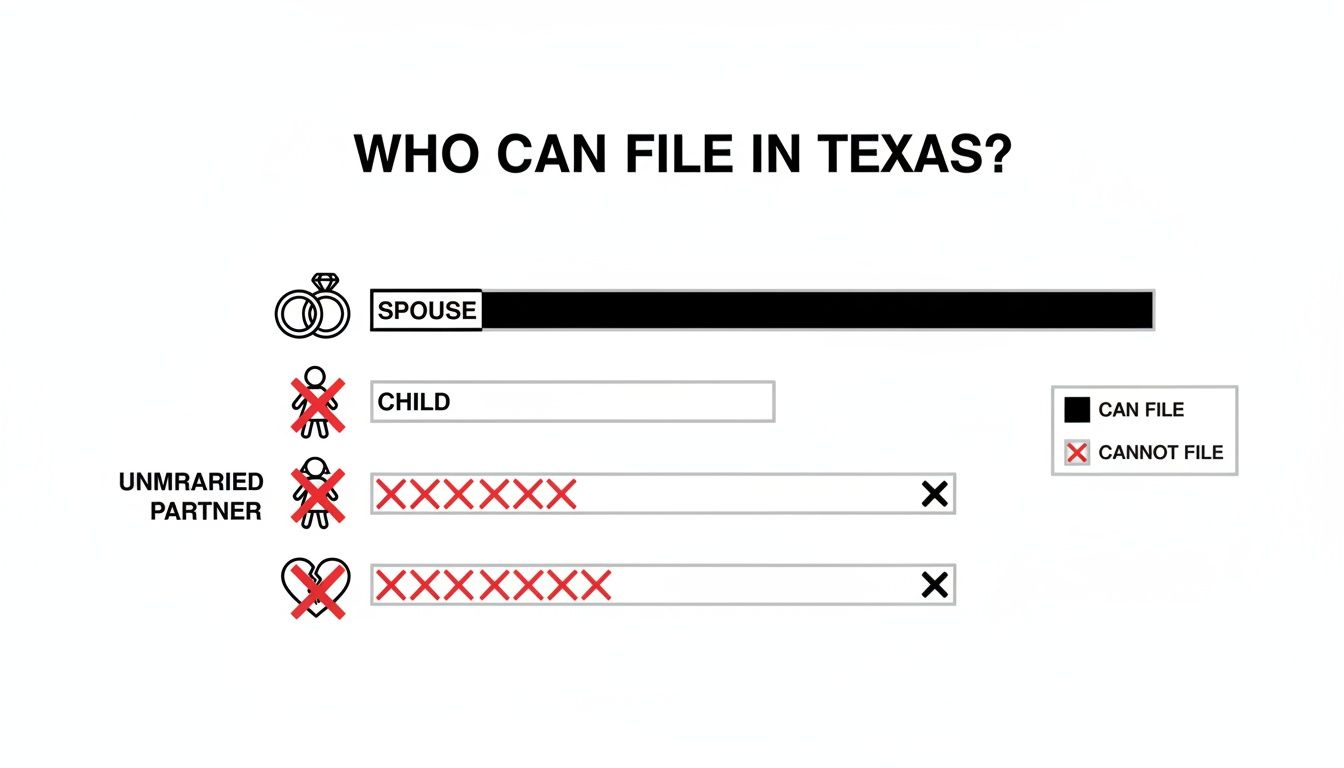
As you can see, Texas law is very strict on this point: only the legally married spouse of the injured person can file.
Building a Narrative with Evidence
Proving the value of what you've lost takes more than just getting on the stand and telling your story. You have to weave together different kinds of evidence to create a powerful and believable narrative for the jury.
For instance, your attorney might bring in friends to talk about how your social life as a couple has completely disappeared. Or they might use entries from your own journal to give the jury a raw, unfiltered look at the daily heartbreaks and new burdens you’re carrying. Every piece helps. Many of the same principles apply here as in other non-economic claims; for more on this, you can check out our guide on how to prove pain and suffering.
The core challenge in a loss of consortium case is making an invisible injury visible. It’s about showing a jury, in concrete terms, how the absence of a spouse's love, help, and companionship has created a hole in the plaintiff's life.
Industry data shows just how significant these claims can be, especially in severe cases. While consortium is only claimed in a fraction of motor-vehicle accidents, when it is included, these non-economic damages can make up 40–70% of the total award in catastrophic injury trials. Juries have a lot of leeway here, which is why attorneys rely so heavily on detailed testimony from both spouses and their family to make the relational loss real.
Ultimately, a jury award for loss of consortium is a formal recognition of the immense value a partner brings to a marriage—a value that goes far beyond any paycheck. It’s an acknowledgment that when one person is catastrophically injured, their spouse suffers a real, distinct, and compensable loss of their own.
Gathering Evidence to Build a Strong Claim
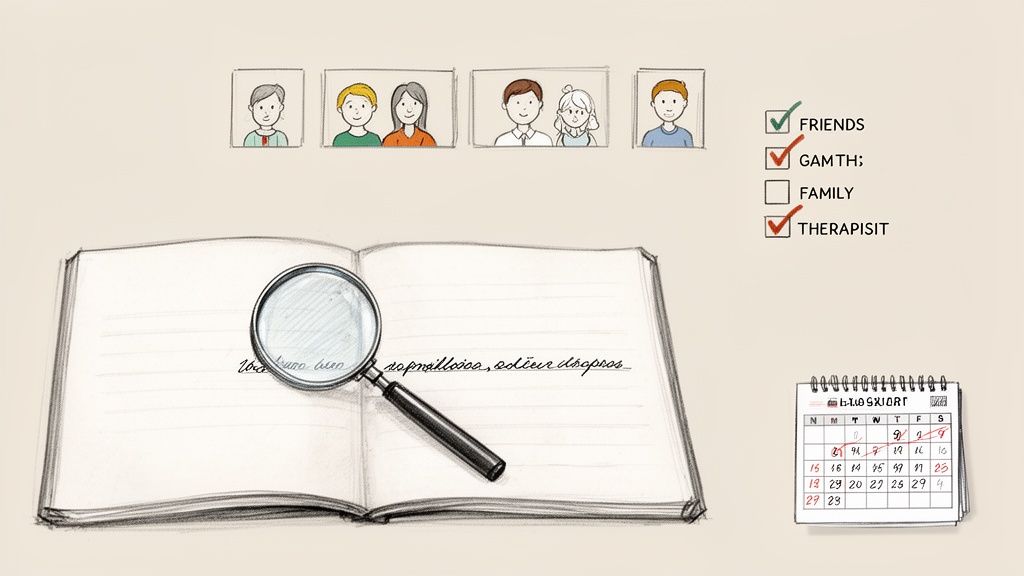
When you file a loss of consortium claim, your story is the heart of the case. But a story alone, no matter how heartfelt, isn't enough to convince a judge or jury. You need to back it up with solid, credible evidence.
Think of it like building a mosaic of your life. You need to show what your relationship looked like before the injury and contrast it with the stark reality of life after. The goal is to paint a clear, undeniable picture of what has been taken from you, using a combination of personal accounts, documentation, and expert insights.
Your Testimony Is Just the Beginning
Your own account of how the injury has changed your marriage is powerful, but it's just the starting point. To truly make an impact, your story needs to be supported by people who have seen the changes firsthand.
Getting testimony from others provides an outside perspective that validates your experience. These are the people who can confirm that the changes you describe are real and not exaggerated.
Consider asking these people to provide a statement or testify:
- Friends and Family: They've seen it all. Maybe you were a couple that hosted every holiday, and now your house is quiet. Or perhaps your annual camping trips have been replaced with endless doctor's visits. They can speak to the loss of shared hobbies, social joy, and companionship.
- Coworkers: They can talk about the ripple effect on your own life. Have you had to take an enormous amount of time off work? Does the stress of being a caregiver affect your performance? Their perspective shows how the injury has impacted every corner of your world.
- Neighbors: These witnesses are often overlooked but can be incredibly valuable. They might have seen your spouse doing all the yard work before the accident, and now they see you struggling to manage it alone. They provide a simple, tangible "before and after" snapshot.
Documenting the Daily Reality
Witnesses see the big picture, but you're living the day-to-day reality. The problem is, memory fades, and the emotional exhaustion can make it tough to recall specifics when it counts. This is where keeping a journal becomes one of the most powerful tools in your arsenal.
It doesn’t have to be a literary masterpiece. Just a simple, regular log of how your life has been affected.
Jot down things like:
- The specific household chores you've had to take over.
- Times you needed emotional support, but your spouse was too consumed by pain to offer it.
- Plans you had to cancel or family events you missed because of the injury.
- How these changes are making you feel—frustrated, lonely, overwhelmed.
A journal turns vague feelings into hard evidence. A statement like, "We don't go out anymore," is forgettable. But an entry that reads, "Had to cancel our anniversary dinner because John was in too much pain to leave the house," is a concrete, powerful example a jury will remember.
This log becomes an invaluable resource, helping you provide specific, compelling examples during depositions or at trial.
Leveraging Expert Opinions and Tangible Proof
To add another layer of credibility, you can bring in expert opinions. A therapist or marriage counselor can testify about the immense psychological strain the injury has put on your marriage. Their professional assessment connects the dots for the jury, formally linking the accident to the decline in your marital relationship.
Finally, don't forget the cold, hard numbers. Tangible proof helps quantify the "services" part of your claim. This is where you show the real-world financial cost of your spouse’s inability to contribute as they once did.
Start collecting receipts and invoices for things like:
- Hiring a cleaning service or lawn care company.
- Paying for childcare you didn't need before.
- Making home modifications, like a ramp or grab bars.
- Gas and parking for countless trips to medical appointments.
This paper trail proves that the loss of your partner's contributions has a direct, measurable financial impact.
Proving a loss of consortium claim requires a comprehensive approach. The table below outlines the key types of evidence you’ll need to gather.
Types of Evidence for a Loss of Consortium Claim
A summary of the different categories of evidence used to support and strengthen a loss of consortium claim in a personal injury case.
| Evidence Category | Specific Examples | Why It's Important |
|---|---|---|
| Testimonial Evidence | Your testimony, statements from friends, family, neighbors, and coworkers. | Provides a human element and third-party validation of the changes in the marital relationship. |
| Personal Records | Journals, diaries, personal calendars, photos, and videos from before and after the injury. | Creates a detailed timeline and offers concrete examples of the day-to-day impact on your life. |
| Expert Testimony | Opinions from therapists, marriage counselors, psychologists, or even economists. | Adds professional credibility and formally links the injury to the emotional and psychological damages. |
| Financial Documents | Receipts for hired help (e.g., cleaning, childcare), invoices for home modifications, medical bills. | Quantifies the economic value of lost household services and demonstrates a measurable financial burden. |
| Medical Records | Physician's notes, treatment plans, and prognoses for the injured spouse. | Establishes the severity and permanence of the injury, which directly correlates to the extent of the consortium loss. |
By strategically combining these different types of proof, you build a case that is not only emotionally compelling but also logically sound and difficult for the other side to dispute.
Don't Miss the Clock: Key Deadlines and Legal Hurdles in Texas
Winning a loss of consortium claim is more than just telling your story. You also have to play by the court's rules, and in Texas, two of those rules can make or break your case: the statute of limitations and the state's unique approach to shared fault.
These concepts have a long history. Consortium claims actually stretch back to old English common law, where they started as a right only a husband could claim. Thankfully, things have evolved. While all 50 states now recognize loss of consortium in some way, the specifics can vary wildly. You can even read about the history and evolution of consortium claims on Wikipedia to see how far we've come. This long journey explains why Texas has such particular procedures you must follow.
The Two-Year Countdown
In Texas, a stopwatch starts the moment the accident happens. You have exactly two years from the date your loved one was injured to file a lawsuit. This is the statute of limitations, and it’s a hard and fast deadline.
This isn't just for your spouse's injury claim; it applies to your loss of consortium claim, too. If you let that two-year window close, the courthouse doors will close with it. It doesn't matter how compelling your case is—miss the deadline, and you lose your right to recover anything. To get a better handle on this critical timeline, check out our guide on the statute of limitations for car accidents in Texas.
How Shared Fault Can Reduce or Eliminate Your Award
Here’s where things can get tricky. Texas follows what’s called a "proportionate responsibility" system, which is just a legal term for figuring out who was at fault and by how much. This rule is a huge deal because it directly impacts your loss of consortium award.
Here’s the breakdown:
- A jury looks at the facts and assigns a percentage of fault to everyone involved.
- If your injured spouse is found to be 50% or less to blame, your award is simply reduced by their share of the fault.
- But here's the cliff: if your spouse is found to be 51% or more at fault, Texas law bars you—and them—from recovering a single dollar.
Let's make this real: Say a jury awards you $100,000 for your loss of consortium. But they also decide your spouse was 20% responsible for the wreck. Your award gets cut by that 20%, so you walk away with $80,000. If that jury had decided your spouse was 51% at fault? You get $0.
Your claim is completely tied to the outcome of your spouse's case. Their percentage of fault becomes your percentage of fault, making this a critical factor in how much compensation, if any, you can ultimately receive.
Common Questions About Texas Consortium Claims
When your family is reeling from a serious accident, it's natural to have questions. The legal world can feel overwhelming, but getting a handle on the specifics of a loss of consortium claim can bring some much-needed clarity. Let's walk through some of the most common concerns we hear from people in Texas.
Can I File for Loss of Consortium If My Spouse Wasn't in a Car Accident?
Yes, you absolutely can. The right to file a loss of consortium claim is tied to the personal injury itself, not how it happened. Think of it as a secondary claim that stems from any situation where someone else's carelessness caused your spouse a life-altering injury.
While these claims often come up after car crashes, they are just as legitimate in other scenarios, such as:
- Medical malpractice
- A serious slip-and-fall
- A workplace or construction site accident
- Injuries from a defective product
The key is proving that a negligent act resulted in a severe injury that, in turn, damaged the fabric of your marriage.
Does My Spouse Have to Be Permanently Disabled for Me to File?
No, a permanent disability isn't a hard-and-fast rule. What matters most is that the injury is severe and has a significant, disruptive impact on your relationship. The length and severity of that disruption are what a jury will focus on when deciding the value of your claim.
For instance, a temporary but devastating injury could sideline your spouse for months or even years. If it prevents them from contributing around the house, providing emotional support, or simply participating in the life you built together, you may have a strong basis for a claim.
The legal focus is less on the permanence of the injury and more on the magnitude of the disruption to the marital bond. A severe, long-term injury can be just as devastating to a relationship as a permanent one.
Will My Claim Hurt My Spouse's Personal Injury Case?
It’s actually the other way around. A legitimate, well-documented loss of consortium claim doesn't harm your spouse's case; it can make the overall legal action stronger. Typically, both claims are filed together in the same lawsuit against the person or company at fault.
By including a loss of consortium claim, you paint a fuller, more honest picture of the total devastation your family has endured. It demonstrates to the court that the defendant's negligence didn't just physically injure one person—it caused deep, emotional, and relational harm to the entire family unit, which deserves to be compensated.
At Verdictly, we believe that access to clear, data-driven information is the first step toward a fair outcome. Our platform provides transparent insights into Texas motor vehicle case values, helping you understand what similar cases have achieved. Explore real verdicts and settlements on Verdictly today.
Related Posts
Kinds of Negligence (kinds of negligence): How They Impact Your Injury Claim
Discover kinds of negligence in Texas personal injury cases and how they can impact your motor vehicle claim. Get clear guidance on your rights now.
Calculating Pain and Suffering: calculating pain and suffering in Texas
Learn how to calculate pain and suffering damages in a Texas car accident. See key factors and how calculating pain and suffering affects your claim.
Calculating pain and suffering car accident: A Practical Guide to Damages
Learn how calculating pain and suffering car accident damages works, with factors and tips to maximize your settlement.