
what is non economic damages - quick guide to understanding
Learn what is non economic damages and how they're proven in a claim, including pain, suffering, and emotional distress.
When you're hurt in an accident, some of your losses are easy to spot. You have medical bills piling up and paychecks you've missed out on. You can add those up with a calculator. But what about the toll it takes on your life—the kind of harm that doesn’t come with a price tag?
That's where non-economic damages come in. They are the law’s way of putting a value on the intangible, human cost of an injury, like physical pain, emotional suffering, and the simple loss of enjoyment in life.
Damages Beyond the Bills

Imagine you’ve been in a serious car crash. The costs you can see and count are called economic damages. These are the repair bills for your car, the invoices from the hospital, and a clear record of the wages you lost while you were out of work. They’re the black-and-white numbers on a spreadsheet.
Non-economic damages, on the other hand, try to answer a much harder question: What is the value of your suffering? They are meant to acknowledge the very real, but deeply personal, harm you've been forced to endure.
These damages recognize that the true impact of an injury goes far beyond financial strain. It gets in the way of your happiness, puts a strain on your relationships, and can rob you of the ability to live the life you had before.
Economic vs. Non-Economic Damages at a Glance
The easiest way to understand the difference is to think about what you can prove with a piece of paper. One type of damage is objective and backed by receipts, while the other is subjective and demonstrated through personal stories and expert testimony.
Here’s a simple table to break it down:
| Attribute | Economic Damages | Non-Economic Damages |
|---|---|---|
| Nature | Tangible, quantifiable financial losses. | Intangible, subjective personal losses. |
| Examples | Medical bills, lost wages, property damage. | Pain and suffering, emotional distress, loss of enjoyment. |
| Proof | Receipts, invoices, pay stubs, bank statements. | Testimony, medical records, expert opinions, journals. |
| Calculation | Straightforward addition of documented costs. | Complex valuation (multiplier or per diem methods). |
This distinction is critical. The legal system understands that your pain and emotional trauma are just as real and damaging as any hospital bill. In many serious injury claims, which you can read about in our complete guide to car accident settlements, non-economic awards can be significant.
In fact, it’s not uncommon for the value of non-economic damages to be much larger than the economic losses, especially when a jury is convinced of the profound human cost of someone else’s negligence.
Getting a handle on this difference is the first step in understanding the true value of your personal injury claim. It ensures that every loss you’ve suffered—both the ones you can see and the ones you feel—is fully accounted for.
The Human Cost of an Injury
Legal terms can feel cold and distant. To really wrap your head around non-economic damages, you have to look past the definitions and see the real people and altered lives behind the legalese. These aren't abstract concepts; they’re about the parts of life that get shattered when someone is hurt.
Let's walk through a few real-world scenarios to see how a single injury can send shockwaves through every part of a person's world.
Pain and Suffering
Think about Sarah, a passionate marathon runner. Before her accident, her weekends were all about long runs, training plans, and the pure joy of race day. Then, a driver blew through a red light, leaving her with a severe spinal injury.
Sure, her economic damages will cover the hospital bills and physical therapy. But what about the daily reality of her new life? Those numbers don't show the chronic, burning pain that turns simple acts like getting out of a chair or sleeping through the night into a monumental struggle. The freedom and identity she found in running have been stolen, replaced by a constant, draining fight against her own body.
That’s pain and suffering. It’s the legal system's way of compensating her for the physical torment and for losing the ability to do what she loved most.
Emotional Distress
Now, let's look at Mark. He was in a massive pile-up on the interstate. Physically, he was lucky—just a few scrapes and bruises. But the psychological trauma was a different story entirely. The shriek of tires or a sudden car horn now triggers a full-blown panic attack, leaving him gasping for air.
Driving, something he never thought twice about, has become a source of overwhelming anxiety. He’s plagued by nightmares and intrusive flashbacks of the crash. This persistent fear has stripped him of his independence and his sense of safety in the world.
This deep psychological harm is what the law calls emotional distress. It's a recognition that the invisible wounds from a traumatic event can be just as crippling as any broken bone.
Non-economic damages are the legal system's way of saying: "We see your invisible wounds. We recognize that your life has been diminished in ways a receipt can't show, and that loss has value."
Loss of Consortium
Finally, consider David and his wife, Maria. A falling beam at a construction site left David with a traumatic brain injury that completely changed his personality. The patient, kind-hearted man Maria married is gone, replaced by someone prone to fits of rage and crushing depression.
Their easy laughter, long talks, and simple intimacy? All gone. Maria has effectively become a full-time caregiver, grieving the loss of the partner and companion who was the foundation of her life. The accident didn't just injure David; it broke the heart of their marriage.
This type of claim is for loss of consortium. It compensates the uninjured spouse for the profound loss of love, affection, and companionship. It’s a crucial acknowledgment that when one person suffers a catastrophic injury, the people closest to them are wounded, too.
These stories aren't just hypotheticals. They show that non-economic damages are about putting a value on the very real, often devastating, human cost of an injury.
How Do You Put a Price on Pain?
It seems like an impossible question, doesn't it? How can anyone put a dollar amount on chronic pain, the anxiety that follows a traumatic accident, or the inability to enjoy life the way you used to? There's no magic formula, of course, but the legal system has developed a few standard methods to translate these very real, very human losses into a monetary figure.
Think of it less as an exact science and more as a structured way to reach a number that a reasonable person would see as fair compensation for what someone has endured. In personal injury law, two main approaches have become the go-to for tackling this difficult task.
The losses we're talking about fall into a few key categories, all of which represent a significant blow to a person's quality of life.
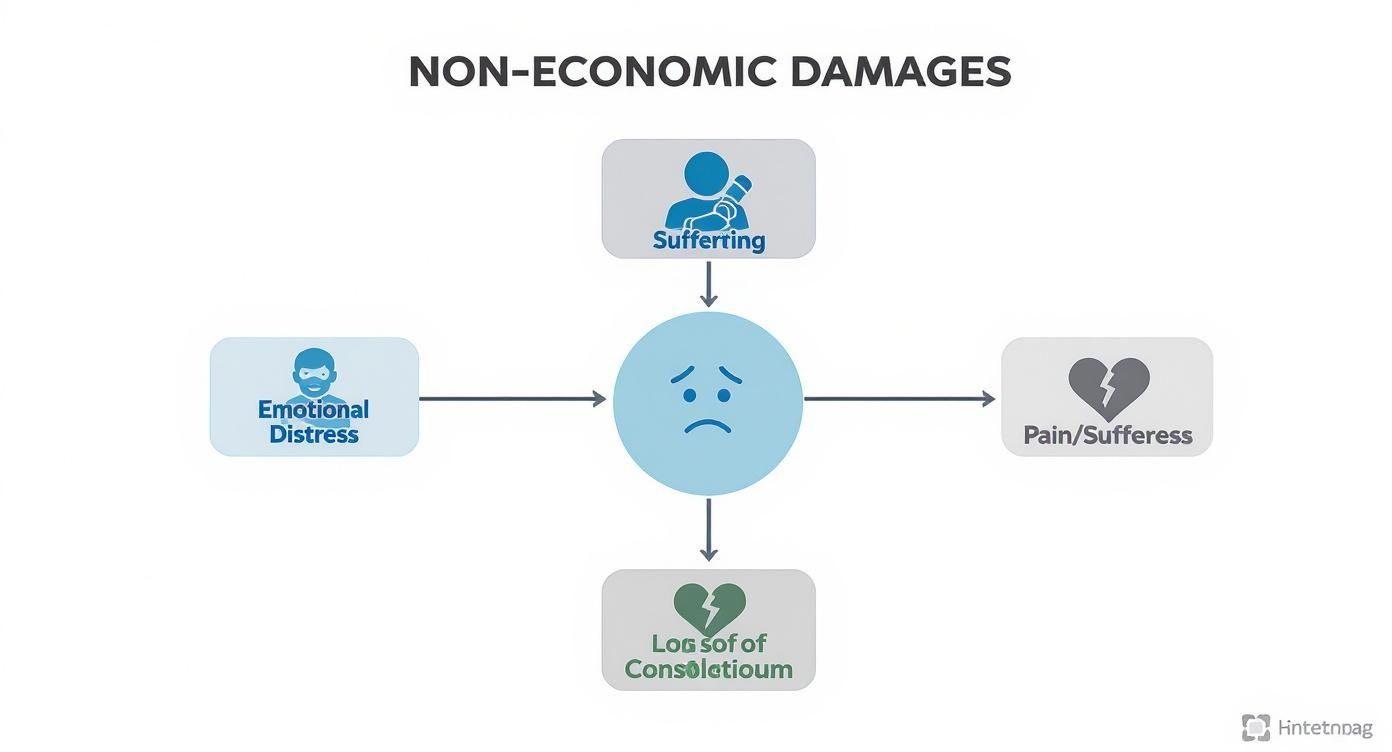
From physical pain to the strain on relationships, these valuation methods try to account for the full spectrum of an injury's impact.
The Multiplier Method
By far the most common approach is the multiplier method. It’s a pretty straightforward concept. You start by adding up all the clear-cut economic damages—things like medical bills and lost wages. Then, you multiply that total by a number, usually somewhere between 1.5 and 5.
So, what determines that multiplier? It all comes down to the severity of the injury and its impact on the person's life.
- A lower multiplier (1.5 to 2) might be used for a whiplash injury that clears up after a few months of physical therapy.
- A mid-range multiplier (3 to 4) could apply to something more serious, like a broken bone that requires surgery and a long, painful recovery.
- A high multiplier (5 or more) is reserved for catastrophic, life-altering injuries, such as paralysis or a severe traumatic brain injury.
Let’s say someone has $50,000 in medical bills and lost income after a serious car crash. If their attorney argues for a multiplier of 3 based on the pain and recovery time, the non-economic damages would be calculated at $150,000. The total estimated value of the case would then be $200,000. It’s a way of tying the intangible suffering directly to the tangible costs of the injury.
The Per Diem Method
Another way to approach this is the per diem method. "Per diem" is just Latin for "per day." This technique assigns a daily rate for the suffering a person goes through and multiplies it by the number of days they were in pain or recovering.
How do you pick a daily rate? Often, it's pegged to something concrete and easy for a jury to understand, like the person's daily pay before the accident. The argument is simple: if you got paid a certain amount for a day of work, then a day spent in pain should be worth at least that much.
For instance, if someone earned $200 a day and their recovery took 180 days until they reached what doctors call "maximum medical improvement," the calculation would look like this:
$200/day x 180 days = $36,000
This method works best for injuries that have a clear recovery timeline. It gets a lot trickier—and less useful—for permanent or lifelong conditions where you can't just count the days.
Choosing the right valuation method is a critical strategic decision. Below is a quick comparison of how these two common approaches stack up.
Comparing Valuation Methods for Non-Economic Damages
| Method | How It Works | Best For |
|---|---|---|
| Multiplier | Totals economic damages (medical bills, lost wages) and multiplies the sum by a factor (typically 1.5 to 5) based on injury severity. | A wide range of cases, especially those with significant or long-term injuries where the impact is directly reflected in high medical costs. |
| Per Diem | Assigns a daily monetary value to suffering (often based on daily wages) and multiplies it by the number of days of recovery. | Shorter-term injuries with a clear and definable recovery period, as it provides a tangible, day-by-day calculation. |
Both methods are simply tools to create a logical starting point for negotiation or a jury argument. The final number can be influenced by many other factors, but these calculations are central to how a case's value is initially framed. It's how you get to figures like the ones in this Austin jury's $671,000 negligence award, where a significant portion of the verdict was meant to compensate for these non-economic losses.
How State Laws Can Limit Your Claim
Just when you think you have a handle on what your case might be worth, you run into the biggest variable of all: state law. The right to be compensated for your pain, suffering, and the emotional toll of an injury isn't always a blank check. Where you file your claim can dramatically change the final number.
Many states have passed laws called damage caps, which put a legal ceiling on how much money you can receive for non-economic losses. These laws are often the result of heated political debates over tort reform. Proponents argue they're necessary to keep insurance costs down and stop juries from awarding astronomical sums.
But for someone who has been seriously hurt, these caps can feel incredibly unjust. They essentially put an arbitrary price tag on very real, very personal human suffering.
How Damage Caps Work in Practice
These limits are all over the map—they vary wildly from state to state. On top of that, a state's damage cap might only kick in for certain types of cases.
Medical malpractice is a classic example. Here in Texas, there's a firm cap on non-economic damages if your injury was caused by a healthcare provider. But that same limit doesn't apply to most other personal injury claims, like a typical car accident. Think about that for a second: two people could suffer identical, life-altering injuries, but one might see their potential recovery slashed simply because the at-fault party was a doctor instead of another driver.
This is why you absolutely must know the local laws. The same exact accident could be worth multiples more if it happened just a few miles away across the state line. For instance, if you were in one of the situations we covered in our guide on single-car accident scenarios, the state where the crash occurred is one of the first things a lawyer would look at to determine what’s possible.
The existence of damage caps makes setting realistic expectations essential. The value of your claim isn't just about how much you've suffered; it's also about what the law in your jurisdiction will allow.
These statutory limits are often a direct reaction to what some call "nuclear verdicts"—exceptionally large jury awards. In response, lawmakers in some states put caps in place to control costs. Colorado, for example, recently moved to nearly triple its non-economic damages cap to $1.5 million for personal injuries and $2.125 million for wrongful death cases filed in 2025. You can learn more about trends in large jury verdicts and how they're shaping these laws.
Since these rules are so complex and are always changing, there's no substitute for professional advice. Talking to a local attorney who lives and breathes your state's personal injury laws is the only way to get a clear picture of what your claim could truly be worth.
Building a Strong Case for Your Suffering

While your suffering is intensely real, it's not something an insurance adjuster or a jury can see on an x-ray. The challenge is making your invisible injuries visible to others. To do that, you have to build a powerful and consistent narrative that shows exactly how the accident turned your life upside down.
This isn't just about the initial event. It's about meticulously documenting the daily grind—the pain, the frustration, and the moments you realize life just isn't the same.
Document Your Day-to-Day Reality
Your own voice is often the most compelling evidence you have. One of the best ways to capture this is by keeping a detailed journal. But don't just write "I was in pain today." That won't cut it. You have to get specific.
- Pain Levels: Use a 1-to-10 scale. What was your pain when you woke up? How did it change after medication? What was it like by the end of the day?
- Emotional Toll: Did you feel a wave of anxiety trying to drive? Did depression creep in because you couldn't play with your kids? Note what triggered these feelings.
- Daily Limitations: What specific things couldn't you do? Think of concrete examples: "Couldn't lift the laundry basket," "had to ask my partner to open a jar," or "woke up every two hours and couldn't get back to sleep."
By consistently logging these details, you're creating a timeline of your suffering. It's far more powerful than trying to remember how you felt six months ago. Your journal becomes a key piece of evidence that translates your personal experience into something a claims adjuster or jury can truly grasp.
Gather Testimony From Those Who Know You Best
What others see can add incredible weight to your claim. Getting statements from friends, family, and even coworkers provides an outside perspective on the "before and after."
A spouse can speak to the loss of companionship and the strain the injury has put on your relationship. A friend can describe how you've been forced to give up hobbies you once cherished. Having other people back up your story demonstrates that your claims are real and not exaggerated.
Use Professional and Visual Proof
Finally, you need to layer in objective evidence to support your personal story. This kind of proof lends a ton of credibility to your case.
Crucial pieces of evidence to gather:
- Medical and Therapy Records: Documents from your doctor, physical therapist, or a mental health professional are non-negotiable. They officially connect your suffering to the injury and provide a professional diagnosis and outlook.
- Photos and Videos: Visuals can be game-changers. Dig up photos of you being active before the accident—hiking, playing sports, enjoying life. Contrast those with current photos or short videos that show your new reality, whether it's using a walker or struggling with a simple task.
When you weave together your personal story, supporting statements, and hard evidence, you create a complete and undeniable picture. You're no longer just telling a jury you're in pain—you're showing them.
Answering Your Top Questions About Non-Economic Damages
When you're trying to figure out what your case is worth, the concept of non-economic damages can feel a bit fuzzy. It’s natural to have questions. After all, how do you put a price tag on pain?
Let's walk through some of the most common questions people ask. Getting these answers straight will give you a much clearer picture of how these damages work in the real world.
Is There a Cap on What I Can Get for Pain and Suffering?
In many situations, yes. State laws often put a ceiling on how much you can be awarded for non-economic damages, and these limits are called damage caps.
You'll see these caps most often in medical malpractice cases, but they can pop up in other personal injury claims, too. The rules are all over the map and change constantly, which means a cap that applies in one state might not exist in another. This is especially true in Texas, where specific caps apply to medical liability claims. Getting advice from a local attorney is the only sure-fire way to know if a cap will affect your case.
Can I Sue for Emotional Distress if I Wasn't Physically Hurt?
You can, but you’ll have a steep hill to climb. Courts are generally skeptical of claims for emotional distress that aren't tied to a physical injury. These "standalone" claims usually require proving the other party’s behavior was either intentional or so reckless that it was almost guaranteed to cause severe emotional trauma.
Think of a situation where someone witnesses a traumatic, life-altering event caused by another person's blatant negligence. The bar for proving this is incredibly high, and the specific legal standards vary significantly from state to state.
A Quick Clarification: Don't confuse non-economic damages with punitive damages. Non-economic damages are about compensating you for your suffering. Punitive damages are about punishing the defendant for truly outrageous behavior and are awarded only in rare circumstances.
How Do Insurance Companies See These Kinds of Claims?
Let's be blunt: insurance adjusters are paid to be skeptical. Because non-economic damages aren't backed by a clear-cut bill or an invoice, adjusters will often push back, suggesting you’re exaggerating your pain or that your emotional struggles aren’t as bad as you say.
This is exactly why your documentation has to be rock-solid. You need to build a case so strong that they can't just dismiss it. Your word alone isn't enough. You need proof.
Here’s what that looks like:
- Medical Records: These are the foundation, officially connecting your pain and suffering back to the incident.
- Therapist or Counselor Notes: This is professional validation of your emotional and mental anguish.
- A Personal Journal: A detailed, day-to-day log of your pain levels, your struggles with daily activities, your mood, and how your life has been limited.
Without this kind of evidence, you’re just asking the insurance company to trust you, and that’s not a winning strategy. Strong proof turns your personal experience into a documented fact they have to take seriously.
Trying to navigate non-economic damages without data is like driving blind. At Verdictly, we give you the headlights. Our platform provides real Texas verdict and settlement data, letting you see what similar cases are actually worth. Explore the Verdictly database and start benchmarking your case with real numbers.
Related Posts

A Guide to Medical Records Reviews in Personal Injury Claims
Learn how medical records reviews can strengthen your Texas injury claim. This guide explains the process, key findings, and how to build a stronger case.

Why Insurance Companies Deny Claims: why insurance companies deny claims
Learn why insurance companies deny claims and how to overcome common denials with proven appeals and tips to maximize your compensation.
How Much Can I Get From a Car Accident Settlement?
Wondering how much can I get from a car accident? This guide breaks down settlement factors, damages, and claim values to help you estimate your compensation.