
What Is Liability Insurance Coverage and How It Works
Understand what is liability insurance coverage with clear examples. Learn how it protects you and impacts accident settlements in Texas.
Liability insurance is your financial shield when you're the one responsible for an accident. It doesn't cover your own car or your own injuries; instead, it’s there to pay for the damages and injuries you cause to other people. Getting this distinction right is the first step to understanding how any car accident claim really works.
Your Financial Shield in an Accident
Think of liability insurance as a safety net, but one you hold out for someone else. When you’re found at fault for a collision, this is the insurance that steps in to make things right for the other party. It’s mandatory for drivers in Texas for exactly that reason—to make sure victims of a crash have a clear path to financial recovery.
Without it, you'd be on the hook personally for every single dollar of damage you cause, from steep medical bills to vehicle repair costs. This could easily lead to financial ruin, lawsuits, and even wage garnishment. So, while it pays out to others, liability insurance is also what protects your own assets from being seized to cover a judgment.
Core Purpose and Function
At its heart, liability insurance does one simple but critical job: it transfers the financial risk of an accident from you to your insurance company. You pay a regular premium, and in exchange, the insurer agrees to cover the costs up to your policy’s limits if you cause a wreck.
Here’s a quick look at the typical process:
- You are found to be at fault in an accident.
- The other person files a claim against your insurance policy.
- Your insurer investigates the claim to verify what happened.
- If the claim is valid, your insurer pays for the other party’s damages up to the maximum amount your policy allows.
The at-fault driver's liability coverage is what sets the stage for almost every negotiation. Understanding its limits and how it works is the key that unlocks a fair outcome after a collision.
To help you get a quick grasp of these concepts, here is a simple breakdown of what liability coverage entails.
Liability Insurance At a Glance
| Coverage Component | What It Covers | Who It Protects |
|---|---|---|
| Bodily Injury (BI) | Medical bills, lost wages, and pain and suffering for people you injure. | The other driver, their passengers, and pedestrians. |
| Property Damage (PD) | Repair or replacement costs for another person's vehicle or property you damage. | The owner of the other car, building, fence, or any other damaged property. |
This table shows the two fundamental parts of any liability policy, which we’ll explore in more detail.
This entire framework is the foundation of nearly every car accident settlement negotiation. The amount of coverage the at-fault driver carries directly shapes the strategies used by both sides and often dictates the upper limit of a potential settlement. That’s why we need to break down its components piece by piece.
The Two Pillars: Bodily Injury and Property Damage
Every liability insurance policy stands on two core foundations, each one covering a distinct type of damage you might cause in an accident. The easiest way to think about it is like having two separate pots of money—one dedicated to people and the other to property. Getting a firm grip on how these two work separately is the first real step to understanding liability coverage.
The first, and often the most significant, is Bodily Injury (BI) liability. This is the part of your policy that pays for the physical harm someone else suffers when an accident is your fault. And it’s not just for the initial trip to the emergency room; BI coverage is meant to handle the full spectrum of costs that come with an injury.
Let's say you're in a rear-end collision on a busy Dallas highway. The other driver’s medical care—from the ambulance ride to their physical therapy months later—all falls under your BI coverage.
Bodily Injury: A Closer Look
Bodily Injury liability is surprisingly broad, covering a number of different damages an injured person can claim. These typically include:
- Medical Expenses: This is the big one. It covers everything from the ambulance and hospital bills to ongoing physical therapy, prescriptions, and even anticipated future medical needs.
- Lost Wages: If someone's injuries keep them out of work, BI coverage can reimburse them for the income they couldn't earn while recovering.
- Pain and Suffering: This is compensation for the actual physical pain and emotional distress caused by the accident. It’s a non-economic damage that can be a huge factor in a final settlement.
- Legal Fees: Should the injured person sue you and win, your BI coverage also steps in to cover their legal expenses.
It's critical to remember that BI coverage isn't just for the other driver. It applies to people—their passengers, a pedestrian you hit, or anyone else injured in the crash.
Property Damage: The Other Half of the Equation
The second pillar is Property Damage (PD) liability. This side of the policy is a bit more direct: it pays to fix or replace other people’s property that you’ve damaged. Most of the time, this means the other driver's car, but it's not limited to just that.
Picture this: you swerve to miss a squirrel and end up driving through someone’s prize-winning garden and taking out their mailbox. Your PD liability would cover the cost of repairing the landscaping and replacing the mailbox. Essentially, it protects other people’s physical stuff from the damage you cause.
Together, these two pillars create the protective shield of your liability insurance. Bodily Injury handles the human toll, while Property Damage takes care of the material losses. Each has its own separate limit, which is the maximum dollar amount your insurance company will pay out for that specific type of damage. This distinction is incredibly important because a serious crash can easily exhaust one or both of these limits, which has a massive impact on how a settlement is negotiated.
Decoding Policy Limits and What They Mean for You
When you're dealing with a car accident claim, the at-fault driver's insurance policy limits are everything. These numbers aren't just details; they represent the absolute maximum amount the insurance company will pay out for the damages. Think of it as the financial ceiling for your entire settlement.
Understanding these limits is the key to understanding the entire claims process. It dictates the negotiation strategy from day one and often determines the final outcome.
In Texas, you'll almost always see liability coverage written as a series of three numbers. This is called a split limit. The state minimum, for example, is 30/60/25. Let’s break down exactly what that means.
Breaking Down the Numbers: 30/60/25
A 30/60/25 policy might sound like insurance jargon, but it's actually pretty straightforward once you know the formula. Each number corresponds to a specific type of coverage, and more importantly, its maximum payout.
Here’s what you get with a 30/60/25 policy:
- $30,000 for Bodily Injury Liability Per Person. This is the most the insurer will pay for a single person's medical bills and other injury-related damages in an accident you caused.
- $60,000 for Total Bodily Injury Liability Per Accident. This is the hard cap for all injuries combined if you hurt more than one person. It doesn't matter how many people were injured or how severe their injuries are—the insurer won't pay a dime over this total.
- $25,000 for Property Damage Liability Per Accident. This is the maximum amount the policy will pay to fix or replace the other person’s car or any other property you damaged.
This diagram helps show how liability insurance is built around those two core pillars: covering injuries and covering property damage.
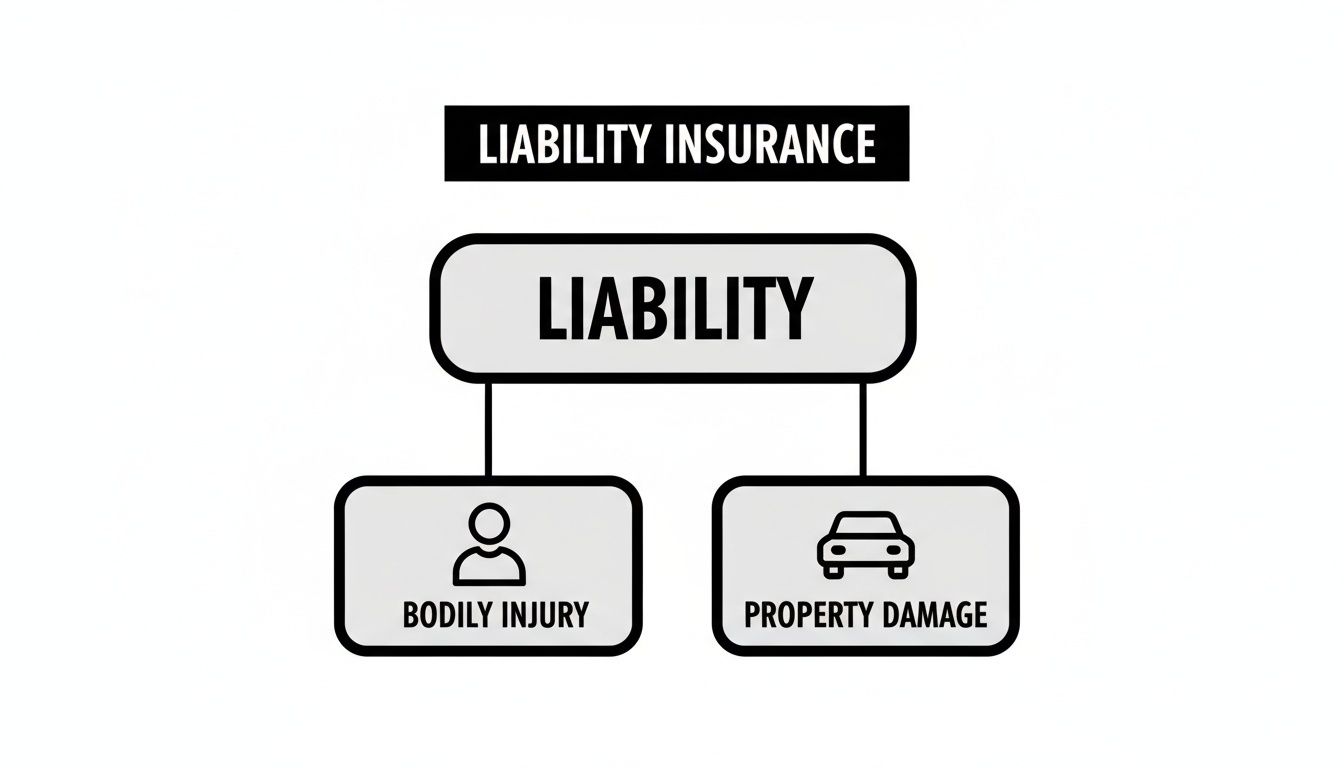
As you can see, the money available for medical bills is completely separate from the money set aside for vehicle repairs.
How Limits Play Out in a Real-World Scenario
Let's put this into practice. Imagine you're in a collision where the at-fault driver carries the Texas minimum 30/60/25 policy. The accident injures you and two of your passengers.
Your medical bills hit $40,000. Your two passengers each have $15,000 in medical expenses. Here's how the at-fault driver's insurance policy would handle it:
- Your $40,000 claim is immediately capped at the $30,000 per-person limit. You're left on the hook for the remaining $10,000.
- Your two passengers can each claim their full $15,000, since that amount is below the $30,000 individual cap.
- The total payout for everyone's injuries is $30,000 (for you) + $15,000 (passenger 1) + $15,000 (passenger 2) = $60,000.
That $60,000 is the absolute per-accident maximum. Even if the total medical bills were much higher, the insurance company simply would not pay any more. This is why we say the at-fault driver's policy limit is both the starting point and, all too often, the finish line for a claim.
The global liability insurance market is enormous, valued at $291.86 billion and still growing. This trend underscores the serious financial risks drivers face on the road today, making it more critical than ever to have adequate coverage.
Getting a handle on these numbers is the first step toward a realistic negotiation. To see how policy limits affect real-world case values, you can use our car accident settlement calculator to get insights based on similar Texas cases.
How Liability Coverage Shapes Car Accident Settlements
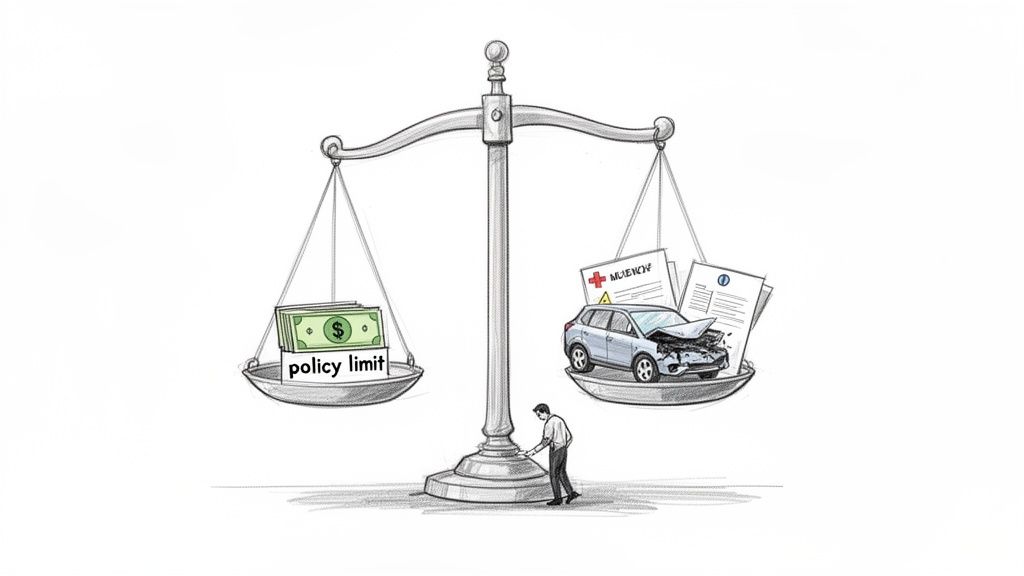
Liability insurance isn't just a legal requirement; it's the financial backbone of every single car accident claim. From the moment an adjuster gets your case, their first move is to check the at-fault driver's policy limits. That number sets the stage for everything that follows.
Think of the policy limit as the total amount of money in the pot. It doesn't matter how catastrophic your injuries are or how high your medical bills get. The adjuster can only work with what's available in that policy. It’s the absolute ceiling on what the insurance company can—and will—offer.
Policy Limits and Settlement Strategy
The size of that insurance policy has a direct and predictable impact on how settlement talks play out.
-
Low-Limit Policies: Let's say the at-fault driver has a bare-bones policy, like the Texas minimum of $30,000. If your damages are obviously much higher than that, the negotiation is often quick. The adjuster will likely put the full $30,000 on the table and call it a day. Why? Because their risk is capped. There’s no financial reason for them to drag out a fight.
-
High-Limit Policies: On the flip side, when you're dealing with a large policy—think commercial trucks or high-net-worth individuals—get ready for a much longer, more detailed fight. With more money on the line, the insurer will scrutinize every single medical record and dispute the severity of your injuries. They'll invest serious resources to minimize their payout.
This reality makes one thing crystal clear: a settlement isn't just about what your case is worth. It's about what’s actually available to pay for it. Understanding what a typical car accident settlement looks like for similar injuries in your area is crucial before you even think about accepting an offer.
The Impact of Litigation Trends
Negotiations don't happen in a vacuum. Broader trends in the insurance world add another layer of pressure. Right now, the U.S. insurance market is getting tougher. Casualty rates have jumped by 8%, largely because of massive jury verdicts against insurance companies.
This isn't happening everywhere. In many international markets, the legal systems don't produce those "nuclear" verdicts, so rate increases are much smaller. But here in the U.S., where car wrecks make up almost half of all liability payouts, adjusters are on high alert.
When an insurance company offers the policy limits, they are effectively saying, "This is all we can pay, regardless of what your claim is actually worth." This is a strategic move to close the claim and eliminate further liability.
Making an Informed Decision
So, what do you do when the insurance company offers you the policy limit? The real question is whether it's a fair outcome for you.
Imagine the at-fault driver's policy is maxed out at $30,000, but real-world data from similar Texas cases shows juries are awarding $100,000 for your type of injury. Suddenly, accepting that low offer becomes a much tougher pill to swallow.
This is exactly why having access to accurate case values is a game-changer. It gives you the power to see if the policy-limit offer is a reasonable end to the road or just a starting point. From there, you and your attorney can decide whether to look at other options, like an underinsured motorist claim or even pursuing the at-fault driver's personal assets.
In the end, the at-fault driver's liability coverage defines the battlefield for your entire financial recovery.
What Liability Insurance Does Not Cover
It's easy to think of liability insurance as a safety net for any and all accident-related costs. But that's a common, and often expensive, misunderstanding. Knowing what your policy doesn't cover is just as crucial as knowing what it does.
At its core, liability insurance is about one thing: paying for the damage you cause to other people and their property. It's a financial shield designed to protect you from claims made by others, not to cover your own losses.
This means if you're the one at fault in an accident, your liability coverage won't touch your own medical bills or the cost to fix your car. For those expenses, you'd need to look to other parts of your policy, like Personal Injury Protection (PIP) or collision coverage.
Common Exclusions to Know
Think of your insurance policy as a contract with very specific rules. The insurance company uses exclusions to draw clear lines around what they will and won't pay for. If a claim falls outside those lines, it will be denied.
Here are a few of the most common situations where your liability coverage won't help:
- Intentional Acts: Liability insurance is for accidents—plain and simple. If you cause damage on purpose, like in a fit of road rage, your insurer isn't going to cover it.
- Your Own Injuries: As we've covered, your own medical expenses are never paid for by your liability policy. This rule also applies to family members who live with you.
- Business Use: Using your personal car for work, whether you're delivering pizzas or driving for a rideshare app, is almost always excluded. You'll need a commercial auto policy or a special add-on (an endorsement) for that kind of use.
These exclusions all point back to the fundamental purpose of liability coverage: it's there to protect others from your mistakes, not to fix your own problems.
An insurance policy is a contract with specific terms. Exclusions are the insurer's way of defining the limits of their financial responsibility, preventing coverage for risks they did not agree to underwrite.
Uncovered Risks You Can't Ignore
Liability insurance is a massive global market for a reason—it’s essential. While North America currently leads, the Asia-Pacific region is catching up fast, with a market projected to hit $65.80 billion next year. You can find more insights on these global insurance trends and their impact.
Even with so much money flowing into the market, dangerous coverage gaps still exist. One of the biggest risks every driver faces is getting hit by someone with no insurance at all. Your own liability policy offers zero help in this situation.
That’s precisely why having separate Uninsured/Underinsured Motorist (UIM) coverage is so important. To see how to protect yourself when the other driver can't pay, check out our guide to uninsured driver accidents. In the end, taking the time to understand what isn't covered is the best way to build an insurance plan that truly protects you.
Common Questions About Liability Insurance Coverage
Getting into a car accident throws your life into chaos, and figuring out the insurance side of things can feel overwhelming. Even after you grasp the basics of liability coverage, real-world questions pop up constantly. Let's walk through some of the most common issues people in Texas run into and get you some clear answers.
What Happens When Damages Exceed Policy Limits?
It’s a nightmare scenario that happens more often than you'd think: your medical bills and car repair costs soar past what the other driver's insurance policy is willing to pay. When your damages are higher than their liability limits, you have a few options, each with its own trade-offs.
Your first choice is to simply accept the policy limit as a full and final settlement. This is usually the fastest way to get paid, but it means you're signing away your right to ever pursue more money for that accident. The case is closed, for better or worse.
A much better route, if you have it, is to turn to your own insurance policy. This is precisely why Uninsured/Underinsured Motorist (UIM) coverage exists. Your UIM policy is designed to step in and cover the difference between the at-fault driver's low limit and the actual cost of your damages.
The last resort is to sue the at-fault driver personally for their assets. Be warned, though—this is often a long, frustrating road, especially if the person doesn't have much to begin with. It's best to talk to an attorney to figure out which path makes the most sense for you.
Finding Out the At-Fault Driver's Policy Limits
You can't build a smart negotiation strategy in the dark. You absolutely need to know the maximum amount of money on the table. After an accident, the other driver's insurance company is required by law to tell you (or your lawyer) their client's policy limits when you ask.
The thing is, insurance adjusters almost never volunteer this information. You have to be proactive and ask for it directly.
A good attorney will immediately send a formal demand letter to the insurer, which legally compels them to disclose the policy limits. This single action is one of the most critical first steps because it sets the financial boundaries for your entire settlement negotiation.
If you end up filing a lawsuit, the policy limits can also be obtained through a formal legal process called discovery. Getting that number is the essential first move in any car accident claim.
Understanding Texas Minimum Liability Requirements
Texas law mandates that every driver on the road must have a certain amount of liability insurance to cover the harm they might cause. The state's bare-bones coverage is commonly known as a 30/60/25 policy.
Here's what that breaks down to:
- $30,000 for bodily injury to a single person.
- $60,000 total for all bodily injuries in one crash.
- $25,000 for property damage.
Driving without this coverage is illegal and comes with steep penalties. More importantly, it means if you cause an accident, you're on the hook personally for every single dollar of damage—a situation that can lead to complete financial ruin.
Will Their Liability Insurance Cover My Rental Car?
Yes, it should. The property damage part of the at-fault driver's liability insurance is meant to cover a comparable rental vehicle while your car is in the shop. It's considered a "loss of use" claim and is a standard part of recovering your property-related losses.
But here’s the catch. The money for your rental car comes from the same pot as the money to fix your vehicle—the property damage limit. In Texas, that limit can be as low as $25,000.
If you have an expensive car that needs major repairs, and you're in a rental for weeks, it's surprisingly easy for those combined costs to blow past that $25,000 limit. If that happens, you’ll either be paying the rest out of your own pocket or turning to your own collision coverage, assuming you carry it.
Getting a handle on the ins and outs of liability coverage is the first step toward a fair outcome. At Verdictly, we believe the next step is getting access to real case data. Our platform gives you transparent insights into Texas car accident verdicts and settlements, so you can negotiate from a position of strength and knowledge. Explore what similar cases are worth on our site.