
What Is a Deposition in a Lawsuit? A Guide for Plaintiffs
Understand what is a deposition in a lawsuit and why it matters. This guide explains the purpose, process, and preparation tips for personal injury plaintiffs.
If you’ve been in a car wreck and filed a lawsuit, you’ve probably heard the term "deposition." It sounds intimidating, but what exactly is it?
Simply put, a deposition is a formal, out-of-court interview where you answer questions under oath. It’s not the dramatic courtroom scene you see on TV. Instead, think of it as a critical fact-finding mission that usually happens in a lawyer's conference room. The opposing attorney gets to hear your side of the story, and everything you say is recorded by a court reporter.
Understanding What a Deposition Is and Why It Matters
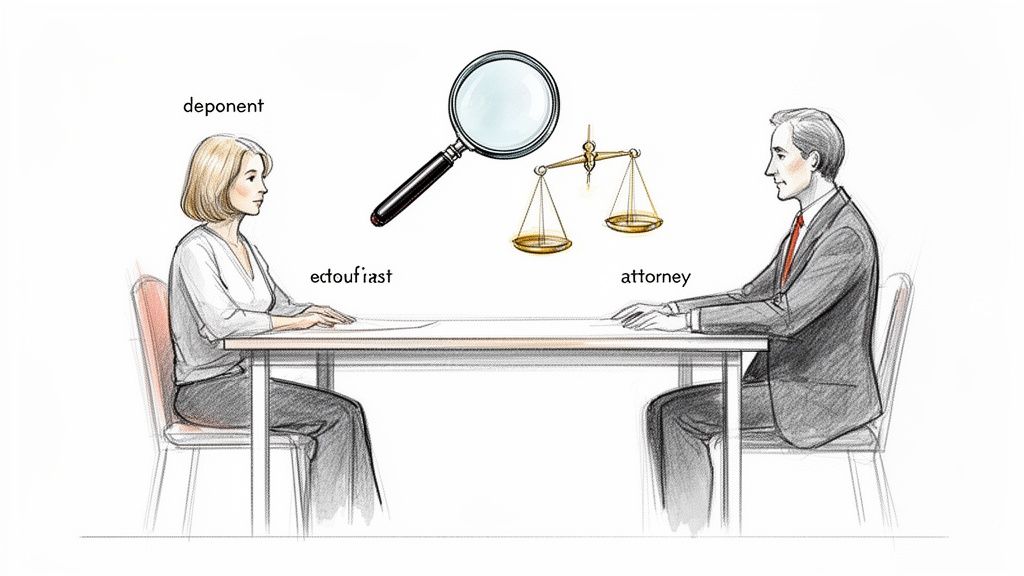
A deposition is basically a sneak peek of what your testimony would be like at trial. It’s a key part of the "discovery" phase of a lawsuit—the official period where both sides exchange information to build their cases. Discovery is just one step in the broader legal journey, which you can explore further in our guide to the stages of a lawsuit.
This is your structured opportunity to tell your story and lay out the facts about your injuries and how the accident has affected your life. Even though there’s no judge or jury, your testimony is sworn and carries the same weight as if you were in a courtroom. According to legal insights from JD Supra, depositions are a cornerstone for gathering facts, evaluating how credible a witness seems, and shaping case strategy long before a trial ever begins.
Core Components of a Deposition
To really get a handle on what a deposition is, it helps to know the key players and pieces involved. It might seem complicated, but each element has a clear and straightforward purpose.
For a quick reference, here’s a simple breakdown of what to expect.
Deposition at a Glance
| Element | Description |
|---|---|
| The Deponent | That's you—the person being questioned. Your job is to answer truthfully based on what you know. |
| The Oath | You'll be sworn in, promising to tell the truth, just like in court. This makes your answers official testimony. |
| The Questions | The other side's lawyer will ask you about the accident, your injuries, your medical treatment, and how it's impacted you. |
| The Transcript | A court reporter types out every single word that’s said. This written record becomes an official document in your case. |
| Your Attorney | Your lawyer is there to protect you, object to improper questions, and help you prepare beforehand. |
In the end, the deposition serves two main purposes. It helps your attorney understand what the other side is thinking, and it locks in your version of events as part of the official case record.
What's the Real Point of a Deposition?
Think of a deposition as more than just a formal interview. It's a strategic chess move that can define the entire path of your lawsuit. On the surface, it looks like a simple question-and-answer session, but for the lawyer on the other side, every single question is calculated to achieve a specific goal. Once you understand what they're really after, you'll see why your testimony is so important.
Defense attorneys have three main objectives during a deposition. First, it’s a pure fact-finding mission. They need to understand the accident, your injuries, and how it's all affected your life—from your point of view. They are looking to uncover the good, the bad, and the ugly of your case, straight from the source.
Second, a deposition is designed to preserve your testimony. Everything you say is recorded, creating a permanent, official record of your story. This locks you into one version of the facts.
Your sworn testimony becomes an anchor. If you try to change your story later in court, even in a small way, the other lawyer will pull out that deposition transcript and use it to attack your credibility in front of the jury. That can be devastating.
They're Sizing You Up
Beyond just gathering facts, the opposing attorney is evaluating you. They’re trying to figure out how a jury will see you. Do you come across as honest and sympathetic? Are your answers clear and consistent? Or do you seem angry, confused, or like you might be hiding something? Your entire demeanor is under the microscope.
A strong, credible performance tells the other side one thing loud and clear: you will be a compelling witness if this case goes to trial. This single factor heavily influences their risk assessment and plays a massive role in how they value your case for a potential settlement.
Setting the Table for Settlement
Ultimately, everything that happens in the deposition—the facts you provide and the impression you make—directly impacts whether your case settles out of court. After it’s over, the defense lawyer reports back to the insurance company with a detailed analysis of your performance.
Here’s how that usually plays out:
- A strong deposition often makes the insurance company sit up and take notice, leading to a much more reasonable settlement offer. When they see you can tell your story clearly and convincingly, the risk of losing at trial goes way up, and they're more motivated to resolve the case.
- A weak deposition, on the other hand, can make them bold. If you seem inconsistent or unbelievable, they might see an opportunity to lowball you or even take their chances in court, thinking they can win.
Your deposition is arguably the single most important day of your case before a potential trial. It’s your best chance to show the other side the true strength of your claim, giving your attorney the leverage needed to negotiate a better outcome for you.
Who Is in the Room During a Deposition
Walking into the room for your deposition can feel pretty intimidating. It’s often a sterile conference room, and you’re surrounded by people you don’t know. The key is to remember that this isn't a random gathering; it's a structured meeting where everyone has a specific job to do.
Let's break down who you can expect to see.
You, of course, are the main event. In legal terms, you're the deponent. Your one and only job is to answer questions truthfully based on what you know. You're the one with the firsthand story, and that’s why everyone is there.
Your Support and the Questioner
Right next to you, you'll find your attorney. Think of them as your guide and your guardrail. They're there to make sure the questions from the other side are fair, to object if they aren't, and to help you navigate the whole process. They’re your advocate from start to finish.
Sitting across the table will be the opposing attorney—the lawyer for the other driver or their insurance company. Their goal is to gather facts, hear your version of events, and see how you come across as a witness.
The Neutral Parties
There will also be a court reporter in the room. This is a highly trained professional whose job is to create a perfect, word-for-word record of everything said. Before you start, they'll ask you to swear an oath to tell the truth. The document they produce, the transcript, is an official record for your case.
A deposition isn't a confrontation; it's a formal, fact-finding mission. Each person in that room, even the lawyer asking you tough questions, is just doing their job. Remembering that helps you stay calm and focused on yours: answering honestly.
Sometimes, a few other people might be present:
- A Videographer, if the other side wants a video recording of your testimony.
- An Expert Witness, who might be there to observe before giving their own testimony later. You can learn more about their unique function by reading our guide on what is expert witness testimony.
- Parties to the Lawsuit, which could be an insurance adjuster or even the other driver.
It's also worth noting that the setting itself is changing fast. A 2023 survey found that over 70% of law firms now handle at least some of their depositions remotely via video conference. This shift, pushed into high gear over the last few years, is fundamentally changing how this critical part of a lawsuit works. You can read more about these deposition trends on JD Supra.
2. Your Step-by-Step Guide to the Deposition Process
Walking into a deposition can feel intimidating, but a lot of that anxiety comes from the unknown. Once you understand that a deposition isn't some chaotic free-for-all but a structured, predictable event, it’s much easier to handle. Think of it as a roadmap—knowing the route helps you stay focused on the most important thing: giving clear, truthful answers.
The whole thing begins with a simple but powerful moment.
Taking the Oath
Before any questions are asked, the court reporter will ask you to raise your right hand and swear an oath to tell the truth. This is the exact same oath you would take if you were testifying in a courtroom in front of a judge.
This is a big deal. From that moment on, everything you say is officially on the record as sworn testimony. It’s a formal reminder that honesty and accuracy are non-negotiable.
The Questioning Phase
With the oath out of the way, the opposing attorney starts asking questions. It’s not an ambush; the questioning usually follows a logical path, starting broad and then digging into the finer details of your case.
Typically, you can expect the questions to unfold in a sequence like this:
- Your Background: They’ll often start with the basics—your education, job history, and family. This isn't just small talk; it helps them build a picture of who you are and gets the conversation rolling.
- The Crash Itself: Next, they'll zero in on the motor vehicle accident. Be ready to talk about the date, time, location, what you saw and heard, and how the events played out from your perspective.
- Your Injuries and Medical Care: This is a huge part of any personal injury deposition. The lawyer will want you to describe your injuries in detail, walk them through the medical treatment you've received, and discuss any symptoms or limitations you still experience.
- Your Damages: Finally, the questioning will turn to how the accident has impacted your life. This means discussing things like lost income from missed work, your physical pain and emotional suffering, and how your daily routine has been affected.
The flowchart below shows how everyone in the room fits into this structured conversation.
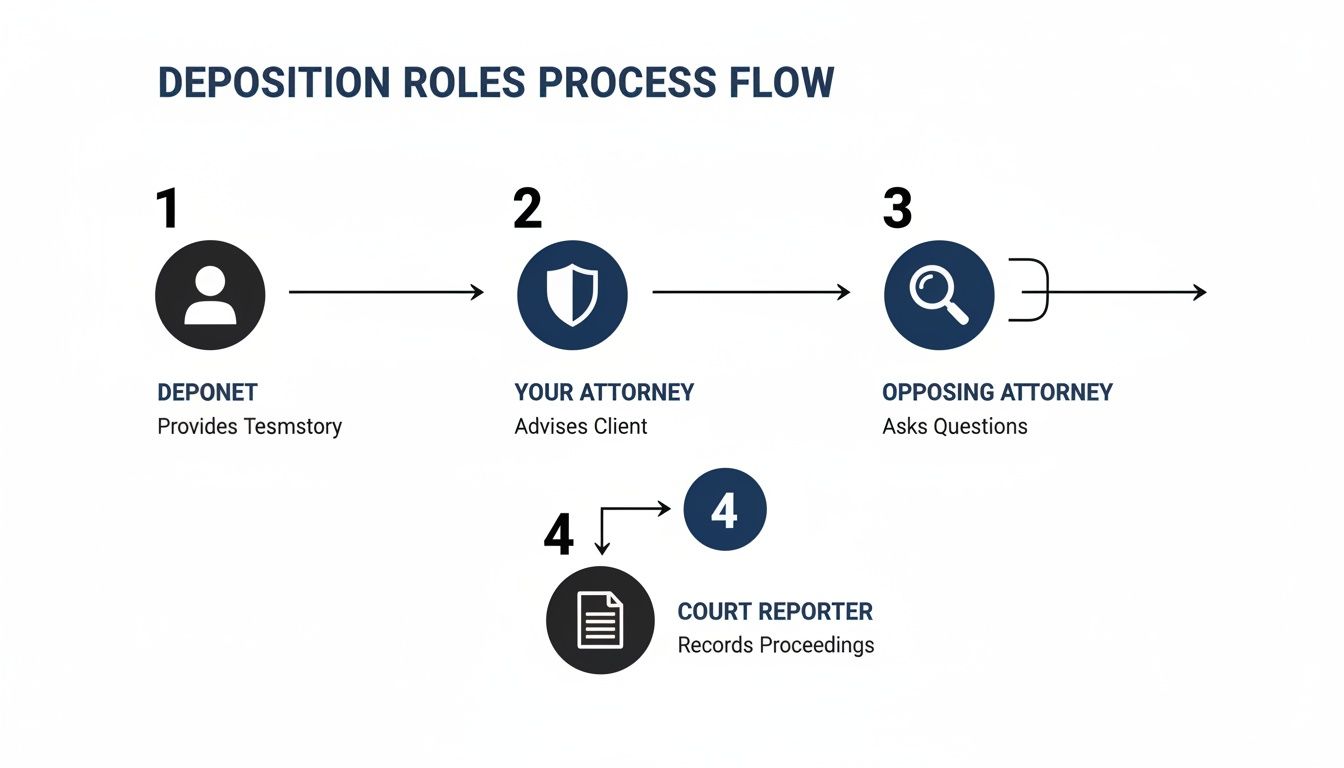
As you can see, everyone has a specific role, which keeps the process orderly and focused on gathering the facts. To help you prepare, let's look at some common questions and why the other side is asking them.
Common Deposition Questions and Their Purpose
The opposing lawyer isn't just asking questions at random. Every single one has a purpose, designed to test your memory, lock in your story, or find inconsistencies. Here are a few examples.
| Question Category | Example Question | Attorney's Goal |
|---|---|---|
| Personal Background | "Can you tell me about your work history for the past 10 years?" | To see if you have a history of physically demanding jobs that could be an alternative source of your injuries. |
| The Accident | "How fast were you going just before the impact?" | To lock you into a specific speed, which they will compare to the police report and other evidence. |
| Medical History | "Have you ever injured your back before this accident?" | To find a "pre-existing condition" they can blame for your current pain, rather than the crash. |
| Injuries & Treatment | "You mentioned your back hurts. Can you describe the pain on a scale of 1 to 10?" | To get you to quantify your pain, which can be used later to argue it wasn't as severe as you claim. |
| Damages | "What activities are you no longer able to do since the accident?" | To get a concrete list of your limitations. If you can't name specific things, they'll argue your life wasn't significantly impacted. |
Understanding the "why" behind the question is half the battle. It helps you give a focused, truthful answer without accidentally giving the other side ammunition to use against you.
What Happens When Your Lawyer Objects?
At some point, you'll likely hear your own lawyer say, "Objection." Don't let it throw you. This is a normal part of the process and it simply means your lawyer thinks the question is legally improper.
When your attorney objects, the best thing to do is stop talking immediately. Pause, look at your attorney, and wait for their guidance. They are your shield, ensuring the questions remain fair and within legal bounds.
After the objection, your lawyer will tell you what to do next. Sometimes they'll tell you to answer the question anyway; other times, they'll instruct you not to answer. Always follow their lead.
Winding Down: The End of the Deposition and the Transcript
After the opposing attorney is done, your lawyer might ask a few questions to clarify anything that was confusing, but this doesn't always happen. Once all the questioning is finished, the court reporter will state for the record that the deposition has concluded.
A few weeks later, the court reporter will create a word-for-word transcript of the entire session. You and your attorney will get a chance to read through it to make sure it's accurate before it becomes an official part of your case.
Knowing this process inside and out is crucial for leveling the playing field. Insurance companies have a playbook, and they use depositions to poke holes in claims. For a deeper dive into how this part of the legal world is evolving, you can find more on the latest deposition trends reshaping legal strategies on jdsupra.com.
Essential Do's and Don'ts for Your Deposition
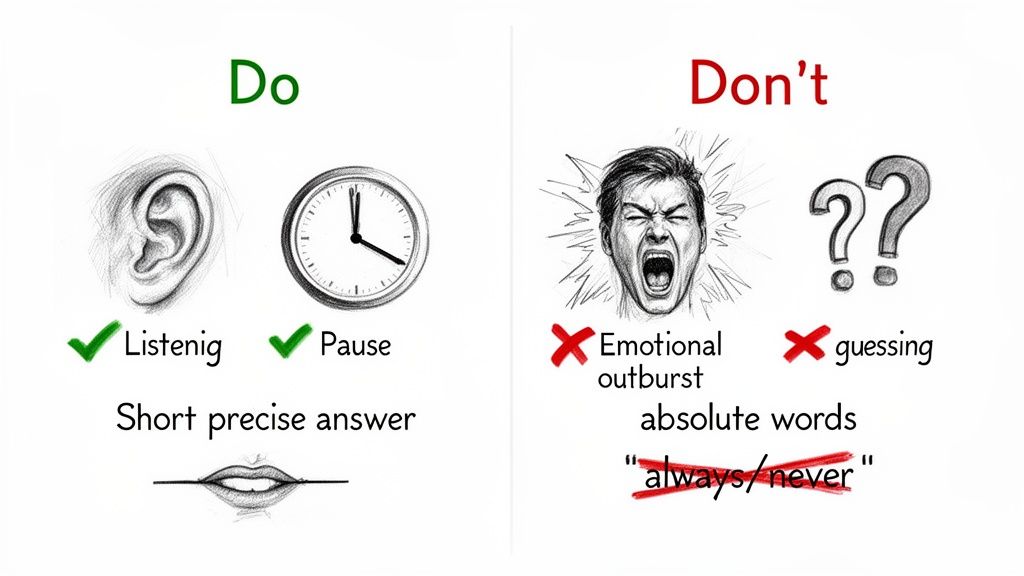
How you handle yourself in a deposition can make or break your lawsuit. It's often the single most important event before a trial or settlement. The way you answer questions, your overall demeanor, and how credible you appear are all under a microscope. By mastering a few key rules, you can present yourself and your case in the strongest possible light.
The number one rule is the simplest: always tell the truth. Everything else flows from that. Beyond honesty, a few practical strategies will help you stay calm, appear credible, and maintain control over your testimony.
Core Principles for Effective Testimony
Navigating the Q&A of a deposition takes real discipline and focus. It’s critical to remember that this isn't a casual conversation; it's a formal exchange of information where every word matters. Your goal is to give accurate, truthful answers without accidentally giving the other side ammunition to use against you.
Here are the fundamental "Do's" to burn into your memory:
-
Do listen to the entire question. Never, ever interrupt or jump to conclusions about where the attorney is going. Let them finish their sentence completely before you even start thinking about your response.
-
Do pause before you answer. Take a breath. This small moment gives you time to fully process the question, frame your answer carefully, and—just as importantly—gives your lawyer a window to object if the question is improper. Silence is your friend.
-
Do only answer the question asked. This is harder than it sounds. If a question can be answered with a simple "yes" or "no," that's your answer. Fight the natural urge to explain or volunteer extra details unless you are specifically asked to.
The golden rule of a deposition is clarity and precision. Your job is not to tell a story or fill the silence; it is to respond truthfully and directly to the questions you are asked—nothing more, nothing less.
Common Pitfalls You Must Avoid
Knowing what not to do is just as important as knowing what you should. The opposing lawyer is actively searching for any inconsistencies, exaggerations, or weaknesses in your story. Avoiding these common traps is crucial to protecting your credibility.
Historically, depositions have always been a cornerstone of legal discovery, forcing sworn testimony that gets to the heart of a case. This is especially true in personal injury law, where over 95% of lawsuits settle before ever seeing a courtroom. Your deposition performance directly influences those negotiations. You can find more details on why personal injury cases take time on the702firm.com.
Keep these critical "Don'ts" top of mind during your testimony:
-
Don't guess or speculate. If you don't know something, the right answer is, "I don't know." If you can't recall a detail, simply say, "I don't remember." A guess that turns out to be wrong can be used to paint you as dishonest.
-
Don't use absolute words. Steer clear of definitive words like "always" and "never." Life is rarely that black-and-white, and making such a sweeping statement gives the other lawyer an easy target to attack. Stick to what you know for sure.
-
Don't get emotional or argumentative. The opposing attorney might intentionally try to provoke you to see how you react. Your job is to stay calm, polite, and professional no matter what. Let your lawyer be the one to handle any confrontations.
Your attorney will go over all of these points with you before the deposition. That preparation meeting is the single most important thing you can do to feel confident and ready for the day.
How Your Deposition Influences Settlement Negotiations
Think of your deposition as more than just a formal Q&A. In reality, it’s the moment the other side gets to size you up and decide what your case is really worth. Once it's over, their lawyers will pour over every word of the transcript and watch the video, looking for much more than just the facts. They're assessing you.
They’re trying to answer one make-or-break question: How would a jury react to you?
If you come across as credible, consistent, and sympathetic, you send them a powerful message. It tells them you’ll connect with jurors at trial, and that’s a huge risk for them. This single factor can push them to offer a much more serious settlement, simply to avoid the uncertainty of facing you in a courtroom. Your performance directly impacts their financial risk assessment.
Your Testimony Sets the Bar for Offers
On the flip side, a poor deposition can torpedo your case's value. If your testimony is confusing, inconsistent, or seems less than truthful, the opposing attorney will pounce on it. They'll see it as a critical weakness to exploit.
This gives them the leverage to make a lowball offer—or even decide to take their chances at trial, gambling that a jury won't believe you.
In a Texas car wreck lawsuit, for example, the deposition is where every detail gets scrutinized under a microscope—the crash itself, what you told the police, your medical treatments, and your lost wages. The strength of your testimony here often determines whether their settlement offers even begin to approach what similar cases are worth. You can explore more about how lawsuit timelines and discovery influence outcomes from insights on the702firm.com.
Ultimately, your deposition is the single best opportunity you have to demonstrate the strength of your case and your conviction. It’s a direct audition for trial that heavily influences the final settlement value and the compensation you receive for your injuries.
Everything you say becomes the bedrock for all future negotiations. For a deeper understanding of how these discussions conclude, you might be interested in our guide on what is a settlement agreement. A strong deposition hands your attorney the ammunition they need to fight for a fair resolution.
Answering Your Lingering Deposition Questions
Even with a solid grasp of the basics, you're bound to have more specific questions buzzing in your head. That's completely normal. Let's tackle some of the most common ones that come up as people prepare for this critical stage of their lawsuit.
Getting clear, straightforward answers to these questions will help you walk into your deposition feeling prepared and a lot more confident.
How Long Does a Deposition Usually Take?
There’s no one-size-fits-all answer here, as the length really hinges on how complex your case is. For a relatively straightforward Texas car wreck, you might be done in 2 to 4 hours.
But if your case involves a multi-car pile-up, severe injuries with long-term consequences, or a lot of disagreement over who was at fault, plan for a much longer day. It's not uncommon for these depositions to take a full 7 hours or even spill over into a second day. Your attorney will have a much better feel for the timing based on the unique facts of your case.
Can I Refuse to Answer a Question?
In almost every situation, the answer is no—you have to answer every question truthfully. The only real exception is if your attorney tells you not to. Think of your lawyer as your legal shield during the deposition.
They might object to a question if it’s improper or asks for "privileged" information, like the confidential advice they’ve given you.
If you hear your attorney say "Objection," your job is simple: stop talking immediately. Just pause and wait for them to give you the green light. They will tell you very clearly whether you should answer the question or remain silent. Always follow their lead.
What Happens After the Deposition Ends?
When the last question is asked, you can finally breathe—but the process isn't quite over. The court reporter, who has been typing away the whole time, will now create the official written transcript of your testimony.
A few weeks later, you and your attorney will get a copy. You’ll need to read through it carefully to check for any typos or mistakes. Once you've signed off on any corrections, that final transcript becomes a permanent, official part of your case file. Both legal teams will then use it to build their strategies for settlement talks or, if it comes to it, trial.
Navigating settlement requires more than just a strong deposition; it requires data. Verdictly provides access to real Texas motor vehicle case summaries, verdicts, and settlements, empowering you to understand typical outcomes before you negotiate. Level the playing field by exploring what similar cases are worth at https://verdictly.co.