
Kinds of Negligence (kinds of negligence): How They Impact Your Injury Claim
Discover kinds of negligence in Texas personal injury cases and how they can impact your motor vehicle claim. Get clear guidance on your rights now.
When we talk about negligence in a personal injury case, we're not talking about someone intentionally trying to hurt another person. Instead, it’s about a failure to be reasonably careful, which unfortunately leads to someone else getting injured. Think of it as the legal framework for holding a person accountable for the consequences of their carelessness.
The Four Building Blocks of a Negligence Claim
Before we dive into the different types of negligence, we need to understand the basic recipe. Every single negligence claim, from a minor fender-bender to a catastrophic 18-wheeler crash, has to prove four key elements. If you can't prove all four, the claim simply won't hold up in court.
I like to think of them as the four legs of a table—take one away, and the whole thing comes crashing down. Let's use a classic real-world example to walk through them: a driver blowing through a red light and causing a wreck.
The Essential Elements Explained
To build a solid case, you have to establish these four pillars with concrete evidence:
- Duty of Care: First, you have to show the defendant had a legal obligation to act with a certain level of care. This one's usually straightforward in car wrecks. Anyone who gets behind the wheel in Texas has a duty to follow traffic laws and operate their vehicle safely to protect others on the road.
- Breach of Duty: Next, you prove the defendant failed to live up to that duty. Running a red light is a textbook breach of the duty to drive safely and obey traffic signals. It’s a clear violation of the rules of the road.
- Causation: This is the critical link. You must demonstrate that the defendant's breach directly caused your injuries. The collision and the resulting harm wouldn't have happened but for the other driver ignoring that red light.
- Damages: Finally, you have to show you suffered actual, compensable harm. This isn't just about getting shaken up; it means you have real damages, like medical bills, lost income from being out of work, car repair costs, and physical pain and suffering.
A negligence claim is not just about pointing a finger; it's about methodically connecting a person's careless action to a specific, measurable harm. All four elements must be proven for a case to be successful.
Getting a handle on this fundamental structure is the first and most important step. If you're thinking about moving forward with a claim, it's also a good time to understand how to choose a personal injury attorney who knows how to build these cases.
Now that we have the foundation, we can start looking at how different levels of carelessness create the various types of negligence you'll encounter.
Exploring the Four Main Kinds of Negligence
In the eyes of the law, not all careless acts are created equal. This is a critical point because the specific kind of negligence involved in a personal injury case can radically change the outcome, especially when it comes to the final compensation amount.
It helps to think of negligence as a spectrum. On one end, you have a simple, momentary mistake. On the other, you have a shocking and conscious disregard for the safety of others. Let's walk through the main categories, using real-world car accident scenarios to make these legal concepts tangible.
Ordinary Negligence: The Everyday Mistake
Ordinary negligence is what we see in the vast majority of injury claims. It’s the legal term for when someone fails to act with the same reasonable care that any other sensible person would have used in a similar situation. We're not talking about someone trying to cause harm; this is all about a lapse in judgment or a brief moment of inattention.
- A real-world example: Imagine a driver fiddling with their car stereo. They look down for just two seconds, but in that instant, the car ahead slams on its brakes. The result? A classic rear-end collision.
That driver didn't intend to hurt anyone, but their failure to keep their eyes on the road was a clear breach of their duty to drive safely. Most common car wrecks—like failing to yield the right-of-way or misjudging another car's speed—fall squarely into this category.
Gross Negligence: A Conscious Disregard for Safety
Moving further down the spectrum, we get to gross negligence. This is a huge leap beyond a simple mistake. In Texas, the law defines it as an act or omission that involves an extreme degree of risk—and the person knew about that risk but decided to do it anyway. It’s a conscious, almost cavalier, indifference to the rights and well-being of others.
Key Takeaway: Gross negligence isn't just carelessness; it's a reckless choice. The defendant knew their actions were incredibly dangerous and proceeded with a "so what?" attitude.
- A real-world example: A driver decides to race their friend down a packed highway during rush hour, weaving between cars at over 100 mph. They are fully aware this behavior could easily kill someone, but they completely ignore that reality for a thrill.
Proving gross negligence is a game-changer. It opens the door for an injured person to pursue punitive damages (sometimes called exemplary damages), which are designed specifically to punish the wrongdoer and send a clear message to the community that such behavior won't be tolerated.
No matter the specific type, every negligence claim rests on the same four pillars. This infographic breaks down that foundational structure.
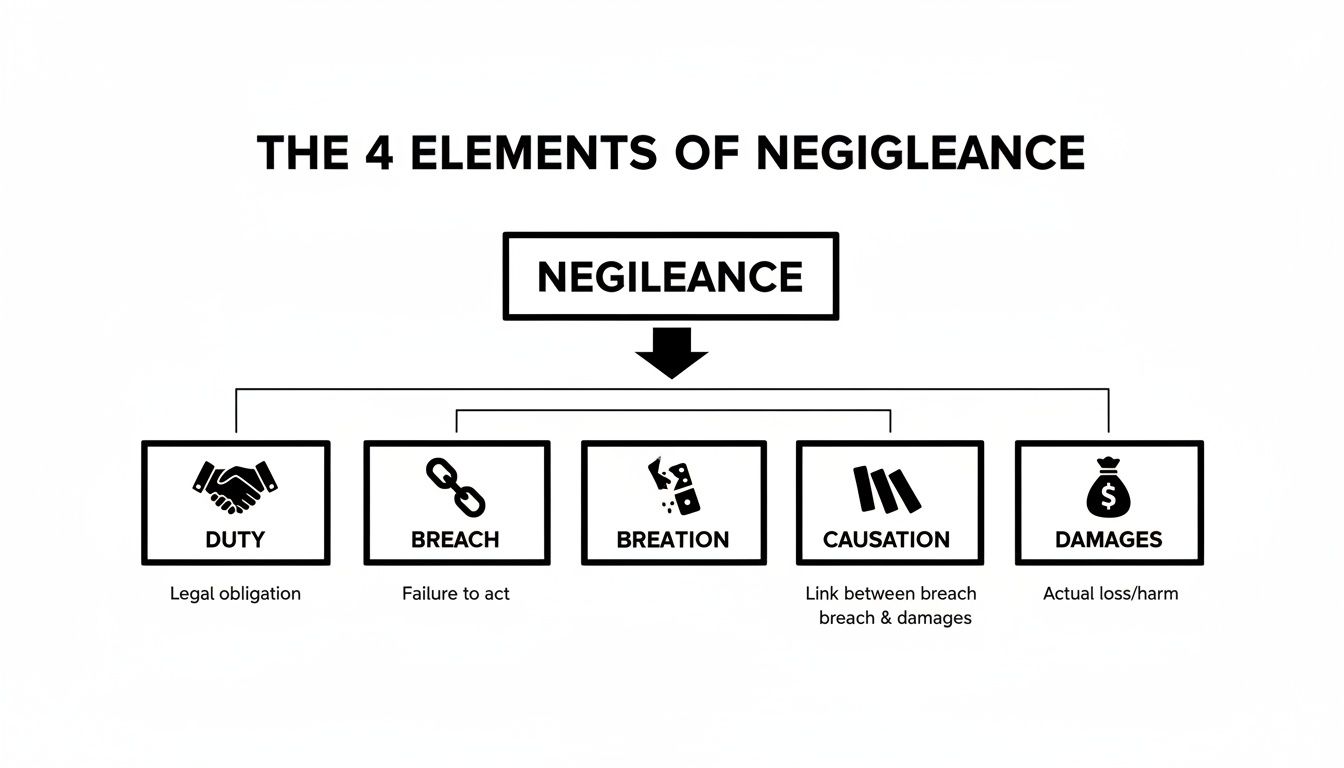
As you can see, a successful claim has to connect the dots from the duty owed all the way to the damages caused by the breach of that duty.
Negligence Per Se: When Breaking the Law is Proof Enough
Sometimes, a jury doesn't need to waste time debating what a "reasonable person" would have done. That's where negligence per se comes in. This legal shortcut applies when the negligent act is a direct violation of a public safety law.
Think of it this way: if a defendant breaks a law meant to protect a specific group of people from a certain kind of harm, and the plaintiff is in that group and suffers that exact harm, negligence is automatically assumed.
The clearest example in Texas car accidents is texting while driving. The state outlawed it for a reason: to prevent distracted driving crashes.
- The Violation: A driver is typing a text and blows through a stop sign.
- The Result: They T-bone a car that was legally crossing the intersection.
- The Connection: The driver broke the no-texting law, and that violation directly caused the exact kind of accident the law was created to stop.
In this scenario, the plaintiff's attorney doesn't have to prove the driver was being "unreasonable." The simple act of breaking that safety statute is the proof. The case then moves on to proving that this act caused the injuries and calculating the damages. Of course, the defendant still has options, which you can explore in our guide on defenses to negligence.
The real-world impact of these actions is staggering. In a single recent year, motor vehicle accidents resulted in 5.2 million injuries that required medical attention. Distracted driving alone—a classic example of negligence—was responsible for 3,308 deaths in just one year.
Comparing Key Kinds of Negligence
To put it all together, it's helpful to see these concepts side-by-side. The table below breaks down the key distinctions between the major types of negligence we've discussed.
| Type of Negligence | Driver's State of Mind | Example in a Car Accident | Impact on a Case |
|---|---|---|---|
| Ordinary | Inattention, carelessness, a simple mistake | Glancing at the radio for a few seconds and causing a rear-end collision. | The most common basis for a personal injury claim; allows for recovery of compensatory damages. |
| Gross | Conscious and voluntary disregard of an extreme risk | Driving 100 mph in a busy school zone, fully aware of the danger. | Can lead to punitive (exemplary) damages in addition to compensatory damages to punish the defendant. |
| Negligence Per Se | Irrelevant; the focus is on violating a safety law | Running a red light (violating a traffic law) and causing a T-bone crash. | The plaintiff doesn't have to prove the act was "unreasonable"; the violation itself establishes negligence. |
Understanding where a specific action falls on this table is often the first step in determining the strategy and potential value of a case. It’s the difference between a simple accident and an act of extreme recklessness.
How Texas Divides Blame with Comparative Negligence
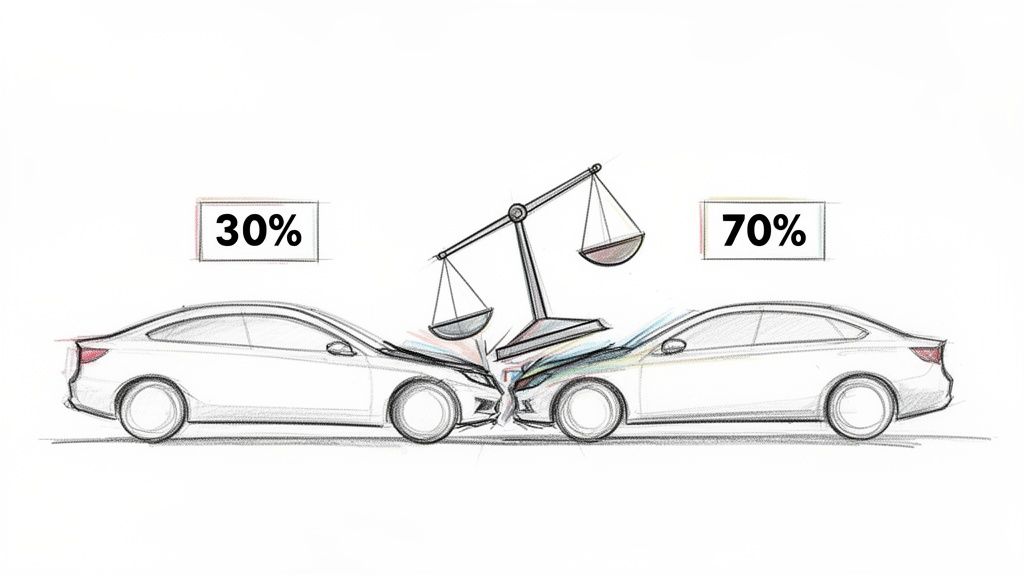
Accidents are rarely black and white. It’s almost never a simple case of one person being 100% wrong and the other being 100% right. More often than not, the actions of both drivers play a role, even if one person is clearly more to blame. This brings up a critical question: what happens if you were partially at fault for the crash that caused your own injuries?
This is where another key type of negligence, known as comparative negligence, comes into the picture. Texas law uses a specific version of this rule to figure out who pays what. It’s a system designed to be fair, but it comes with a strict cutoff that can make or break your entire case.
Understanding the Texas 51 Percent Bar Rule
Here in Texas, we operate under a "modified comparative fault" system. In the real world, we just call it the 51% bar rule. The rule itself is simple, but its impact on your ability to recover any money is huge.
Simply put, you can only get a financial recovery if your share of the blame is 50% or less. If a jury decides you were 51% or more responsible for what happened, you are legally barred from collecting any compensation. Not one penny.
This rule exists to stop someone who was mostly at fault from turning around and suing the other person for damages. It sets a very clear line in the sand: to have a valid claim, you have to be less responsible than the defendant.
This system is a cornerstone of Texas personal injury law, shaping how insurance adjusters, attorneys, and juries approach every negligence case.
How Fault Percentages Reduce Your Compensation
So, what happens if your fault is determined to be 50% or less? You can still recover damages, but the total amount you receive will be reduced by your exact percentage of blame. It's like a straightforward math problem applied directly to your settlement or verdict.
Let's walk through a practical example to make it crystal clear:
- The Scenario: You're driving a little over the speed limit. Suddenly, another driver blows through a stop sign and T-bones your car.
- The Damages: After hearing all the evidence, a jury calculates your total damages—medical bills, lost income, pain and suffering—at $100,000.
- The Blame Game: The jury then weighs everyone's actions. They conclude the other driver was the main cause for running the stop sign, but they also find that your speeding contributed to the crash. They assign 80% of the fault to the other driver and 20% of the fault to you.
Since your share of the blame (20%) is well under the 51% bar, you are still entitled to compensation.
To figure out your final award, you just subtract your percentage of fault from the total damages:
$100,000 (Total Damages) - 20% (Your Fault) = $80,000 (Your Final Award)
You would walk away with $80,000 instead of the full $100,000. But think about how different this would be if the jury decided you were 51% at fault. Your award would plummet from $49,000 (at 50% fault) straight to zero. This is exactly why the battle over percentages is one of the most intense parts of any car wreck lawsuit.
When Someone Else Is Responsible for the Driver's Actions
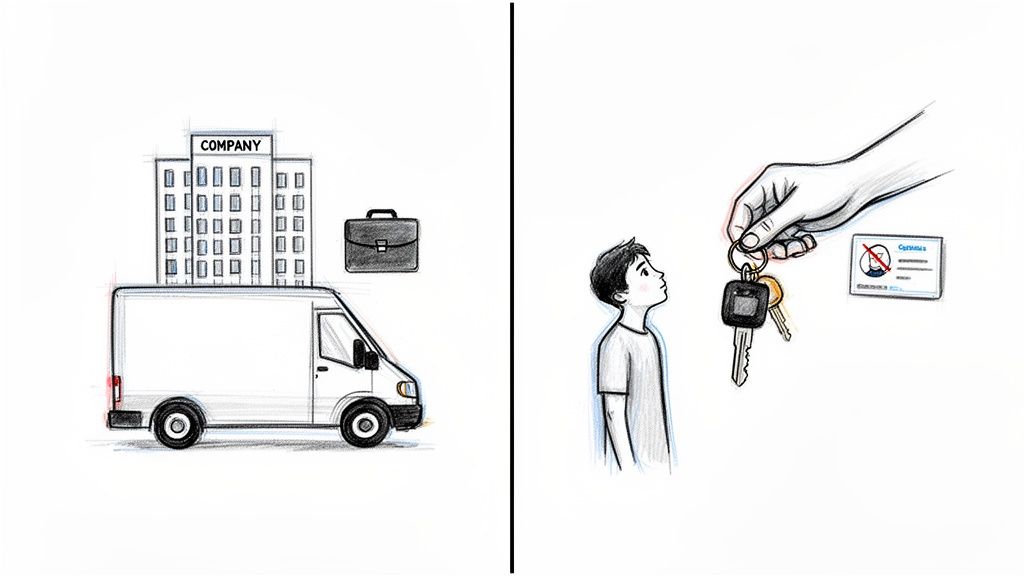
In a surprising number of car accidents, the chain of responsibility doesn't end with the person who was behind the wheel. The law has long recognized that in certain situations, a third party can be held legally accountable for a driver’s mistake. This is a game-changing concept for anyone injured in a crash, as finding every liable party is the key to getting the full and fair compensation you deserve.
Two of the most common ways this plays out are through vicarious liability and negligent entrustment. They might sound like dense legal jargon, but the core ideas are actually quite simple and grounded in common sense.
Vicarious Liability in Texas
Think of vicarious liability as a legal principle that makes one person responsible for the actions of another. The classic example is an employer and their employee. If a delivery driver causes a serious wreck while making their rounds, the company they work for can often be held liable for the damage.
The logic is that the employee was acting on the company's behalf—furthering its business interests—when the accident happened. Lawyers call this being in the "course and scope of employment."
This is a critical lifeline for accident victims. Why? Because a company usually has far more resources and much better liability insurance coverage than an individual driver, which can make all the difference when injuries are severe and medical bills are piling up.
Negligent Entrustment
Now, let's talk about negligent entrustment. This is a different kind of third-party fault. It happens when someone carelessly hands over a dangerous item, like a car, to a person they know—or should have known—was reckless, incompetent, or unfit to handle it.
Here, the fault isn't about what the driver did. It's about the owner's bad decision to give them the keys in the first place.
This concept is easier to understand with a few real-world scenarios:
- Loaning a Car to a Drunk Friend: Giving your keys to someone you can clearly see is intoxicated.
- Letting an Unlicensed Teen Drive: A parent knowingly lets their 15-year-old take the family car for a joyride.
- Ignoring a Bad Driving Record: Handing your car over to a friend who you know has a history of DUIs or a stack of speeding tickets.
A claim of negligent entrustment requires proving that the vehicle's owner was aware of the driver's incompetence but gave them permission anyway, and that this poor judgment directly led to the crash.
Connecting the Dots with Proximate Cause
Proving someone was careless is a big deal, but it’s only half the story in a negligence case. You also have to connect their specific action directly to the injury that occurred. This critical link is what we call proximate cause, and it’s the legal principle that keeps the scope of liability reasonable.
Think of it as a two-part test. To make a successful claim, you have to pass both parts. It’s not enough to show the defendant’s action was a cause; you have to prove it was the legal cause of the harm.
The "But-For" Test
First, we have to establish what lawyers call "cause-in-fact." The simplest way to do this is with the "but-for" test. You just ask: would the injury have happened but for the other person's action? If the answer is no, you've established a factual link.
It's pretty straightforward. A driver blows through a red light and T-bones another car. But for the driver running that light, the collision wouldn't have happened. That's cause-in-fact.
The Foreseeability Test
The second piece of the puzzle is foreseeability. This part is a bit more subjective. It asks whether a reasonable person in the same situation could have seen that this type of harm was a likely result of their actions. This is what stops the chain of liability from stretching into absurd, unpredictable scenarios.
Let's imagine a driver is speeding down a quiet neighborhood street and causes a minor fender-bender. The damage to the other car is absolutely a foreseeable result.
But what if the loud bang from the accident startles a bird, which then flies into a nearby power line, causing a surge that fries a computer two blocks away? The driver couldn't have possibly predicted that. The chain of events is just too bizarre and remote to hold them legally responsible for the broken computer.
To establish proximate cause, you must show the injury was a natural and direct consequence of the negligent act, without any intervening event breaking the chain of causation.
This concept is essential across all kinds of negligence, from a simple car wreck to a complex medical malpractice lawsuit. The global medical negligence market hit USD 4.5 billion in 2023 and is expected to reach USD 7.8 billion by 2032, according to some reports. Check out this article on the worldwide impact of medical errors for more context.
Cases like these hinge on drawing a clear, provable line from a doctor's mistake to the patient's injury. Proving that connection often requires highly specialized evidence, which is why it's so important to understand what expert witness testimony is and how it works.
Common Questions About Negligence in Texas
If you’re trying to make sense of things after a car wreck, you’re not alone. The legal side can be confusing, so let's clear up some of the most common questions we hear about the different kinds of negligence in Texas.
What’s the Real Difference Between Ordinary and Gross Negligence?
Think of it like this: ordinary negligence is a simple mistake, a momentary lapse in judgment. It’s the driver who glances down to change the radio station and drifts out of their lane. They didn't intend to cause harm, but their failure to pay attention still led to an accident.
Gross negligence, on the other hand, is a whole different level of carelessness. It’s when someone acts with such a blatant and extreme disregard for the safety of others that you have to wonder what they were thinking. Street racing on a busy highway is a classic example.
The distinction is critical because a finding of gross negligence opens the door to punitive damages—money awarded specifically to punish the defendant for their reckless actions.
What Happens If I'm a Little Bit at Fault for the Accident? Can I Still Recover Money?
Absolutely, as long as you aren’t mostly at fault. Texas operates under a rule called “modified comparative fault,” which you’ll often hear referred to as the 51% Bar Rule.
Here's how it works: If a jury decides you are 51% or more responsible for the crash, you get nothing. But if your share of the blame is 50% or less, you can still collect damages. Your final award is just reduced by your percentage of fault. For instance, if you were awarded $100,000 but found to be 20% at fault, you’d walk away with $80,000.
Getting a realistic assessment of your own potential fault is one of the most important steps in valuing your claim. It directly shapes your negotiation strategy with the insurance company.
Is There a Deadline to File a Negligence Lawsuit in Texas?
Yes, and it's a strict one. In nearly all Texas personal injury cases, you have two years from the date of the wreck to file your lawsuit. This deadline is called the statute of limitations.
If you miss that two-year window, the courthouse doors will almost certainly be closed to you forever, no matter how strong your case is.
What Kind of Evidence Do I Need to Prove Negligence?
Proving any type of negligence boils down to having solid evidence. You can’t just say the other driver was careless; you have to show it. Some of the most powerful pieces of evidence include:
- The official police report: This contains the officer's initial observations and findings.
- Photos and videos: Document everything—the scene, the damage to all vehicles, and your injuries.
- Eyewitness statements: Independent accounts from people who saw what happened can be incredibly persuasive.
- Dashcam or surveillance footage: This kind of objective evidence is often the key to locking down what really happened.
This collection of evidence is what you'll use to establish the four pillars of a negligence claim: duty, breach, causation, and damages.
Navigating these rules requires more than just legal theory—it requires real-world data. Verdictly gives you a look behind the curtain at actual Texas motor vehicle verdicts and settlements, so you can compare your case to similar ones in your specific county. Find out what cases like yours are truly worth by exploring our database at https://verdictly.co.
Related Posts
Calculating pain and suffering car accident: A Practical Guide to Damages
Learn how calculating pain and suffering car accident damages works, with factors and tips to maximize your settlement.
How to guide: how to negotiate with insurance adjuster
Learn how to negotiate with insurance adjuster effectively to maximize your settlement, protect your rights, and avoid common claim pitfalls.
How to Prepare for a Deposition A Texas Motorist's Guide
Learn how to prepare for a deposition with our guide for Texas motorists. Get expert tips on telling your story, handling questions, and using technology.