

How To Prove Pain And Suffering With Compelling Evidence
Learn how to prove pain and suffering with practical evidence methods, real‐world examples, and expert tips to strengthen your personal injury claim.
Gathering Core Evidence For Pain And Suffering
Building a solid claim starts with tracking every detail. Medical reports, personal pain journals, witness observations and expert opinions work together to reveal the real impact of an injury. When you know what to collect and when, your case tells a compelling story.
Why Medical Records Matter
Medical files turn subjective discomfort into documented facts. Every consultation note, prescription refill and therapy session adds a layer:
- Consultation Summaries chart symptoms, treatments and professional judgments
- Imaging Reports (X-rays, CT scans, MRIs) show the physical roots of pain
- Medication And Therapy Logs confirm ongoing care
In one case, a claimant saw a 30% increase in non-economic damages after securing prompt MRI scans and keeping a day-by-day pain log. That jump underscores how detailed records shape valuations.
“Clear medical documentation bridges subjective complaints and hard evidence.”
In the United Kingdom, catastrophic motor injury payouts can be eye-opening. Claims involving tetraplegia average over £6 million, with 72.69% of that covering non-economic losses. Read more about UK compensation findings here
Keeping A Detailed Pain Journal
A concise daily log takes minutes but delivers powerful proof. Jot down:
- Pain levels on a 0–10 scale
- Medication times and dosage
- Activity limits or trigger notes
- Quick photos of mobility aids or impacted tasks
Timestamp each entry to reinforce credibility. Over time, this journal becomes the backbone for non-economic damage estimates.
Leveraging Witness Statements And Expert Reports
Outside voices bring your struggles into focus. Family members, friends or coworkers can share what they see:
- Signed statements on mood swings or mobility changes
- Therapist evaluations outlining long-term care needs
- Life-care planner reports projecting future expenses
A mock deposition can prep experts and ensure their testimony aligns with your narrative. Linking these observations to journal entries or imaging creates a clear, relatable timeline.
This screenshot highlights key legal interpretations and the scope of compensable harm.
Key Evidence Types For Proving Pain And Suffering
Below is a quick look at the evidence categories that matter most. Use this as a reference when building your file.
| Evidence Type | Purpose | Typical Impact |
|---|---|---|
| Medical Records | Show diagnostic findings and treatment history | Base valuation for harm |
| Pain Journal | Document daily pain levels and routines | Boosts credibility and detail |
| Witness Statements | Provide third-party observations of suffering | Humanizes claim |
| Expert Reports | Offer professional opinions on prognosis and need | Strengthens long-term damage claim |
Every category reinforces the others. Together, they paint a vivid portrait of pain and loss.
Next Steps For Your Documentation
- Request all medical files within the first month after injury
- Set daily reminders for journal entries and photo updates
- Schedule interviews and collect signed witness statements
- Engage experts early to agree on report deadlines
Once your file is complete, compare similar cases on Verdictly to gauge realistic award ranges and demonstrate your due diligence.
Establishing A Persuasive Narrative
Facts have the greatest impact when they flow like a story. Start with the moment of injury, follow through treatments and end on everyday hurdles. This chronological approach guides jurors or adjusters through your experience:
- Blend vivid personal details with hard data for emotional resonance
- Tie each witness statement back to a journal note or medical finding
- Highlight turning points, like a treatment milestone or a flare-up
In the end, your goal is a seamless narrative that balances technical proof with the human side of suffering.
Gathering Medical Evidence And Documentation
Medical records serve as the foundation of any strong pain and suffering claim. If you can’t show clear, dated proof of your injuries, adjusters will treat your case like guesswork instead of fact.
Right after an ER or urgent care visit, make it a priority to request full hospital charts. That includes intake notes, surgeon observations and discharge plans. Submitting HIPAA Authorizations without delay can shave weeks off your waiting time.
When you get diagnostic images, record the modality and date. An MRI or CT scan within 48 hours of trauma often reveals acute damage that other tests miss. Also, note provider contact info and record numbers for quick follow-ups.
- HIPAA Authorizations: Sign and send release forms to each facility immediately.
- Monitor Requests: Track request dates and expected delivery windows.
- Verify Files: Confirm that every page of the chart is included, from nursing notes to lab results.
Secure Hospital Charts With Timeline
A six-month roadmap helps you pace record collection without scrambling at the last minute. Think of it as a series of checkpoints:
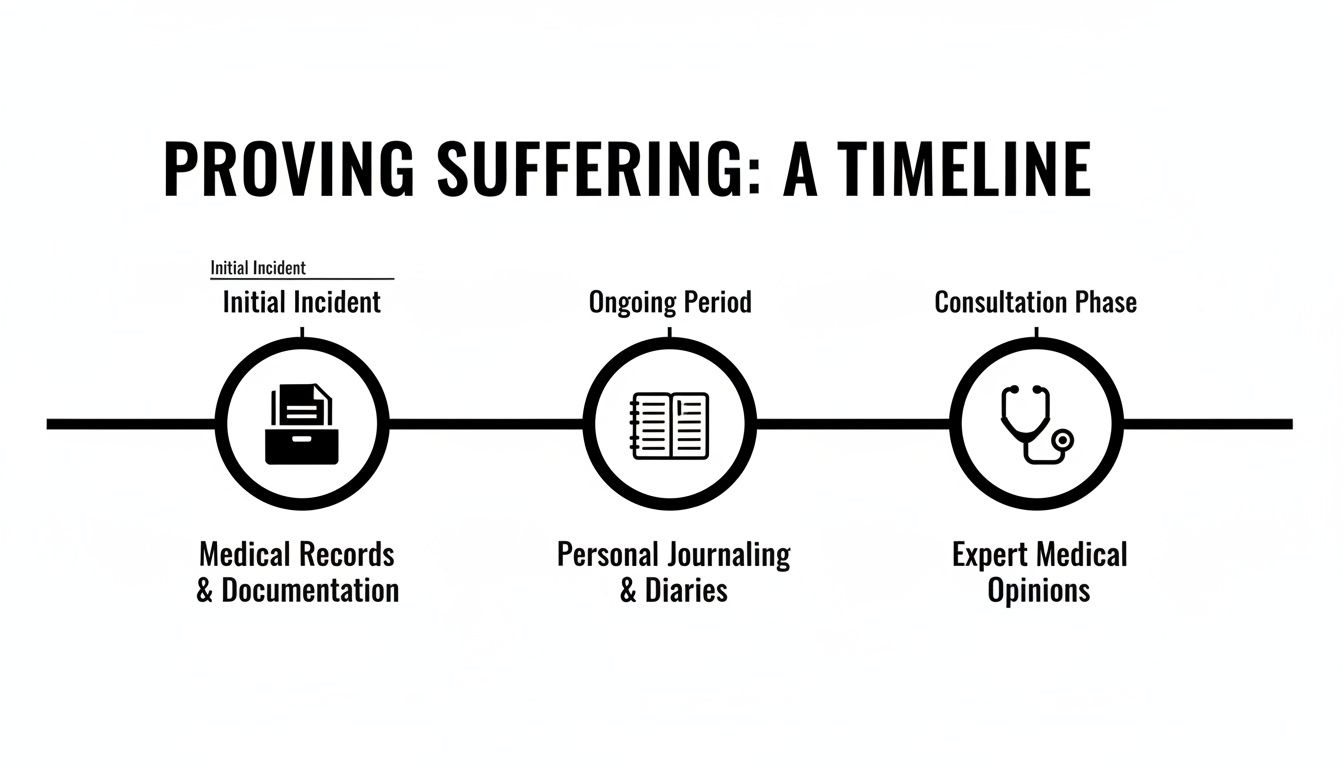
| Month | Focus Area |
|---|---|
| Month 1 | ER records + trauma surgeon notes |
| Month 2 | MRI, CT scans + lab findings |
| Month 3 | Start daily pain logs (timestamped) |
| Months 4–6 | Psychological evaluations + expert referrals |
German courts, for example, now award over €1 million in extreme cases—thanks to exhaustive medical documentation and neurodevelopmental assessments. For more on European compensation trends, see Leuphana.
Track Pain Scale And Psychological Reports
Turning subjective pain into measurable data builds credibility. Use a standard 0–10 pain scale or a tool like the McGill Pain Questionnaire.
- Daily Logging: Record pain level, mood and activity limits twice a day.
- Attach Evidence: Include short videos or photos of mobility aids in use.
- Mental Health Notes: Ask counselors to provide brief letters on anxiety, depression or PTSD symptoms.
This combination of physical and emotional records makes your narrative far more persuasive.
Collaborate With Nurses And Techs
Front-line staff often catch details you might miss. After each session, have a nurse or tech review your logs for gaps—wound care complications or therapy setbacks can be crucial.
Best practices for collaboration:
- Download progress notes through patient portals as soon as they post
- Schedule quick check-ins with a case manager or nurse coordinator
- Keep a shared spreadsheet tracking each record’s status and follow-up reminders
Proactive engagement with medical teams helps uncover overlooked data and demonstrates diligence.
Finally, gather surgeon follow-up notes and rehab summaries to capture long-term progress or setbacks. Label every document by date and provider to streamline retrieval and speed up legal review.
By following this approach, you’ll assemble a comprehensive “evidence web” that clearly maps out your health journey—your strongest tool for proving pain and suffering in negotiations or courtroom proceedings.
Documenting Personal Impact And Lay Support

Numbers on a chart tell one story. Personal notes show the real toll. A quick pain journal—under five minutes each evening—bridges that gap, tying medical data to daily life.
Keeping a log like this boosts credibility. Suddenly, discomfort isn’t just hearsay; it becomes a series of concrete events. And those specifics can make your case hard to ignore.
- Time-Stamped Entries: Capture exactly when pain spikes or meds start working
- Trigger Notes: Link an activity—like climbing stairs—to a flare-up
- Medication Logs: Document doses and relief levels for clarity
- Photo Logs: Snap images of limps, braces or swelling at precise moments
Creating A Quick Pain Journal
Start with a simple note on your phone. Then:
- Date and precise time
- Pain level on a 0–10 Scale
- Activity you attempted or avoided
- Medication name and dosage
“A concise pain journal entry can increase non-economic valuations by 25%,” says one seasoned claims adjuster.
Keep each entry to a couple of bullet lines. For instance:
“July 12, 10:15 AM – Walked 30 steps, pain 7/10, took 10 mg ibuprofen, rested 20 min.” This makes it easy to skim, share with experts, and spot patterns.
Gathering Family And Coworker Statements
Stories from people around you add a human touch. Ask a sibling or roommate what changed—maybe you stopped playing with the kids or couldn’t carry groceries. At work, a colleague might recall you missing a deadline or wincing at your desk.
Best practices:
- Ask open questions: “What did you notice about my pace on the stairs?”
- Focus on one incident per statement
- Have each person sign and date their note
- Record short audio clips for added authenticity
Blockquote these snippets in your brief. They break up dense text and let jurors hear real emotion.
Preserving Digital Evidence
Your phone is full of proof. Screenshots of a friend’s “Can you make brunch?” or a canceled calendar invite illustrate social setbacks.
| Evidence Type | Use Case |
|---|---|
| Text Messages | Notifying missed appointments |
| Social Media Posts | Photos showing limited mobility |
| Voice Memos | Real-time descriptions of pain |
| Calendar Screenshots | Canceled events and therapy sessions |
Keep everything in dated folders. Consistent file names make review a breeze and prevent any record from slipping through the cracks.
Expert Insight
Pairing photos with journal entries helps jurors and adjusters truly feel the impact.
Integrating Lay Support With Medical Records
Tie each personal statement back to a medical note. A summary matrix is invaluable here: match your pain journal dates with prescription refills, family statements with physical therapy records, and social media timestamps alongside doctor’s visits.
- Link pain spikes to refill dates
- Align witness accounts with clinic notes
- Cross-reference digital timestamps with appointment records
This crosswalk turns scattered details into a cohesive narrative. It shows consistency—and that consistency strengthens your ability to prove pain and suffering.
Putting these steps into practice takes minutes each day but pays off hugely in negotiations or trial. Use Verdictly benchmarks to estimate realistic award ranges and demonstrate your thorough research.
Tip Gather your records early so you can spot any gaps before you file your claim.
Working With Experts And Legal Professionals
Putting together the right team can turn a standard claim into a compelling narrative. It all starts with choosing experts whose backgrounds speak for themselves—doctors, life-care planners, psychologists. When their insights align perfectly with your case, adjusters and jurors sit up and take notice.
I’ve seen too many firms leave experts in the dark with vague instructions. That misstep often leads to costly revisions. Instead, take these practical steps:
- Verify Credentials: Check medical licenses, peer-reviewed articles, and any specialty board certifications.
- Review Past Testimonies: Watch or read previous depositions to gauge how the expert communicates under pressure.
- Conduct A Pre-Engagement Chat: A quick call helps you confirm that their report style is clear, concise, and tailored to your courtroom needs.
Writing Effective Scopes Of Work
A crisp, detailed scope of work is your roadmap. Spell out the questions you need answered—how pain flares up in daily activities, projected treatment costs, or changes to a client’s lifestyle. Clarity here saves valuable hours later on.
For example, one Texas practice switched to bullet headers and numbered tasks. The result? They cut expert review time in half.
Expert Insight: Clear scopes reduce revision rounds by up to 50% in many law firms.
Sharing Evidence Efficiently
When records, daily journals, and preliminary reports live in one well-organized folder, everyone wins. I recommend using a cloud folder with subfolders named for each expert’s specialty—no more hunting through endless email threads.
To fine-tune your process:
- Bundle Documents: Group medical records, cost projections, and client journals in a single PDF, with clear bookmarks.
- Prep Mock Questions: Draft pain-and-activity-focused questions so experts see exactly what you need.
- Hold Rehearsals: Run through timelines and key facts, then gather feedback to refine the scope before it goes final.
In one case, a life-care planner initially overlooked linking care expenses to specific flare-up dates. A simple exhibit table cross-referencing journal entries and cost estimates fixed the gap instantly.
Engaging Experts Early
Waiting until deadlines loom forces last-minute scrambles and missed nuances. Reach out as soon as your core medical evidence is in place—ideally within six weeks of intake. This gives experts enough time to:
-
Develop detailed prognoses for future care
-
Tailor non-economic damage analyses to your client’s unique story
-
Review and revise without speeding through critical details
-
Check out our guide on expert witness testimony for a deeper dive into roles and report standards: Learn more about expert testimony basics
Coordinating Multidisciplinary Teams
Imagine life-care planners, psychologists, and medical experts all on the same page, speaking in one unified voice. That cohesion prevents siloed reports and narrative gaps.
Here’s a quick coordination checklist:
- Confirm Each Expert’s Report Deadline and cloud access
- Standardize Terminology: Agree on how to describe pain levels, treatment phases, and future needs
- Cross-Reference Evidence: Ensure everyone cites the same journal entries, imaging dates, and cost figures
- Host A Final Call: Resolve any inconsistencies before the reports go on record
Final Checks And Best Practices
Before you file, give every expert report a final review. Look for labeled images, dated charts, and clear links between documented pain and your damage theory. The smallest detail can shift a valuation significantly.
In one Dallas case, an early psychologist report increased non-economic damages by 20% by tying PTSD assessments directly to daily journal entries.
That example shows how synchronized expertise and personal records form an unshakeable foundation. As a last step:
- Reconcile Expert Invoices: Match fees against delivery timelines to keep budgets on track
- Maintain A Master Evidence Log: Tie each report back to your case themes for quick reference
- Use Trial Software: Display expert exhibits in a visual timeline that tells your client’s story at a glance
When you master these elements, what started as scattered documents becomes a persuasive, unified narrative. Your expert team is more than support—it's the engine that powers a compelling proof of pain and suffering.
Estimating Non-Economic Damages And Using Benchmark Data
Putting a dollar sign on pain and suffering can feel like guesswork, but context brings clarity. By weaving in credible comparators and court decisions, you present a demand that’s tough to ignore.
Early on, tap into Verdictly data alongside landmark rulings. That combination gives you a defensible range rather than a shot in the dark.
Imagine two similar whiplash claims—one in Paris, another in Madrid. The Paris case landed around €50,000 total, with 45% earmarked for pain and suffering. In Madrid, nearly 52% of a €65,000 settlement covered non-economic harm.
- Severity dictates the curve: a prolonged recovery pushes you toward the upper end.
- Emotional distress, like PTSD, can spike your percentage even further.
- Interference with daily routines—lost hobbies or chores—justifies a loftier figure.
A well-researched benchmark range stops adjusters from simply shrugging off your numbers.
Building Credible Valuation Ranges
Start by pulling raw verdicts from Verdictly’s benchmark tool. Filter by jurisdiction, injury type and year to spot true comparators.
Use those median and upper-quartile values to craft a transparent narrative in your demand letter. You’re not guessing—you’re mirroring results that real cases have produced.
Compensation Benchmarks Across Europe
Below is a snapshot of non-economic damage awards for catastrophic injuries in key markets. This table highlights regional tendencies and helps you fine-tune your figures.
| Country | Average Award | Non-Economic % | Benchmark Source |
|---|---|---|---|
| France | €50,000 | 45% | Court of Paris |
| Spain | €65,000 | 52% | Madrid Ruling |
| Germany | €75,000 | 50% | BGH Decisions |
| Italy | €60,000 | 48% | Rome Tribunal |
This table makes it easy to see how awards shift from one country to another. When you show these side-by-side, adjusters recognize you’ve done the math.
Applying Cross-Border Benchmarks
Juxtaposing Europe’s averages with U.S. numbers creates powerful leverage. For instance:
- France’s median of €45,000 often skews conservative.
- Spain sits higher at €60,000, reflecting broader empathy for non-economic harms.
- In Texas, the median climbs to around $80,000, thanks to jury proclivities.
Scale these figures for local cost-of-living and inflation to land on a precise range.
In one sciatic-injury case, the claimant anchored her demand between €70,000 and €90,000. Highlighting a €75,000 French award and an €80,000 Spanish average persuaded the insurer to boost their offer by 20%. That real-world win underscores how benchmarks fuel negotiations.
When you’re ready to draft your demand letter, check out our guide on pain and suffering settlement amounts for realistic valuation strategies Check out our guide on pain and suffering settlement amounts.
Key Takeaways
- Lean on Verdictly and court rulings to frame non-economic damages.
- Tailor your range by injury severity, emotional impact and regional trends.
- Always cite your data—objective context neutralizes lowball tactics.
Grounded, well-sourced figures not only prove pain and suffering—they secure the settlement you deserve.
Negotiation Strategies And Litigation Tips
Before you sit down at the negotiation table, build your case around solid facts and genuine human stories. Blend medical records with personal anecdotes—like how chronic pain ended your morning jog—to keep adjusters engaged and honest.
If you need a deeper dive on crafting that letter, check out How to Write a Settlement Demand Letter.
Adjusters see dozens of demands each week. Clear, scannable formats stand out:
- Use headings such as Injury Overview or Treatment Chronology
- Keep paragraphs under five lines
- Highlight key figures in bold—3 MRI scans, 5 therapy sessions
Crafting A Persuasive Demand Letter
Opening with a human touch sets the tone. Try: “After the crash on March 12, daily tasks like lifting a coffee cup became a struggle. My medical reports, treatment logs, and journal entries document each setback.” This balances empathy with authority.
Use bullet points to boost clarity:
- Total medical expenses now and projected future costs
- Non-economic losses (lost hobbies, sleep disruptions)
- Visuals—photos of injuries or a mini timeline
- A clear settlement range and response deadline
“Concise exhibits and a human story within a demand letter increase settlement offers by at least 15%,” says a senior claims adjuster.
One client saw a 20% jump in their offer after embedding an interactive PDF timeline of their physical therapy journey.
Handling Adjuster Pushback
Lowball offers and extra-documentation requests are par for the course. When that happens:
- Refer to key facts with exact page citations
- Send a brief fact sheet summarizing open issues
- Schedule a 10–15 minute call to walk through major exhibits
Combining written records with a quick verbal review keeps momentum and prevents stalls. For instance, walking an adjuster through an MRI image can clear up unseen details on the spot.
Firm boundaries matter. Say, “Our settlement threshold is based on comparable verdicts of $80,000 to $100,000 for similar injuries.” Pull those numbers directly from Verdictly benchmarks to add weight.
When To Mediate Or Move To Court
Bringing the case to pre-suit mediation often speeds things up—especially if both sides want to avoid litigation costs. But if the insurer won’t budge past 70% of your bottom-line demand, it’s time to talk filing suit.
A concise jury-focus statement can preview live testimony powerfully. Keep it under 100 words and highlight vivid pain anecdotes alongside expert projections.
| Strategy | Best Use Case | Risk Reduction |
|---|---|---|
| Written Demand Letter | Initial negotiation | Low |
| Pre-Suit Mediation | Cooperative adjusters | Moderate |
| Jury-Focus Statement | High non-economic claims | High engagement |
| Filing Suit | Impasse after negotiations | Litigation costs |
A clear exit strategy prevents endless back-and-forth. Know your bottom line and timeline, then choose between court or a pragmatic settlement.
Stay persistent.
Common Questions About Proving Pain And Suffering
Which Pain Journal Style Works Best For Adjusters?
Adjusters respond well when your journal feels effortless and clear. Consistency is key—your entries should look like part of your routine, not extra homework.
- Track date and time alongside your pain rating.
- Jot down activities or triggers that may have caused discomfort.
- Record each medication, its dose, and how much relief it offered.
- Optionally, snap a timestamped photo of any braces or mobility aids.
"Consistent entries boost credibility and can increase awards by 25%."
How Do I Choose The Right Expert Witness?
A strong expert isn’t just about impressive credentials. You want someone who can break down complex medical details in plain language and remains responsive throughout your case.
- Verify they’ve testified in cases like yours.
- Request sample reports to ensure clarity and depth.
- Have a quick call to assess their communication style.
Can I Use Social Media Posts To Prove My Suffering?
Yes—but only if you preserve authenticity and context. Treat your social channels like another piece of evidence.
- Capture screenshots that clearly show dates.
- Secure metadata with a preservation affidavit.
- Link your posts back to real-life events or tasks you couldn’t complete.
When Should I Introduce Benchmark Data In Negotiations?
Early. Presenting benchmark figures at the outset sets realistic expectations and discourages lowball offers.
- Compare your injury severity against median and upper-quartile verdicts.
- Pull relevant cases from your jurisdiction for added weight.
- Show how your facts align with those benchmarks.
Tip: Ground data in solid examples to reinforce credibility.
For example, mentioning a €50,000 award for whiplash in Paris alongside a $80,000 verdict in Texas illustrates a realistic range.
Link to Verdictly for up-to-date median values when building your demand.
Final Thoughts On Proving Pain And Suffering
Combining a detailed pain journal, trustworthy experts, and well-researched benchmarks creates a powerful narrative for non-economic damages. Present everything clearly—adjusters will take notice and often respond with stronger offers.
Explore real verdicts in Texas motor vehicle cases and settle confidently with Verdictly at Verdictly powering negotiations. Review median and upper-quartile ranges today.