
Calculating Pain and Suffering: calculating pain and suffering in Texas
Learn how to calculate pain and suffering damages in a Texas car accident. See key factors and how calculating pain and suffering affects your claim.
When you're hurt in a car crash, the financial hit goes way beyond the obvious medical bills and car repairs. There's a very real human cost to your injuries—the physical pain, the emotional fallout, and the way your entire life gets turned upside down. In legal terms, this is all bundled under "pain and suffering."
Unlike a hospital bill, there’s no price tag on this kind of harm. It's subjective, but that doesn't mean it's a complete guess. Experienced attorneys and insurance adjusters use established methods to put a number on it, and understanding how they do it is the first step toward a fair settlement.
Understanding Pain and Suffering in a Texas Injury Claim
After a wreck, it's easy to focus on the costs you can see: the stack of bills from the ER, the lost paychecks from missed work. These are called economic damages because they have a clear dollar amount attached.
But the real, lasting impact of a serious accident often comes from the things you can't put on a spreadsheet. This is where non-economic damages—what most people call pain and suffering—come in. They're designed to compensate you for the physical and emotional toll the accident has taken on your life. It’s a broad term, but it covers a lot of ground.
What Does Pain and Suffering Include?
This isn't just about the immediate ache from an injury. The goal is to account for the total blow to your quality of life, which can include a wide range of personal hardships.
- Physical Pain: This covers everything from the initial trauma of the injury to the chronic, nagging pain that might stick with you for months or even years.
- Mental Anguish: Think about the anxiety, fear, depression, or sleepless nights that often follow a traumatic event. In severe cases, this can include Post-Traumatic Stress Disorder (PTSD).
- Loss of Enjoyment of Life: This is about your inability to do the things that once brought you joy. Maybe you can no longer play golf with your friends, lift your grandkids, or work in your garden. It’s a real, tangible loss.
- Physical Impairment and Disfigurement: Lasting impacts like a permanent limp, visible scarring, or the loss of a limb carry a heavy psychological weight long after the physical wounds have healed.
The emotional and psychological trauma can be just as debilitating as the physical injuries, often requiring specialized support for mental health recovery after a motor vehicle accident.
Key Takeaway: Documenting these impacts is absolutely critical. Keeping a simple daily journal about your pain levels, emotional struggles, and the activities you can no longer do can become incredibly powerful evidence for your claim.
Economic vs Non-Economic Damages at a Glance
To really get a handle on your claim's potential value, you need to understand how these two categories of damages work together. Insurance companies and lawyers separate them to build a complete picture of your losses.
Here's a straightforward breakdown:
| Damage Type | What It Covers | Examples |
|---|---|---|
| Economic Damages | Direct, verifiable financial losses you suffered because of the accident. | Medical bills, lost wages, vehicle repair costs, future medical expenses. |
| Non-Economic Damages | Subjective, non-monetary losses related to the human impact of the injury. | Physical pain, emotional distress, loss of consortium, permanent disfigurement. |
Seeing them side-by-side makes it clear: one is about what you paid out, and the other is about what you went through. A fair settlement has to account for both.
How Are Pain and Suffering Awards Actually Calculated?
When it comes to putting a dollar figure on pain and suffering, there’s no magic formula. It’s not like there's some official calculator that spits out a number. Instead, attorneys and insurance adjusters fall back on a few established methods to translate a very personal, human experience into a monetary value that can be used for negotiation.
The whole point is to bring some objectivity to an inherently subjective loss. This gives everyone a starting point for settlement talks. The two frameworks you’ll see most often are the multiplier method and the per-diem method. They get to the same place but from different directions, and the right one often depends on the specifics of the case.
The Multiplier Method: The Go-To Approach
By far, the multiplier method is the one most frequently used in Texas car accident claims. The logic behind it is pretty straightforward: your intangible damages (pain and suffering) should be proportional to your concrete, calculable financial losses.
First, you tally up all your economic damages. This is the hard-number stuff—every medical bill, lost paycheck, and out-of-pocket expense you've incurred because of the accident. Once you have that total, you multiply it by a number, which typically falls somewhere between 1.5 and 5.
Where your case falls on that scale depends entirely on the details.
- A 1.5x multiplier might be appropriate for a minor sprain with a quick recovery.
- A 3x multiplier could be justified for a more serious injury, like a broken arm that needed surgery and a few months of physical therapy.
- A 5x multiplier (or even higher) is generally reserved for catastrophic cases involving permanent disability, chronic pain, or significant disfigurement.
The key is that the multiplier has to be defensible. We have to be able to point to specific facts to justify it—the severity of the collision, how long your recovery took, whether the injury is permanent, and how dramatically your life was disrupted.
For a deeper dive into the mechanics, you can read more on how to calculate pain and suffering damages in Texas.
This chart gives you a quick visual of how your concrete economic damages stack up against the non-economic damages we're trying to value.
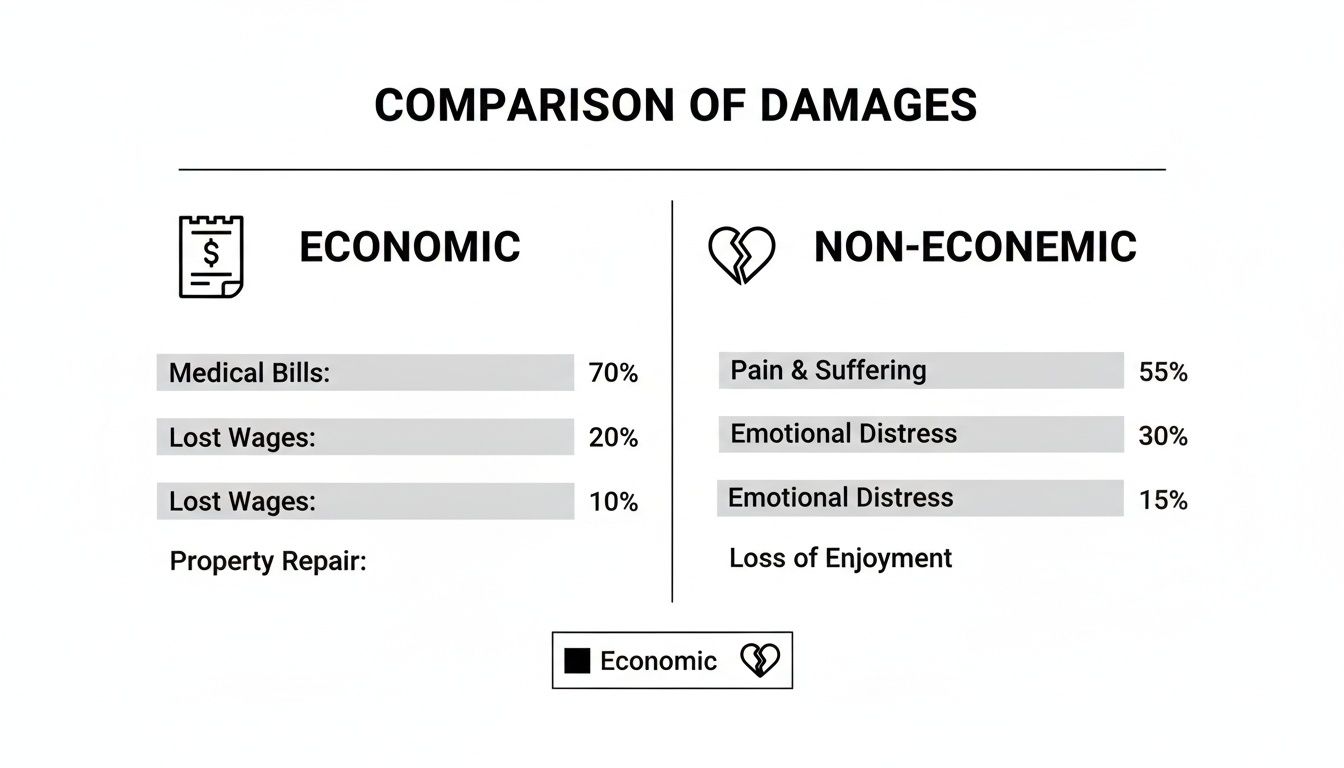
As you can see, the economic damages form the foundation. The multiplier method then builds upon that foundation to account for the human cost of the injury.
A Real-World Example of the Multiplier Method
Let’s walk through a common scenario. Imagine you were rear-ended in Fort Worth and ended up with a herniated disc requiring surgery.
- Your Medical Bills (so far): $15,000
- Your Lost Wages: $5,000
- Total Economic Damages: $20,000
Given the invasive nature of the surgery and the long road of physical therapy ahead, your attorney might argue that a multiplier of 3.5 is fair and reasonable.
The math would look like this: $20,000 (Economic Damages) x 3.5 (Multiplier) = $70,000 in pain and suffering.
This brings your total initial settlement demand to $90,000 ($20,000 + $70,000). This isn't just a random number; settlement data often supports this kind of valuation, showing that moderate injuries in this economic range frequently land in that 1.5 to 2.5 multiplier territory or higher, depending on the specifics.
The Per-Diem Method: A Day-By-Day Approach
Though less common, the "per-diem" method is another tool in the negotiator's toolbox. The name is Latin for "per day," and that’s exactly how it works. We assign a daily dollar value for your suffering for every single day from the accident until you reach what doctors call maximum medical improvement (MMI).
Maximum Medical Improvement (MMI): This is the clinical term for the point when your condition has stabilized and you're not expected to get any better. It doesn't mean you're 100% healed—it just means you've recovered as much as you're going to.
The daily rate needs a solid justification. A common way to anchor this number is to tie it to your daily earnings. The argument is simple: if you earn $200 a day at your job, then enduring the pain, limitations, and stress from your injury each day is worth at least that much.
So, if your recovery took 150 days to reach MMI, the calculation is straightforward:
150 days x $200/day = $30,000 in pain and suffering.
This method works best for injuries that have a clear and finite recovery period. It loses its punch when dealing with permanent or long-term injuries because, well, how do you put an "end date" on a lifetime of pain? For any method, having a solid benchmark is crucial, which is why we built a free compensation calculator for car accident cases that draws from real Texas jury verdicts and settlements.
The Key Factors That Drive Your Settlement Value
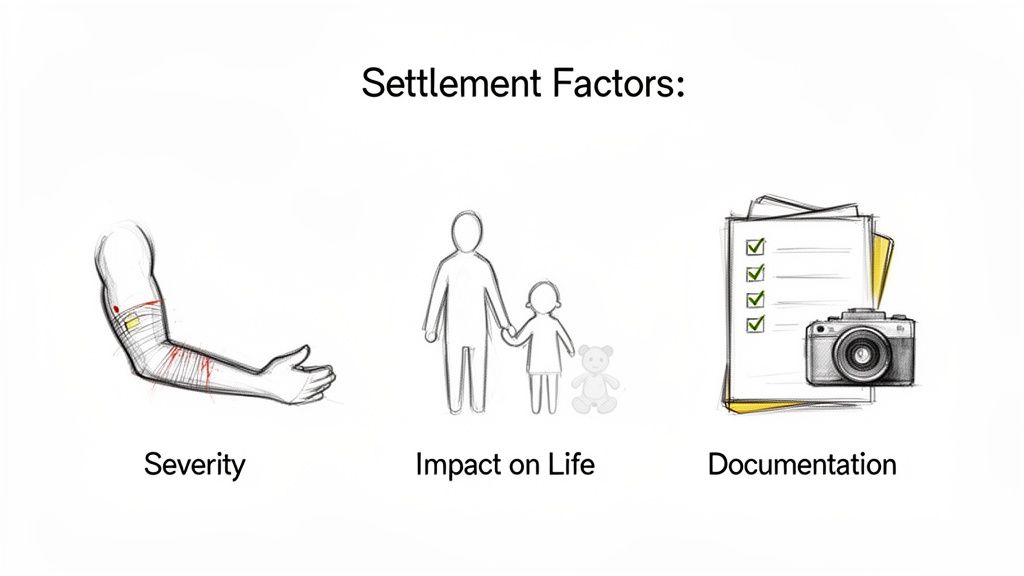
It’s a huge mistake to think that two accidents with the same medical bills will get the same settlement offer. That’s just not how it works. The numbers on your medical invoices and lost wage statements are only the beginning of the story. The real value of your pain and suffering claim is found in the personal details of what you’ve been through.
An insurance adjuster—or a jury, if it comes to that—doesn’t just see a bill for a spinal fusion. They hear the story of a father who can no longer pick up his toddler. They don’t just see a receipt for physical therapy; they imagine the daily frustration of an avid runner who now struggles just to walk around the block.
These are the human elements that give your claim weight. Understanding them is crucial because they directly influence the multiplier an adjuster might use or the daily rate they'd consider reasonable. They provide the "why" behind a higher settlement number.
Injury Severity and Permanence
Without a doubt, the single biggest driver of your claim's value is the injury itself. A whiplash injury that clears up in six weeks is never going to be valued the same as a traumatic brain injury with lifelong cognitive problems. It's just a different reality.
Insurance companies and juries put a high premium on objective injuries—the kind that can be seen on an MRI, X-ray, or CT scan. A broken bone, a herniated disc, or a deep laceration that requires stitches is tangible proof that a serious injury occurred.
Think of it on a spectrum:
- High-Value Injuries: These are the game-changers. We're talking about injuries that require surgery, leave you with permanent hardware like plates and screws, cause significant scarring, or result in a permanent loss of function.
- Lower-Value Injuries: This category usually includes sprains, strains, and deep bruises that heal completely with conservative care like physical therapy, leaving no lasting impairment.
The permanence of an injury is a massive factor. If a doctor writes in your records that you'll likely deal with chronic pain or limited mobility for the rest of your life, the value of your claim shoots up. Why? Because the "suffering" component now stretches out indefinitely.
Impact on Your Daily Life and Future
This is where your story truly comes to life. How has the injury fundamentally changed your life? An injury that stops you from working is one thing, but an injury that steals a hobby or a passion you love? That’s something else entirely.
In legal terms, this is called "loss of enjoyment of life," and it’s a powerful concept in negotiations. The more the accident has taken from you, the more compensation you're entitled to.
Juries connect with tangible losses of joy and purpose. A claimant who can no longer coach their kid's soccer team, tend to their garden, or even cook a holiday meal presents a far more compelling case for significant damages than someone whose life has seen minimal disruption.
To show this impact, you need to get specific:
- Did you have to give up your weekend hiking trips?
- Can you no longer perform basic chores like mowing the lawn or carrying groceries?
- Has the injury strained your marriage or personal relationships?
- Were you forced to abandon a career path you were working toward?
Each specific example paints a vivid picture of loss that goes far beyond a medical chart.
The Role of Medical Treatment and Documentation
The quality and consistency of your medical care are critical. Insurance adjusters are trained to spot red flags, like big gaps in treatment or a failure to follow your doctor's advice. They'll use these to argue that your injuries must not have been that bad.
On the flip side, a well-documented history of diligent care strengthens your case immensely. Seeing specialists, getting the recommended surgery, and showing up for every physical therapy session proves you were in legitimate pain and did everything you could to get better.
This is especially relevant today. The global pain treatment market was valued at $96.2 billion in 2024 and is projected to hit $144.2 billion by 2029. As you can learn more about the global pain treatment market, these staggering numbers show just how expensive and serious long-term pain management is, validating why settlements for chronic conditions are so significant.
Your Credibility and Likability
Finally, never, ever underestimate the human element. If your case ends up in front of a jury, their impression of you can make or break the outcome. An honest, sympathetic person who comes across as genuine is far more likely to get a fair award than someone who seems to be exaggerating or looking for an easy payday.
Consistency is your best friend here. Your story in a deposition, your doctor's notes, your own journal, and what your friends and family say should all line up. Any contradiction, no matter how small, can be used to poke holes in your credibility and sink your claim's value.
Using Real Case Data to Strengthen Your Claim
The multiplier and per-diem methods are solid starting points. They give you a logical framework for coming up with an initial number, but let's be honest—they exist in a bit of a bubble. The real question every attorney and adjuster wants to know is: what are Texas juries actually awarding for cases like this, in this specific county?
This is where theory hits the road. An argument based on a subjective multiplier is one thing; an argument backed by hard data from local courtrooms is a different beast entirely. It’s far more persuasive.
Shifting from Guesswork to Data-Backed Benchmarks
Instead of just picking a multiplier out of thin air, you can anchor your demand in what has already happened in the real world.
Let's say you're handling a case involving a rotator cuff tear from a T-bone accident in Harris County. A simple multiplier might point you toward a certain number, but that figure is completely detached from the local legal environment. It lacks context.
Data-driven tools completely change this dynamic. By tapping into a database of verdicts and settlements, you can find cases that are nearly identical to yours.
- Injury Type: Filter specifically for rotator cuff tears.
- Accident Type: Narrow the search to T-bone or side-impact collisions.
- Location: Zero in on Harris County, because we all know that what a jury awards in Houston is often wildly different from what they might award in Lubbock.
This approach transforms your negotiation from a subjective argument into a factual discussion. You’re no longer just saying, "I believe my client's pain is worth this much." Instead, you're showing them, "Juries in this very county have consistently found that this injury, under these circumstances, is worth this much."
Leveraging Verdictly for Precise Insights
Platforms that gather and sort public case data put this powerful research right at your fingertips. You can get way more granular than simple averages and focus on the details that truly drive value in a pain and suffering claim.
For example, this is what case data looks like inside Verdictly. It’s designed to give you a quick, clear snapshot of award amounts, injury details, and locations.
Analyzing these results lets you pinpoint the median and average awards for the exact injury you're dealing with. Suddenly, you have a realistic, defensible benchmark for your claim's value.
Expert Tip: Don't just stop at the final award number. The real gold is often in the case summaries. Was a surgery involved? Did the plaintiff have a particularly compelling story? These details provide the "why" behind the numbers and help you understand what pushes certain cases higher or lower than others.
Applying Real Data to Your Negotiation Strategy
When you walk into a negotiation armed with this kind of data, your demand letter and follow-up conversations become infinitely more compelling.
Imagine the adjuster comes back with a lowball offer based on a standard 1.5x multiplier. Instead of just pushing back, you can respond with concrete evidence. You can point to a half-dozen specific cases from their own turf where juries awarded significantly more for a comparable injury. This immediately puts the adjuster on their heels and forces them to justify their low offer against a backdrop of objective facts.
To give you an idea, here’s a sample data table you might build from your research for rear-end collisions in Dallas County.
Example Verdictly Data for Rear-End Collisions in Dallas County
This table shows how quickly you can see the landscape for common injuries in a specific venue, giving you immediate context for your own case.
| Injury Type | Median Medical Bills | Median Pain & Suffering Award | Common Multiplier Range |
|---|---|---|---|
| Cervical Strain (Whiplash) | $8,500 | $15,000 | 1.5x - 2.0x |
| Herniated Disc (Non-Surgical) | $22,000 | $55,000 | 2.0x - 3.0x |
| Herniated Disc (Surgical) | $75,000 | $250,000 | 3.0x - 4.5x |
This kind of structured data is invaluable. It helps you set realistic expectations for your client and gives you the ammunition you need to shut down an insurance company's attempt to devalue your case.
Using a tool like the Verdictly case finder to explore similar case outcomes can arm you with the specific precedents needed to build the strongest possible argument for fair compensation. At the end of the day, grounding your claim in real-world outcomes is the most effective way to make sure the final settlement truly reflects the impact this injury has had on your client's life.
How to Document and Negotiate Your Claim Effectively

Running the numbers is a crucial first step, but it’s only half the battle. Now comes the hard part: proving it. An insurance adjuster isn't just going to take your word for it and write a check. They are trained professionals whose job is to question, minimize, and devalue the very real human cost of your injuries.
Your negotiating power comes down to one thing: the quality of your evidence. A well-documented, compelling claim is much harder for an adjuster to dismiss. This means you need to systematically gather proof that paints an undeniable picture of how this accident has turned your life upside down. Without that, even the most carefully calculated number is just a wish.
Building Your Evidence Arsenal
The goal here is to translate your personal, subjective experience into objective proof. You have to show the adjuster or jury the extent of your suffering, not just tell them about it. Every single piece of evidence you gather adds another layer of credibility to your story.
Start this process from day one. Don't wait. Memories fade, and critical details get lost in the shuffle of doctor's appointments and daily life.
Here's a practical checklist of what you need to start gathering:
- Keep a Daily Journal: This is your secret weapon. Every day, jot down your pain levels on a scale of 1-10. Note which activities were difficult or impossible. Did you sleep? How did you feel emotionally? This log creates a powerful, day-by-day timeline of your experience.
- Take Photos and Videos: Visuals are incredibly powerful. Snap photos of your injuries right after the accident and keep documenting the healing process, especially any scarring. A short video showing you struggling with a simple task—like buttoning a shirt or walking up the stairs—can be far more persuasive than paragraphs of text.
- Gather Witness Statements: Ask friends, family, or even coworkers to write down the changes they've noticed in you. Were you an active person who is now stuck on the couch? Their outside perspective helps validate your own account.
Structuring a Powerful Demand Letter
Once you've organized all your evidence, it's time to put it all together in a formal demand letter. This isn't just a simple request for money. It's a professional, persuasive argument that lays out the facts, details your injuries, explains your pain and suffering calculation, and makes a specific settlement demand.
Your letter needs to be clear, concise, and backed by the proof you’ve collected. It should tell the story of the accident and its aftermath, connecting every piece of evidence to your request for compensation. A well-crafted demand letter shows the adjuster you're serious and organized. For a deeper dive, you can explore this guide on how to prove pain and suffering with compelling evidence.
A common mistake is getting too emotional in the demand letter itself. Stick to the facts. Let your journal, photos, and witness statements do the emotional heavy lifting. The letter should be a clear, logical presentation of your claim.
Navigating the Negotiation Process
After you send your demand, the adjuster will respond. Almost without fail, their first offer will be a lowball. Do not get discouraged. This is a standard tactic—the opening move in the negotiation dance. Their job is to settle the claim for as little as possible.
Your job is to respond with calm confidence. Politely reject their offer and present a counter-demand, always tying it back to the evidence you provided. If they ignore the long-term impact of your injuries, point them back to your doctor’s prognosis or the witness statements about your diminished quality of life.
Keep the conversation focused on the facts and the data. When you anchor your arguments in real-world case outcomes and detailed personal documentation, you move the negotiation away from their subjective opinion and into objective reality. Armed with solid proof and a data-backed valuation, you're in the strongest possible position to fight for the full compensation you deserve.
Common Questions About Texas Injury Claims
When you're trying to navigate an injury claim, a lot of specific questions pop up. Even after you get a handle on the basic calculation methods, you’re often left wondering how the unique details of your situation might change things. Let's tackle some of the most frequent questions we hear.
Is There a Cap on Pain and Suffering Damages for Car Wrecks in Texas?
This is a big one, and there's a lot of confusion around it. For most car accident cases in Texas, the simple answer is no, there is no legal cap on what you can recover for pain and suffering. The caps you might hear about apply to other specific areas, like medical malpractice claims, but they don't impact typical auto cases.
That said, it doesn't mean you can just pick a number out of thin air. Any award has to be reasonable and backed up by solid evidence. If a jury returns a verdict that a judge feels is excessive or completely out of line with the facts, it can be reduced on appeal. This is precisely why having objective data is so powerful—it helps ground your expectations in what local courts actually consider "reasonable."
Can My Own Actions Reduce What I Recover for Pain and Suffering?
Yes, they absolutely can. Texas follows a rule called modified comparative fault (you'll also hear it called proportionate responsibility). In a nutshell, this means your total compensation gets reduced by your percentage of blame for the accident.
Let's say a jury decides your total damages are $100,000, but they also find you were 20% at fault for the crash. Your final award gets cut by that 20% ($20,000), leaving you with $80,000.
Here's the crucial part: If the jury finds you 51% or more responsible for the accident, you get nothing. Texas law completely bars you from recovering any damages at that point. This makes proving the other driver was primarily at fault a make-or-break part of your case.
How Does a Pre-Existing Injury Affect My Claim?
Having a pre-existing condition definitely complicates things, but it doesn't automatically sink your claim. You can't be compensated for a health issue you had before the accident. What you can be compensated for is any aggravation or worsening of that condition directly caused by the crash.
This is where the "eggshell skull" rule comes into play. Legally, the at-fault party has to take you as they find you. It doesn't matter if you were more fragile or susceptible to injury than someone else; they are still on the hook for the harm they caused.
The key to succeeding here is crystal-clear medical evidence. Your attorney's job is to draw a bright, undeniable line between your old condition and the new or worsened injuries from the collision. Being completely upfront with your doctors and your legal team is essential.
Why Did the Insurance Adjuster Offer Such a Low Multiplier?
Don't take it personally. A lowball offer isn't a comment on your case's real value; it's just the opening move in a very predictable negotiation dance. The adjuster's job is to close your claim for as little money as possible, so they will almost always start with a rock-bottom multiplier, often 1.5x or even less.
To justify that low number, they'll likely argue that:
- Your injuries are just minor "soft tissue" issues.
- Your medical treatment was excessive or went on for too long.
- Your pain and suffering seems exaggerated or isn't well-documented.
This is all part of the playbook. The best countermove is a strong, well-organized demand package. When you can back up your claim with compelling documentation and, more importantly, point to objective data on what similar local cases have settled for, you change the entire conversation. It’s no longer about their opinion—it’s about the facts.
When you anchor your negotiation in real-world data, you replace guesswork with confidence. At Verdictly, we believe that transparent legal data leads to fairer outcomes. Explore our platform to see what Texas juries have awarded in cases just like yours and enter your negotiation from a position of knowledge. Find out what your case is really worth.
Related Posts
How Much Can I Get From a Car Accident Settlement?
Wondering how much can I get from a car accident? This guide breaks down settlement factors, damages, and claim values to help you estimate your compensation.

Calculating pain and suffering car accident: A Practical Guide to Damages
Learn how calculating pain and suffering car accident damages works, with factors and tips to maximize your settlement.

Using a Compensation Calculator for Car Accident Claims
Discover how to use a compensation calculator for car accident claims in Texas. Get practical steps for estimating your settlement value with real-world data.