
Injured in a pedestrian accident: Texas guide to quick recovery
If you were injured in a pedestrian accident, get clear steps to protect your health, document evidence, and navigate Texas insurance claims.
When you've just been hit by a car, the world turns into a blur of chaos and confusion. Your absolute first priorities are to get to a safe place and get medical help. I can't stress this enough: even if you think you're okay, the adrenaline surging through your system is a powerful painkiller that can easily mask severe injuries. Getting checked out by a professional is non-negotiable, both for your well-being and for the strength of any future claim.
Your First Moves After a Pedestrian Accident
The minutes right after an accident are incredibly disorienting. But what you do in that small window of time can make a huge difference in your physical recovery and your ability to get the compensation you deserve. The goal is simple: protect your health while gathering the facts.
Prioritize Medical Attention Immediately
Your health is everything. Let me repeat that—your health comes first. Even if you feel like you can walk away with just a few scrapes, you need to be evaluated by a medical professional. Serious issues like internal bleeding or brain injuries often don't show obvious symptoms right away.
Getting to a doctor or an emergency room quickly does two critical things for you:
- It uncovers hidden injuries. A professional medical evaluation can diagnose problems you can't see or feel yet, ensuring you get the right treatment before things get worse.
- It creates a paper trail. Your medical records are powerful evidence. They officially link your injuries directly back to the moment of the accident. If you wait, the insurance company will jump at the chance to argue that something else must have caused your injuries.
"Whatever you do, don't tell the driver, the police, or anyone else at the scene that you're 'fine' or 'okay.' Adrenaline can make you feel invincible. Just say you need to see a doctor to be sure."
This infographic breaks down the three most critical actions to take right away.
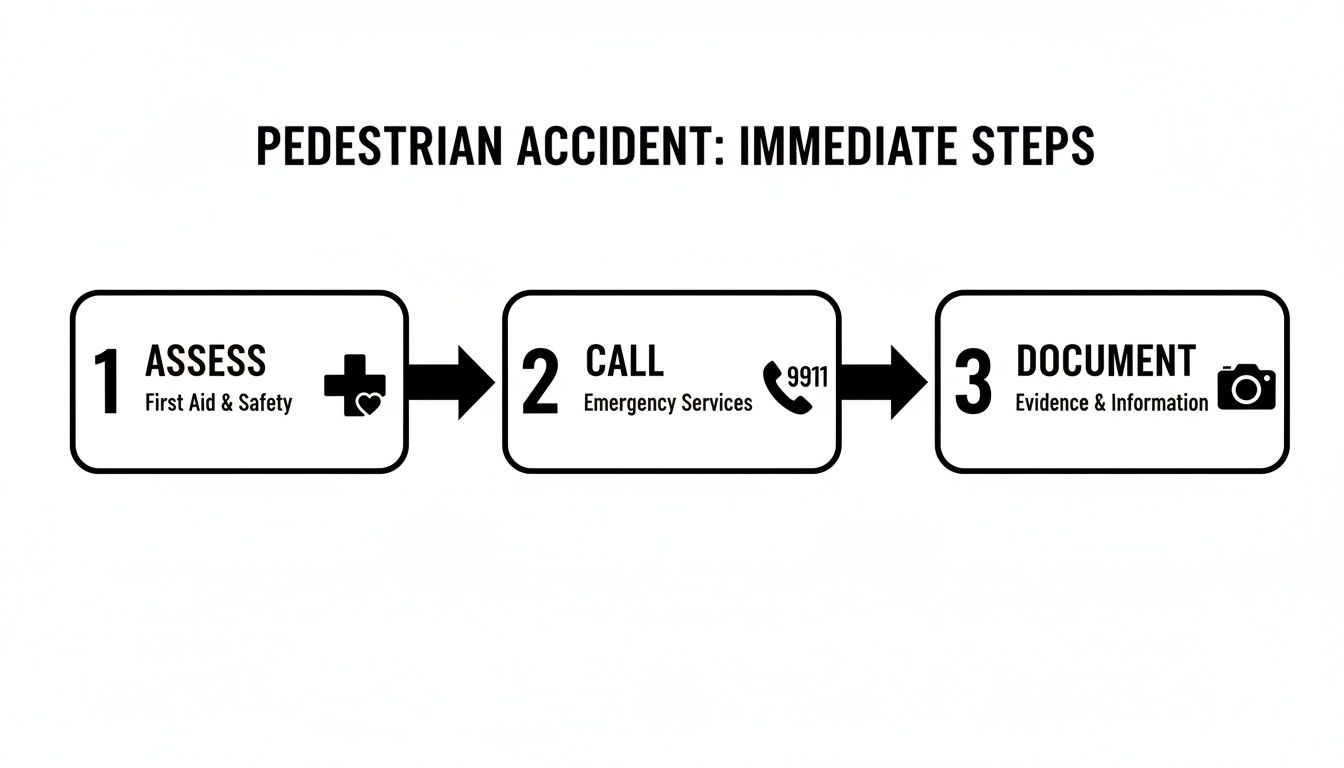
Think of it this way: assess your body, call for help, and document everything you can. These are the building blocks of a solid case.
Secure the Scene and Call 911
If you can move without causing more pain, get yourself to a sidewalk or another safe spot away from traffic. Your next call should be to 911. Don't hesitate. Tell the operator you're a pedestrian who has been hit by a vehicle and give them your location.
Getting a police report is vital. It’s an official, objective account of what happened, and it will be one of the most important documents you have.
While you're waiting for first responders, try to keep your conversation with the driver to a minimum. Stick to exchanging insurance and contact information. Don't get into an argument about who was at fault. A simple "I'm sorry" can be twisted and used against you later, so just focus on the facts.
To keep things straight during a stressful time, use this quick checklist.
Post-Accident Action Checklist
This table is a quick reference for the critical steps to take immediately after a pedestrian accident to ensure your safety and preserve your rights.
| Action Item | Why It's Critical |
|---|---|
| Move to Safety | Prevents further injury from traffic. |
| Call 911 | Summons medical help and creates an official police report. |
| Seek Medical Care | Diagnoses hidden injuries and creates a medical record linking injuries to the accident. |
| Avoid Admitting Fault | Protects you from having innocent statements used against you by insurers. |
| Get Driver's Info | You'll need their name, contact, license, and insurance details for your claim. |
| Document the Scene | Photos of the car, your injuries, and the surroundings provide crucial evidence. |
| Identify Witnesses | Independent accounts can powerfully support your version of events. |
Taking these initial steps lays the groundwork for accountability and helps you understand the basics of a what is a personal injury claim. Every piece of information you gather is a step toward holding the at-fault driver responsible.
Start Documenting Everything for Your Claim
After you've addressed your immediate safety and medical needs, the next critical phase begins: gathering evidence. What you do in the first few hours and days following the accident can make or break a future claim. You need to switch into detective mode, because every single detail matters.
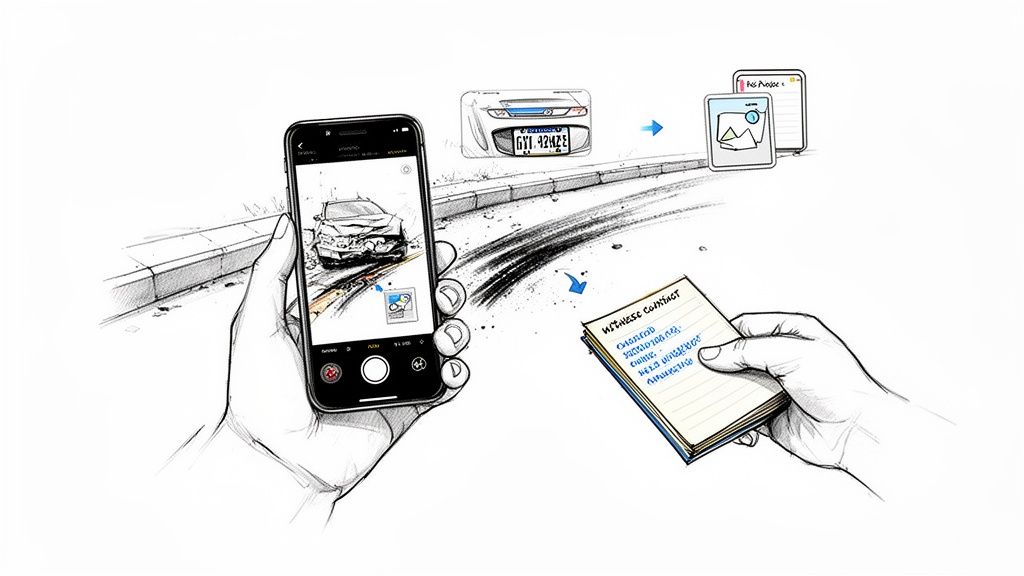
Your smartphone is your best friend here. Don't be shy with the camera—take more photos and videos than you think you could possibly need. You want to capture the scene from every conceivable angle and distance.
Your Essential Photo and Video Checklist
Your first priority is to document the scene exactly as it is, before anything gets moved. The goal is to create a visual record that tells the story for you.
- The Vehicle: Get clear shots of the car that hit you. Be sure to capture the license plate, where it ended up after the collision, and any damage to the front, hood, or windshield.
- Your Injuries: Photograph any visible cuts, bruises, or scrapes right away. This is important: continue to take pictures of your injuries every day. This creates a visual timeline of your recovery, which can be incredibly powerful.
- The Surroundings: Pan out and capture the bigger picture. Get photos of nearby traffic signs (like speed limits or pedestrian warnings), crosswalks, traffic lights, and even potential hazards like potholes or construction zones.
- Weather and Lighting: Were the roads slick from a recent rain? Was the sun low on the horizon, creating a blinding glare? These details might seem small, but they can be crucial for establishing fault.
Pro Tip: A single photo showing long skid marks, a blocked stop sign, or a malfunctioning "Walk" signal can sometimes be the linchpin that proves the driver was negligent. Never underestimate the power of what your camera can capture.
Get the Details from Everyone Involved
Once you've documented the physical scene, it's time to gather information. This isn't the moment to be polite to a fault; you need to get the facts.
Start with the driver. You'll need their full name, phone number, home address, driver's license number, and all their auto insurance information. If they'll let you, the easiest way to get this right is to just take a quick, clear photo of their insurance card and driver's license.
Next, look for witnesses. People who saw what happened and have no stake in the outcome are gold for your claim. Get their names and phone numbers. You can even politely ask if they'd be willing to give a quick summary of what they saw while you record it as a voice memo on your phone.
Don't Leave Without the Police Report
Always, always call the police to the scene. An officer will create an official crash report, which is a foundational document for any insurance claim or lawsuit. This report is a goldmine of information, usually containing:
- The officer’s professional opinion on how the accident happened.
- Summaries of statements from you, the driver, and witnesses.
- Any traffic tickets issued to the driver.
- A diagram showing the positions of the vehicle and pedestrian.
A few days after the accident, you can request a copy of this report from the responding police department. Insurance adjusters see this as an objective, authoritative account, and they take it very seriously.
Finally, start a simple journal. Each day, jot down notes about your pain level, any difficulties with daily tasks, doctor's appointments, and how you're feeling emotionally. This personal record is invaluable, especially when it comes time to build a case for your non-economic damages. It’s the real-world evidence you'll need when you start looking into how to prove pain and suffering. Every entry helps paint a complete picture of how this accident has truly affected your life.
Understanding Common Pedestrian Injuries and Their True Impact
When a multi-ton vehicle hits a person, the outcome is almost always catastrophic. Think about it: a pedestrian has absolutely no protection. No airbags, no seatbelts, no steel frame. The human body takes the full force of that impact, and the injuries are often severe and life-altering.
Being hurt in a pedestrian accident is so much more than the initial diagnosis from the ER. The real impact isn't just measured in broken bones, but in the long, difficult road to recovery that lies ahead.
The Most Vulnerable Parts of the Body
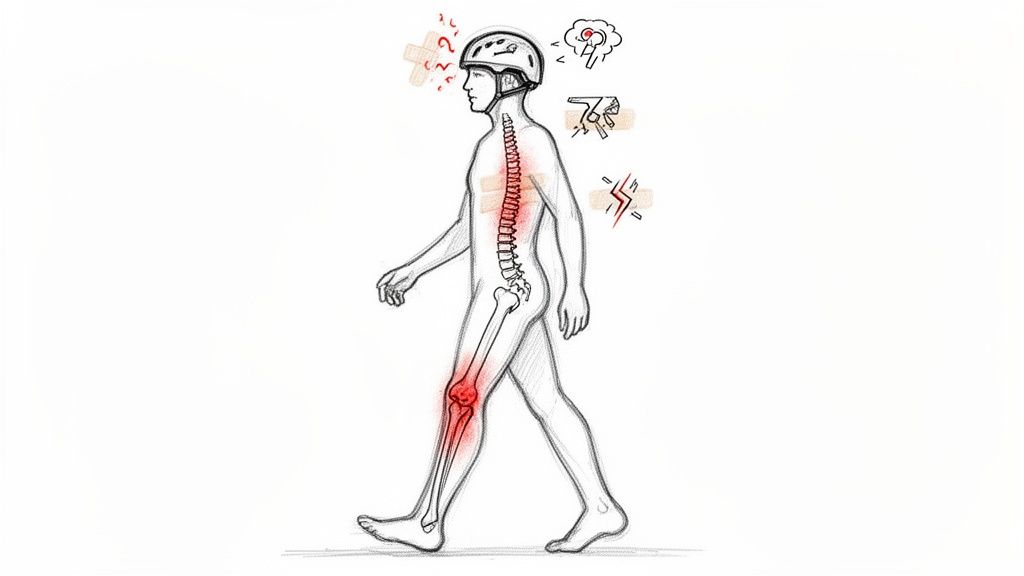
It really comes down to physics. A car's bumper usually strikes the lower legs first, causing devastating fractures to the tibia and fibula. As the person's body is thrown onto the hood and windshield, the head, spine, and chest are next to suffer a brutal impact.
This pattern is tragically consistent. In fact, research on why pedestrian protection is a global safety priority shows this clearly. The most serious injuries are heavily concentrated in the head and lower extremities, which see the highest rates of moderate to fatal harm. The spine and chest aren't far behind.
This is why we so often see these specific injuries in pedestrian cases:
- Traumatic Brain Injuries (TBIs): Anything from a "mild" concussion to a severe brain bleed can cause permanent cognitive and behavioral changes.
- Spinal Cord Injuries: Damage here can mean paralysis, chronic pain, and a total loss of normal function. It's one of the most devastating outcomes.
- Compound Fractures: Leg and pelvic fractures are incredibly common and almost always require complex surgeries with rods, plates, and screws to put a person back together.
- Internal Organ Damage: The sheer force can cause internal bleeding, rupture organs, and create a life-threatening emergency.
The initial hospital stay is just the beginning. I've seen it time and again—the real challenge is the long-term recovery. It often involves multiple surgeries, years of physical therapy, and a permanent change in your quality of life.
Beyond the Physical Wounds
The visible injuries are only one part of the story. The psychological trauma of being struck by a vehicle can be just as debilitating as the physical pain. These are the deep, invisible wounds that can linger for years.
Many survivors develop Post-Traumatic Stress Disorder (PTSD), suffering from flashbacks, nightmares, and crushing anxiety. A simple act like crossing the street can suddenly become terrifying. This emotional distress is a very real, and very compensable, part of your damages.
Long-Term Consequences to Consider
As you begin to recover, the true scope of what you've lost starts to become clear. It’s not just about the medical bills piling up in the mailbox; it’s about the life that was taken from you.
Any claim you file must account for every single aspect of this new reality:
- Chronic Pain: Many of these injuries don't just "heal." They leave a legacy of lifelong pain that needs constant management.
- Loss of Earning Capacity: What happens if your injuries prevent you from ever returning to your old job? Your entire financial future is at risk.
- Loss of Enjoyment of Life: Can you no longer play with your kids, enjoy your favorite hobby, or even take a walk without pain? This is a profound loss, and it has real value in a claim.
Understanding the full medical and emotional scope of your injuries is absolutely critical. It helps you talk to your doctors and, more importantly, ensures that any settlement demand you make truly reflects the immense impact this accident has had on every single part of your life.
You can bet on one thing after a pedestrian accident: the at-fault driver's insurance adjuster will be calling you, and fast. They’ll likely sound friendly, concerned, and eager to help.
Don't be fooled. Their job isn’t to look out for you; it's to protect their company's money by paying out as little as possible on your claim.
Remember this: anything you say to an adjuster can be twisted and used to devalue your case. They are trained professionals who know how to ask leading questions and get you talking. You need to be just as prepared.
The Landmines to Avoid When Speaking with an Adjuster
Every question an adjuster asks is a calculated move designed to get you to say something that hurts your claim. A simple, polite apology or an offhand comment about feeling "okay" can have a massive, negative impact on your final settlement. The key is discipline. Stick to the facts and nothing more.
Here are the absolute "don'ts" for any conversation with an insurance company:
- Never apologize. Don't say "I'm sorry," even if you're just expressing regret that the whole situation happened. They will spin this as an admission of fault. No exceptions.
- Don't downplay your injuries. Avoid phrases like "I'm fine," "I'm doing okay," or "It's not that bad." The reality is, many serious injuries don't show their full extent for days or even weeks. The best response is simply to state that you're under a doctor's care.
- Don't guess or speculate. If you're asked about speed, distance, or a specific sequence of events you're not 100% sure about, don't offer an opinion. It’s perfectly fine—and much smarter—to say, "I'm not sure about that right now."
The biggest trap of all is the recorded statement. An adjuster will push for this, often making it sound like a routine, necessary step to process your claim. It isn't.
You are under no legal obligation to give a recorded statement to the other party's insurance company. You should politely but firmly refuse. Its only real purpose is to lock you into a story and find inconsistencies later on to use against you.
Guarding Your Medical Privacy
Another classic adjuster tactic is sending you a broad medical authorization form. It looks like standard paperwork, but signing it gives them carte blanche to dig through your entire medical past.
They aren't just looking at records from the accident. They're on a fishing expedition, hoping to find any pre-existing condition or old injury they can blame for your current pain. It’s a common way they try to argue their driver isn’t responsible for your medical bills.
Never sign a blanket medical release. The insurance company is only entitled to see records directly related to the injuries from this specific accident. This is one of the most important areas where an attorney can protect you. They can handle these requests, filter out irrelevant information, and make sure your privacy—and your claim's value—remain intact.
What's My Pedestrian Injury Claim Actually Worth?
Trying to put a price tag on everything you’ve gone through after being hit by a car feels wrong, and frankly, a bit impossible. How can you assign a dollar amount to the chronic pain you now live with, the sleepless nights, or that pit in your stomach every time you have to cross a street?
While no check can erase what happened, Texas law does provide a framework for demanding compensation for every single loss—the obvious financial ones and the deeply personal ones. Getting a handle on how these calculations work is the first step toward making sure you get a fair shake. It’s not about pulling a number out of thin air; it’s about methodically adding up every way this accident turned your life upside down.
The Two Buckets of Damages in a Texas Claim
Your claim is essentially divided into two categories of damages. I like to think of them as the "spreadsheet losses" and the "human losses."
Economic damages are the tangible, on-paper costs. These are the expenses you can prove with a stack of bills, receipts, and pay stubs. It’s straightforward math.
This bucket includes things like:
- All your medical bills: We’re talking about everything from the ambulance ride and ER visit to surgery, physical therapy, prescriptions, and even the cost of any medical care you’ll need down the road.
- Lost income and earning potential: This isn't just about the wages you missed while you were out of work. If your injuries mean you can't go back to your old job or have to take a pay cut, you can claim that future lost income, too.
These concrete costs are the foundation of your claim, but they're often just the tip of the iceberg. The real, lasting impact of an accident is usually found in the harm that doesn't come with a price tag.
Non-economic damages are meant to compensate you for the immense personal suffering the accident caused. This is where the legal system acknowledges the human cost of someone else's negligence.
This includes compensation for:
- Physical pain and suffering
- Mental and emotional anguish (like anxiety, depression, or PTSD)
- Loss of enjoyment of life (not being able to play with your kids, garden, or go for a run)
- Disfigurement and permanent scarring
- Long-term impairment or disability
This is the part of the claim that’s more subjective, and it’s exactly where insurance adjusters will try to lowball you. Their job is to turn your trauma into a simple math problem, but your life is much more than a number on their claim form.
How to Value Your Claim with Real-World Data, Not Guesswork
So, if the "human losses" are so subjective, how do you figure out a fair number? This is where data becomes your most powerful tool. Instead of relying on some vague online calculator, you can look at what actual juries and insurance companies have paid out for cases just like yours, right here in Texas.
Our personal injury calculator guide walks through how analyzing real-world data can bring much-needed clarity to this process.
By digging into verdicts and settlements from pedestrian accidents in your county, you can see the real-world value of cases involving similar injuries, whether it's a broken leg or a more severe traumatic brain injury. This data-driven approach gives you a realistic benchmark grounded in what’s actually happening in courtrooms, not just what an insurance company wants you to believe.
This knowledge is power, especially when you see the staggering statistics. The National Highway Traffic Safety Administration estimates that 7,314 pedestrians died in traffic crashes in 2023. A shocking 83% of those deaths happened in urban areas, just like the ones we see all across Texas. You can read more about these disturbing pedestrian safety trends to understand the scale of the problem.
Arming yourself with data gives you the confidence to walk into negotiations with a clear, fact-based understanding of what your case is truly worth. It ensures you're ready to fight for a result that is genuinely fair.
Answering Your Top Questions After a Pedestrian Accident in Texas
If you’ve been hit by a car, you’re probably overwhelmed and have a million questions running through your mind. The legal process can seem daunting, but getting some clear answers is the best way to start moving forward.
Let’s tackle some of the most common questions we hear from people in your situation.
What if I Was Partially at Fault for What Happened?
This is a huge concern for many people, especially if they were crossing mid-block or were distracted. The good news is that even if you share some of the blame, you can likely still recover money in Texas.
Our state operates under a modified comparative fault system, which you might also hear called the 51% bar rule. In simple terms, you can collect damages as long as you are determined to be 50% or less responsible for the accident.
Your final settlement or award is simply reduced by your percentage of fault. So, if a jury awards you $100,000 but decides you were 20% at fault, your award would be cut by that 20%, leaving you with $80,000.
How Long Do I Have to File a Lawsuit?
Time is not on your side after an accident. In Texas, the statute of limitations for personal injury claims gives you just two years from the date you were injured to file a lawsuit.
This is a hard-and-fast deadline. If you miss it, the court will throw your case out, and you’ll lose your right to compensation for good. It's one of the most important dates to keep in mind.
Who Is Most at Risk of Being Hit?
Anyone can be a victim, but the statistics paint a clear picture of who is most vulnerable on our roads. The data shows some pretty stark disparities.
For example, men are far more likely to be victims, making up a staggering 72.7% of all pedestrian deaths in 2023. You can dig deeper into these pedestrian safety facts and trends, which also show that older adults and people in lower-income areas face much higher risks.
Can I Get Money for My Emotional Trauma?
Yes. The law recognizes that the harm from an accident isn't just physical. The mental and emotional toll—the sleepless nights, the anxiety of crossing a street, the flashbacks—is a very real part of your suffering, and you can be compensated for it.
This is what lawyers call non-economic damages. It’s compensation for the very real human cost of the accident—things like anxiety, depression, PTSD, and the simple loss of enjoyment in life that comes after a traumatic event.
Keeping a journal about your daily struggles and getting professional help from a therapist are powerful ways to document this part of your claim. It’s not just about the medical bills; it’s about acknowledging the full impact on your life.
Trying to figure out what your case is worth can feel like guesswork. That's where real-world data comes in. Verdictly has built a powerful, AI-driven database of actual Texas verdicts and settlements, so you can see what cases similar to yours have settled for. Don't go into a negotiation blind. Arm yourself with data-driven insights by exploring real case outcomes at https://verdictly.co.
Related Posts
A Guide to Medical Records Reviews in Personal Injury Claims
Learn how medical records reviews can strengthen your Texas injury claim. This guide explains the process, key findings, and how to build a stronger case.

Why Insurance Companies Deny Claims: why insurance companies deny claims
Learn why insurance companies deny claims and how to overcome common denials with proven appeals and tips to maximize your compensation.
How Much Can I Get From a Car Accident Settlement?
Wondering how much can I get from a car accident? This guide breaks down settlement factors, damages, and claim values to help you estimate your compensation.