

Your Guide to Using a Personal Injury Calculator
Discover how to use a personal injury calculator to estimate your claim's value. This guide covers damages, key inputs, and how to interpret your results.
Ever wondered what your personal injury claim might actually be worth? A personal injury calculator is a tool designed to give you a ballpark estimate. Think of it as a starting point—a way to translate the messy details of your accident, like medical bills and lost wages, into a preliminary settlement figure.
This initial number isn't a guarantee, but it provides a crucial baseline. It helps you get a feel for your claim's potential value before you even sit down with an attorney, giving you a clearer picture from day one.
How Personal Injury Calculators Estimate Claim Value
It's tempting to see a personal injury calculator as a crystal ball, but it’s more like a financial forecasting tool for your specific situation. It takes the key variables of your case—medical expenses, time off work, and the severity of your injuries—and runs them through a common industry formula to produce a probable compensation range.
The real purpose here is to set realistic expectations. By seeing how the tangible costs and intangible suffering translate into a dollar amount, you gain a foundational understanding of what drives a settlement's value. This empowers you, giving you a solid starting point for a more productive conversation with a lawyer.
The Logic Behind the Calculation
At its core, the calculation is surprisingly straightforward. It mirrors the initial valuation methods that insurance adjusters and attorneys have used for years, combining clear-cut costs with a multiplier for the less tangible aspects of your suffering.
The formula breaks down into two main parts:
- Economic Damages: These are the black-and-white financial losses you can add up with a receipt—things like medical bills, prescription costs, and lost income.
- Non-Economic Damages: This is the tougher part. It's an attempt to put a number on your pain, emotional distress, and the impact the injury has had on your daily life.
The calculator tallies up all your economic damages and then applies a multiplier (usually between 1.5 and 5, depending on injury severity) to estimate your non-economic damages. Add those two figures together, and you have your total estimated settlement value. This structured approach helps demystify what can often feel like a number pulled out of thin air.
A common mistake is treating the calculator's output as final. It’s a data-driven starting point, not a legal promise. The estimate is there to frame the conversation and show you which parts of your claim carry the most financial weight.
Using Data to Inform Estimates
So, where do these estimates come from? These tools analyze historical settlement data from similar cases, factoring in injury severity and even state-specific legal trends to provide a realistic range.
Recent industry data shows that the average personal injury settlement in the U.S. falls somewhere between $24,000 and $55,100, with some legal-tech firms reporting a median value closer to $55,056.08. By plugging in your specific details, the calculator helps place your situation within these broader trends.
For example, if you were in a car crash, understanding the typical settlement landscape for those cases is critical. Our complete guide to car accident settlements offers a much deeper look into how those specific claims are valued.
Ultimately, a personal injury calculator is your first step toward financial clarity. It takes the chaos of post-accident expenses and organizes it into a coherent picture, preparing you for what comes next.
Breaking Down the Damages in Your Claim
To get a sense of what your claim might be worth, you first need to understand the building blocks of any settlement. These are called "damages." A personal injury calculator basically organizes all your losses into two main buckets, much like an accountant separates hard assets from intangible goodwill on a balance sheet.
Those two categories are economic damages and non-economic damages. By clearly defining and adding up everything that falls into each bucket, the calculator gives you a structured way to estimate the total value of your claim.
Economic Damages: The Tangible Costs
Let's start with the easy stuff. Economic damages are the straightforward, black-and-white financial losses you've suffered because of your injury. Think of these as anything you can prove with a receipt, an invoice, or a pay stub. They're the most concrete part of your claim because they represent actual money that has come out of your pocket or that you've failed to earn.
A personal injury calculator always begins by tallying up these tangible costs. They form the solid foundation of your settlement estimate, providing a clear baseline dollar amount before any other, more subjective factors come into play.
Here's a quick look at how these direct financial impacts build the initial estimate.
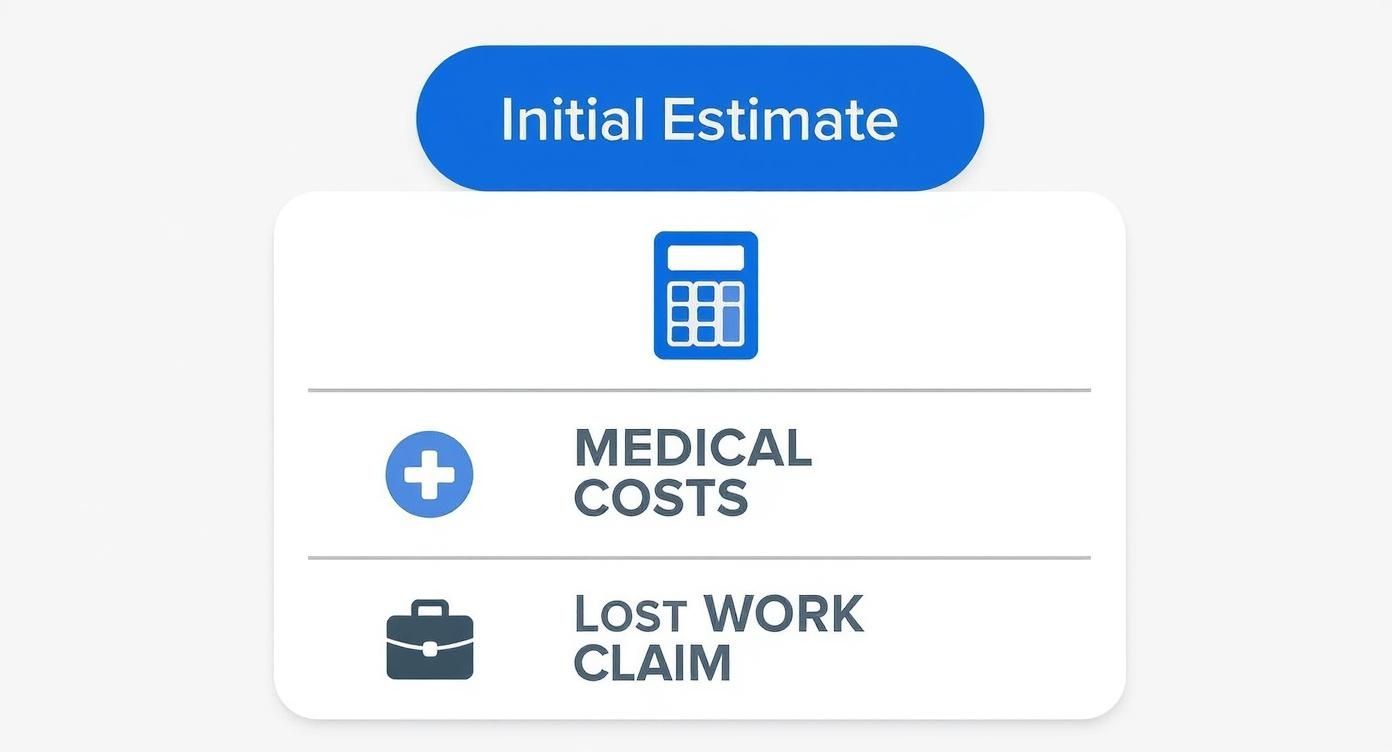
As you can see, your estimate starts with the measurable costs of medical care and lost work—the two things that are typically easiest to document.
When you're plugging numbers into a calculator, it's crucial not to miss anything. Make sure you gather paperwork for all possible economic damages:
- Medical Expenses: This is a big one. It includes everything from the ambulance ride and initial ER visit to ongoing physical therapy, prescription drugs, and any future surgeries you might need.
- Lost Wages: Add up all the income you lost from being unable to work. Don't forget to consider your loss of future earning capacity if your injuries will have a long-term impact on your career.
- Property Damage: If you were in a car wreck, this is the cost to repair or replace your vehicle. It also includes any personal items that were damaged inside, like a laptop or phone.
- Out-of-Pocket Costs: Little things add up. This includes gas money for trips to the doctor, medical equipment you had to rent, or even modifications made to your home to accommodate your recovery.
Non-Economic Damages: The Human Cost
Now we get into the more abstract—but equally critical—part of your claim. Non-economic damages are meant to compensate you for the kind of suffering that doesn’t come with a neat price tag. This covers your physical pain, emotional distress, and the overall negative impact the injury has had on your quality of life.
Since you can't get a receipt for pain and suffering, a personal injury calculator relies on a common formula used in the legal world called the "multiplier method" to assign it a dollar value.
Think of your economic damages as a solid foundation of bricks. The multiplier is like adding extra layers on top to represent just how bad your experience really was.
The multiplier is a number, usually somewhere between 1.5 and 5, that gets applied to your total economic damages. A minor injury with a quick recovery might get a 1.5x multiplier, while a catastrophic, life-altering injury could get a 4x or 5x multiplier.
Let's run through a quick example. Say your total medical bills and lost wages add up to $20,000. If your injury was moderately severe—like a broken leg that needed surgery—the calculator might apply a multiplier of 3. This would peg your non-economic damages at $60,000 ($20,000 x 3).
Your total estimated settlement would then be $80,000 ($20,000 in economic damages + $60,000 in non-economic damages).
The value of personal injury claims can swing wildly, because every case is unique. The U.S. personal injury law market is a $57 billion industry, partly because people are more aware of their legal rights than ever before. For context, the average payout for dog bite claims was recently $64,555, while slip and fall cases often land between $10,000 and $50,000. More severe cases like medical malpractice have a median payout closer to $250,000.
Understanding how these multipliers work is the key to making sense of the number a calculator gives you. It shows how a catastrophic event, like a truck crash causing a brain injury, can lead to a massive award to account for the immense human cost. For a real-world look at this, you can see how a jury awarded $4.8 million for a traumatic brain injury in a truck crash, a case where non-economic damages clearly played a decisive role.
Gathering Your Information for an Accurate Result
 Let's be blunt: a personal injury calculator is only as good as the numbers you feed it. Think of it like baking a cake. If you just guess at the ingredients or leave something out, you're not going to get the result you were hoping for. The same principle applies here.
Putting in sloppy or incomplete data will spit out a settlement estimate that isn't just inaccurate—it could be dangerously misleading. Your first job is to become an organized record-keeper, gathering every shred of evidence tied to your accident. This isn't just about getting a better calculator result; it's about building the entire foundation for a potential claim.
Taking the time to do this right forces you to account for every single loss, creating a comprehensive file that will prove incredibly valuable if and when you decide to sit down with an attorney.
Your Document Checklist for Economic Damages
We’ll start with the easy stuff: economic damages. These are the tangible, black-and-white financial losses you’ve suffered. Because they come with a paper trail, they are the most straightforward part of your claim to prove. The key is to be meticulous.
Grab a folder or create a dedicated digital one and start collecting. Keeping everything in one place now will save you from a massive headache later.
Key Documents to Collect:
- Official Accident Report: This is non-negotiable. The police report offers an official account of what happened, who was involved, and often gives an early opinion on who was at fault.
- Medical Bills and Invoices: Every single one. This means the ambulance ride, the ER visit, hospital stays, follow-up appointments with your doctor, physical therapy—all of it.
- Proof of Lost Income: To get paid for the time you missed from work, you need proof. Gather your pay stubs from before and after the incident, ask your employer for a letter confirming your pay rate and time missed, and have your recent tax documents handy.
- Receipts for All Out-of-Pocket Expenses: Don't let the small things slide, because they add up quickly. This includes prescriptions, medical supplies like crutches or braces, and even the mileage you've driven to and from all your doctor's appointments.
Your goal is thoroughness. Every dollar you can document strengthens the accuracy of your personal injury calculator result and, more importantly, strengthens your potential case.
Documenting Non-Economic Factors
Now for the trickier part. Things like pain and suffering don't come with a neat receipt, but you can—and absolutely should—gather evidence to demonstrate their impact. This is where you tell the story of how the injury has turned your life upside down. When an online calculator asks you to rate your injury’s severity, this is the information you'll use to make an honest assessment.
This evidence is what justifies a higher multiplier when the calculator estimates your non-economic damages. It proves your suffering was real and had a significant, disruptive effect on your world.
How to Document Your Suffering:
- Keep a Daily Journal: This is your most powerful tool. Every day, jot down your pain levels, your emotional state, and the things you couldn't do. Note sleepless nights, anxiety attacks, or the frustration of not being able to perform simple tasks. This log becomes an undeniable record of your day-to-day struggle.
- Take Photographs and Videos: A picture is worth a thousand words. Document your injuries as they heal. Photos of bruising, casts, or surgical scars provide clear, visual proof of your physical trauma.
- Gather Witness Statements: Ask friends, family, or even coworkers if they'd be willing to write down their observations. Statements about the changes in your mood, abilities, or overall quality of life since the accident can be incredibly compelling.
By putting together this complete file, you're doing much more than just plugging numbers into a personal injury calculator. You're taking control of your situation and laying the groundwork needed to pursue the fair compensation you deserve.
Walking Through a Sample Injury Calculation

Theory is great, but nothing makes these concepts click like seeing a personal injury calculator in action. Let’s move from abstract ideas to a real-world example and walk through a hypothetical scenario to see how the math actually works. This will show you exactly how all the pieces come together to produce a ballpark settlement figure.
Let's imagine a driver named Alex, who gets rear-ended at a busy intersection in Dallas. The other driver is clearly at fault. Alex ends up with a broken arm and a nasty case of whiplash, which means medical bills and time away from work.
Before Alex can even start plugging numbers into a calculator, the first step is to gather all the documented financial losses. This collection of bills, receipts, and pay stubs forms the solid, provable foundation of the entire claim.
Tallying the Economic Damages
First things first, we need to add up all of Alex’s direct, out-of-pocket costs. These are known as economic damages—the tangible losses with a clear paper trail, making them the most straightforward part of the equation.
After digging through the paperwork, Alex’s records show the following:
- Emergency Room Visit & X-rays: $4,500
- Orthopedic Specialist Follow-up: $1,500
- Physical Therapy Sessions (8 weeks): $4,000
- Prescription Pain Medication: $500
- Lost Wages (4 weeks off work): $5,000
When we add these figures up, we get Alex's total economic damages. This number represents the immediate financial hole the accident created.
$4,500 + $1,500 + $4,000 + $500 + $5,000 = $15,500 in Total Economic Damages
This isn't just a subtotal; it's a critical baseline. It represents the proven financial losses and becomes the anchor for calculating the more subjective part of the claim.
Applying the Multiplier for Non-Economic Damages
Now, we need to account for the human side of the injury—the non-economic damages. This is where we try to put a number on Alex's pain, suffering, and the general upheaval the accident caused in their life. The most common way to do this is with the multiplier method.
The multiplier is a number, typically between 1.5 and 5, chosen based on how severe the injuries are. Alex’s broken arm and whiplash are certainly painful and disruptive, but they probably aren’t catastrophic or permanently disabling. This puts the injury squarely in the moderate range.
For this scenario, let's assign a multiplier of 2.5x. This reflects an injury that’s much more serious than a few bumps and bruises but doesn't involve long-term disability. The more severe the injury and the bigger its impact on your life, the higher that multiplier climbs.
With the multiplier decided, we apply it to the economic damages we just calculated:
$15,500 (Economic Damages) x 2.5 (Multiplier) = $38,750 in Non-Economic Damages
This calculation is an attempt to quantify the weeks of pain, the frustration of not being able to button a shirt, and the overall stress that came with the crash.
Calculating the Final Estimated Settlement
The last step is the easiest. We simply add the economic and non-economic damages together to arrive at a total estimated value for Alex's claim. This figure provides a comprehensive, data-driven starting point for understanding what a fair settlement might look like.
$15,500 (Economic) + $38,750 (Non-Economic) = $54,250 (Total Estimated Value)
To make it even clearer, the table below breaks down the entire calculation, showing how each component contributes to the final number.
Sample Calculation for a Car Accident Claim
| Damage Component | Calculation/Value | Notes |
|---|---|---|
| Medical Expenses | $10,500 | Includes ER, specialist, therapy, and medication. |
| Lost Wages | $5,000 | Reflects one month of missed work due to recovery. |
| Total Economic Damages | $15,500 | This is the sum of all documented financial losses. |
| Pain & Suffering Multiplier | 2.5x | A moderate multiplier for a broken arm and whiplash. |
| Non-Economic Damages | $15,500 x 2.5 = $38,750 | This estimates the value of physical and emotional distress. |
| Total Estimated Value | $54,250 | The sum of economic and non-economic damages. |
As you can see, a personal injury calculator follows a logical process to turn a list of expenses and injuries into a tangible settlement estimate. It’s a powerful way to get an initial sense of what your claim could be worth.
Why a Calculator Is Only a Starting Point
Getting that instant number from a personal injury calculator can be a relief. Suddenly, you have a figure to work with—something tangible that puts a value on what you've lost. But it's crucial to understand what that number really is: an educated first guess, not a guaranteed check.
Think of it like getting a Zestimate for your house. It gives you a solid ballpark figure based on data, but it can't see the custom-built kitchen or the leaky roof. In the same way, an online calculator can't capture the deeply human elements that ultimately determine what a personal injury claim is truly worth.
The estimate you get is a fantastic baseline. It helps you frame the financial scope of your case based on the concrete numbers you fed into it. Consider it the beginning of the conversation, not the final word.
The Nuances No Algorithm Can Capture
A calculator is great with math, but it has no feeling for nuance. The real value of your claim will be molded by things you can't just type into a form field. These are the very factors a skilled attorney will zero in on to build the strongest possible case.
A few key variables will always be outside the calculator's grasp:
- Witness Credibility: How does your witness come across? A confident, clear-headed witness can be a game-changer. A shaky or inconsistent one can do real damage. An algorithm has no way of judging this.
- Jury Appeal: If your case ever sees a courtroom, the emotional connection you make with a jury is huge. Things like your perceived honesty, the defendant’s behavior, and basic human sympathy can sway a verdict far more than cold calculations.
- The Lawyers in the Room: The experience, reputation, and tenacity of the attorneys on both sides play a massive role. A top-tier insurance defense lawyer can drive a settlement value down, while a seasoned plaintiff’s attorney knows exactly which levers to pull to maximize it.
These are the unquantifiable details where a simple calculation stops and a real legal strategy begins.
A personal injury calculator gives you an excellent estimate of your documented damages. It can’t predict the human dynamics of a negotiation or a courtroom, which are often just as important.
Your Local Legal Landscape Matters
On top of all that, no online tool can truly understand the legal climate of your specific city or county. A case in a historically conservative part of Texas might settle for a very different amount than the exact same case tried in a more plaintiff-friendly jurisdiction just down the road.
Local court rulings, the known tendencies of certain judges, and even the general attitude of the local jury pool are all critical pieces of the puzzle. Attorneys who work in an area for years build up an instinct for these local flavors—a gut feeling that a generic, nationwide calculator can't possibly have.
This is why the number you get is best used as an educational tool. It gives you a framework and prepares you for a much more productive conversation with a legal professional. That expert can then take your baseline number and layer on the context, experience, and strategic thinking that a machine will never possess. The personal injury calculator empowers you to start the journey with knowledge, but an expert has to guide you across the finish line.
Taking the Right Steps After Getting Your Estimate
Getting a number from a personal injury calculator is a great starting point. It gives you a tangible figure to work with and helps you get your bearings. But that number is just the beginning of the road, not the final destination. The single most important thing you can do now is take that initial insight and talk to a legal professional.
Think of your estimate as a useful piece of data that needs an expert to interpret it correctly. A skilled personal injury attorney will look at your results, ask the kind of nuanced questions a calculator can't, and frame your estimate within the context of local laws and recent case outcomes. They take your ballpark figure and turn it into a strategic foundation for building a real case.
Why an Attorney Is Your Most Important Next Step
An attorney does so much more than just confirm a number; they build the story around it. Remember, insurance companies have teams of adjusters and lawyers working full-time to minimize what they pay out. Your calculator estimate alone isn't going to move the needle with them. An experienced lawyer, on the other hand, knows their playbook and understands how to negotiate effectively.
This is where an online tool hits its ceiling. The push to standardize compensation is a growing trend worldwide. For instance, some international indexes now track awards across dozens of countries, where payouts for moderate injuries can fall anywhere between $20,000 to $60,000. In Canada, the average payout was $26,501 per claim, though obviously, the most serious cases bring in far higher amounts. Digging into these international bodily injury benchmarks shows just how much data informs claim valuations across the globe.
Your calculator estimate is a powerful tool for self-education. An attorney's expertise is the tool you need for successful negotiation and litigation. They know how to leverage evidence to argue for the highest possible multiplier for your pain and suffering.
Gaining a Strategic Advantage with Better Data
While a public personal injury calculator is fantastic for getting a preliminary estimate, legal pros are working with far more sophisticated tools. They subscribe to powerful databases packed with actual jury verdicts and confidential settlement details from cases that mirror yours. This gives them a huge advantage, letting them benchmark your claim against what has actually been paid out in the real world.
This is the kind of detail that builds a winning strategy. By knowing what juries have awarded for similar injuries in your jurisdiction, an attorney can set realistic settlement goals and argue your case from a position of strength, backed by hard data. For more insights on legal strategies and data, you can read more on the Verdictly blog at https://www.verdictly.co/blog. Your estimate got you in the game; now let an expert help you win it.
Frequently Asked Questions
Even after seeing how these calculators work, you probably still have a few questions. Let's tackle some of the most common ones to clear things up and help you decide on your next steps.
Are Online Personal Injury Calculators Accurate?
Think of them as a starting point, not a final answer. They can give you a decent baseline estimate, but their accuracy is definitely limited. A simple online tool can't possibly weigh all the unique factors of your case—things like the credibility of a witness, the strength of your evidence, or even the specific trends in your local courthouse.
The number you get is a helpful ballpark figure. It gives you an idea of what might be possible, but it’s not a guarantee. For a truly reliable valuation of your claim, nothing beats sitting down with a seasoned personal injury attorney who can analyze the specific details of your situation.
How Is Pain and Suffering Actually Calculated?
This is the million-dollar question, and the answer is tricky because there’s no single, universally accepted formula for something as personal as "pain and suffering." It's what we call a non-economic damage.
The most common method, and the one most calculators use, is the multiplier method. Here's how it works: your total hard costs (medical bills, lost income) are added up and then multiplied by a number, usually somewhere between 1.5 and 5. A lower multiplier might be used for an injury you recover from quickly, while a higher one is reserved for severe, life-altering injuries with long-term consequences.
An online calculator takes a guess at the right multiplier based on the information you provide. A skilled attorney, on the other hand, builds a powerful narrative to justify the highest possible multiplier, which can make a massive difference in your final settlement.
Can I Use a Calculator Estimate to Negotiate Myself?
It's tempting to take that number and run with it, but I'd strongly advise against it. While the estimate is great for your own understanding, it won't carry much weight with an insurance adjuster. They have their own sophisticated software and are trained in negotiation tactics designed for one purpose: to pay out as little as possible.
The smartest way to use your estimate is as a tool to help you decide whether to hire a lawyer. An attorney doesn't just bring an estimate to the table; they bring legal leverage, data from real-world verdicts, and the experience to counter an adjuster's lowball offers. They completely level the playing field.
Want to see what Texas juries and insurance companies have actually paid for cases similar to yours? Verdictly offers a searchable database of real verdicts and settlements from across the state. This gives you and your attorney the hard data needed to build a powerful case. Explore real case outcomes on Verdictly and negotiate from a position of strength.