
Failure to Maintain Lane in Texas A Motorist's Essential Guide
Injured after a crash? Understand Texas 'failure to maintain lane' laws, how fault is proven, and what your car accident claim could be worth.
In Texas, the term failure to maintain lane might sound like simple traffic jargon, but it’s often the legal linchpin in serious car accident claims. It boils down to a driver not staying within their marked lane as safely and practically as possible, and this one mistake is frequently the root cause of devastating crashes.
Decoding the Duty to Stay in Your Lane
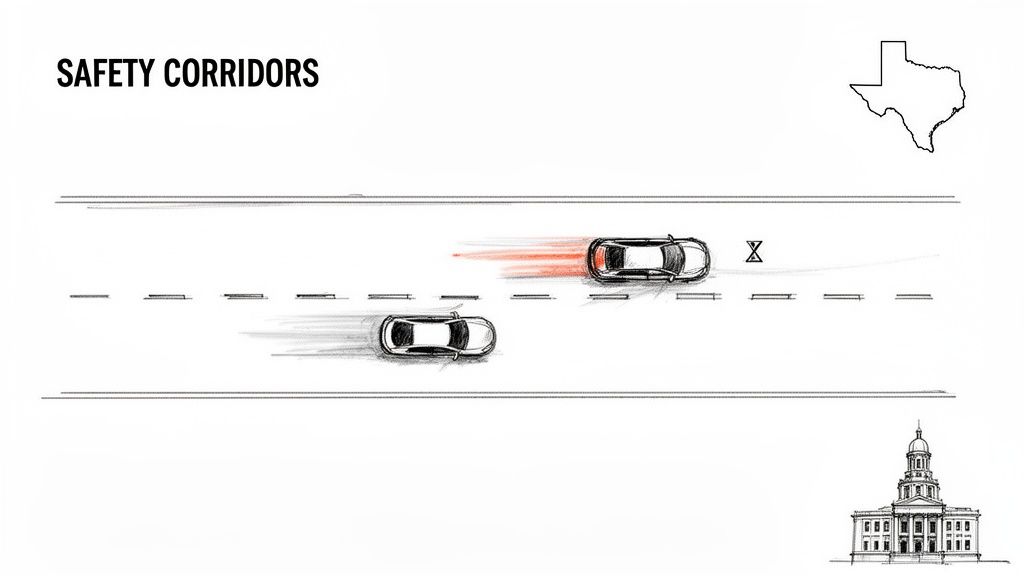
Every time you get behind the wheel, you're accepting a legal duty to drive with reasonable care. A huge piece of that duty is spelled out in the Texas Transportation Code, which mandates that every driver must operate their vehicle "as nearly as practical entirely within a single lane." The reason for this rule is simple: predictability on the road saves lives.
Think of each marked lane on a highway as its own safety corridor. When everyone stays in their designated corridor, traffic moves like it's supposed to—smoothly and safely. A failure to maintain lane happens the moment a driver strays from that corridor without a good reason, instantly turning their vehicle into a dangerous, unpredictable hazard. This isn't just about a traffic ticket; it's a clear act of negligence.
To truly understand what "failure to maintain lane" means in a legal context, it helps to break down its core components. The law isn't just about crossing a line; it's about the context and the duty of care owed to other drivers on the road.
The table below outlines the key elements that define this violation in Texas.
Key Elements of a Failure to Maintain Lane Violation
| Component | Description |
|---|---|
| Duty of Care | Every driver has a legal obligation to operate their vehicle safely to avoid harming others. |
| Marked Lanes | The law applies to any roadway divided into two or more clearly marked lanes for traffic. |
| "As Nearly As Practical" | Drivers must remain within a single lane unless it is unsafe or impractical to do so (e.g., avoiding debris). |
| Unsafe Movement | Leaving the lane must be done safely and only after signaling. Drifting or swerving constitutes a breach. |
| Causation | The lane violation must be a direct cause of the collision and the resulting injuries or damages. |
Understanding these elements is the first step in building a strong case. When another driver violates these basic rules of the road, they have breached their duty of care, and that forms the foundation of a negligence claim.
The Standard of "As Nearly As Practical"
Now, the law is realistic. It doesn't expect drivers to be perfect robots, gripping the wheel in a straight line for miles. The phrase "as nearly as practical" is a built-in acknowledgment that small, safe adjustments are a normal part of driving. You might need to move over slightly to dodge a pothole or some debris in the road.
But that flexibility isn't a free pass for carelessness. The entire case often hinges on whether the lane deviation was safe and necessary given the circumstances.
A failure to maintain lane violation forms the legal foundation for proving fault in a collision. By showing the other driver breached their duty to stay in their lane, you establish the negligence required to hold them financially responsible for your injuries and damages.
The distinction is critical. An aggressive driver weaving through traffic is a clear violation. So is the driver who slowly drifts into the next lane because they were texting or falling asleep. Both actions introduce a level of danger that simply doesn't belong on the road.
Why This Violation Matters in Accident Claims
Lane violations are a massive cause of collisions nationwide. In fact, national data reveals that at least 33 percent of all crashes involve a vehicle changing lanes or running off the road. That means roughly one-third of all accidents can be traced back to a driver's failure to manage their lane. For more insight, check out the Colorado State Patrol's findings on lane violations.
For anyone injured in a car wreck, getting a handle on this concept is the first step toward getting justice. When a police officer writes a ticket for failure to maintain lane at the scene, it serves as powerful initial evidence that the other driver was at fault. That citation goes a long way toward proving the negligence that is the cornerstone of any successful personal injury claim, connecting the other driver's bad decision directly to the harm you've suffered.
What Really Causes a “Failure to Maintain Lane” Crash?
A "failure to maintain lane" ticket rarely tells the whole story. The lane departure itself is the effect, not the cause. It’s almost always the direct result of a driver doing something they shouldn't have been doing behind the wheel.
Pinpointing that specific, preventable behavior is the key to a successful injury claim. These aren’t just abstract legal ideas; they’re real-world—and often tragic—scenarios that play out every single day on Texas roads. Let's walk through some of the most common reasons drivers lose control and drift out of their lane.
The Distracted Driver
We've all seen it. A driver on I-35 during rush hour, head down, eyes on their phone. A text message buzzes. They think they can handle a quick glance, just for a second. But in that tiny window of inattention, their car starts a slow, silent drift into the next lane.
The driver next to them, who is paying attention, has zero warning before a front tire crosses the line and clips their rear bumper, sending their car into a terrifying spin. This is the textbook distracted driving accident. By looking away from the road, the driver gave up their ability to make the constant, tiny steering corrections needed to stay centered. The collision was a direct result of their failure to maintain their lane.
The Drowsy or Fatigued Driver
Think about a long-haul trucker pushing through the night to make a deadline. After 10 hours on the road, their eyelids get heavy. The monotonous drone of the highway starts to hypnotize them. Without even realizing it, their massive rig begins to drift over the center line, inch by inch, into oncoming traffic.
Suddenly, a family returning from vacation is face-to-face with an 80,000-pound truck in their lane. It’s an impossible situation. Driver fatigue is just as dangerous as being drunk—it destroys judgment and slows reaction time to a crawl. A drowsy driver is physically incapable of controlling their vehicle, and that slow, uncontrolled drift is the tell-tale sign.
A momentary lapse, whether from a text message or pure exhaustion, can inflict lifelong consequences. Proving the at-fault driver was distracted, tired, or impaired is the foundation for establishing their negligence in a failure to maintain lane crash.
The Impaired Driver
A driver leaves a bar after a few too many, feeling buzzed but telling themselves they’re "fine to drive." As they try to navigate a curvy road, the alcohol wreaks havoc on their reflexes and blurs their vision. They completely misjudge a turn, and their car swings wide across the double yellow line, sideswiping an innocent driver.
When the police arrive, the smell of alcohol and the driver’s slurred speech make the cause obvious. Driving under the influence of alcohol or drugs is the very definition of negligence. Impairment makes it impossible for a person to stay within their lane markers, and this specific violation is often the first thing an officer spots before flipping on their lights.
The Aggressive or Reckless Driver
You know this driver, too. The one in the sports car, weaving through traffic on the Katy Freeway like it's a video game. They’re impatient, jumping between lanes with no signal, cutting people off left and right.
In a final reckless move, they try to shoot a gap that’s way too small, completely misjudging the space. They slam into the side of another car, triggering a chain-reaction pile-up. This isn't an "accident"—it's a choice. The driver intentionally disregarded everyone else's safety with their dangerous lane changes. Their actions are a clear and deliberate failure to operate their vehicle safely within a single lane, creating chaos for everyone around them.
How to Prove Fault in a Lane Departure Crash
After a crash caused by someone's failure to maintain their lane, your top priority becomes proving they were at fault. Knowing they were negligent isn't enough—you have to be able to demonstrate it with solid, convincing evidence. Think of it like assembling a puzzle; each piece of evidence you gather helps create a clear picture of exactly what happened and why.
Building a strong case means being strategic about collecting proof. From the officer's report written at the scene to video footage and physical clues, every detail helps show how the other driver’s mistake directly led to your injuries.
The Police Report as a Starting Point
The single most important document created right after a wreck is the official police report. When an officer shows up, they're doing more than just directing traffic; they're conducting the first official investigation into the crash.
The responding officer will note their observations, talk to both drivers, and interview anyone who saw what happened. Critically, if they conclude that one driver broke a traffic law—like failing to stay in their lane—they'll issue a ticket. That citation is a huge red flag for insurance companies and a powerful piece of evidence pointing to fault.
The officer’s report is an impartial, third-party account of the crash. It usually contains a narrative explaining how the collision happened, a diagram of the scene, and the officer’s initial take on who was responsible.
While the police report isn't the final word, it gives your claim a powerful launchpad. It’s an official record that makes it much harder for the other driver's insurance company to argue with the facts.
Digital Evidence: The Modern Proof
In this day and age, a bit of video footage can completely change the game. It offers an unbiased look at the critical moments before the impact, often catching the other vehicle's lane departure in the act.
- Dashcam Footage: If you have a dashcam, its video can be your best friend. It provides a clear, undeniable first-person view of the other car drifting or swerving into your path.
- Traffic and Security Cameras: Look around. Many intersections, businesses, and storefronts have cameras that might have recorded the accident. A good attorney knows how to act fast to preserve this footage before it gets deleted.
- Eyewitness Videos: It's common for bystanders to pull out their phones after a crash. This footage can be incredibly useful for establishing where the cars ended up and documenting the scene's conditions.
Digital evidence cuts through the noise. It can instantly turn a messy "he said, she said" dispute into a straightforward demonstration of negligence.
The infographic below shows the top reasons why drivers fail to stay in their lane.
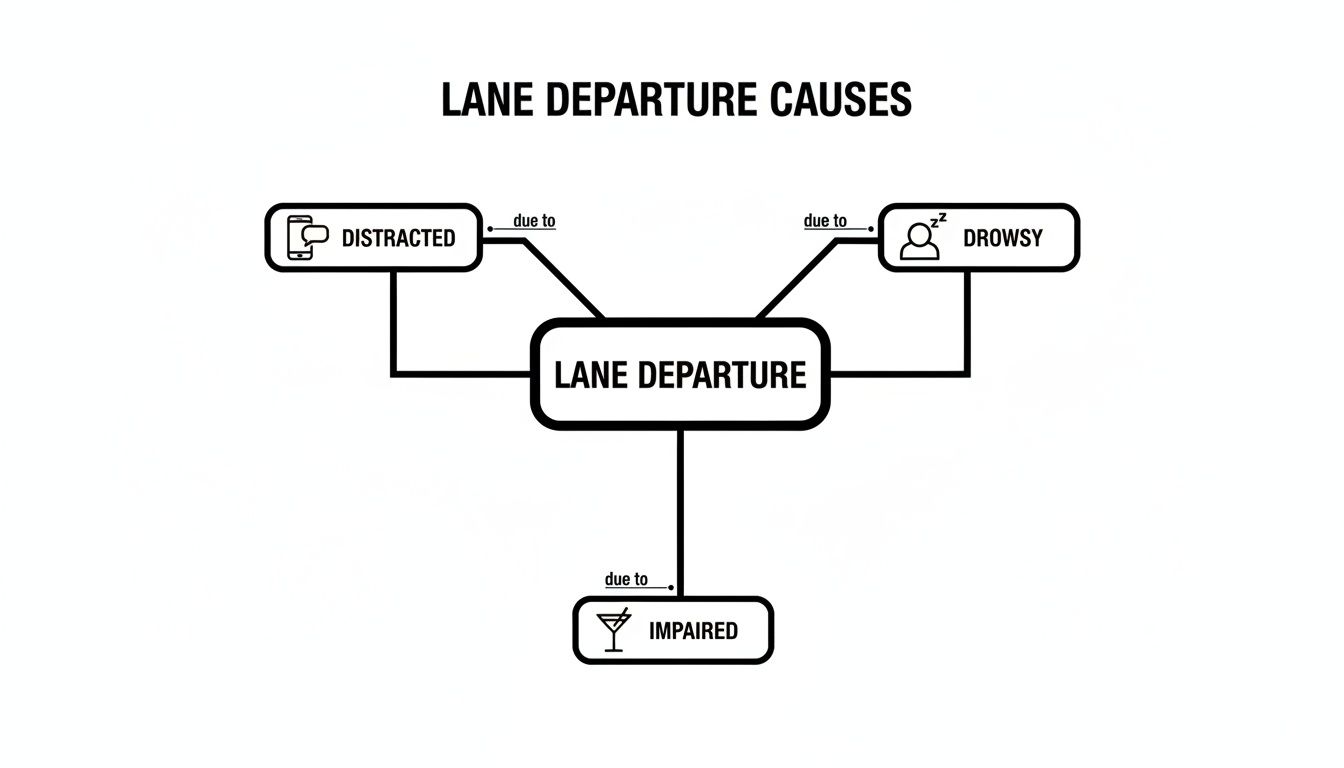
As you can see, the usual suspects—distraction, drowsiness, and impairment—are behind most of these dangerous lane departures.
Physical and Witness Evidence
Video is powerful, but don't discount the traditional forms of evidence. What you can find at the scene and what other people saw can provide critical context to back up your claim.
Witness Statements are pure gold. An independent witness—someone with no skin in the game—who saw the other car leave its lane provides incredibly credible testimony. Their account can confirm the details in the police report and shut down any attempts by the other driver to change their story.
The physical evidence left at the scene also tells its own story. This can include:
- Skid Marks: The length and direction of tire marks can help experts figure out how fast the vehicles were going and what they were doing right before impact.
- Vehicle Debris: The location of shattered glass, bits of plastic, and fluid spills helps pinpoint exactly where the collision occurred.
- Property Damage: The dents, scrapes, and crumple zones on both vehicles reveal the angle and force of the impact.
For more serious or complicated crashes, you might need an accident reconstruction expert to piece everything together. These pros use science and engineering to analyze all the physical evidence and create a model showing exactly how the crash unfolded. You can learn more about their role in our guide on what is expert witness testimony. By weaving all of these threads of evidence together, you can build a case that leaves no doubt about who was at fault.
Even when the other driver is clearly at fault for failing to stay in their lane, don't be surprised when their insurance company puts up a fight. Their job is to pay out as little as possible, and they have a playbook of common legal defenses they use to shift the blame.
Knowing these arguments in advance is your best preparation. It helps you see their strategy coming and build a strong case to shut it down.
The Sudden Emergency Defense
A classic argument is the "sudden emergency" doctrine. The other driver will claim they had to swerve out of their lane to avoid some unforeseen hazard—a deer jumping into the road, a tire exploding, or debris falling off a truck.
For this to be a legitimate defense, the event really has to be sudden and unexpected. The driver can't have caused the emergency themselves (by speeding, for instance), and their reaction has to be what any reasonable person would have done.
Frankly, this defense often crumbles under investigation. If the driver says they swerved to miss an animal, but there's no physical evidence, their story starts to look thin. If they were texting moments before the so-called "emergency," their argument is even weaker.
An "emergency" that was really caused by the driver's own distraction or bad judgment won't hold up in court. The burden is on them to prove the situation was truly out of their hands.
The Phantom Vehicle Argument
Another common story is the "phantom vehicle" claim. In this scenario, the at-fault driver insists that a mysterious, unknown third car cut them off or forced them off the road, causing them to swerve into your lane. And just like that, the phantom driver conveniently vanishes.
This is where your evidence is everything. Dashcam footage, surveillance video from a nearby business, or a statement from an eyewitness can quickly prove there was no other car. Without any proof, the phantom vehicle defense is usually seen for what it is: a desperate attempt to blame someone who doesn't exist.
The Comparative Fault Accusation
Perhaps the most common tactic of all is simply to blame you. Texas operates under a legal rule called modified comparative fault, which means a jury can assign a percentage of blame to everyone involved. If the insurance company can convince a jury that you were even a little bit at fault, they can reduce their payout.
They might argue you were speeding, distracted, or had a broken taillight. If you're found to be 10% at fault, your total compensation gets cut by 10%. Even more critically, if you are found 51% or more at fault, Texas law says you get nothing. You can learn more about how to challenge these arguments in our comprehensive guide on defenses to negligence.
The scale of lane-change crashes is staggering. The National Highway Traffic Safety Administration reports hundreds of thousands each year, and research shows a huge number of these are caused by simple driver inattention, not unavoidable emergencies. Pushing back against these defenses means being prepared with solid evidence that proves the other driver was the one who made the mistake.
How a Lane Violation Can Make or Break Your Injury Claim
When the police hand the other driver a ticket for failure to maintain lane, it’s a game-changer for your injury claim. That little piece of paper isn't just about a traffic violation; it's the strongest proof you have that their mistake caused your injuries. It’s the legal cornerstone for holding them financially responsible.
Think of that citation as the official starting gun. It proves the other driver was negligent, establishing a clear line from their actions to your harm. From there, the conversation shifts from who is at fault to how much you've lost. This is where we start talking about damages.
Tallying Up the Full Cost of the Crash
Your claim's value isn't just a random number an insurance adjuster pulls out of thin air. It's a calculated total of every single loss you've suffered because of the accident, both tangible and intangible.
Generally, these losses are grouped into two buckets:
- Economic Damages: These are the straightforward, billable costs. We're talking about every dollar spent on medical care (now and in the future), lost income from time off work, and the bill to fix or replace your car.
- Non-Economic Damages: These are just as real, but harder to put a price tag on. This covers the physical pain you've endured, the mental anguish and stress, and how the crash has fundamentally changed your day-to-day life.
Getting a handle on what you can claim is essential. To dive deeper, check out our detailed guide on the types of damages in personal injury cases.
Using Real-World Data to Anchor Your Claim's Value
So, what's a fair settlement for your case? You don't have to guess. The best way to approach this is to look at what actual Texas juries and insurance companies have paid out for similar accidents. Using real-world data takes the emotion out of it and gives you a powerful tool when you're negotiating.
Nailing down the fact that the other driver failed to stay in their lane is the single most important step in proving their negligence. Getting this right can significantly boost your claim's value by shutting down arguments about who was at fault.
The statistics show just how serious these violations are. According to the Insurance Information Institute's findings, failing to keep in the proper lane contributes to 3,230 fatal crashes nationwide. That accounts for 5.6 percent of all categorized fatal collisions, making it one of the most lethal driving errors.
By looking at verdicts and settlements from past "failure to maintain lane" cases, you get a clear picture of what's realistic. It helps you negotiate from a position of strength, armed with hard data, not just what you feel your claim is worth.
For instance, a legal data platform lets you see what cases like yours are actually worth.
This screenshot shows how you can sift through real case results, filtering by the type of accident, the injuries involved, and where it happened. This lets you benchmark your own situation against what's happened before, giving you the confidence to know if an insurance adjuster's offer is truly fair.
What To Do After a Lane Departure Accident
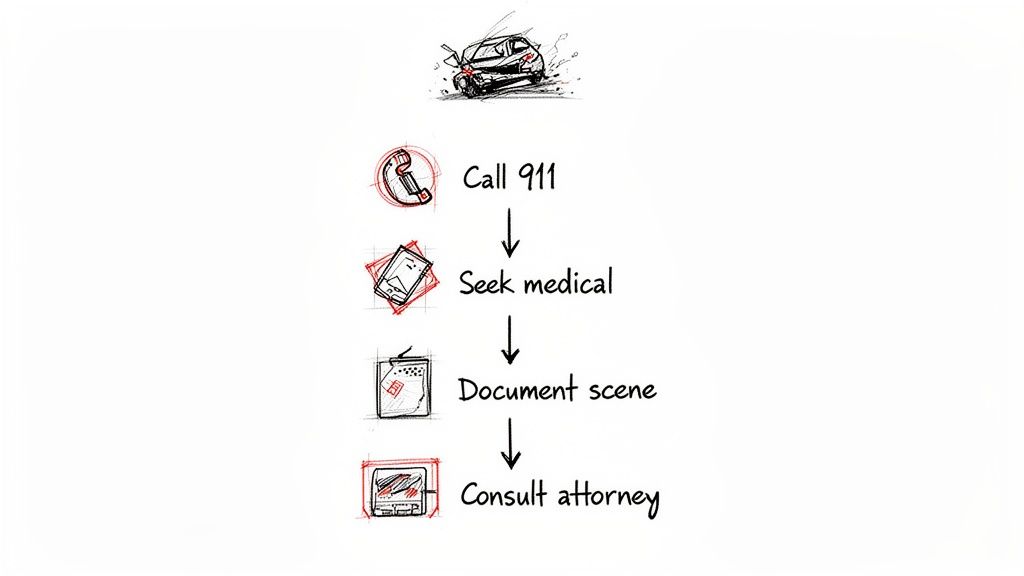
The moments after a car crash are disorienting and stressful. But the steps you take right away can make all the difference for your health and your ability to get fair compensation later on. Taking the right actions from the start is how you build a solid case proving the other driver's failure to maintain lane was the cause of the accident.
Your first move, always, is to check on everyone's safety. Call 911 immediately if anyone is hurt. Even if you feel fine, getting checked out by a doctor is a smart move. Adrenaline can mask serious injuries that only show up hours or days later.
Lock Down the Scene and Gather Proof
Once you know everyone is safe, your next job is to become a detective. The evidence you gather at the scene is pure gold for your claim because it's fresh and unbiased. Memories fade, but photos don't lie.
If you’re physically able, here’s what you need to do:
- Call the Police: No matter what the other driver says, get law enforcement on the scene. The official police report is an objective record of what happened, and if the other driver gets a ticket for a lane violation, that's a huge piece of evidence.
- Take Photos and Videos: Your phone is your most powerful tool. Document where the cars ended up, the damage to both vehicles from every angle, any skid marks on the road, and the general road conditions. If you have visible injuries, take pictures of those, too.
- Find Witnesses: Did anyone else see what happened? Get their name and number. An independent witness who can back up your story is incredibly persuasive.
After you leave the scene, keep gathering information. Start a folder—digital or physical—and put everything related to the crash inside.
Every piece of paper—from a doctor's bill to a note from your employer about missed work—is a building block for your claim. Meticulous organization from day one can prevent major headaches down the road.
This file is where you'll keep medical records, car repair estimates, receipts for things like prescription co-pays, and notes from every conversation you have with an insurance company.
Protect Your Claim and Get an Expert Opinion
Soon after the crash, you'll likely get a call from the other driver's insurance adjuster. Be careful. They are trained to be friendly, but their goal is to pay out as little as possible. Avoid giving a recorded statement or admitting any fault before you've had a chance to speak with an attorney.
The single most important step you can take is to talk to a personal injury lawyer who has experience with car accident cases. They can take over the stressful communications with the insurance company, handle the confusing paperwork, and make sure you don't miss any critical deadlines. A good attorney will help you understand what your claim is truly worth and has the experience to fight for the full compensation you deserve.
Common Questions After a Lane-Change Wreck
After a car wreck, your head is probably swimming with questions. It’s a stressful, confusing time. Let's walk through some of the most common concerns that come up in these "failure to maintain lane" cases.
What If the Other Driver Didn’t Get a Ticket?
This is a big one. Lots of people assume that if the police don't issue a ticket, their case is dead in the water. That's simply not true.
A traffic ticket is helpful, sure, but it’s just one piece of the puzzle. Your personal injury claim is a civil case, completely separate from any traffic court proceedings. We can still build a powerful argument for negligence using other evidence, like witness testimony, dash cam video, and the physical evidence left at the scene. The lack of a ticket just means we'll lean more heavily on that other proof to show what really happened.
Could I Be Blamed Even Though They Hit Me?
It's possible, and it’s something you need to be ready for. Texas operates under a legal rule called modified comparative fault. This means a jury can split the blame, assigning a percentage of fault to each person involved.
Maybe the other driver drifted into your lane, but you were going a little over the speed limit. The insurance company will jump on that, arguing you share part of the responsibility.
Here’s the critical part: In Texas, you can still recover money as long as you are found to be 50% or less at fault. But, your final payout will be cut by whatever percentage of fault is assigned to you. If you're found 51% or more to blame, you get nothing.
Insurance adjusters love to use this rule to try and reduce what they owe you.
How Long Do I Have to File a Claim in Texas?
The clock is ticking from the moment the crash happens. In Texas, the statute of limitations for most personal injury claims is a strict two years from the date of the accident.
If you miss that two-year deadline, your case is almost certainly over before it begins. The court will throw it out, and you'll lose any chance of getting compensation for your injuries. It’s crucial to get the ball rolling quickly to make sure evidence is saved and your rights are protected.
Ready to see what similar cases are actually worth? Verdictly gives you a transparent look at real Texas motor vehicle verdicts and settlements, so you can stop guessing and start negotiating with solid data. Check out comparable cases and see how your claim stacks up by visiting https://verdictly.co.
Related Posts
What to Do After a Hit and Run Car Accident in Texas
A complete guide on what to do after a hit and run car accident in Texas. Learn the critical first steps, your legal options, and how to file a claim.
Calculating pain and suffering car accident: A Practical Guide to Damages
Learn how calculating pain and suffering car accident damages works, with factors and tips to maximize your settlement.
Pain and Suffering Calculation (pain and suffering calculation): Texas Damages
Explore how the pain and suffering calculation works in Texas, including multiplier and per diem methods, to help you estimate your settlement.