
What Is Expert Witness Testimony in Texas Injury Cases
Understand what is expert witness testimony and its crucial role in Texas personal injury claims. Learn how experts can shape the outcome of your case.
In a personal injury lawsuit, some questions are straightforward: What color was the traffic light? What did you hear right after the crash? These are questions for a fact witness—someone who can only testify about what they personally saw, heard, or experienced.
But what about the more complex questions? What was the precise angle of impact? How will this spinal injury affect someone's ability to work for the next 20 years? Answering these requires more than just firsthand observation. It requires expert witness testimony.
Decoding The Role Of Expert Testimony In Texas Law
An expert witness is a qualified professional brought in to help a judge or jury understand technical or scientific issues that are beyond the grasp of the average person. They don't just state what happened; they analyze the facts and explain why it happened and what the consequences are.
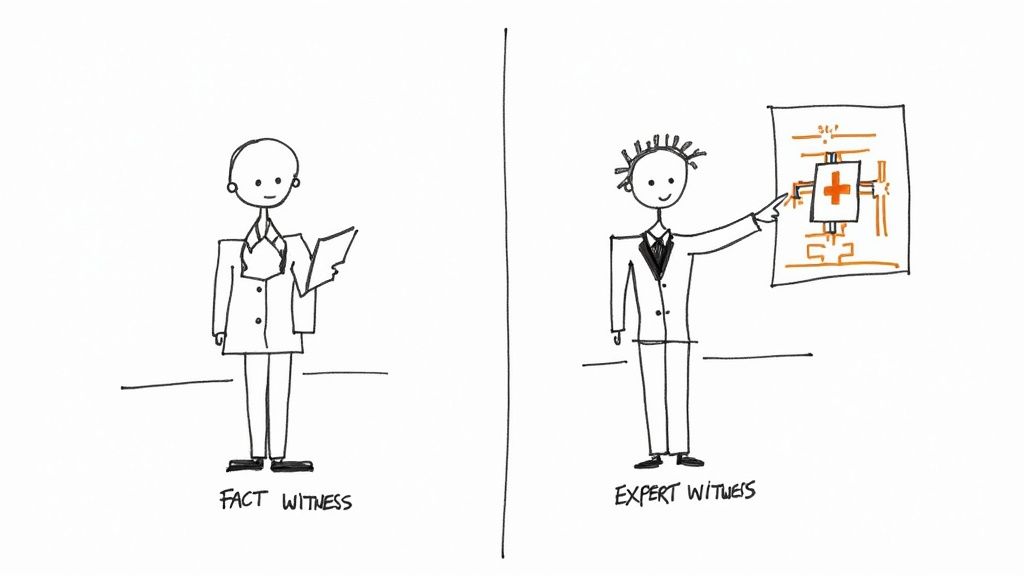
Think of it like this: a fact witness is like a sports fan describing a key play from the stands. They can tell you who had the ball and where they ran. An expert witness is the color commentator, breaking down the play with slow-motion replays, explaining the offensive strategy, and analyzing why a certain defensive formation failed. They add a whole new layer of understanding.
The Power Of Specialized Knowledge
Why is this so important? Because the details of a personal injury case often dive deep into complicated subjects. A jury isn't expected to be fluent in orthopedic surgery, accident reconstruction physics, or economic forecasting. The expert’s job is to bridge that knowledge gap.
Their testimony can be incredibly persuasive. Studies have shown that a juror’s perception of an expert's knowledge and credibility directly influences how they weigh the evidence and, ultimately, their final decision. When an expert can clearly and confidently explain a complex topic, it can be the single most important factor in winning a case.
Distinguishing Fact Witnesses From Expert Witnesses
The fundamental difference between these two types of witnesses boils down to one thing: opinions. A fact witness is strictly forbidden from offering their opinion, while an expert is brought in specifically to do so.
Here’s a quick comparison to make the distinction crystal clear.
Fact Witness vs Expert Witness At a Glance
| Attribute | Fact Witness | Expert Witness |
|---|---|---|
| Permissible Testimony | Can only testify about facts based on direct, personal knowledge. | Can offer opinions and draw conclusions based on their expertise. |
| Basis of Knowledge | Firsthand observation (what they saw, heard, or did). | Specialized education, training, skill, or experience in a field. |
| Purpose in Court | To provide a factual account of events. | To help the jury or judge understand complex evidence. |
So, while a friend who was in the car can describe the immediate pain the victim felt, an orthopedic surgeon (the expert) can analyze MRI scans and explain how the collision caused a specific herniated disc that will require future surgeries.
This expert analysis is essential for proving causation and justifying the full scope of a claim. By connecting the defendant’s actions to the victim's long-term financial and medical needs, they help establish the different types of damages in personal injury cases.
Key Experts in Texas Car and Truck Accident Cases
The aftermath of a serious car or truck accident is often a chaotic mess of tangled metal and conflicting stories. This is where an expert witness comes in. Think of them as translators—they take highly technical, complex evidence and turn it into a logical, compelling story that a judge or jury can actually understand.
In Texas personal injury cases, you'll see a recurring cast of these specialists. They aren't just rattling off facts; they’re building the foundation of the case by answering two critical questions: Who is to blame, and what is the real-life cost of the harm that was done?
The Crash Detective: Accident Reconstructionist
When the police report is vague or both drivers are pointing fingers, an accident reconstructionist is the one who cuts through the noise. These experts are the ultimate crash detectives, using a blend of physics, engineering, and forensic science to figure out precisely what happened in the seconds before, during, and after a collision.
They don't guess—they calculate. By meticulously analyzing things like skid marks, the crush damage on the vehicles, and data from a truck's "black box," they can nail down the facts.
- Vehicle Speed: How fast was everyone really going?
- Collision Sequence: Who hit whom, and from what direction?
- Driver Actions: Did someone slam on the brakes, swerve at the last second, or even accelerate?
- Visibility: Could a driver have even seen the other car, or was their view blocked?
Their work can turn a confusing scene into a crystal-clear sequence of events. For instance, in a multi-car pileup on I-35, a reconstructionist can build a computer simulation that pinpoints the one lane change or sudden stop that triggered the entire chain reaction.
The Medical Storyteller: Medical Experts
Medical records are full of clinical terms and test results, but they rarely capture the human story of an injury. That's the job of a medical expert. Whether it's an orthopedic surgeon, a neurologist, or a pain management doctor, they connect the diagnosis to the victim's actual life.
They break down the complex science into simple terms. A good medical expert can stand in front of a jury with an anatomical model, point to the exact spinal disc that was herniated in a rear-end crash, and explain why that small injury will lead to a lifetime of pain and limitations.
One of their most crucial jobs is establishing causation—making the undeniable link between the crash and the injuries. They also provide a professional opinion on the future medical care someone will need, which is essential for calculating the full, long-term damages.
The Career Forecaster: Vocational Expert
When a catastrophic injury makes it impossible for someone to go back to their old job, how do you measure that loss? You bring in a vocational expert. This specialist acts as a career forecaster, analyzing how the victim's new physical or cognitive limitations have permanently damaged their ability to earn a living.
They dig into the details by:
- Reviewing the person's education, skills, and entire work history.
- Assessing the physical and mental requirements of their former job.
- Identifying what kind of work, if any, the victim can still do.
- Calculating the gap in pay between their old career path and their new, limited one.
This expert gives the jury the numbers they need to see not just the paychecks already lost, but the entire lifetime of diminished earning potential.
The Financial Architect: Economic Expert
Finally, the economic expert takes all the data from the other experts—the future medical bills, the lost earning capacity—and puts a firm, defensible dollar amount on it. They are the financial architects who build a credible damages model for the jury.
Using established economic principles and actuarial tables, they calculate the present-day value of all those future losses. This is a vital step. A dollar for a surgery needed in 20 years isn't worth the same as a dollar today. The economist factors in inflation, life expectancy, and interest rates to arrive at a single number that represents the money needed right now to make the victim whole over their lifetime. Their testimony gives a jury a logical, evidence-based reason for the amount they award.
How Texas Courts Decide if an Expert Can Testify
It’s not enough for someone to have a fancy degree or an impressive title to testify as an expert in a Texas courtroom. The courts are serious about their role as gatekeepers, making sure that any expert testimony a jury hears is genuinely reliable and actually helpful.
Think of it like this: a judge won’t let a chef serve a dish to the jury unless they can prove the recipe is sound, the ingredients are good, and the final product is trustworthy. An expert's opinion carries a lot of weight, so this gatekeeping function is critical to prevent "junk science" or pure speculation from derailing a case.
The Modern Standard for Expert Reliability
Years ago, the test was simpler. Courts often just asked if an expert's theory was "generally accepted" in their field, a standard known as Frye. But that changed. Texas, like the federal system, moved to a more thorough and flexible approach, laid out in a major case called ***E.I. du Pont de Nemours & Co. v.## How Texas Courts Decide if an Expert Can Testify
It’s not enough for someone to have a fancy degree or an impressive title to testify as an expert in a Texas courtroom. The courts are serious about their role as gatekeepers, making sure that any expert testimony a jury hears is genuinely reliable and actually helpful.
Think of it like this: a judge won’t let a chef serve a dish to the jury unless they can prove the recipe is sound, the ingredients are good, and the final product is trustworthy. An expert's opinion carries a lot of weight, so this gatekeeping function is critical to prevent "junk science" or pure speculation from derailing a case.
The Modern Standard for Expert Reliability
Years ago, the test was simpler. Courts often just asked if an expert's theory was "generally accepted" in their field, a standard known as Frye. But that changed. Texas, like the federal system, moved to a more thorough and flexible approach, laid out in a major case called E.I. du Pont de Nemours & Co. v. Robinson. This is often called the Daubert standard, named after the federal case it mirrors.
Under this modern Texas standard, a trial judge must be satisfied on two key points before an expert ever speaks to the jury:
- Reliability: Is the expert’s opinion based on solid principles and methods?
- Relevance: Will the testimony actually help the jury understand the evidence or decide a key fact in the dispute?
This careful approach isn't just a Texas trend. As legal battles have grown more technical, courts worldwide have had to figure out how to properly integrate expert knowledge to reach fair outcomes. You can learn more about the international evolution of expert testimony and its impact on modern law.
This flowchart shows how the big questions in a car wreck case naturally lead to the need for different kinds of experts.
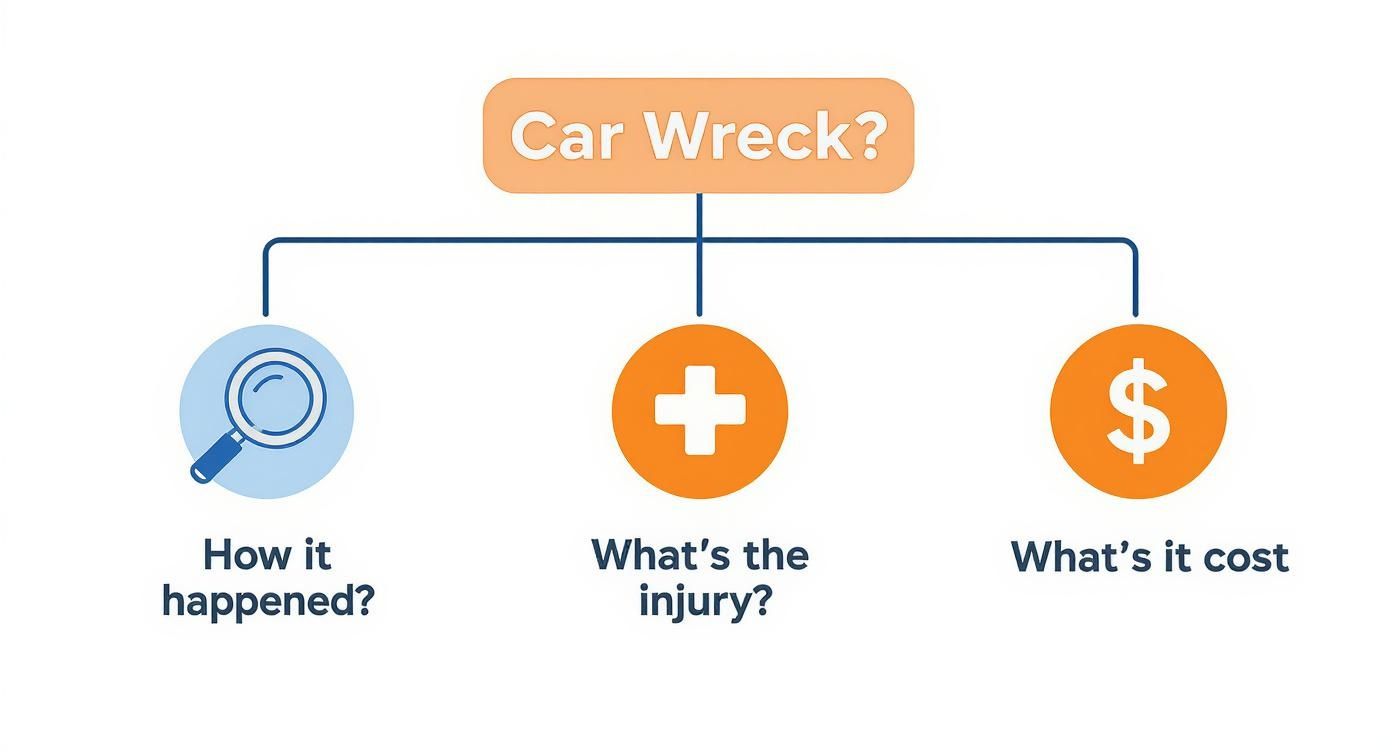
As you can see, figuring out how the crash happened, what injuries it caused, and what it all costs financially often requires specialized knowledge that a jury simply wouldn't have on its own.
The Six Robinson Factors for Scrutiny
So, how does a judge decide if an opinion is "reliable"? They use a quality-control checklist, often referred to as the Robinson factors. These aren't rigid rules, but they are the key questions a judge will ask about an expert's work.
- Testability: Can the expert's theory be tested to see if it’s false? If a theory can't be challenged, it’s not considered good science.
- Peer Review and Publication: Has the theory or method been published in professional journals and scrutinized by other experts? This shows it has stood up to review by the scientific community.
- Known Potential Rate of Error: How often is the technique or theory wrong? A method with a high error rate isn't reliable enough for the courtroom.
- General Acceptance: While it's no longer the only test, the fact that a method is widely accepted in its field is still a powerful sign of its reliability.
- Non-Judicial Uses: Has this method been used for anything other than a lawsuit? If a technique was developed purely for litigation, it raises a red flag.
- Subjective Interpretation: How much of the opinion is based on the expert’s personal judgment versus objective data? The less subjective, the better.
Key Takeaway: An expert can’t just offer up a conclusion. They have to show their work and prove that their methods are sound, objective, and based on more than a hunch.
In the end, the trial judge makes the call. If they believe an expert's methodology is flawed or their conclusion is an unsupported leap, that testimony gets thrown out. This entire process is designed to ensure that the expert opinions a jury hears are not just compelling, but fundamentally trustworthy.
How Expert Testimony Drives Settlements and Verdicts
Expert testimony does a lot more than just break down complicated topics for a jury. In a personal injury case, it’s the engine that powers the financial outcome, shaping everything from early settlement talks to the final number in a verdict.
The whole process often kicks off when an expert drafts their detailed, evidence-based report. This document is far more than just paperwork; it’s a strategic weapon. When your attorney shares a compelling report from a top-notch accident reconstructionist or a life care planner with the other side, it sends a powerful message about the strength of your case.
This sneak peek gives the insurance company a clear picture of how you’ll prove fault and calculate your damages. When they’re staring down the barrel of a well-reasoned, defensible expert opinion, they’re suddenly much more willing to offer a fair settlement. Why? To avoid the risk and cost of a trial they now know they’ll probably lose. You can discover more about car accident settlements and see how experts fit into the bigger picture in our complete guide.
Shaping Settlement Negotiations
Once negotiations start, those expert reports become the foundation of your attorney’s arguments. They swap out guesswork for hard data, giving your claim real, quantifiable value.
For instance, an economic expert can project a lifetime of lost wages down to the penny. A vocational expert can then explain exactly how a specific injury wipes out future job opportunities, putting a concrete number on that loss. These figures are what give your attorney serious leverage.
A strong expert opinion transforms the negotiation from a debate over subjective pain into a data-driven discussion about measurable financial losses. This shift often forces the defense to increase their settlement offer significantly.
This is also where the "battle of the experts" often begins, long before trial. Attorneys exchange reports and poke holes in the opposing expert’s analysis. Having a credible, well-prepared expert in your corner gives you a huge advantage, often pushing the case to a favorable resolution without ever setting foot in a courtroom.
Influencing a Jury's Decision at Trial
If the case doesn't settle and heads to trial, the expert's role becomes even more direct and powerful. Now, they aren’t just trying to convince an insurance adjuster; they're educating and persuading a jury. A gifted expert can take an abstract idea like "future medical needs" and make it tangible, real, and completely justifiable.
Their true skill lies in making the complex simple.
- A neurosurgeon might use an anatomical model to show the jury the precise mechanics of a spinal cord injury.
- An accident reconstructionist could present a 3D animation of the crash, turning a chaotic event into a clear, understandable sequence.
- An economist can use simple charts to illustrate the devastating financial ripple effects of a lifelong disability.
This kind of testimony gives the jury a logical roadmap to follow. It gives them the confidence to award a specific, often large, sum of money because they understand exactly how your team arrived at that number. A credible expert’s testimony can easily be the single most important factor that decides a high-stakes personal injury case.
How to Choose an Expert Witness Who Wins Cases
Picking the right expert witness for your personal injury case is part art, part science. Think of it like scouting a star player for a team. A killer resume full of accolades is nice, but it means nothing if they can't perform when the game is on the line. An expert witness has to do more than just know their stuff; they need to break it down in a way that’s credible, compelling, and crystal clear to a jury.
Seasoned legal teams know this selection process is a make-or-break strategic decision. An expert with a list of credentials a mile long but a terrible "bedside manner" in the courtroom can sink your case faster than you can say "objection." The goal isn't just to find an authority; it's to find a gifted teacher.
Look Beyond the CV: Qualifications and Real-World Experience
Naturally, the first thing you'll do is check their credentials. You have to scrutinize their education, professional licenses, published work, and hands-on experience in their specific field. This isn't just about finding someone smart—it’s about making sure their qualifications can survive a legal challenge from the other side.
But a solid CV is just the ticket to the game. A truly great expert has a deep well of practical, real-world experience to draw from. Take a medical expert, for example. One who still actively treats patients is almost always going to be more persuasive than an academic who has spent the last 10 years just testifying in lawsuits. That connection to the real world grounds their opinions in what's happening right now.
The ultimate test for any expert is their knack for turning dense, technical jargon into simple, persuasive truths. A brilliant mind is useless if the jury is just staring back with blank faces. The best experts are storytellers; they use their specialized knowledge to build a narrative that is both logical and memorable.
The Art of Communication and Building Credibility
Without a doubt, the single most critical skill for an expert witness is communication. They must have the ability to deconstruct highly technical concepts—like the biomechanics of a high-speed collision or the lifelong effects of a traumatic brain injury—into plain, simple English.
To pull this off, they often rely on a few key tools:
- Powerful Analogies: Comparing a herniated spinal disc to a leaky jelly donut. It just clicks.
- Visual Aids: Using anatomical models, accident reconstruction animations, or simple diagrams to show exactly what happened.
- Clear Language: Intentionally ditching the academic-speak for straightforward explanations that everyone in the room can follow.
Credibility is just as vital. Juries are smart, and they can spot a "hired gun" from a mile away—that expert who seems to have a full-time job testifying for plaintiffs or defendants. The most effective experts project an air of objectivity and unwavering professional integrity. Their opinions are built on a foundation of verifiable data and accepted scientific principles, not just on what the lawyer who hired them wants the jury to hear.
Vetting for Weak Spots and Preparing for Cross-Examination
Before you ever sign an expert, you need to play devil's advocate and hunt for their weaknesses. This means digging deep into their history of prior testimony. Has this expert ever contradicted their current opinion in a previous case? Do they have a known bias toward one side or the other? Any skeletons in their professional closet will almost certainly be rattled loose during cross-examination.
This vetting process also includes a gut check on how they’ll hold up under the heat of cross-examination. A great expert has to stay calm, confident, and professional, even when the opposing attorney is coming at them aggressively. If they get flustered, defensive, or argumentative on the stand, they can lose the jury’s trust in an instant. This is exactly why many attorneys run mock depositions—to see how their potential expert performs under fire before it's too late.
Picking the right expert involves a lot more than a simple Google search. It requires a thoughtful approach to vetting their entire professional persona. The following table outlines some of the crucial questions every attorney should ask.
| Evaluation Area | Key Questions to Ask | Why It Matters |
|---|---|---|
| Qualifications & Expertise | - Is your experience directly relevant to the specific issues in this case? - How much of your time is spent on clinical/field work versus litigation work? | Establishes foundational credibility and ensures their expertise is current and practical, not just theoretical. |
| Communication Skills | - Can you explain [complex concept] to me as if I were a high school student? - What is your experience with creating and using visual aids? | Tests their ability to be a "teacher" for the jury. An expert who can't simplify concepts is an expert who can't persuade. |
| Prior Testimony History | - Have you ever testified for the opposing counsel or their firm? - Have any of your opinions been excluded by a court? If so, why? | Uncovers potential conflicts of interest, biases, or past professional stumbles that could be used against them in court. |
| Demeanor & Temperament | - How do you handle aggressive questioning? - Can you provide an example of a time you were challenged on the stand? | Gauges their ability to remain poised and professional under pressure. A calm expert appears more credible than a defensive one. |
| Objectivity & Bias | - What percentage of your expert work is for plaintiffs versus defendants? - Are your opinions based on industry-accepted methodologies? | Helps identify a potential "hired gun" reputation. An expert who appears objective is far more persuasive to a jury. |
By working through these questions, you can move past the resume and find an expert who not only has the right credentials but also the communication skills and courtroom presence to truly make a difference in the outcome of your case.
Common Questions About Expert Witness Testimony
Let's move from the theoretical to the practical. To really wrap your head around this topic, it helps to look at the questions that come up time and time again in real-world Texas personal injury cases. Here are a few straightforward answers to clarify how experts actually function in the legal system.
How Much Does an Expert Witness Cost?
This is the big one, and the answer is: it depends. The cost of an expert witness can swing wildly based on their specialty, their reputation, and just how tangled the case is. For instance, a respected medical specialist or a top-tier accident reconstructionist in Texas can command anywhere from $400 to well over $1,000 per hour.
And that hourly rate isn't just for their time on the stand. It covers everything—poring over case files, drafting exhaustive reports, preparing for depositions, and, of course, testifying in court. In a complicated car wreck case, it's not unusual for the total bill for just one expert to run into the tens of thousands of dollars. This makes hiring an expert a major strategic and financial commitment.
Can an Expert Give an Opinion on Who Was at Fault?
They can get right up to the line, but they can't cross it. Under Texas Rule of Evidence 704, an expert's testimony isn't thrown out simply because it touches on an "ultimate issue" that the jury has to decide. An accident reconstruction expert can absolutely testify that, based on the evidence, a truck driver’s failure to brake was the direct cause of the crash.
What they can't do is offer a pure legal conclusion. The expert can't say the defendant was "negligent"—that's the final legal call reserved for the jury. Their job is to build the scientific and factual bridge that helps the jury walk over to that conclusion on their own. To dig deeper into this, it’s worth understanding the nuances of comparative negligence in Texas.
What Happens if an Expert Is Disqualified?
If a judge boots your expert after a Daubert or Robinson hearing, it can be a catastrophic setback. A disqualification means that person is completely barred from testifying at trial.
Imagine your entire case hinges on proving the crash caused a specific, complex back injury. If the medical expert hired to connect those dots gets disqualified, your claim could fall apart, and you might even face a summary judgment.
The Bottom Line: The risk of disqualification is precisely why good lawyers are so meticulous about vetting their experts. Finding a professional with a rock-solid methodology and impeccable credentials isn't just a "nice to have"—it's an absolute necessity for building a case that can survive an attack from the other side.
At Verdictly, we believe that transparent data empowers better decisions. Our platform provides access to real Texas motor vehicle case summaries, including insights from expert testimony, to help you understand what your case might be worth. Explore real verdicts and settlements at https://verdictly.co.
Related Posts
A Texas Guide to Loss of Consortium Claims
Understand what loss of consortium means in Texas. This guide explains who can file, the evidence required, and how these complex claims are valued.
Hit and Run What Happens: Steps After an Accident - hit and run what happens
Hit and run what happens: A concise guide to immediate actions, the investigation process, and how to pursue fair compensation. (hit and run what happens)