
What Is the Litigation Process: what is litigation process Explained Simply
Discover what is litigation process in plain terms: a clear guide from filing to verdict, with practical steps for your case.
So, what exactly is litigation? When you can't resolve a legal dispute through informal talks, litigation is the formal, structured process for handling it in court. It's the official pathway for seeking justice and compensation after you've been injured.
Your Roadmap Through a Personal Injury Lawsuit
The word "litigation" can sound pretty intimidating, bringing to mind images of complex courtroom dramas and confusing legal jargon. But it's much more manageable when you think of it as a journey with a clear, logical sequence of steps. Each stage is a signpost, guiding you from the moment of injury to a final resolution.
This guide will serve as your map. While our main focus is on personal injury and motor vehicle accident cases in Texas, the fundamental stages are largely the same for civil lawsuits across the country. Every lawsuit has two main parties:
- The Plaintiff: This is the injured person who is filing the lawsuit to seek compensation.
- The Defendant: This is the person or company being sued, the one accused of causing the harm.
The whole point of the process is to create a structured environment where both sides can present their evidence, make their arguments, and ultimately reach a conclusion—either by agreeing to a settlement or by having a judge or jury decide.
It's a fact that most personal injury claims get settled long before a lawsuit is ever filed. But knowing what happens when they don't is what gives you leverage. If you're just starting, it's a good idea to understand the basics of what constitutes a personal injury claim to get the full picture.
This flowchart maps out the basic journey from injury to negotiation and, potentially, a court verdict.
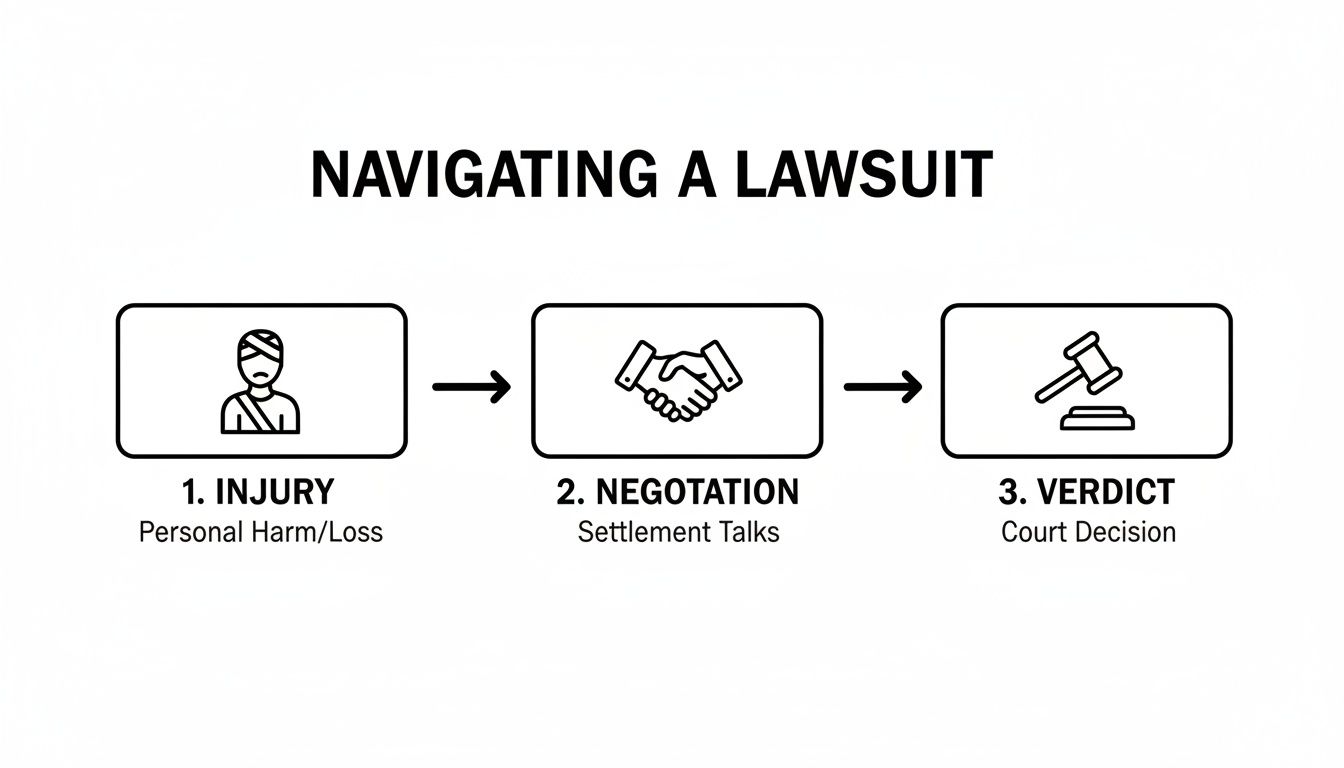
As the graphic shows, while a trial verdict is the ultimate end of the road, negotiation is a huge part of the process—it's where the vast majority of cases are resolved.
Before we break down each step in detail, here's a quick look at the major phases you can expect on this journey.
The Core Stages of a Personal Injury Lawsuit
| Stage | Primary Goal | Key Activities |
|---|---|---|
| Pre-Suit | Settle the claim without court intervention. | Investigating the incident, gathering medical records, sending a demand letter, and negotiating with the insurance adjuster. |
| Pleadings | Formally start the lawsuit and define the legal arguments. | The Plaintiff files a Petition (Complaint), and the Defendant files an Answer. |
| Discovery | Exchange information and evidence between both sides. | Written questions (Interrogatories), requests for documents, and depositions (sworn testimony). |
| Motions & Mediation | Resolve legal issues and attempt a final settlement. | Filing motions to narrow issues for trial; attending mandatory mediation to negotiate a resolution. |
| Trial | Present the case to a judge or jury for a final decision. | Jury selection, opening statements, presenting evidence and witnesses, closing arguments, and receiving a verdict. |
| Post-Trial | Enforce the verdict or appeal the decision. | Finalizing the judgment, collecting payment, or filing an appeal if there were legal errors. |
This table gives you a bird's-eye view. Now, let's zoom in on what really happens at each of these stages.
Why Is There a Formal Process, Anyway?
You might be wondering why we need all these formal rules. The simple answer is fairness. Without a structured process, legal fights could become chaotic, endless battles. The rules of litigation create a level playing field.
At its heart, the litigation process is designed to ensure a resolution is based on evidence and law, not on who has more power or resources. It's a system for uncovering the truth.
Every step, from filing the first piece of paper to hearing the final verdict, is there for a reason: to move the case steadily toward a just and final conclusion. In the sections that follow, we'll walk through each of these stages one by one. By the end, the whole system will feel less like a maze and more like the predictable path it’s meant to be.
The Pre-Litigation Phase: Where Most Cases Are Really Won
If you've only seen legal battles play out on TV, you probably picture dramatic courtroom showdowns. The reality is that the most critical work in a personal injury case happens long before anyone ever steps foot in front of a judge. This all-important stage is called the pre-litigation phase.
Think of it as building your case brick by brick. It’s a meticulous process of investigation, documentation, and strategic negotiation aimed squarely at settling the claim with the at-fault party's insurance company. The simple truth is that the vast majority of personal injury cases are resolved right here, making this the single most important part of the journey for most clients.
Success at this stage boils down to one thing: building such a strong, evidence-backed case that you convince the insurance company that paying you fairly now is a much better financial decision for them than fighting you in court and losing later.
Gathering Your Ammunition: Evidence is Everything
The moment an accident happens, a clock starts ticking. Evidence doesn't wait around—memories get fuzzy, witnesses can be hard to track down later, and physical proof can be lost forever. The immediate goal is to lock down every piece of information that tells the story of what happened and proves the full extent of your injuries and losses.
This isn't a casual affair; it's a full-blown investigation. Some of the key moves include:
- Documenting the Scene: This means grabbing photos and videos of everything—the crash site, the damage to all vehicles, and any visible injuries.
- Securing Witness Statements: We need to find anyone who saw what happened and get their story while the details are still fresh in their minds.
- Getting the Official Report: The police report is a vital, objective summary of the incident from a neutral third party.
- Preserving Key Evidence: A crucial step is sending a spoliation letter. This is a formal legal notice that tells the at-fault party they have a duty to preserve things like their vehicle's black box data or any relevant surveillance footage.
At the same time, you have to be just as diligent about documenting your medical treatment. That means going to every single doctor's appointment, following your treatment plan to the letter, and keeping a detailed file of every bill, diagnosis, and prescription. This medical file becomes the hard proof of what you’ve been through.
The Demand Letter: Your Case on Paper
Once your doctor says you’ve reached Maximum Medical Improvement (MMI)—meaning you’ve either fully recovered or your condition is as good as it's going to get—it's time to put all that gathered evidence to work. Everything gets packaged into a single, comprehensive document: the demand letter.
This is so much more than just a letter asking for money. A properly written demand letter is your entire case argued on paper. It lays everything out logically for the insurance adjuster:
- The Facts: A clear, step-by-step story of how the accident happened.
- Liability: A breakdown of why their insured is legally at fault, pointing to specific evidence and traffic laws.
- Injuries: A complete summary of your medical diagnoses, the treatments you endured, and what your doctors expect for your future.
- Damages: An itemized list of all your financial losses (special damages) like medical bills and lost income, plus a calculation for your non-financial losses (general damages) like pain and suffering.
The demand letter wraps up with a specific dollar amount you are demanding to settle the case. It’s the opening shot in the negotiation battle, forcing the insurance company to take your claim seriously and put a value on it.
The insurer’s adjuster will take this package, review it, and almost always come back with a lowball counteroffer. This is completely normal, and it officially kicks off the back-and-forth negotiation process. Your attorney will use the mountain of evidence you've built to push back and fight for a fair number. If you can agree on a figure, the case settles. If not, it’s time to take the next step and file a lawsuit.
Kicking Things Off: Filing the Lawsuit
When settlement talks with the insurance company stall out, it’s time to take the fight to a new arena: the courthouse. This is the point where your claim officially becomes a lawsuit, moving from informal negotiation to a formal legal battle. You’re no longer just asking for compensation; you’re demanding it under the authority of the court.
This stage is driven by paperwork, but it's the most critical paperwork of the entire process. It all starts when your attorney drafts and files a document known in Texas as an Original Petition. (In many other states, it's called a Complaint.)
Think of the Petition as the opening chapter of your legal story. It’s not just a summary of what happened; it’s a formal, structured document that lays out your entire case for the court and the other side to see.
What is an Original Petition?
The Original Petition is the document that officially starts the lawsuit. It’s a precisely written legal instrument designed to do a few very important things.
First, it identifies everyone involved—that’s you (the plaintiff) and the person or company you’re suing (the defendant). It then explains why this particular court has the authority to hear the case. From there, it tells the story of the accident, clearly connecting the defendant's negligence to your injuries and losses.
Finally, it wraps up with what's called a "prayer for relief." This is just the legal term for stating what you're asking the court to award you, which is almost always monetary damages to cover everything you've been through.
Filing the Original Petition with the court clerk is the official starting gun for the lawsuit. It turns a private insurance dispute into a public legal case, subject to strict rules and deadlines, and formally notifies the defendant that things have escalated.
Jurisdiction and Venue: Choosing the Right Courthouse
Before a single page is filed, your lawyer has to figure out exactly where to file it. This boils down to two key legal concepts:
- Jurisdiction: Does this court have the legal authority over the people and the subject matter involved?
- Venue: Of all the courts that have jurisdiction, which one is the correct geographic location for the lawsuit?
In a typical Texas car wreck case, jurisdiction isn't usually a major hurdle. The real strategic decision often comes down to venue. The rules generally say you can file in the county where the collision happened or where the defendant lives. Picking the right venue can affect everything from travel logistics to the potential jury pool, so it's a decision your attorney will weigh carefully.
Making it Official: Service of Process
Once the Petition is filed, you can't just text a copy to the defendant and call it a day. The law demands a formal delivery procedure called service of process. This is a crucial step that protects the defendant’s constitutional right to due process—they have to be officially notified they’re being sued and given an opportunity to respond.
This is where a neutral third party, like a sheriff's deputy or a private process server, steps in. They personally hand-deliver a copy of the lawsuit and a citation (a formal summons from the court) to the defendant. This isn't optional. Without proper service, the court can't proceed, and your case is stuck in neutral.
Once served, the clock starts ticking for the defendant. They have a strict deadline to file their formal response, a document called an Answer. In the Answer, they must go through your Petition line by line and either admit, deny, or state they don't have enough information to respond to each allegation. This document is their opening move, and it officially draws the battle lines for the rest of the lawsuit.
Uncovering the Truth During the Discovery Phase

Once the initial lawsuit papers are filed, we dive into what is usually the longest and most revealing stage of any case: discovery. This is the formal, court-supervised process where both sides are legally required to lay their cards on the table. The whole point is to prevent "trial by ambush," making sure everyone knows what evidence the other side has long before stepping into a courtroom.
Think of it as a mandatory information exchange. This is where the real detective work happens, leveling the playing field and giving both sides a hard look at the case's true strengths and weaknesses. Depending on how complex your personal injury claim is, this phase can stretch on for many months, sometimes even over a year.
The Essential Tools of Discovery
To get to the bottom of things, lawyers have a few powerful legal tools in their arsenal. Each one is designed to pull out a specific type of evidence, from written facts to live testimony. In a typical Texas car accident case, you'll almost certainly see the main discovery methods in action.
Here are the workhorses of the discovery process:
- Interrogatories: These are basically written questions that one side sends to the other. The recipient has to answer them in writing and under oath. For example, the defendant might be asked to list every single person they spoke to right after the crash.
- Requests for Production: This is a formal demand for documents and other tangible things—photos, videos, you name it. A plaintiff’s attorney would use this to get their hands on a truck driver's safety logs or the other driver's cell phone records from around the time of the wreck.
- Requests for Admission: These are simple, direct "yes or no" questions meant to get the other party to admit or deny specific facts. This really helps narrow down what's actually in dispute, so we don't waste time at trial arguing over things everyone already agrees on.
These written tools build the foundation of the case, creating a paper trail of sworn statements and hard evidence that helps paint a much clearer picture of what really happened.
The Deposition: A Live Rehearsal for Trial
Probably the most well-known part of discovery is the deposition. This is where a witness—the plaintiff, the defendant, a police officer, or a medical expert—is questioned live and under oath by the opposing attorney. It doesn't happen in a courtroom but usually in a conference room, with a court reporter transcribing every single word.
A deposition is a critical preview of how a witness will perform at trial. It locks in their testimony, making it very difficult for them to change their story later. That sworn transcript can be used in court to challenge any inconsistencies.
For example, if you're the injured party in a car wreck case, the defendant's lawyer will depose you. They'll grill you with detailed questions about the crash, your injuries, your medical history, and how all of this has upended your life and ability to work. It can feel intense, but it's an absolutely essential step in building your case.
Why Discovery Matters So Much
The discovery phase truly shapes the outcome of a lawsuit. As both sides start collecting police reports, medical records, expert opinions, and sworn testimony, the fog of uncertainty begins to lift. This is often the point where the true value of a case becomes clear, pushing everyone toward a more realistic settlement negotiation.
The sheer volume of information to sift through has exploded in recent years. A 2025 survey from Opus 2 found that 93% of litigation teams report the amount of data they handle is growing, and many are struggling to find the key documents in a flood of videos and social media posts. This makes having a skilled legal team who knows how to manage discovery more crucial than ever.
By bringing all the relevant facts to light, discovery ensures that any settlement or verdict is based on a complete and honest understanding of the case.
Navigating Mediation and Pre-Trial Negotiations
Once discovery wraps up and all the evidence is on the table, the lawsuit enters a new, decisive phase. Before anyone even thinks about stepping into a courtroom, two key events often determine the outcome: pre-trial motions and mediation. This is where legal strategy gets intense, and it’s precisely where the vast majority of personal injury cases are resolved.
Think of it as the final, high-stakes negotiation before you reach the point of no return. Both sides have laid their cards out, and now they have to decide: is a guaranteed settlement a better bet than the roll of the dice at trial? This is where having a solid grasp of the process really helps manage everyone's expectations.
Clearing the Path with Pre-Trial Motions
Leading up to mediation, lawyers often file pre-trial motions, asking the judge to rule on specific legal issues. One of the most significant is the Motion for Summary Judgment. In short, this motion argues that the core facts of the case are so one-sided and clear that there's no genuine dispute for a jury to even consider.
An attorney files this motion hoping the judge will agree, rule in their favor, and end the case right then and there. It’s a tough motion to win in personal injury cases where facts are almost always in dispute, but when successful, it brings the lawsuit to a screeching halt, saving a ton of time and money.
The Mediation Room: Where Most Cases Settle
In Texas, the courts require most civil lawsuits, including personal injury claims, to go through mediation before they’re allowed to go to trial. This isn’t a dramatic courtroom battle; it’s a structured, confidential negotiation session led by a neutral third-party expert known as a mediator.
The mediator’s sole job is to help both sides find a path to a settlement they can both live with. They can’t force anyone to agree to anything. Instead, they act as a skilled go-between, moving from one party's room to the other, candidly discussing the strengths and weaknesses of each position and exploring creative compromises. For many people, this is the first time they’ve been in the same building as the other side since the day of the incident.
Mediation is the ultimate opportunity for both the plaintiff and the defendant to take control of their own destiny. It allows them to craft their own resolution rather than handing that power over to a jury of strangers.
Because of this, an overwhelming number of cases get resolved at this stage. A settlement provides certainty, closes a difficult chapter, and completely avoids the financial and emotional drain of a trial. The initial demand package, which we break down in our guide on writing an effective settlement demand letter, sets the stage for these critical negotiations.
Preparing for a Successful Negotiation
A successful mediation isn't something you just show up for; it’s the result of serious preparation. Your attorney will put together a confidential mediation statement for the mediator, highlighting your best arguments and strongest evidence. This is where all the hard work from discovery—the depositions, documents, and expert reports—is leveraged to show just how strong your claim is.
This negotiation-heavy phase isn't unique to personal injury cases; it’s happening all across the legal world. For instance, the 2025 Litigation Trends Survey from Norton Rose Fulbright found that corporations juggled an average of 62 lawsuits in 2024. In fact, 73% of them were actively filing lawsuits as plaintiffs, showing just how common it is to use the legal system to resolve disputes.
If you can’t hammer out an agreement in mediation, the case is officially placed on the court’s trial docket. That means you're now in line, waiting for your day in court.
Going to Trial and Seeking a Final Verdict
So, what happens to that tiny fraction of cases that just can’t find a middle ground through settlement? They head to trial. While TV shows paint a picture of dramatic, last-minute confessions on the stand, a real trial is a far more structured and methodical affair. This is the final showdown where both sides get to lay out their story for a neutral audience—the jury.
Everything done up to this point—the discovery, the depositions, the motions—was all in preparation for this moment. The goal shifts completely from negotiation to persuasion. Each attorney's job is to take all the evidence and weave it into a compelling story that convinces a jury their client’s version of the facts is the right one. The stakes couldn't be higher, as the power to decide the outcome is now completely out of the parties' hands.
The Anatomy of a Courtroom Trial
Trials don't just happen; they follow a very specific script designed to give each side a fair shot. Think of it as a series of building blocks, each one laying the foundation for the next, all leading the jury toward a final decision.
Here’s how it typically unfolds:
- Jury Selection (Voir Dire): This is where it all begins. Attorneys for both sides get to question a pool of potential jurors to find out if they have any preconceived notions or biases. The whole point is to assemble a jury that can hear the case fairly and impartially.
- Opening Statements: Once the jury is picked, each lawyer gives a preview of their case. It’s like the "coming attractions" for the trial—they lay out a roadmap of what they intend to prove and what the evidence will ultimately show.
- Presentation of Evidence: This is the main event. The plaintiff's attorney goes first, calling witnesses to testify and introducing evidence like medical bills, accident reports, or photos of the scene.
- Cross-Examination: After a witness testifies for one side, the other side’s attorney gets a turn to ask questions. This is a crucial part of the process, used to poke holes in the testimony, challenge a witness’s memory, or expose any inconsistencies.
- Closing Arguments: With all the evidence in, each lawyer gets one last chance to speak directly to the jury. They connect the dots, summarize the evidence in the most favorable way, and make their final, persuasive pitch for why the jury should find in their client’s favor.
Deliberation and the Final Verdict
After closing arguments, the judge reads a set of legal instructions to the jury and gives them a document called the "Jury Charge." This document is essentially a list of questions the jury must answer to decide the key issues in the case. The jurors then head back to a private room to deliberate. There, they’ll sift through all the evidence and testimony to decide who was at fault and, if they find the defendant liable, figure out how much money to award for damages.
When they’ve reached a decision, they come back to the courtroom and announce the verdict. The judge then makes it official by signing a Judgment, which is the court's final, binding order.
The trial phase is often the most expensive and time-consuming part of a lawsuit. The costs for expert witnesses, creating trial exhibits, and the sheer amount of attorney time required can be staggering. This financial reality is a huge reason why over 95% of cases settle long before they ever see the inside of a courtroom.
This high-risk, high-cost environment has opened the door for new ways to fund these legal battles. Litigation funding has exploded into a $15 billion global industry, giving plaintiffs the financial firepower they might otherwise lack to take a complex case all the way. You can find more insights on how this is changing the game at Darrow.ai. This kind of backing can cover the steep costs of discovery and trial preparation, helping to level the playing field against deep-pocketed defendants.
Common Questions About the Litigation Process
It's completely normal to have a ton of questions when you're staring down the barrel of a lawsuit. Knowing what to expect is the best way to manage your stress and make smart choices for your case.
Let's break down some of the most common worries people have when they're facing a personal injury claim.
How Long Does the Litigation Process Take?
Every case is different, so there's no magic number here. The timeline really depends on how complicated your situation is, how serious your injuries are, and how backed up the local courts are. A simple car wreck case might wrap up in the pre-suit phase in just six to twelve months.
But once you file a lawsuit, things slow down. It’s not unusual for a case to take 18 to 24 months—or even longer—to finally get to trial. The process can get stretched out by things like fighting over who was at fault, dealing with multiple defendants, or waiting until you've finished extensive medical treatment so everyone knows the full extent of your damages. For a much deeper dive on this, check out our guide on how long a civil lawsuit typically takes.
How Much Does It Cost to Hire a Lawyer?
Here’s some good news. For personal injury cases, almost all attorneys work on what's called a contingency fee basis. This is a "no win, no fee" setup. You don't pay anything upfront for the lawyer's time. Instead, their payment comes out as a percentage of whatever you recover, whether it's from a settlement or a jury verdict.
A standard contingency fee is typically between 33% and 40% of the total amount recovered. The bottom line is, if your lawyer doesn't win your case, you don't owe them a dime for their fee.
One thing to be clear on from the start is case expenses. These are the hard costs of running a lawsuit—things like court filing fees, paying for expert witnesses to testify, or ordering all your medical records. You might be on the hook for these, so always read your fee agreement carefully to see exactly how those costs are handled.
What Is the Difference Between a Settlement and a Verdict?
Think of a settlement as a private deal. It’s a voluntary agreement you make with the other side (and their insurance company) to close the case for a specific amount of money. You get a guaranteed outcome, you know exactly what you're getting, and you avoid the stress and uncertainty of a trial.
A verdict, on the other hand, is the decision a judge or jury hands down after hearing all the evidence at trial. It's a gamble. The jury could award you far more than the final settlement offer, but they could also award you far less—or even nothing at all. This is exactly why over 95% of personal injury cases end in a settlement. It’s all about trading risk for certainty.
At Verdictly, we’re firm believers that solid data leads to fairer negotiations. Our platform gives you and your attorney AI-powered insights into real Texas motor vehicle case outcomes, letting you ground your expectations in facts from thousands of similar cases. Explore Verdictly’s case data today.