
What to Do After a Hit and Run Car Accident in Texas
A complete guide on what to do after a hit and run car accident in Texas. Learn the critical first steps, your legal options, and how to file a claim.
A hit and run car accident is what happens when a driver involved in a crash makes the deliberate choice to speed away. They don't stop, they don't check on anyone, and they certainly don't exchange information. That single act of fleeing the scene instantly elevates a simple traffic accident into a criminal offense.
It leaves the victim stranded, often alone, to pick up the pieces.
What Makes an Accident a "Hit and Run"?
Think about the last time you saw a minor fender-bender. The drivers pull over, maybe a little frustrated, but they trade insurance cards and phone numbers. It's a hassle, but it's a civil, predictable process.
Now, imagine that same fender-bender, but instead of pulling over, the other driver stomps on the gas and vanishes into traffic. That's the cold reality of a hit and run car accident. You're left standing on the side of the road with a damaged car, maybe nursing an injury, and absolutely no way to hold the other person accountable.
The key ingredient here is the conscious decision to flee. The driver knows they have a legal and moral duty to stop, but they choose to run instead. This isn't just about avoiding a ticket; it's about evading all responsibility for their actions.
Two Very Different Paths
To really understand the difference, it helps to see how these two scenarios play out.
We can break down the key distinctions between a standard accident and a hit and run in a simple table. This gives you a quick, at-a-glance view of just how different the aftermath is when one driver decides to flee.
Hit and Run vs Standard Accident Key Differences
| Action | Standard Car Accident | Hit and Run Car Accident |
|---|---|---|
| Driver Accountability | Both drivers remain and accept responsibility. | One driver intentionally flees to evade responsibility. |
| Information Exchange | Insurance, contact, and vehicle details are shared. | No information is provided by the fleeing driver. |
| Immediate Aftermath | Focus is on safety, police reports, and insurance. | Focus is on getting medical help and a criminal investigation. |
| Legal Status | A civil matter, handled by insurance companies. | A criminal offense with potential jail time and fines. |
| Victim's Next Steps | File a claim with the at-fault driver's insurance. | File a claim with their own insurance (Uninsured Motorist). |
As you can see, the moment a driver flees, they completely change the game. Instead of a straightforward insurance claim, the victim is now a key witness in a police investigation, all while trying to figure out how to get their own car fixed and medical bills paid.
A hit and run isn't just an accident. It's an act of betrayal against the basic rules of the road we all agree to follow. It puts one person's desire to escape consequences above the safety and well-being of another human being.
This isn't just a local problem, either. The World Health Organization reports that road traffic crashes are the top cause of death for people between the ages of 5 and 29. Drivers who flee the scene only make this global crisis worse, leaving injured people without immediate aid when they need it most.
Your Immediate Steps After a Hit and Run
The screech of tires, the jolt of impact, and then—nothing. Just the tail lights of the other car getting smaller as it speeds away. It’s a chaotic, disorienting experience that can leave you shaken and unsure of what to do next.
But the actions you take in these first few critical moments can make all the difference for your safety, your insurance claim, and any potential legal case. Staying calm and acting deliberately is your best move.
Your absolute first priority is safety. Before anything else, check on yourself and anyone else in the car. Adrenaline is a powerful painkiller, so even if you feel okay, don't assume you're uninjured.
If your car is still drivable, pull it over to a safe spot—the shoulder, a side street, or the nearest parking lot. Getting out of the flow of traffic is crucial to prevent another collision. Flip on your hazards to make sure other drivers can see you clearly.
Call 911 and Document Everything
Once you’re out of harm’s way, call 911 immediately. This is not optional. A police report is the official record of the incident, and your insurance company will absolutely require it. When the police arrive, they create a formal document that proves a hit-and-run occurred.
While you wait for help, it's time to become your own detective. Your memory is a powerful tool, so grab your phone and start a voice memo or a note. Jot down every single detail you can remember about the other car and driver. Don't filter yourself—even a seemingly small detail could be the one that helps police track them down.
- Vehicle Details: What was the make, model, and color? Was it a sedan, a truck, or an SUV? Was it old and beat up, or new?
- License Plate: This is the jackpot. Did you see the whole thing? Even a partial plate—a few letters or numbers—is incredibly useful.
- Unique Features: Think about anything that stood out. A dented bumper, a roof rack, a loud muffler, or even a noticeable bumper sticker.
- Driver Description: If you got a glimpse of the driver, what did you see? Gender, approximate age, hair color, or even what they were wearing can help.
This is the simple, criminal sequence of events in any hit-and-run.
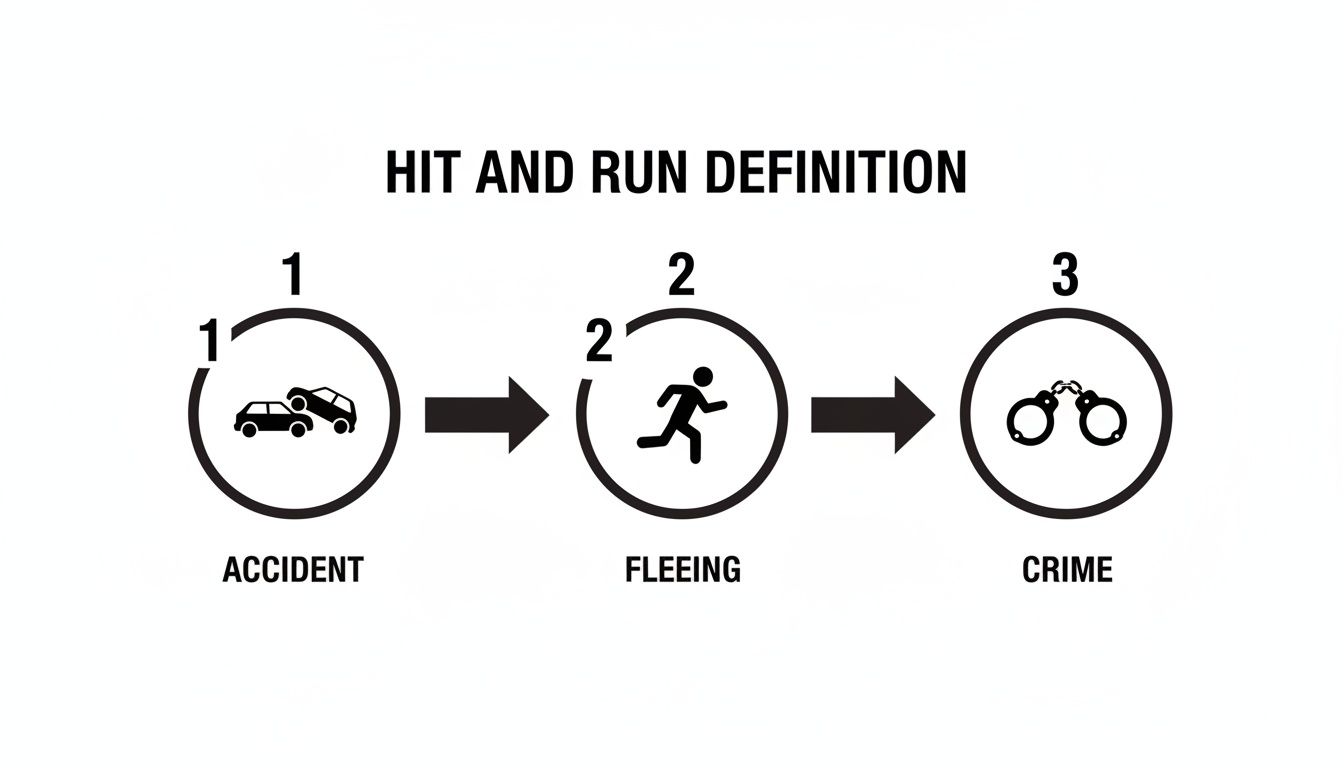
The image breaks it down perfectly: a standard accident turns into a serious crime the second a driver decides to flee instead of facing the consequences.
Gather Evidence From the Scene
Now, use your phone’s camera to document everything. Don't just take one or two pictures; take dozens from every possible angle. You can never have too much evidence. Be sure to capture:
- The damage to your car (close-ups and wider shots).
- Any visible injuries you have.
- Debris left behind from the other vehicle, like paint chips or pieces of a broken headlight.
- The surrounding area, including skid marks, traffic signals, and road conditions.
Take a moment to look around for potential witnesses. Someone at a bus stop, a pedestrian, or an employee at a nearby shop might have seen exactly what happened. If you find someone, politely ask for their name and phone number. A third-party account can be incredibly powerful for your case.
Never, ever chase the fleeing driver. It’s dangerous and rarely ends well. Instead, focus on gathering the information you can right where you are. The global statistics on traffic incidents are sobering. The World Health Organization reports 1.19 million road traffic deaths annually, and hit-and-runs make these situations even more dangerous by delaying medical aid. You can read the full research about these traffic fatality trends to see just why holding these drivers accountable is so critical.
Understanding Texas Hit and Run Laws
When you're the victim of a hit and run, the law can feel confusing and impersonal. But in Texas, the legal code isn't just a dusty rulebook; it's the primary tool for holding an irresponsible driver accountable. Getting a handle on these laws is the first real step toward justice, giving you a clear picture of just how seriously the state takes this crime and what your options are.
Texas law doesn't treat a hit and run like a simple fender-bender or a minor traffic ticket. It’s a major offense, and the consequences get exponentially worse depending on the damage and injuries the fleeing driver leaves behind. The entire legal framework is built on one simple, non-negotiable expectation for every driver on the road.
The Duty to Stop and Render Aid
At the very core of Texas hit and run law is the “duty to stop and render aid.” This isn't just a legal technicality—it's a fundamental moral obligation. It means any driver involved in a crash that injures or kills someone has to stop their vehicle immediately at the scene (or as close as they can without creating more danger).
After stopping, the driver is legally required to:
- Share their name, address, and the registration number of their vehicle.
- Show their driver’s license if asked.
- Provide "reasonable assistance" to anyone who's hurt, which could mean anything from calling 911 to personally transporting them to a hospital.
When a driver makes the choice to flee, they're not just leaving the scene of an accident. They are committing a crime by directly violating this duty. That decision is what elevates the incident, triggering serious penalties that reflect a blatant disregard for human life and safety.
Criminal Consequences for the Fleeing Driver
The penalties for a hit and run in Texas aren't one-size-fits-all. They scale up dramatically based on the outcome of the crash. Imagine a ladder of consequences—the more harm the driver causes, the higher they climb.
To make this clearer, let's break down the potential criminal charges a fleeing driver could face.
Texas Hit and Run Penalties at a Glance
| Accident Outcome | Potential Charge | Typical Penalties |
|---|---|---|
| Property Damage Only | Misdemeanor (Class C or B) | Fines up to $2,000; up to 180 days in jail. |
| Non-Serious Bodily Injury | State Jail Felony | 180 days to 2 years in state jail; fines up to $10,000. |
| Serious Bodily Injury | Third-Degree Felony | 2 to 10 years in prison; fines up to $10,000. |
| Death | Second-Degree Felony | 2 to 20 years in prison; fines up to $10,000. |
As you can see, the state pursues these cases aggressively. While the criminal case is handled by prosecutors, it’s a critical piece of the puzzle for you as the victim.
Remember, the police investigation into the felony crime often uncovers crucial evidence—like security camera footage or witness statements—that can become the foundation of your own civil claim for compensation.
The state files the criminal charges, but the evidence they collect directly strengthens your ability to pursue financial recovery for your medical bills, lost wages, and pain and suffering. This two-pronged approach ensures that a driver’s cowardly act of fleeing has serious legal repercussions from every angle.
Filing an Insurance Claim for a Hit and Run
The aftermath of a hit-and-run can leave you feeling completely stranded. The other driver is gone, so who’s going to pay for your wrecked car, your medical bills, and your time off work? It’s a frustrating and scary question, but the answer is probably sitting in your own glove box: your auto insurance policy.
This might sound backward at first. Why should your insurance have to pay when someone else was clearly at fault? Well, in the eyes of the law, a driver who flees the scene and can't be found is treated exactly like an uninsured motorist. That simple fact is the key that unlocks specific coverages you’ve been paying for, designed for this very situation.
Your own policy suddenly becomes the most critical tool for your financial recovery. To make it work for you, you’ll need to understand a couple of key coverages and take the right steps to build a solid claim.
Unlocking Your Uninsured Motorist Coverage
This is where your Uninsured/Underinsured Motorist (UM/UIM) coverage becomes the hero of the story. It exists for one primary reason: to protect you when the at-fault driver either has no insurance or, like in a hit-and-run, simply vanishes. In essence, your UM/UIM coverage steps into the shoes of the phantom driver's missing insurance policy.
Think of it as your personal safety net. It's built to cover the very real damages you’re facing, such as:
- Medical Expenses: From the ambulance ride and ER visit to follow-up appointments and long-term physical therapy.
- Lost Wages: If your injuries keep you from doing your job, this helps cover the income you’re losing.
- Pain and Suffering: This is compensation for the physical agony and emotional trauma the crash has caused.
- Property Damage: In Texas, your UM/UIM policy can also cover the cost to fix or replace your car, though you'll likely have a deductible.
Making a claim on your UM/UIM policy is not admitting you were at fault. It's you exercising a right you paid for to protect yourself from someone else’s reckless actions. You can learn more about how fault and coverage interact by exploring our guide on https://verdictly.co/blog/uninsured-driver-accidents.
The Role of Personal Injury Protection
Another powerful piece of your policy is Personal Injury Protection (PIP). Unless you signed a form specifically rejecting it, you have this coverage in Texas. People often call it "no-fault" coverage because it pays out for your medical bills and a chunk of your lost wages no matter who caused the crash.
PIP coverage is your first line of defense. It provides immediate funds for your initial medical treatment without the need to prove the other driver was at fault—which is essential when the other driver is gone.
This coverage is a lifesaver after a hit-and-run because it gets you access to money quickly. While the insurance company investigates your bigger UM/UIM claim, PIP can start paying your doctors right away, stopping the bills from piling up and landing in collections.
Steps for a Successful Insurance Claim
Don't wait. Reporting the hit-and-run to your insurance company as soon as possible is the single most important thing you can do. Every policy has a rule about timely notification, and if you wait too long, you give the insurer a reason to doubt your story or even deny the claim outright.
Follow this simple checklist to get the ball rolling on your hit-and-run claim:
- Notify Your Insurer Immediately: Pick up the phone and call your insurance company’s claims line. Be direct and clear: "I was the victim of a hit-and-run accident."
- Provide the Police Report Number: Your insurance company will not move forward on a UM/UIM claim without an official police report. It’s the undisputed proof that a crime actually happened.
- Document Everything Meticulously: Start a folder—physical or digital—and put every single piece of paper related to the accident in it. This means medical bills, pharmacy receipts, car repair estimates, and a log of the days you missed from work.
Knowing the basics of filing a personal injury claim is incredibly helpful here, as the process shares many of the same early steps. While your insurance adjuster will conduct their own investigation, handing them a well-organized file from the start makes their job easier and shows you mean business, paving the way for a fair settlement.
Determining the Value of Your Hit and Run Claim
After a hit-and-run, one of the first questions on everyone's mind is, "What is my claim actually worth?" It's a fair question, but the answer isn't simple. The value isn't just about a crumpled fender or a single hospital bill; it's about the entire impact the crash has had on your life, your work, and your well-being.
Figuring out that value isn't just guesswork. It's a methodical process that involves tallying up every single loss, which we break down into two key categories. Understanding these is the first step toward making sure you're fighting for a truly fair settlement.
Breaking Down Economic Damages
The first bucket of losses is what we call economic damages. Think of these as all the tangible, out-of-pocket costs that come with a clear price tag. They represent the direct financial hole the accident put you in.
These are the concrete expenses you can add up with a calculator, and they form the foundation of any personal injury claim because they can be proven with receipts, bills, and pay stubs.
- Medical Bills: This is everything from the ambulance ride and ER visit to surgery, physical therapy, prescription drugs, and any future medical care your doctor says you'll need.
- Lost Wages: If your injuries kept you out of work, you're owed compensation for that lost income. This also includes what we call "loss of future earning capacity" if your injuries are permanent and affect your ability to earn a living down the road.
- Property Damage: This covers the cost to get your vehicle repaired or, if it was totaled, what its fair market value was right before the crash. It can also include other personal items that were damaged, like a laptop or a car seat.
Understanding Non-Economic Damages
The second category, non-economic damages, is trickier but just as real. These damages are meant to compensate you for the human cost of the accident—the kinds of suffering that don’t come with an itemized bill.
Because these losses are so personal and subjective, they are often the most debated part of a claim. This category includes things like:
- Pain and Suffering: This is compensation for the actual physical pain, discomfort, and agony your injuries have caused.
- Mental Anguish: A serious crash, especially a hit-and-run, is traumatic. This covers the emotional fallout—the anxiety, fear, depression, or even PTSD that follows.
- Loss of Enjoyment of Life: If your injuries now prevent you from doing the things you once loved, whether it’s playing with your kids, jogging, or gardening, you can be compensated for that loss.
A fair settlement isn’t just about covering today's bills. It has to account for the full spectrum of your losses—physical, financial, and emotional—both now and for the future.
Using Data to Establish a Fair Benchmark
So, how do you put a dollar figure on something as personal as "pain and suffering"? This is where having real-world data becomes incredibly powerful. Instead of just accepting whatever an insurance adjuster thinks is fair, you can look at what actual Texas juries have awarded in cases similar to yours.
This screenshot shows how data platforms can organize real case outcomes, giving you insights into typical award ranges.
By analyzing thousands of past verdicts and settlements, you start to see patterns. You can see how different injuries are valued and what factors tend to lead to higher or lower awards.
For people who use Verdictly—whether it's an accident victim, their family, or their attorney—having access to Texas court records from 2015-2025 is a game-changer. We see that hit-and-run outcomes can vary wildly based on the type of injury and even the county where the case is filed. Data platforms can show you typical award ranges for rear-end collisions or pedestrian accidents, which helps set a realistic baseline for negotiations. You can explore more about these motor vehicle trends to understand why claims backed by solid data are so much more compelling.
This data-driven approach completely changes the dynamic. It shifts the conversation from "here's our lowball offer" to a negotiation grounded in what’s happened in the real world. By starting with a data-backed benchmark, you and your lawyer can argue for a settlement that truly reflects what your case is worth. For a closer look at this process, check out our guide on using a compensation calculator for car accidents.
Why a Personal Injury Attorney Is Your Best Advocate
Trying to handle a hit and run car accident claim by yourself is a tough spot to be in. It's like walking into a high-stakes negotiation against a team of seasoned pros with no backup. Insurance companies are businesses, after all. Their primary goal is to protect their bottom line, which often means paying out as little as possible—even on perfectly valid claims.
This is where having a good personal injury attorney in your corner can completely change the game. A lawyer does more than just fill out paperwork; they level the playing field. They’ve seen all the tactics insurers use to delay, lowball, or flat-out deny claims. More importantly, they know exactly how to push back with evidence, legal arguments, and a deep understanding of the law.
Simply having an attorney on your side sends a clear message to the insurance company: you're serious, and you won't be pushed around.
Launching an Independent Investigation
The police will do their criminal investigation, but your attorney can launch a separate civil investigation focused squarely on getting you compensated. This is a massive advantage. Police departments are often stretched thin, but a dedicated legal team can pour resources into your specific case.
This independent effort often involves:
- Hiring private investigators to chase down every lead, even something as small as a partial license plate.
- Tracking down and interviewing witnesses who may have been overlooked in the initial chaos.
- Scouring the area for security cameras on storefronts or traffic cams that the police might have missed.
- Subpoenaing records, like cell phone tower data or business receipts, to place a suspected driver at the scene.
Taking these extra steps dramatically boosts the chances of finding the driver who fled. Once they're identified, you can pursue a claim against their insurance policy, not just your own.
By managing the entire investigative and legal process, an attorney allows you to focus on your most important job: recovering from your injuries and putting your life back together.
Maximizing Your Financial Recovery
One of the most crucial things a lawyer does is figure out what your claim is actually worth. It’s not just about adding up your current medical bills and the car repair estimate. A great attorney looks at the big picture—how this hit and run car accident will ripple through your life, potentially for years.
They often bring in medical and financial experts to properly document and calculate things like:
- The full cost of future medical treatments, from physical therapy to surgeries you might need down the road.
- Lost earning capacity if your injuries prevent you from working or advancing in your career.
- The real, tangible cost of your physical pain and emotional trauma.
Your attorney will handle every phone call and email with the insurance adjuster, lead every negotiation, and build a rock-solid case designed to get you the best possible outcome. For anyone trying to pick up the pieces after a crash, knowing when you need professional help is half the battle. You can learn more in our complete guide on hiring a personal injury attorney. They are there to make sure your rights are protected every step of the way.
Common Questions After a Hit and Run
When you're the victim of a hit-and-run, the questions can start piling up almost as fast as the stress. It’s like trying to navigate a maze in the dark. Below, we’ll shed some light on the most common concerns people have after a driver flees the scene.
What if I Only Got a Partial License Plate Number?
Don't discount that small piece of information—it can be a huge break in the case. A partial plate number, especially when paired with the car's make, model, and color, gives the police a powerful starting point.
Get every single detail you can remember to the police right away. They can feed that partial information into their databases and often narrow the search down to a surprisingly small number of vehicles. An experienced attorney can also take that lead and bring in a private investigator who has access to even more sophisticated tools to help track down the driver.
Will My Insurance Rates Go Up for a Hit and Run Claim?
This is a huge worry for most people, and thankfully, Texas law is on your side. Insurers are legally prohibited from raising your rates for an accident that wasn’t your fault.
By definition, a hit-and-run is never the victim's fault. That means when you file a claim using your Uninsured Motorist (UM/UIM) or Personal Injury Protection (PIP) coverage, your premiums should not increase. If your insurance company tries to hike your rates after you file a claim for a hit-and-run, that’s a massive red flag that you need to consult with an attorney.
Key Takeaway: You paid for your insurance coverage to protect you in situations exactly like this. A hit-and-run is considered a not-at-fault accident, and your insurer cannot penalize you for using your policy as intended.
How Long Do I Have to File a Claim in Texas?
Texas has what’s called a statute of limitations, which sets a hard deadline for filing a lawsuit. For personal injury cases, you generally have a two-year window from the date of the accident to take legal action.
But don't let that two-year clock fool you. Your insurance policy has its own, much stricter timeline. Most insurers require you to report an accident "promptly" or "immediately." If you wait weeks or even months, they could argue your claim isn't valid and try to deny it. The best move is always to report the incident to both the police and your insurance company as soon as you possibly can.
What Happens if the Hit and Run Driver Is Found?
If the police manage to track down the driver who fled, it’s a game-changer for your case. This is the best possible outcome, as it opens up a whole new set of options for getting the compensation you deserve.
Once the driver is identified, you can:
- File a claim directly with their car insurance company. This means their policy, not yours, will be on the hook for your damages.
- Leverage the criminal case. Any evidence the police and prosecutors gather for the criminal charges (like police reports, witness statements, or even the driver's confession) can be used to prove your civil case and strengthen your claim.
An attorney who specializes in personal injury law knows how to handle these situations, making sure you are fully compensated, whether the at-fault driver is ever found or not.
At Verdictly, we believe that access to information is the key to a fair outcome. Our AI-powered platform provides transparent data on real Texas motor vehicle accident verdicts and settlements, so you can understand what your case may be worth before you ever step into a negotiation. Start your research at https://verdictly.co and approach your claim with confidence.
Related Posts
A Texas Guide to Your Hit and Run Auto Accident Claim
Involved in a hit and run auto accident in Texas? This guide walks you through the critical steps, your legal rights, and how to value your claim.
Calculating pain and suffering car accident: A Practical Guide to Damages
Learn how calculating pain and suffering car accident damages works, with factors and tips to maximize your settlement.
Pain and Suffering Calculation (pain and suffering calculation): Texas Damages
Explore how the pain and suffering calculation works in Texas, including multiplier and per diem methods, to help you estimate your settlement.