
Small claims court for auto accident: How to file, calculate damages, and win
Discover how small claims court for auto accident works, how to calculate damages, file your claim, and win your case with or without a lawyer.
After a car wreck, figuring out how to get paid for your damages can feel overwhelming. One route that’s often overlooked is taking your case to small claims court. In Texas, we call it Justice Court, and it’s a much more straightforward, faster, and less expensive way to handle clear-cut accident disputes. Think of it as a way to resolve your claim without getting tangled up in the complexities of a full-blown lawsuit.
Is Justice Court the Right Move for Your Accident Claim?
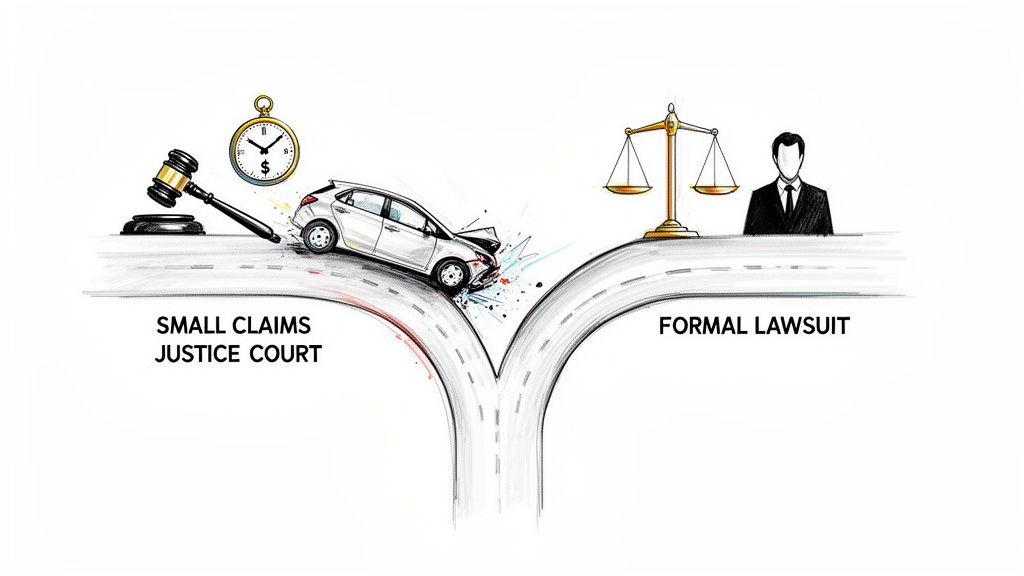
Not every car accident case is a good fit for Justice Court. This venue was specifically created for people to handle their own disputes when the facts are pretty obvious and the amount of money involved isn't astronomical. It’s the legal system's express lane, designed for speed and simplicity.
The biggest advantage is how approachable it is. The formal rules of evidence and procedure you see on TV don't really apply here, which makes the whole process far less intimidating if you're representing yourself. This also keeps your costs way down since you can avoid the expense of hiring an attorney and paying for complex court filings.
When to Seriously Consider Justice Court
This path really shines in certain situations. You should lean toward filing in Justice Court when:
- Fault is a no-brainer. The other driver clearly caused the crash. Maybe they were ticketed for running a red light, or they rear-ended you at a stop sign. There's little room for them to argue.
- Your total damages are under the $20,000 cap. This is a hard limit in Texas. Your claim for repairs, medical bills, and other losses must fall at or below this amount.
- You need a resolution sooner rather than later. Justice Court cases are usually wrapped up in a few months, not the years it can take for a case to wind through the higher court system.
- You're comfortable handling things yourself. The system is designed for you to be your own advocate.
The whole point of small claims court is to make justice accessible. It’s built to knock down the financial and procedural walls that can stop people from pursuing what they're rightfully owed.
When a Higher Court Is the Better Option
But let's be clear—this streamlined approach has its limits. If your case is messy, with serious injuries, a big debate over who was at fault, or damages that easily top the $20,000 limit, you belong in a traditional civil court.
That monetary cap is the single biggest factor. Looking at national averages, the typical property damage claim is about $6,551, but the average for bodily injury claims jumps to $26,501. As you can see, a lot of injury cases will quickly exceed the small claims limit, pushing them into a more formal legal setting. If you're interested in the numbers, you can find more personal injury law statistics on Clio's blog.
To make it even clearer, here's a quick side-by-side comparison of your two main options.
Small Claims Court vs Traditional Civil Court for Auto Accidents
| Feature | Small Claims Court (Justice Court in TX) | Traditional Civil Court |
|---|---|---|
| Monetary Limit | $20,000 maximum in Texas | No upper limit (or very high limits) |
| Attorney Required? | No, designed for self-representation | Almost always necessary due to complexity |
| Case Timeline | Fast; typically resolved in a few months | Slow; can take one to several years |
| Cost | Low; minimal filing fees, no attorney costs | High; significant attorney fees, expert costs, filing fees |
| Rules & Procedure | Informal and relaxed | Strict rules of evidence and civil procedure apply |
| Discovery Process | Very limited or none | Extensive (depositions, interrogatories, etc.) |
| Best For | Clear-cut cases, minor to moderate damages | Complex cases, serious injuries, disputed fault |
Ultimately, choosing the right venue is the first critical step in getting the compensation you deserve. This table should help you see which path makes the most sense for your specific situation.
Figuring Out What Your Claim is Actually Worth
Before you even think about filing a lawsuit, you need to know exactly what you’re asking for—down to the last cent. Walking into court without a precise, evidence-backed number is like heading out on a road trip with no map and no destination. Your first job is to meticulously add up every single cost that has come out of your pocket because of this accident.
This process begins with what lawyers call economic damages. These are the real, tangible financial losses you can prove with a receipt, an invoice, or a pay stub. Think of them as the black-and-white figures that are very hard to argue with.
Tallying Up Your Hard Costs
You're essentially creating a financial snapshot of the accident's aftermath. This means gathering every single piece of paper that represents a dollar you had to spend or a dollar you couldn't earn.
Make sure your list of economic damages includes these key items:
- Vehicle Repair or Replacement: You'll need at least two written estimates from reputable body shops. If the car was a total loss, you'll need its fair market value right before the crash.
- Medical Bills: This is a big one. It covers everything from the ambulance and ER visit to follow-up doctor's appointments, physical therapy, prescriptions, and even chiropractor visits. Keep every single bill.
- Lost Wages: Did the accident and your recovery make you miss work? You can and should claim that lost income. A simple letter from your employer or a few recent pay stubs will prove your pay rate and the time you missed.
- Rental Car: If you needed a rental while your car was in the shop, those costs are part of your claim.
- Towing and Storage: Don't forget the invoice from the tow truck company if your car had to be hauled away from the scene.
A Word of Advice: Get organized from day one. Start a physical folder or a digital one on your computer and save everything. A Justice of the Peace is always more impressed by someone who can present their losses clearly, not someone fumbling through a messy stack of papers.
Knowing your exact number is non-negotiable. For a more objective perspective, a data-driven car accident settlement calculator can be a huge help. It uses real case outcomes from Texas to give you a solid benchmark for what claims like yours are actually worth.
Writing a Formal Demand Letter
Once you have your grand total, your next move isn't running to the courthouse. It's sending a demand letter. This is a formal, professional letter sent to the at-fault driver (and their insurance company, if you have their information).
In it, you'll lay out the facts of the accident, provide an itemized list of your damages, state the total amount you are demanding, and make it clear you intend to file a lawsuit in small claims court if you can't settle.
This letter shows the court you made a good-faith effort to resolve the issue first. Honestly, a sharp, well-written demand letter is often all it takes to get the insurance adjuster to take you seriously and start negotiating.
Here’s a look at how to structure the core of your letter.
Example Demand Letter Snippet
Subject: Demand for Compensation – Auto Accident on [Date of Accident]
Dear [At-Fault Driver's Name],
I am writing to demand payment for the damages I sustained in the auto accident that occurred on [Date] at [Location]. You were the at-fault driver, as your failure to [e.g., stop at the red light] was the direct cause of the collision.
As a direct result of your negligence, I have incurred the following documented expenses:
- Vehicle Repairs: $4,250.75
- Medical Bills: $1,820.00
- Lost Wages: $640.00
Total Economic Damages: $6,710.75
Please consider this a formal demand for payment in the amount of $6,710.75. If we are unable to resolve this matter within 30 days, I intend to file a lawsuit against you in Texas Justice Court to recover my losses.
How to File Your Lawsuit in Texas Justice Court
So, you’ve calculated your damages, sent a solid demand letter, and still, nothing. The insurance company is stonewalling or the at-fault driver is ignoring you. It's time to take the next step and formally file your case.
Don't be intimidated. Filing a lawsuit in a Texas Justice Court is a straightforward process, intentionally designed so regular folks can navigate it without hiring an attorney. Your starting point is getting the right paperwork.
Kicking Things Off: The Petition
The journey begins with a document called a Petition. Think of this as the official story of your case. It’s where you’ll lay out who you are, who you're suing (the defendant), the basic facts of the car wreck, and exactly how much money you believe you're owed. My advice? Be direct and stick to the facts. This document sets the stage for your entire case, so clarity is key.
Once your Petition is filled out, you have to file it in the right place. This is a common tripwire for people handling their own cases. In Texas, you must file in the Justice of the Peace (JP) precinct where the defendant lives or where the accident actually happened. Getting this wrong can get your case dismissed on a technicality, forcing you to waste time and money starting all over again.
Making It Official: Filing and Service
With the completed Petition in hand, head to the clerk’s office at the correct JP court. You’ll need to pay a filing fee to get your case on the court's calendar, which usually runs somewhere between $50 and $100, varying by county.
Now for a step you absolutely cannot get wrong: service of process. You can't just drop the lawsuit in the mail and call it a day. Texas law is very clear that the defendant must be formally "served" with a copy of your Petition and a citation (a summons to appear in court).
You generally have three options to get this done:
- Sheriff or Constable: This is the go-to method for most people. You pay a fee to the local constable or sheriff's office, and they'll handle serving the papers. It’s reliable and carries official weight.
- Private Process Server: You can also hire a certified private process server. They often work faster and can be more flexible with their timing.
- Certified Mail: While sometimes an option, serving by certified mail with a return receipt has very strict rules. It's often best to stick with a constable or private server to ensure it’s done right.
Let me be clear: proper service isn't just a suggestion, it's a requirement. If the defendant isn't served correctly according to the rules, the court has no power over them, and your case is dead in the water. The court clerk is a great resource and can explain the specific methods your precinct allows.
Finally, don't let time run out. You have a strict deadline for filing a lawsuit after a wreck. To make sure you’re well within your window, it’s worth reading up on the statute of limitations for a car accident in Texas.
This flowchart shows the preliminary work—calculating damages and sending a demand—that should happen before you even think about filing.
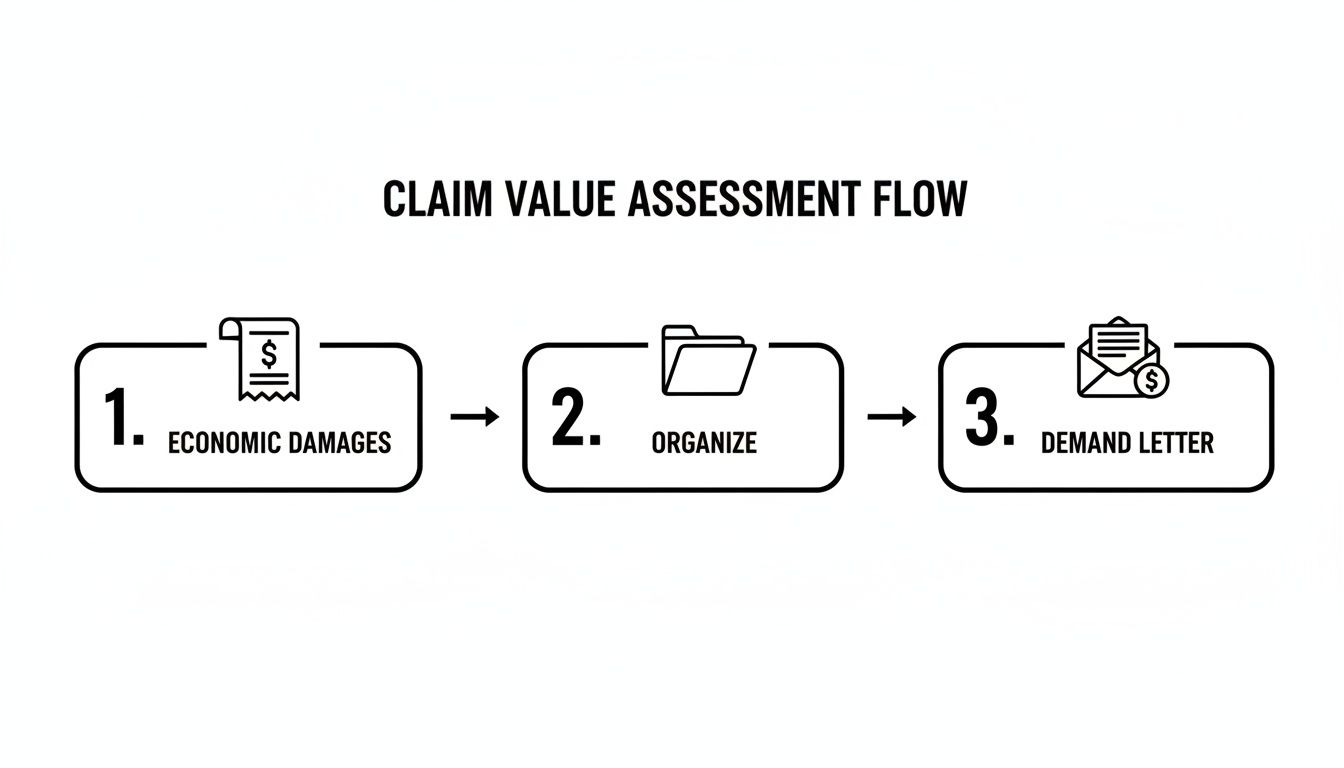
Following these initial steps ensures you've built a strong, documented foundation for your claim long before you step foot in a courtroom.
Building a Winning Case with the Right Evidence
Your side of the story is crucial, but a judge needs more than just your word to rule in your favor. A winning argument in a small claims court for an auto accident is built on a foundation of solid, undeniable evidence. The other driver is going to tell their version of events, so your job is to back up everything you claim with objective proof.
This is where you shift from simply knowing what happened to being able to prove it. You need to gather every document, photo, and statement that paints a clear, undeniable picture of the other driver's fault and the true extent of your damages. Think of yourself as a detective building a case that's impossible to argue against.
Gathering Your Core Evidence
The official police report is almost always your strongest starting point. It's a neutral, third-party account of the scene, and it often includes diagrams, the officer's opinion on who was at fault, and a record of any tickets issued. You can usually get a copy from the police department or sheriff's office that responded to the crash for a small fee. It's well worth it.
Next up: visual proof. Photos and videos are incredibly powerful in a courtroom. Make sure you have clear pictures showing:
- Vehicle Damage: Get shots of the damage to both cars from every angle—close-ups to show the details and wider shots to give context.
- The Scene: Photograph the entire accident scene. Capture the intersection, any skid marks, debris on the road, and relevant traffic signs or signals. These can tell a story all on their own.
- Your Injuries: If you have visible injuries like bruises, scrapes, or cuts, take pictures right away. Keep documenting them over the next few days as they develop or change color.
And don't forget about witnesses. A statement from an impartial bystander who saw what happened can be a total game-changer. Be sure to get their contact information at the scene and follow up to ask for a short, signed statement about what they witnessed.
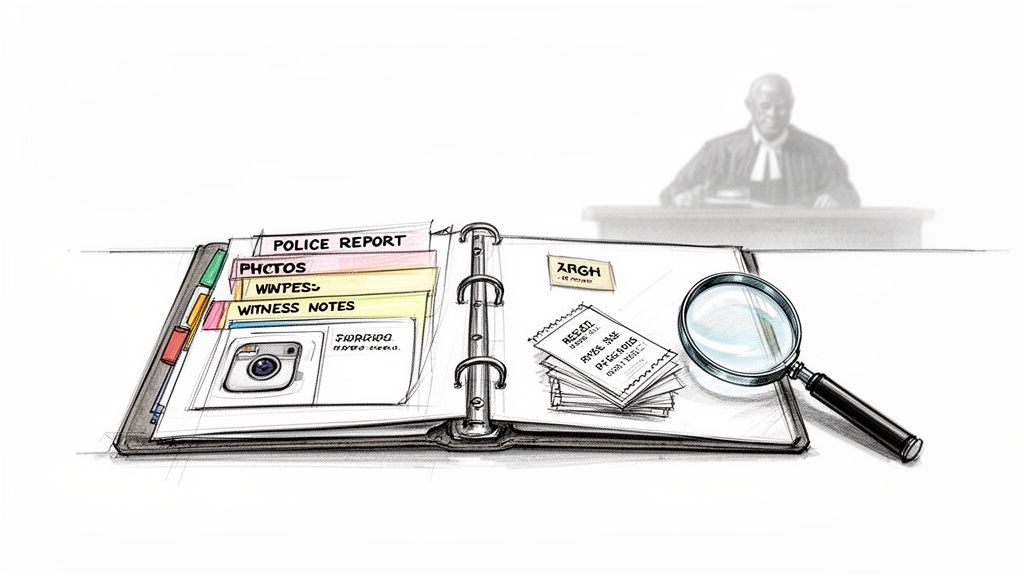
Pro Tip: Create a "trial binder" with labeled tabs for each piece of evidence: Police Report, Photos, Medical Bills, Repair Estimates, Witness Statements, etc. Walking in with a well-organized binder immediately tells the judge you’re prepared and serious.
Preparing for Your Day in Court
Gathering paperwork is only half the battle; you also need to prepare yourself. The judge is going to want to hear what happened directly from you. Practice explaining the accident clearly and concisely. Stick to the facts and resist the urge to get overly emotional or exaggerate.
You also have to anticipate what the other driver might argue. Are they going to claim you slammed on your brakes? Will they try to downplay the damage to your car? Thinking through their likely defenses helps you prepare counter-arguments supported by your evidence. It’s also important to recognize how crucial these courts are. Federal data shows that motor vehicle crashes cost the U.S. economy about $340 billion in a single year, which really underscores why an efficient court system is so vital. You can read more about the societal impact of traffic crashes to see the bigger picture.
Finally, remember that your case isn't just about the bills. While repair estimates are easy to understand, you should also be ready to explain the accident's non-economic impact on your life. Our guide on how to prove pain and suffering offers some great insights for documenting these less tangible, but very real, damages. This kind of thorough preparation is what turns a simple complaint into a compelling, evidence-backed case the judge can believe in.
So, the Judge Made a Call. Now What?
The hearing's over, the Justice of the Peace has rendered a decision, and the tension in the courtroom has finally broken. Whether you're breathing a sigh of relief or feeling the sting of disappointment, the journey isn't quite over. What comes next depends entirely on which side of that judgment you landed on.
A win in small claims court feels fantastic, but it's crucial to understand that a favorable judgment doesn't magically deposit money into your bank account. What you have is a legal document stating you're owed money. The often-frustrating reality is that the ball is now in your court to actually collect it.
If You Won Your Case: Turning a Judgment into Cash
In a perfect world, the person you sued (the defendant) would simply pay you what the court ordered. Sometimes that happens. But if they don't, you have to be proactive to enforce the judge's decision. Texas law gives you some pretty powerful tools to do this, but you typically have to wait about 30 days to give the other party time to appeal.
Once that waiting period is over, and if you still haven't been paid, you can start the collection process. You might need to do some post-judgment digging (discovery) to figure out where the defendant has assets. If they continue to stonewall, it's time to go back to the court and ask for help.
Here are your main options for compelling payment:
- A Writ of Execution: This is a serious step. It’s a court order that allows a constable or sheriff to seize the defendant's non-exempt property—think a second car, not their primary vehicle—and sell it at auction. You get the proceeds from that sale.
- A Writ of Garnishment: This is one of the most effective methods. If you know where the defendant banks, this writ orders the bank to freeze their account and turn the funds over to you to satisfy the judgment.
Key Takeaway: Don't sit back and wait after you win. The court has done its job by issuing the judgment; it won't act as a collection agency for you. It's up to you to use the legal tools available to turn that piece of paper into the compensation you deserve.
If the Judgment Didn't Go Your Way
Losing is tough, no doubt about it. It can feel like all that work was for nothing. It's important to take a clear-eyed look at your options, which are unfortunately quite limited.
If you were the one who filed the lawsuit (the plaintiff) and you lost, that's generally the end of the road in Texas Justice Court. You cannot appeal the judge's decision. The system is designed this way to provide a quick and final resolution.
However, if you were the one being sued (the defendant) and you lost, you do have the right to appeal. But you have to act fast. The deadline is strict—usually just 21 days from the date the judgment was signed.
Filing an appeal kicks the case up to the County Court at Law for what’s called a "trial de novo." This means you get a complete do-over, as if the first trial never happened. Be warned, though: this new trial will be much more formal. The relaxed atmosphere of Justice Court is gone, replaced by strict rules of evidence and procedure. It's a whole new ballgame, and the process becomes significantly more complex and expensive. Deciding to appeal is a big step that needs careful thought.
Answering Your Top Questions About Small Claims After a Wreck
Walking into the legal world after a car accident can feel overwhelming, especially when you're thinking about taking on the other driver in court. Let's clear up some of the most common questions people have when considering small claims court for an auto accident in Texas.
A lot of people's first question is whether they need to hire a lawyer. The simple answer is no. In fact, the entire small claims system—or Justice Court, as it's officially called in Texas—was created so everyday people could represent themselves. It's designed to be a more straightforward, less formal process than what you see in higher courts.
The whole point is to settle disputes without the massive expense and complicated procedures that come with hiring attorneys. This do-it-yourself approach is what makes the process relatively quick and keeps costs down for everyone involved.
Can You Sue for Pain and Suffering?
This is a big one, and the answer isn't a simple yes or no. Technically, you can ask for money to compensate for your pain and suffering, but getting a judge to award it in Justice Court is a real uphill battle. These courts are much more comfortable dealing with tangible, provable financial losses—what lawyers call "economic damages."
Put yourself in the judge’s shoes for a moment. A repair bill for $4,500 is a concrete number supported by a professional estimate. On the other hand, putting a price tag on your physical pain or emotional distress is highly subjective. It's tough to prove without bringing in expert witnesses, which just isn't how small claims cases typically work.
Your best bet is to build your case on a solid foundation of documented expenses. You'll have a much stronger argument if you focus on proving every dollar you were out-of-pocket for things like:
- The cost to repair your vehicle or an estimate of its replacement value.
- Every medical bill, from the ER visit to your physical therapy sessions.
- Pay stubs showing the exact wages you lost from missing work.
- Receipts for your rental car, tow truck, and any other direct costs.
By sticking to these hard numbers, you make it easy for the judge to see exactly what you're owed and rule in your favor.
What if the Other Driver’s Insurance Company Is Ghosting You?
This is exactly the kind of situation small claims court was made for. If the at-fault driver's insurance adjuster is dodging your calls, dragging their feet, or making a lowball offer that's frankly insulting, filing a lawsuit is often the quickest way to get their attention. It sends a clear message: you're not going away, and you expect to be paid fairly.
Now, here's a crucial detail: you don't actually sue the insurance company. Your lawsuit is filed directly against the person who caused the accident.
Once the at-fault driver gets served with the official court papers, their insurance policy requires them to immediately notify their carrier. This single action completely changes the game. The insurance company is now legally obligated to get involved, defend their policyholder, and deal with your claim. Suddenly, you're their top priority.
Filing the suit takes your claim from a private argument they can ignore and turns it into a formal legal proceeding with strict deadlines. This move alone is often enough to bring a reasonable settlement offer to the table long before your court date arrives.
At Verdictly, we believe that access to real case data is the key to a fair negotiation. Our platform provides transparent, AI-powered insights into Texas motor vehicle case outcomes, so you can benchmark your claim against thousands of similar cases. See what your case could be worth before you settle. Learn more about Verdictly.
Related Posts

What to Do After a Hit and Run Car Accident in Texas
A complete guide on what to do after a hit and run car accident in Texas. Learn the critical first steps, your legal options, and how to file a claim.
How to Start a Civil Lawsuit in Texas: A Practical Guide
Learn how to start a civil lawsuit in Texas with this practical guide. We cover claim evaluation, filing procedures, evidence gathering, and settlement.
Calculating pain and suffering car accident: A Practical Guide to Damages
Learn how calculating pain and suffering car accident damages works, with factors and tips to maximize your settlement.