

How to Start a Civil Lawsuit in Texas: A Practical Guide
Learn how to start a civil lawsuit in Texas with this practical guide. We cover claim evaluation, filing procedures, evidence gathering, and settlement.
Before you ever think about filing papers or seeing the inside of a courtroom, the first and most important step is a brutally honest look at your situation. Kicking off a lawsuit is a massive commitment of your time, money, and emotional energy. Jumping in without a solid case is just setting yourself up for a long, frustrating road to nowhere.
The real goal isn't just to start a lawsuit; it's to start one you have a real chance of winning.
Do You Really Have a Case? What to Know Before Filing
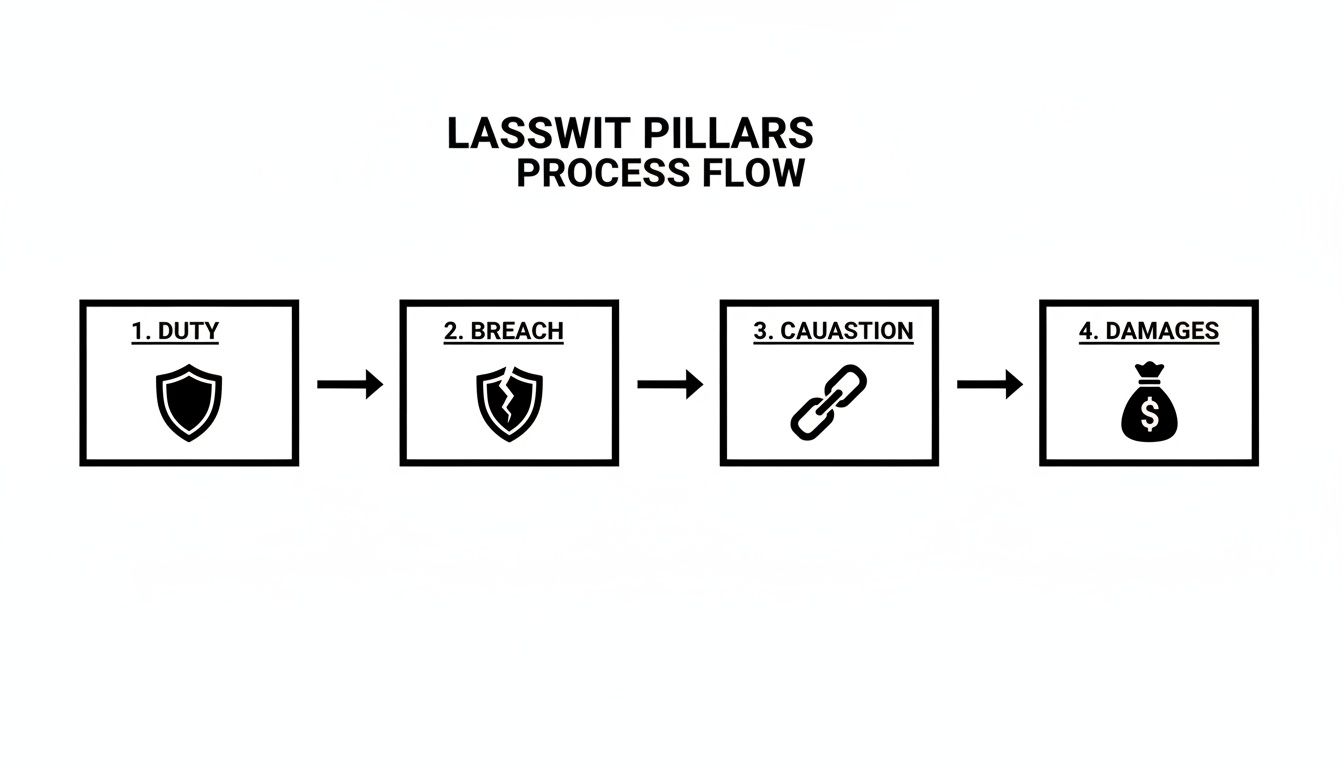
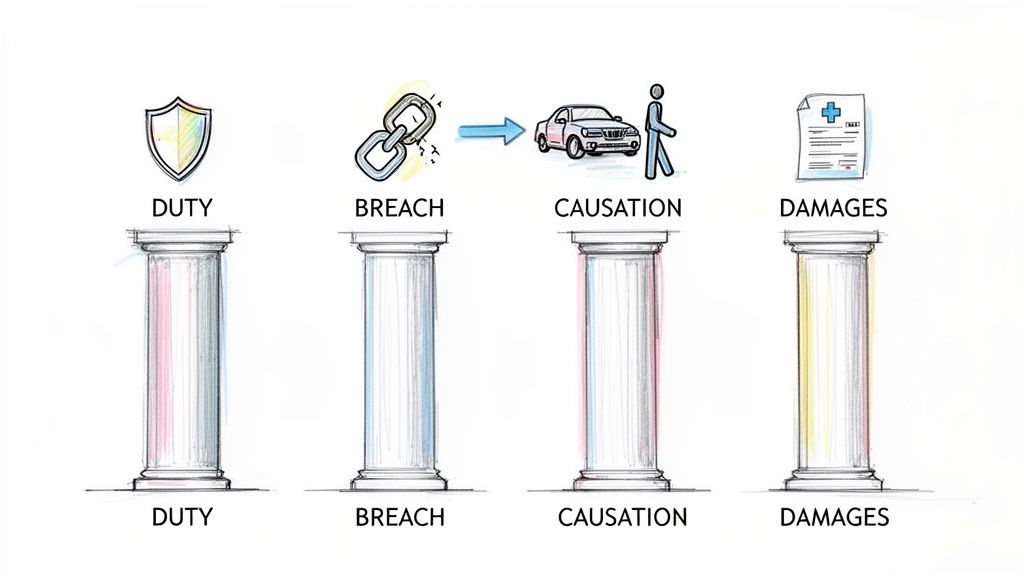
This whole initial evaluation comes down to one big question: can you actually prove what happened? In the world of Texas personal injury law—especially for things like car wrecks—"proof" stands on four essential pillars. Think of them like the legs of a table. If you're missing even one, the entire thing comes crashing down.
The Four Pillars of a Viable Lawsuit
Every single successful negligence claim, whether it’s a minor fender-bender or a life-altering injury, has to nail these four points. Let’s walk through them using a classic example: a rear-end collision on a busy Texas highway.
-
Duty: First, you have to show the other person owed you a legal duty of care. For drivers, this one is easy. Anyone behind the wheel in Texas has a responsibility to drive safely, obey traffic laws, and generally not endanger others.
-
Breach: Next, you prove they breached that duty. Let’s say the other driver was texting and didn't see traffic stop ahead, causing them to plow into your car. That's a textbook breach of their duty to pay attention and operate their vehicle safely.
-
Causation: This is the link. You must prove their breach caused your injuries. The impact from the collision gave you whiplash and a herniated disc in your back. The key here is that your injuries would not have happened but for their negligent act of texting and driving.
-
Damages: Finally, you have to show you suffered actual, measurable harm. This isn't just a vague "I was hurt." It’s the concrete stuff: medical bills, lost wages from missing work, the cost to repair your car, and even compensation for your physical pain and suffering.
You have to connect all four dots—from the duty they owed you all the way to the damages you suffered—to build a case that can stand up in court.
Before moving forward, it's wise to run through a quick self-assessment. Answering these questions can give you a much clearer picture of whether you have a legitimate claim or if you might be facing an uphill battle.
Texas Lawsuit Viability Checklist
Answer these essential questions to quickly gauge the strength of your potential civil lawsuit before you proceed.
| Key Question | What You Need to Confirm | Why This Is Critical |
|---|---|---|
| Did the other party have a clear duty to you? | Was the person driving, performing a professional service, or maintaining a property? | Establishes the legal relationship and the standard of care they were required to meet. |
| Can you prove they breached that duty? | Do you have a police report, photos, witness statements, or other evidence of negligence? | This is the "fault" element. Without proof of a breach, there is no case. |
| Is the link between their action and your injury direct? | Can you show your injuries were a direct result of the incident, not from a pre-existing condition? | You must directly connect their mistake to your harm to establish causation. |
| Can you quantify your damages? | Do you have medical bills, repair estimates, and proof of lost income? | Vague or undocumented harm is difficult to claim. You need concrete numbers. |
| Are you within the statute of limitations? | For most Texas personal injury cases, did the incident happen less than two years ago? | This is a hard deadline. If you miss it, your claim is almost certainly barred forever. |
If you can confidently answer "yes" to these questions, you likely have a solid foundation for a claim. If you find yourself hesitating on one or more, it’s a sign you need to dig deeper or seek professional advice.
The Critical Deadline You Cannot Miss
That last point on the checklist deserves its own warning. Beyond the four pillars, you have an absolute, non-negotiable deadline called the statute of limitations. For most personal injury cases in Texas, you have two years from the date of the injury to file a lawsuit.
If you miss this two-year window, your case is dead on arrival. It doesn't matter how strong your evidence is or how badly you were hurt. The court will dismiss it, and you will lose your right to seek compensation forever.
This rule exists to keep evidence from going stale and to prevent people from living under the threat of a lawsuit indefinitely. The clock starts ticking the moment the accident happens, so you can't afford to wait.
Gathering Your Initial Evidence
With these legal hurdles in mind, your next move is to start collecting the raw materials of your case. Don't stress about crafting the perfect legal argument right now. Just focus on gathering and organizing the facts. Get a folder—a real one or a digital one—and start putting everything related to the incident in one place.
Here’s a good starting checklist:
- The Official Police Report: This is often the most important initial document. It contains the officer’s notes, witness info, and sometimes a preliminary conclusion about who was at fault.
- Photos and Videos: Snapshots of the scene, the damage to all vehicles, and any visible injuries are incredibly compelling pieces of evidence.
- Witness Contact Information: Get the names, phone numbers, and email addresses of anyone who saw what happened. A neutral third-party account can be a game-changer.
- Medical Records and Bills: This is the backbone of your damages claim. Collect every single document from doctors, ER visits, physical therapists, chiropractors, and pharmacies.
- Proof of Lost Income: You’ll need pay stubs from before the accident and a letter from your employer confirming how much time you missed from work and the wages you lost because of it.
Getting all this organized early does two things. First, it forces you to look at your case objectively and see its strengths and weaknesses. Second, if you do decide to talk to a lawyer, you’ll walk into that first meeting looking prepared, serious, and ready to go, which saves everyone time and gets things moving faster.
Getting Your Lawsuit Drafted and Filed
So, you’ve done your homework and confirmed your case has merit. Now it's time to take the next step and formally start the legal process. This is where you move from gathering evidence to taking official action by drafting and filing what’s known in Texas as an Original Petition.
Think of the Petition as your opening act. It's the official document that tells the court—and the person you're suing—your side of the story. It lays out what happened, why they are at fault, and what you’re asking for as compensation.
What Goes into a Petition?
Drafting a legal document sounds daunting, but a Petition follows a pretty logical structure. You don’t need to use a bunch of legalese; clarity and directness are what matter most. Your goal is to present the core facts and explain the legal basis for your claim.
Let’s stick with our Dallas rear-end collision example to see how it works:
- Parties: This is simple. You are the "Plaintiff" (the one filing the suit), and the at-fault driver is the "Defendant."
- Jurisdiction and Venue: Here, you'll briefly explain why this court is the right one. Since the wreck happened in Dallas, you’d state that Dallas County is the proper venue.
- Facts: This is the narrative part. In plain English, you’ll describe the accident—the date, time, and location. Explain what you were doing (e.g., "stopped at a red light at the intersection of Main and Elm") and what the Defendant did (e.g., "failed to control their speed and crashed into the rear of my vehicle").
- Cause of Action (Negligence): Now you connect the facts to the law. You’ll state that the Defendant was negligent because they breached their duty to drive safely. It helps to list specific things, like "failing to keep a proper lookout" or "following too closely."
- Damages: This section outlines all the harm you've suffered. List everything you can think of: past and future medical bills, lost income, physical pain, mental anguish, and the cost to repair or replace your car.
Essentially, you’re building a clear, compelling story that shows the judge exactly why you're suing.
Picking the Right Texas Court
Not all courts are created equal. In Texas, the right court for your case almost always comes down to how much money you’re seeking—the "amount in controversy."
- Justice of the Peace (JP) Courts: These are for smaller claims, generally up to $20,000. They're designed to be more informal and accessible if you're representing yourself. For minor cases, you might want to look into how to file a small claims case.
- County Courts at Law: These courts are the next step up, often handling cases with damages between $200 and $250,000, though the limits can vary slightly from county to county.
- District Courts: These are the highest-level trial courts in Texas. They handle cases involving more than $250,000 and other complex legal issues.
Picking the correct court is a critical technical detail. If you file in the wrong one, the judge can dismiss your case. That forces you to start all over again, which could put you at risk of missing your statute of limitations.
Dealing with Filing Fees
Kicking off a lawsuit isn't free. You'll need to pay a filing fee to the court clerk when you submit your Original Petition, which usually runs a few hundred dollars. There's also a separate fee for "service of process," which is the cost to have a constable or private process server formally deliver a copy of the lawsuit to the defendant.
What If You Can't Afford the Fees? The courthouse doors are supposed to be open to everyone. If you can't afford the court costs, you can file a "Statement of Inability to Afford Payment of Court Costs." You’ll have to provide details about your income and assets. If a judge signs off on it, your fees will be waived.
Filing your lawsuit is a huge milestone. It’s the moment your case becomes real, and it officially notifies the other side that you are serious about holding them accountable. This has become an increasingly common step for people seeking justice. In fact, a recent Insurance Journal report found that plaintiffs filed over 13,000 class-action lawsuits in federal courts alone in a single year—that's an average of more than 36 new filings every single day. While your individual injury case is different, it shows that filing a lawsuit is a standard tool for getting what you're owed.
Notifying the Defendant and Handling Their First Moves
Getting your Original Petition filed with the court clerk feels like a huge win, but it’s really just the first play of the game. Your lawsuit doesn't actually start until the person you're suing knows about it. You have a constitutional duty to formally notify them, and this critical step is called service of process.
Messing this up is one of the easiest ways to get your case thrown out before it ever gets off the ground.

Think of it this way: you can't have a secret lawsuit. The whole system is built on the idea that everyone has a right to defend themselves. Service of process makes sure the defendant gets a copy of your petition and an official summons, putting them on notice that they need to respond.
How Service of Process Works in Texas
You can't just walk up and hand the papers to the defendant yourself. To keep things fair and official, Texas law requires a neutral third party to do the job.
You’ve got a couple of solid options:
- Sheriff or Constable: For a fee, you can have the local sheriff or constable’s office in the defendant's county serve the paperwork. This is the old-school, tried-and-true method.
- Private Process Server: These are certified professionals who specialize in delivering legal documents. I often find they’re more persistent and creative than law enforcement, which is a huge advantage if you think the defendant might try to duck and hide.
Once the server hands over the documents, they file a sworn statement with the court called a "Return of Service." This is your proof that the defendant was properly notified, and it’s what gives the court power over them.
Key Takeaway: You have to get service right. A simple mistake—serving the wrong person, using an outdated address, or failing to file the return correctly—is a gift to the defense. Their lawyer will immediately file a motion to dismiss, and you’ll be right back at square one.
What if You Can’t Find the Defendant?
People move. Sometimes they actively try to avoid being served. If you can't find the defendant, you don't just throw in the towel. You have to go back to the judge and ask for permission to use a different method.
This is called substituted service. You'll need to file a formal motion and a sworn affidavit showing the court all the "diligent efforts" you made to serve them in person. If the judge agrees you've done your homework, they might let you serve them by:
- Leaving the lawsuit with anyone over 16 at their home or work.
- Serving them through email or even a social media direct message.
- As a last resort, publishing a notice in the newspaper.
Decoding the Defendant’s First Move
Once service is complete, the ball is in their court. A new clock starts ticking. In Texas, the defendant generally has until the Monday after 20 days from the day they were served to file their official response.
Their first filing is almost always a document called an Original Answer.
Don't expect a point-by-point rebuttal. Most of the time, the Answer contains what’s known as a "general denial." This is just legal jargon for, "We deny everything, and you have to prove it all." It's a standard move that puts the burden of proof squarely on your shoulders.
But they won’t stop there. Good defense attorneys come out swinging. Along with the Answer, they often file a flurry of initial motions designed to poke holes in your case right from the start. A big one to watch for is a Motion to Dismiss. This is their attempt to get the judge to end the lawsuit immediately for a technical error, like:
- You filed after the statute of limitations expired.
- You filed in the wrong county or court (improper venue).
- Your petition doesn’t actually state a legally valid claim.
This initial back-and-forth is a test. The defense is checking for weaknesses and seeing if you have the resolve to fight back. Navigating these early challenges is absolutely crucial to keeping your lawsuit alive and moving toward the next phase: gathering evidence.
Uncovering the Facts: What is the Discovery Phase?
Once the initial court papers have been filed and everyone has "answered," your lawsuit moves into what's known as discovery. This is the formal, pre-trial phase where both sides are legally required to share information and evidence.
The whole point of discovery is to prevent "trial by ambush." The court wants both you and the defendant to have a complete picture of the facts and evidence the other side has. It's your chance to methodically build your case and see exactly what you're up against. Think of it less as a courtroom drama and more as a structured investigation where you finally get to see the other side's cards.
Your Investigation Toolkit
Under the Texas Rules of Civil Procedure, you have several powerful tools at your disposal to dig for the truth. An experienced lawyer knows how to use these not just to gather information, but to strategically box the other side in.
Here are the primary tools you'll encounter:
- Interrogatories: These are basically written questions you send to the other party. They have to answer them in writing, and—this is key—under oath. You could ask them to list all their activities in the 30 minutes before the crash, for example.
- Requests for Production: This is your formal demand for documents and other tangible things. You can request photos, emails, maintenance records, and in a commercial truck crash, even the driver's logbooks and the company's safety manuals.
- Requests for Admission: These are simple, direct statements that you ask the other side to either admit or deny. For instance, "Admit that you were traveling at 55 mph at the moment of impact." Every fact they admit is one less thing you have to prove in court.
- Depositions: This is often the most pivotal part of discovery. It’s a live, in-person Q&A session where your lawyer questions the defendant (or other witnesses) under oath. A court reporter is there, transcribing every single word. To get a real sense of their power, it's worth understanding what a deposition in a lawsuit truly entails and how it can make or break a case.
How Discovery Builds Your Case
Let's go back to that rear-end collision with the delivery truck. Through discovery, you aren't just asking the driver what happened. You're demanding concrete proof.
You can request the truck’s "black box" data to see its exact speed. You can get the driver's cell phone records to see if they were texting. You can demand the company's entire safety and training file on that driver. Each piece of evidence helps you paint a clear picture of negligence for a judge or jury.
A savvy discovery strategy isn't just about collecting facts. It's about systematically dismantling the defendant's story until they have nowhere left to hide. Every sworn answer, every document produced, locks them into a version of events they can't back away from later.
This power to compel the other side to show their hand is a cornerstone of our legal system. It's a mechanism for leveling the playing field. In a way, it mirrors the power seen in other areas of law, like the qui tam provisions of the False Claims Act. There, private citizens can sue on behalf of the government to expose fraud, leading to massive settlements. In one recent year, the DOJ reported record civil fraud recoveries of nearly $6.9 billion thanks to such actions. You can read more about these impressive civil fraud recovery statistics to see the impact.
For your Texas injury claim, the principle is the same: use the tools available to uncover the truth and hold the other party accountable. The evidence you gather here will be the foundation for any settlement talks and, if necessary, your entire trial strategy.
The Big Decision: Should You Settle or Go to Trial?
Forget what you’ve seen in the movies. Very few personal injury lawsuits end with a dramatic trial and a jury verdict. The reality is that the vast majority—easily over 90% of cases—are resolved through a settlement. This is the most critical fork in the road for your case, where you have to make a tough call.
You’ll need to weigh the certainty of a guaranteed payout against the gamble of putting your fate in a jury's hands.

This is where the real strategy comes into play. You can almost guarantee that the first settlement offer you get from an insurance company won't be their best one. It’s an opening move, a test to see if you’ll take a quick, lowball offer and go away. Your job is to decide—based on facts, not just feelings—whether to accept it, make a counteroffer, or reject it and keep moving toward the courthouse.
How to Look at a Settlement Offer
When an offer finally comes in, it's natural to feel a sense of relief. But you can't let that emotion cloud your judgment. You need to look at that number with a cold, hard, analytical eye.
Here's what you're really balancing it against:
- The Cost of Trial: Trials get expensive, fast. You're talking about fees for expert witnesses to testify, court reporters for depositions, and the cost of creating trial exhibits. All of that gets deducted from your final award, shrinking what you actually take home.
- The Time: Pushing a case all the way to a verdict can easily tack on another year, sometimes more, to the process. A settlement means it's over now.
- The Stress: A trial is an ordeal. You'll be put on the stand, cross-examined by an opposing attorney, and forced to live with the daily uncertainty of the outcome. It takes a huge emotional toll.
- The Risk: This is the big one. There are no guarantees in a courtroom. A jury could award you less than what the insurance company offered you. In the worst-case scenario, you could lose and walk away with absolutely nothing.
A settlement, by contrast, gives you a sure thing. It takes all that risk, stress, and future cost off the table. For a deeper look into how these agreements work, you can explore the details of a settlement agreement in our guide.
Using Data to Level the Playing Field
This is your secret weapon. Insurance adjusters do this all day, every day. They have access to huge internal databases on what claims like yours are worth. You can counter that advantage by arming yourself with objective, real-world data from your specific court and county.
It changes the entire conversation. Instead of just saying, "I deserve more," you can present hard facts.
"Your offer of $35,000 is noted. However, data from the last five years shows the median jury verdict for a rear-end collision in Dallas County involving a herniated disc is actually $78,000. My injuries and the facts of my case are very similar. Your offer simply isn't aligned with what local juries are awarding."
This data-driven negotiation shifts the dynamic immediately. You’re no longer just trading opinions; you’re discussing facts based on historical outcomes. It forces the adjuster to justify their low number against what’s actually happening in the real world. In a recent year, the top ten class-action settlements alone exceeded $70 billion, with some cases taking an average of 72 months to resolve. This highlights why benchmarking your own claim is so critical from the start.
What Happens When You Can't Agree? Mediation.
If you and the insurance company are at a standstill, the next logical step is usually mediation. In fact, most courts in Texas will require you to go through mediation before they’ll even consider giving you a trial date.
Think of mediation as a structured settlement conference. A neutral third-party mediator—often a retired judge or an experienced attorney—is brought in to help both sides find common ground. The mediator’s job isn’t to pick a winner. Their goal is to facilitate a conversation, poke holes in each side's arguments, and guide everyone toward a resolution.
The entire process is confidential, and you are never forced to settle. But a skilled mediator can be incredibly effective at bridging the gap and helping you find a number that everyone can live with, saving you the immense cost and risk of a trial.
Common Questions About Starting a Texas Lawsuit
Even with a clear roadmap, jumping into the legal system brings up a ton of practical questions. It's only natural. Getting answers to these common concerns upfront will help you set realistic expectations and make smarter decisions down the road.
Let's tackle the questions I hear most often from people about to file a lawsuit in Texas.
How Much Cash Do I Need to Start a Lawsuit?
The initial out-of-pocket costs are probably less than you think. You're looking at court filing fees, which usually run between $350 and $500 depending on which Texas court you're in. Then, you have to pay a professional to "serve" the person you're suing, which typically costs another $75 to $150.
But here’s the good news for anyone with a personal injury claim: most experienced attorneys work on a contingency fee basis.
This is a game-changer. It means you don't pay a dime in legal fees upfront. Your lawyer only gets paid if they win money for you, taking a pre-agreed-upon percentage of the settlement or jury verdict. If you don't recover anything, you owe them zero for their time.
What About Other Case Expenses? As a lawsuit moves forward, you'll have costs for things like expert witness reports, court reporter fees for depositions, and medical record retrieval. With a contingency fee agreement, your attorney usually covers these expenses as they come up and gets reimbursed out of the final settlement or award.
Can I Just Represent Myself Without a Lawyer?
Legally, yes. You absolutely have the right to represent yourself, which is called proceeding "pro se."
Practically speaking, though, it's a monumental task in a serious injury case. You'll be up against a seasoned insurance defense lawyer who knows the rulebook inside and out. The Texas Rules of Civil Procedure and the Rules of Evidence are incredibly complex, and one misstep can sink your entire case.
For a very small claim in a Justice of the Peace court (think small claims court), going pro se is common and much more doable. For anything involving significant injuries or complex facts, trying to go it alone is a massive gamble.
How Long Is This Lawsuit Going to Take?
This is the million-dollar question, and there's no single answer. The timeline for a lawsuit can swing wildly based on a few key things:
- How Complicated Is It? A simple rear-end crash case with undisputed fault might settle in 6 to 12 months.
- Is the Other Side Being Reasonable? If the defendant is willing to negotiate in good faith, things move much faster. If they want to fight you on every single point, get ready for a long haul.
- Will We End Up in a Courtroom? A case involving life-altering injuries that needs years of discovery and a full-blown jury trial could easily take 2 to 3 years—sometimes even longer—to see a final resolution.
You also have to factor in the court's own docket. The legal system was not designed for speed. Patience isn't just a virtue here; it's a necessity.
Ready to understand what your case is truly worth? Don't negotiate blind. Verdictly provides access to real Texas motor vehicle verdicts and settlements, giving you the data you need to argue for a fair offer. Explore our database and level the playing field today.
Related Posts

A Guide to Medical Records Reviews in Personal Injury Claims
Learn how medical records reviews can strengthen your Texas injury claim. This guide explains the process, key findings, and how to build a stronger case.

Why Insurance Companies Deny Claims: why insurance companies deny claims
Learn why insurance companies deny claims and how to overcome common denials with proven appeals and tips to maximize your compensation.

How Much Can I Get From a Car Accident Settlement?
Wondering how much can I get from a car accident? This guide breaks down settlement factors, damages, and claim values to help you estimate your compensation.