

Using a Knee Injury Settlement Calculator to Estimate Your Claim
Discover how a knee injury settlement calculator works. Learn about economic and non-economic damages, see examples, and estimate your potential compensation.
A knee injury settlement calculator isn't a crystal ball, but it's a powerful tool for getting an estimated value of your personal injury claim. By plugging in key financial details like your medical bills and lost wages, it uses standard legal formulas to give you a ballpark idea of what your case might be worth. This gives you a solid starting point before any negotiations even begin.
How a Knee Injury Settlement Calculator Actually Works
When you're staring at a mountain of medical bills after a knee injury, it's natural to wonder, "What is my claim actually worth?" A settlement calculator helps demystify this by acting as a data-driven estimator.
Think of it like a home appraiser. An appraiser doesn't just guess a house's value; they analyze comparable sales, square footage, and property features to arrive at a data-backed number. In the same way, a settlement calculator analyzes the key factors of your injury to forecast a potential settlement range. It organizes the financial and personal impact of what you've gone through into two main categories.
The Two Pillars of Your Settlement
At the core of every knee injury claim are two fundamental types of damages. The calculator's job is to combine them to create a comprehensive estimate.
- Economic Damages: These are the straightforward, verifiable financial losses you can prove with a receipt. Think of things like ER visits, surgical costs, physical therapy bills, and any income you lost because you couldn't work.
- Non-Economic Damages: This is where things get more subjective. These damages cover intangible losses that don't have a price tag, like your physical pain, emotional distress, and the loss of enjoyment you've experienced since the injury.
This diagram shows how these two categories come together to build your total settlement estimate.
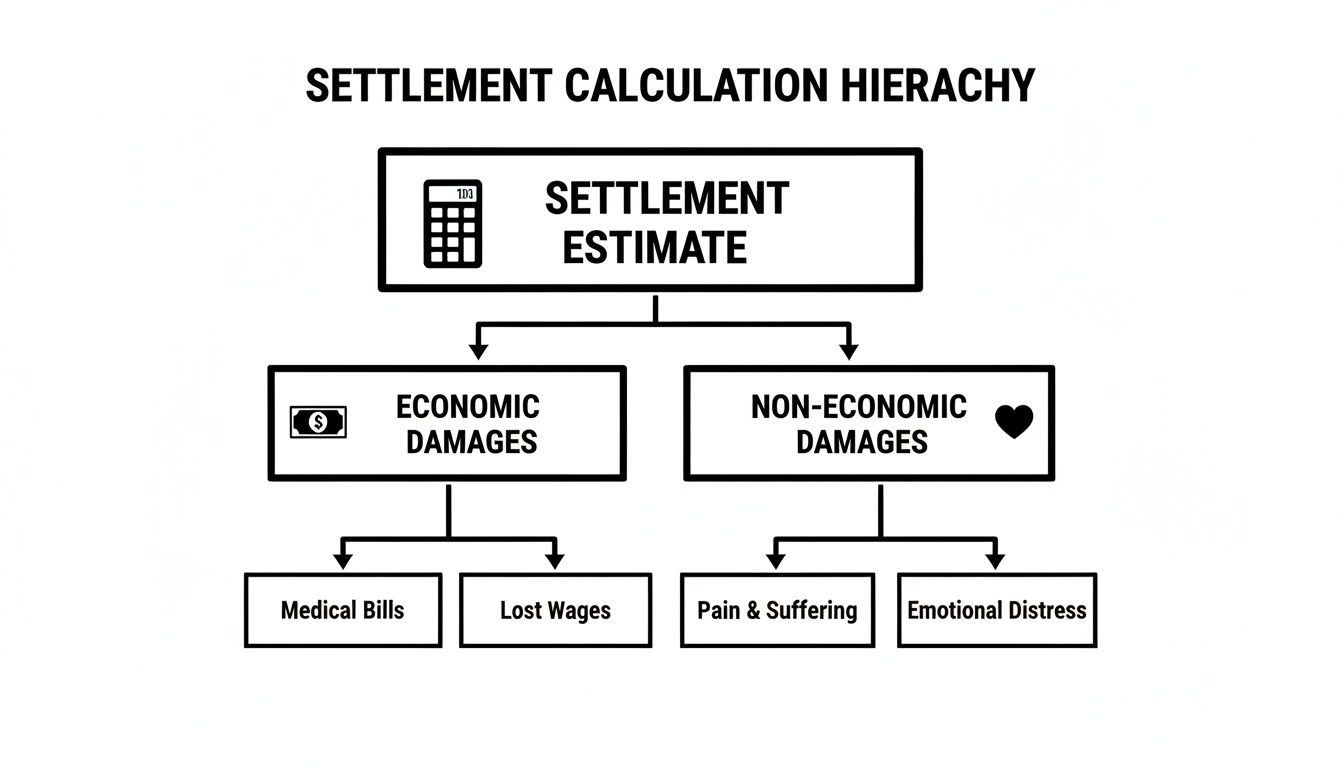
As you can see, a final settlement is built by adding the hard numbers of economic damages to the more nuanced value of non-economic damages.
Key Takeaway: The more accurate and complete your data is for both economic and non-economic losses, the more realistic the calculator's estimate will be. Garbage in, garbage out—so detail matters.
It’s important to remember that these tools are designed to set realistic expectations from the get-go. They show you what a claim could be worth based on the information you provide. While a knee-specific tool is helpful, you can get a broader view by reading our guide on using a personal injury lawsuit calculator, which explains how these calculations work across different types of cases.
Ultimately, the number you get is a powerful starting point for negotiation, not a guaranteed outcome.
Calculating Your Economic Damages After a Knee Injury

When we talk about building a knee injury claim, economic damages are the concrete foundation. Think of them as every verifiable, black-and-white cost you can back up with a receipt, an invoice, or a pay stub. These are the hard numbers that serve as the starting point for any serious settlement talk.
To get a realistic estimate from a knee injury settlement calculator, you first need to pull together a complete list of these costs. This isn't just about the major surgery bill. It's about meticulously tracking every single dollar you've spent or lost because of what happened to your knee.
Past and Future Medical Bills
It's no surprise that the biggest chunk of your economic damages will likely be medical expenses—both the bills you've already paid and the ones you know are coming. You have to document everything. I mean everything. From the ambulance ride to the long road of physical therapy.
A solid list of medical costs should include:
- Emergency Services: The ambulance trip and everything that happened in the ER.
- Hospital Stays: The daily rate for your room, meals, and any procedures done while admitted.
- Surgical Procedures: This bucket includes the surgeon's fee, the anesthesiologist, and the operating room costs for repairs like an ACL reconstruction.
- Diagnostic Imaging: The price tags on those X-rays, MRIs, and CT scans that showed what was really going on inside your knee.
- Follow-Up Appointments: Every single visit to your orthopedic specialist and primary care doctor.
Key Takeaway: Don't stop at the bills you have in hand. If your doctor says you'll probably need another surgery down the road, or if you're facing years of physical therapy and pain management, those future costs are a huge part of your claim.
Lost Wages and Earning Capacity
A serious knee injury doesn't just hurt; it can sideline you from your job. Tallying up this financial hit is a straightforward but absolutely critical part of figuring out your damages.
Lost wages are exactly what they sound like: the income you couldn't earn while you were recovering. You calculate this by multiplying your pay rate by the hours you missed. And don't forget to include any overtime, bonuses, or commissions you would have normally earned.
But what if the injury changes your career path for good? That's where diminished earning capacity comes in. If your knee injury means you can't go back to your old job or you have to take a lower-paying position, you can be compensated for that future loss of income. This is especially crucial for people in physically demanding lines of work. For a more detailed look at how these types of losses are valued, our guide on using a bodily injury calculator provides some great context.
Other Out-of-Pocket Expenses
Finally, you have all the smaller expenses that are easy to forget but can add up to a surprising amount. These are the costs you paid for directly because of your injury that aren't medical bills or lost pay.
Think about common out-of-pocket costs like:
- Prescription Medications: Painkillers, anti-inflammatories, and anything else the doctor ordered.
- Medical Equipment: The cost to rent or buy crutches, a knee brace, a walker, or a wheelchair.
- Home Modifications: Did you have to install handrails or a shower seat to get around safely? That counts.
- Transportation Costs: All those trips to the doctor and physical therapist add up in gas and parking fees.
When you carefully gather and document every single one of these economic damages, you build an undeniable, evidence-based case for your settlement. This detailed accounting is the first and most important step to understanding what your knee injury claim is truly worth.
Placing a Value on Your Pain and Suffering
So, how do you put a price tag on chronic pain, emotional distress, or not being able to enjoy the life you had before the accident? Your economic damages cover the bills you can stack up and count. But non-economic damages are about compensating for the most personal—and often most significant—part of a serious knee injury.
It's a tough concept. Think about trying to value a priceless family heirloom. There’s no receipt and no market price, but its worth is immense. In the same way, your personal story of suffering, your daily struggles, and the loss of your quality of life have to be translated into a dollar figure during settlement talks. This is where a knee injury settlement calculator goes beyond simple math and starts trying to quantify the intangible.
The Multiplier Method Explained
The most common way lawyers and insurance companies estimate pain and suffering is called the multiplier method. It’s a straightforward formula designed to connect the severity of your intangible losses back to the hard numbers of your economic damages.
Here’s the basic idea:
- First, you add up all your economic damages (medical bills, lost wages, etc.).
- Then, that total is multiplied by a number, usually somewhere between 1.5 and 5.
- The multiplier you choose is a direct reflection of how severe your knee injury is and what its long-term impact will be.
A minor knee sprain that heals up in a few weeks might only get a multiplier of 1.5. On the other hand, a torn ACL that requires reconstructive surgery and forces someone to give up their favorite sport could easily justify a multiplier of 4 or even higher. That number is the key variable and, frankly, the most argued-over point in any settlement negotiation.
Key Takeaway: The multiplier isn't just a random number. It’s a reflection of your injury's story—how it has fundamentally changed your daily life, your emotional well-being, and your future.
Factors That Influence Your Multiplier
What makes the difference between a multiplier of 2 and a 4? Insurance adjusters and attorneys look at a handful of key factors to build a case for a specific number. The more serious and disruptive the injury, the higher the multiplier you can argue for.
These factors almost always include:
- Severity of the Initial Injury: A complex fracture is simply worth more than a simple sprain.
- Invasiveness of Medical Treatment: Any case involving surgery is going to command a higher multiplier than one that only required physical therapy.
- Length of Recovery: A recovery that drags on for over a year points to a much greater degree of suffering than one that's over in a few months.
- Long-Term Prognosis: If you're facing the risk of permanent disability, chronic pain, or future arthritis, that significantly boosts the multiplier.
- Impact on Daily Life: Clear evidence showing you can no longer work, care for your family, or enjoy your hobbies is absolutely critical.
To see how these elements come together in real cases, you can explore more detailed examples of pain and suffering settlement amounts in our dedicated guide. Understanding these factors makes it clear why documenting your personal experience is just as important as saving your medical receipts.
Putting It Into a Real-World Context
Let's walk through a hypothetical case. Imagine someone has $20,000 in documented economic damages from a meniscus tear that required arthroscopic surgery. Because the injury involved an operation and a six-month recovery that kept them from working at full capacity, their attorney argues for a multiplier of 3.
The math looks like this: $20,000 (Economic Damages) x 3 (Multiplier) = $60,000 (Non-Economic Damages)
That $60,000 for pain and suffering is then added to the original $20,000 in economic damages, bringing the total estimated settlement value to $80,000. It’s a simplified example, but it shows how dramatically the multiplier can swing the final number. Research shows the median payout for personal injury cases is around $31,000, but that figure can jump much higher when surgery and clear negligence are part of the equation. This data underscores why getting the pain and suffering calculation right is so crucial for a fair outcome.
How Your Specific Injury Drives the Settlement Value
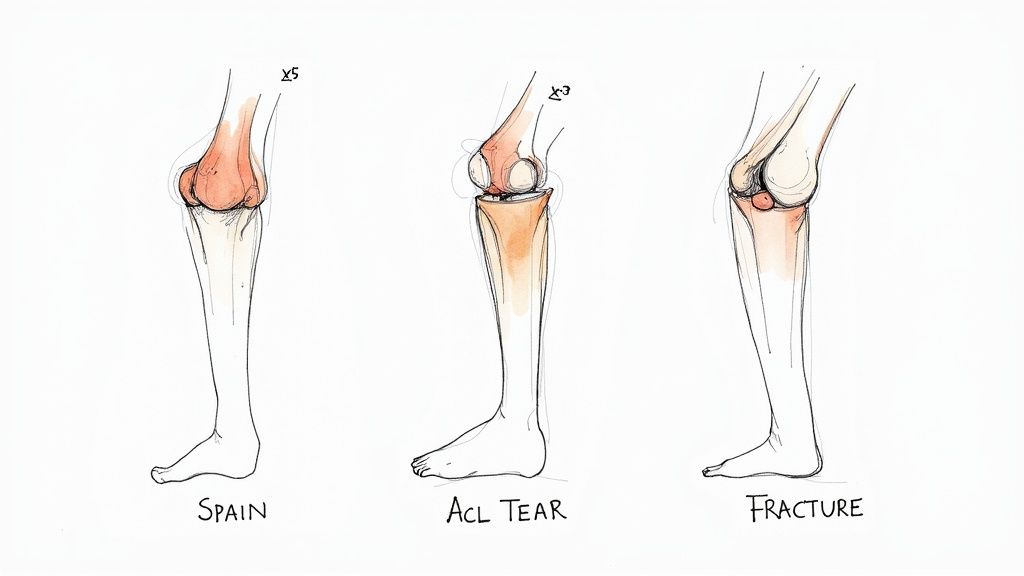
Let's be clear: not all knee injuries are the same, and they aren't treated the same in a personal injury claim. Think of it like car damage—a minor fender bender is a world away from a head-on collision. The specific diagnosis from your doctor is one of the most powerful factors influencing what your settlement might look like.
A knee injury settlement calculator is designed to weigh the severity of your diagnosis heavily because it's directly tied to everything that follows: medical bills, time off work, pain levels, and the potential for lifelong problems. A simple sprain might heal in a few weeks, but a serious fracture can change your life forever.
Common Knee Injuries and What They Mean for Your Claim
To get a realistic sense of your claim's potential, you have to understand this hierarchy of injuries. Every diagnosis tells a different story about treatment, pain, and life disruption, and each story has a different value when it's time to negotiate a settlement.
Here’s a quick breakdown of common knee injuries, from the less severe to the more serious:
- Knee Sprains and Strains: These are classic soft tissue injuries. The ligaments get stretched, but not torn. They hurt, for sure, but they usually get better with rest and physical therapy. This means lower medical bills and a shorter recovery, placing them on the lower end of the settlement spectrum.
- Meniscus Tears: The meniscus acts as the knee's shock absorber. Tearing it can cause serious pain, clicking, and a feeling of instability. The typical fix is arthroscopic surgery, which, while minimally invasive, is still surgery. The need for an operation automatically raises the claim's value well above a simple sprain.
- Ligament Tears (ACL, MCL, PCL): These are major injuries often seen in car accidents and nasty falls. A complete tear of a big-ticket ligament like the ACL almost always requires reconstructive surgery. You're looking at months of grueling physical therapy afterward. The high cost of surgery, long recovery, and risk of future problems put these claims in a much higher settlement bracket.
When Fractures and Complex Injuries Enter the Picture
The game changes completely when bones in the knee joint are broken. A fractured patella (kneecap) or tibial plateau isn't just about surgical repair; it carries a significant risk of long-term, debilitating complications.
These types of injuries often lead to post-traumatic arthritis, chronic pain, and a permanent loss of mobility. Because the potential for lifelong issues is so high, both the economic (medical bills, lost wages) and non-economic (pain and suffering) damages are substantially greater.
The bottom line is this: the more invasive the treatment and the higher the risk of permanent impairment, the more the settlement is worth. An injury that threatens your ability to walk or work normally will always be valued much higher than one you can fully bounce back from.
The Highest Tier: Knee Replacement Cases
At the very top of the severity scale are injuries that ultimately require a total knee replacement (TKR). This isn't just a repair—it's a life-altering procedure where your natural joint is surgically replaced with a prosthesis. As you can imagine, cases that lead to a knee replacement command the highest settlement values, and it's not even close.
In fact, some knee replacement surgeries have led to multimillion-dollar settlements. We've seen cases where the average economic damages awarded were over $1.9 million, with pain and suffering compensation topping $3.5 million. These huge figures reflect the permanent nature of the surgery, the high likelihood of needing future revision surgeries, and the reality of lifelong medical care. You can learn more about why these surgical cases command such substantial settlements.
To put that in perspective, a case involving arthroscopic surgery for a meniscus tear, while still serious, often settles in the $50,000 to $150,000 range. The massive difference shows just how much the specific diagnosis can move the needle.
Comparing Injury Types Side-by-Side
To see it all laid out, this quick comparison shows how different diagnoses translate into vastly different settlement ranges. The table illustrates the typical treatment path and how both medical costs and the pain and suffering multiplier scale up with the severity of the injury.
| Injury Type | Common Treatment | Impact on Settlement Value |
|---|---|---|
| Knee Sprain | Rest, Ice, Physical Therapy | Low: Minimal medical bills and short recovery. |
| Meniscus Tear | Arthroscopic Surgery | Medium: Involves surgery and moderate recovery time. |
| ACL Tear | Reconstructive Surgery | High: Expensive surgery and long-term rehabilitation. |
| Knee Fracture | Surgical Repair (Plates/Screws) | Very High: High risk of arthritis and permanent issues. |
| Knee Replacement | Total Joint Arthroplasty | Highest: Permanent impairment and lifelong medical needs. |
As you can see, the road from diagnosis to settlement is paved by the severity of your injury. Knowing where your condition falls on this spectrum is critical for using a knee injury settlement calculator effectively and heading into negotiations with your eyes wide open.
Why Liability and Location Can Change Everything
Your settlement isn’t just about the injury itself. Far from it. Two other factors have a massive impact on the final number: who was at fault and where the accident happened.
Think of it like this: your injury and medical bills are the foundation of your claim. But liability and location are the walls and roof—without them, you don't have a complete structure. These are two areas where online calculators often fall short, and understanding them is key to knowing what your claim is truly worth.
The Impact of "Comparative Negligence"
In personal injury law, fault is rarely black and white. Most of the time, both parties share some level of responsibility. The legal system has a way of dealing with this called comparative negligence, which basically means a court assigns a percentage of blame to everyone involved.
That percentage directly affects your payout. Let's say your total damages add up to $100,000. If a jury decides you were 20% at fault for the accident—maybe you were glancing at your phone right before a car crash—your settlement gets cut by that amount.
- Total Damages: $100,000
- Your Percentage of Fault: 20%
- Reduction Amount: $20,000 (20% of $100,000)
- Your Final Payout: $80,000
This is why proving the other party was the one primarily at fault is one of the most important things your attorney will do.
The Bottom Line: Every percentage point of fault assigned to you is a direct reduction from your final settlement. This makes gathering solid evidence to prove the other party’s negligence an absolute must.
How Your Location Changes the Rules
It might sound odd, but where your injury happened can dramatically alter your case's value. A knee injury claim in Houston might be worth something completely different than the exact same injury in Los Angeles. Every state—and sometimes even every county—has its own laws, legal history, and jury attitudes that shape what a claim is worth. This is what lawyers call jurisdiction.
For example, some states limit how much you can be awarded for pain and suffering. Others have different rules about fault. Texas, for instance, has a modified comparative fault rule. Here, if you're found to be 51% or more responsible for the accident, you get nothing. Zero. This "51% bar" can completely wipe out a claim that might have been paid in another state.
Even local jury trends play a part. If juries in a certain county are known for awarding large sums for knee injuries, you can bet insurance companies know it, too. They'll often offer a higher settlement just to avoid facing a jury there. An experienced local attorney knows these jurisdictional details inside and out and will use them to strengthen your negotiating position.
The Burden of Proof is on You
You can't just expect an insurance adjuster to agree with your side of the story. It's up to you and your legal team to build a rock-solid case that proves the other party was negligent and, therefore, liable for your injury.
The strength of your argument depends entirely on the evidence you can gather. This includes things like:
- Photos and Videos: Capturing the scene of the accident, your injuries, and anything that contributed to it (like a wet floor or a pothole).
- Witness Statements: Getting contact information and a brief account from anyone who saw what happened.
- Official Reports: Securing a copy of the police report or an official incident report from the business where you fell.
This evidence helps create a clear, undeniable picture of what happened. For example, settlements for knee injuries from slip and fall cases can be all over the map. Research shows the average payout is around $42,500, but cases involving severe ligament tears can be worth much more. The key to hitting those higher numbers is having the proof to show the property owner was negligent. You can see more data on slip and fall case values on consumershield.com.
Turning Your Estimate Into a Negotiation Strategy
An online estimate is a fantastic tool, but it’s just the beginning. The number a knee injury settlement calculator gives you isn't the finish line; it’s an educated starting point that prepares you for the real-world negotiations to come.
Think of it like knowing the blue book value of a car before you step onto the lot. You wouldn't just take the salesperson's first price. You'd use your research to anchor the conversation and negotiate from a position of strength.
From Estimate to Action Plan
The trick is to use your settlement estimate as the foundation for your negotiation strategy, not the final word. You have to back that number up with organized, persuasive proof of everything you’ve lost. This is where all that careful record-keeping really pays off, turning abstract figures into a rock-solid case.
When you present your claim to an insurance adjuster, you’ll want to have your documentation in order:
- Your Complete Medical File: This means every single bill, doctor’s note, report from an MRI or X-ray, and pharmacy receipt.
- Proof of Lost Income: Collect your pay stubs, a letter from your boss, and any other paperwork that shows the time you missed from work.
- A Pain Journal: Your daily notes describing your pain levels and how the injury has disrupted your life are powerful. They add crucial, human context to your non-economic damages.
Expect the First Offer to Be Low. Insurance adjusters are professional negotiators. Their job is to settle claims for as little as possible. Their initial offer is almost always a test to see if you’ll accept a quick, low payout.
This is where your research shines. Having a well-supported estimate empowers you to confidently reject a lowball offer. You can counter with a number that’s firmly grounded in your documented medical bills and lost wages, plus a reasonable amount for your pain and suffering. Your preparation shows the adjuster you know what your claim is worth and you're ready to fight for it.
But the most critical step is to take this knowledge and get professional guidance. A qualified personal injury attorney can give your case an expert evaluation, find the weak spots in the insurance company's arguments, and handle the legal maze for you. While a calculator provides a valuable estimate, an experienced lawyer is the one who can turn that estimate into a successful result.
Your Top Questions About Knee Injury Settlements Answered
If you're dealing with a knee injury claim, you've probably got a lot of questions. Let's walk through some of the most common ones to give you a clearer picture of what to expect.
How Long Will My Knee Injury Case Take?
Honestly, there's no magic number. It really boils down to how complicated your specific case is.
For a more straightforward situation—say, a minor injury where the other party is clearly at fault—you might see a settlement in just 3-6 months. But if your injury needs surgery or if there's a fight over who caused the accident, things can stretch out significantly. In those cases, it's not uncommon for the process to take 18-24 months, sometimes even longer if it heads to court.
I Already Had a Bad Knee. Can I Still Get a Settlement?
Yes, absolutely. This is a common concern, but the law has a principle for it, often called the "eggshell plaintiff" rule.
Basically, the person at fault is responsible for making your pre-existing condition worse. The trick is to have solid medical records. You need to clearly show what your knee's condition was before the accident and then prove how this new incident aggravated it.
Do I Have to Get Surgery to Receive a Large Settlement?
Not necessarily. While a major surgery definitely drives up the settlement value—think high medical bills and a long, painful recovery—it's not the only factor.
A severe injury that leaves you with chronic pain, permanent limitations on what you can do, or keeps you out of work for an extended period can also lead to a very significant settlement, surgery or not.
Key Insight: The real driver behind a settlement's value isn't just one medical procedure. It's the overall, long-term impact the injury has on your life, your happiness, and your ability to earn a living.
What Should I Do if the Insurance Company's First Offer Seems Low?
Don't be surprised—it almost always is. The initial offer is just a starting point. Insurance companies are known for making lowball offers, often 20-40% lower than what the claim is truly worth, hoping you'll take the quick cash and walk away.
This is where a knee injury settlement calculator becomes so useful. It gives you a realistic, data-driven baseline to start from. With that information, you can push back on their low offer with actual evidence. This is also the point where having an experienced attorney in your corner can make all the difference.
Ready to see what your case could be worth based on real Texas data? Use Verdictly to search and filter thousands of actual motor vehicle verdicts and settlements. Arm yourself with information and negotiate from a position of strength. Explore Texas case outcomes on Verdictly today.