

Pain and Suffering Calculation (pain and suffering calculation): Texas Damages
Explore how the pain and suffering calculation works in Texas, including multiplier and per diem methods, to help you estimate your settlement.
Calculating a value for pain and suffering isn't as simple as punching numbers into a calculator. While the basic idea involves taking your hard costs (like medical bills) and multiplying them by a factor, usually between 1.5 and 5, that's just the opening move in a much more nuanced negotiation here in Texas.
What Pain and Suffering Really Means in Texas Law
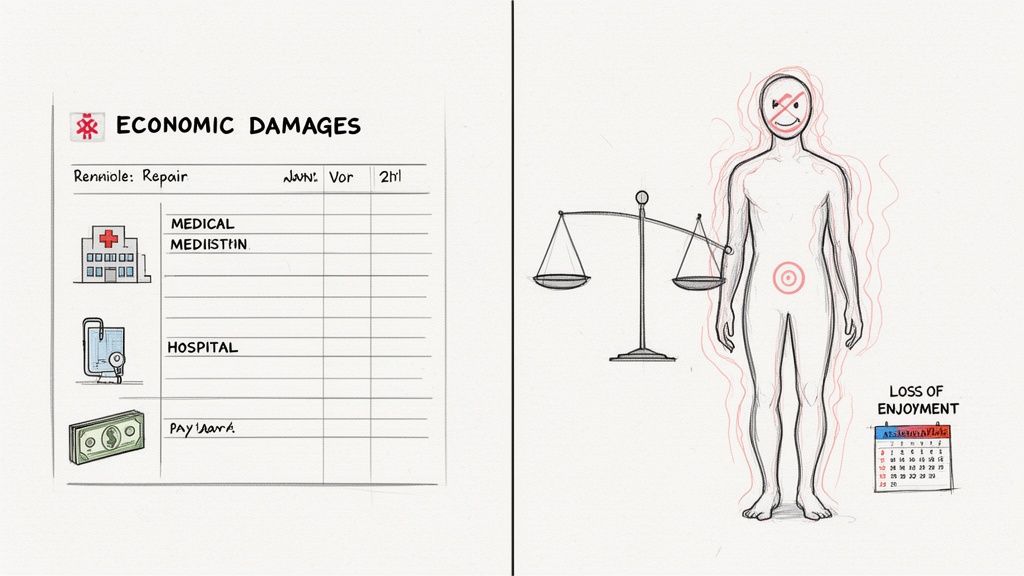
After an accident, some of your losses are easy to see. The ambulance ride, the hospital stay, the weeks of missed work—these all come with receipts and pay stubs. We call these economic damages because they have a concrete price tag.
But the real story of an injury goes far beyond the bills.
Imagine restoring a vintage car only to have it wrecked. The repair estimate for parts and labor is your economic damage; it’s straightforward. The pain and suffering is everything else: the sheer frustration of being unable to drive it, the sting of missing a car show you'd planned for all year, and the lost sense of pride in your now-damaged passion project. That's the part without a price tag.
Defining the Human Cost of an Injury
In a Texas personal injury claim, "pain and suffering" is the legal term for this very real, human cost. It’s a type of non-economic damage, which compensates you for genuine losses that don't generate an invoice. You can find a more in-depth explanation in our guide on https://verdictly.co/blog/what-is-non-economic-damages. It's the law's attempt to recognize how profoundly an injury can derail your life.
This can cover a whole spectrum of personal hardships:
- Physical Pain: From the sharp, immediate pain of the injury to the chronic ache that lingers through recovery and rehabilitation.
- Emotional Distress: The anxiety, fear, depression, or even PTSD that often follows a traumatic event.
- Loss of Enjoyment of Life: When you can no longer play with your kids, go for a run, or work on your hobbies like you used to.
- Disfigurement: The mental anguish and self-consciousness that comes from permanent scars or physical changes.
Pain and suffering isn't just about the hurt. It’s about the total collapse of your quality of life—how an injury changes who you are and what you can do, day in and day out.
The Two Core Calculation Methods
Since these losses are deeply personal, there's no magic formula. Instead, lawyers and insurance adjusters in Texas typically start with one of two methods to begin putting a number on this human toll.
- The Multiplier Method: This is the go-to approach. You add up all your economic damages and multiply that total by a number that reflects just how severe your suffering has been.
- The Per Diem Method: This technique assigns a daily dollar amount for your suffering and multiplies it by the number of days you've been dealing with the pain.
Getting a handle on these two methods is the first step. They create a logical starting point for translating an intangible, personal loss into a tangible figure that can be used in settlement talks.
The Multiplier Method: The Go-To Formula for Your Settlement
When it comes to figuring out a dollar amount for pain and suffering, the multiplier method is the most common starting point for lawyers and insurance companies in Texas. Think of it as a way to anchor something intangible—your suffering—to the concrete financial losses you’ve already paid for.
The formula itself is straightforward: you take your total economic damages and multiply them by a specific number.
Total Economic Damages x Multiplier = Pain and Suffering Award
Your economic damages are all the easy-to-prove costs: medical bills, physical therapy sessions, prescription receipts, and every dollar of lost income from being unable to work. The real negotiation, and where a good attorney makes their mark, happens with the multiplier.
How Is the Multiplier Chosen?
The multiplier isn't just pulled out of a hat. It's a number that reflects just how severe your injury was and how deeply it affected your life. This number usually falls somewhere between 1.5 and 5, though truly catastrophic injuries can push it even higher.
Predictably, the insurance adjuster will push for a low multiplier, while your attorney will build a case to justify a much higher one.
So, what moves the needle? Several key factors come into play:
- Severity of the Injury: A minor sprain that heals quickly might only warrant a 1.5x multiplier. A herniated disc that needs surgery and leaves you with chronic pain? That's a different story, potentially justifying a 4x or 5x multiplier.
- Length of Recovery: A long, grueling recovery process—think multiple surgeries, months of physical therapy, and extended time off work—screams "significant suffering" and supports a higher number.
- Permanent Damage: Did the injury leave a permanent mark? Things like lasting scars, a limp, nerve damage, or a loss of mobility will dramatically increase the multiplier.
- Impact on Your Day-to-Day Life: This is all about telling your story. Could you no longer play with your kids, enjoy your hobbies, or even handle basic household chores? The more your life was disrupted, the stronger the argument for a higher multiplier.
The multiplier is the key battleground in negotiations. It’s not just a number; it’s a value that has to be backed up by clear evidence of how the injury truly impacted your world.
The multiplier method is still the leading approach for calculating these types of damages in personal injury cases, with that 1.5 to 5 range being the standard. For example, if you have $10,000 in medical bills and lost wages, a 2x multiplier adds $20,000 for pain and suffering, bringing the total settlement to $30,000.
A Dallas Car Accident Example
Let's look at how this plays out in a real-world Dallas car accident scenario.
Scenario A: The Minor Injury
- Economic Damages: You walked away with whiplash and bruising. After the ER, a few doctor's visits, and some missed work, your total costs are $5,000.
- Injury Impact: You were back to normal in about six weeks with no lasting issues.
- Multiplier: The insurance company offers a 1.5x multiplier.
- Calculation: $5,000 (Economic Damages) x 1.5 = $7,500 (Pain and Suffering).
- Total Potential Settlement: $5,000 + $7,500 = $12,500.
Scenario B: The Serious Injury
- Economic Damages: The same accident, but this time you suffered a fractured femur requiring surgery. The medical bills and lost wages pile up to $75,000.
- Injury Impact: Recovery was a painful six-month ordeal with intense rehab, and you've been left with a permanent limp.
- Multiplier: Your lawyer argues for a 4x multiplier, pointing to the surgery, long recovery, and permanent impairment.
- Calculation: $75,000 (Economic Damages) x 4 = $300,000 (Pain and Suffering).
- Total Potential Settlement: $75,000 + $300,000 = $375,000.
The scenarios above really highlight how the multiplier can dramatically change the outcome of a case. To see how these factors might apply to your unique situation, you can get a more personalized estimate by checking out our personal injury lawsuit calculator.
At the end of the day, securing fair compensation comes down to the strength of your evidence and your legal team's ability to tell a compelling story.
Multiplier Method Calculation Scenarios
This table breaks down how the multiplier directly corresponds to the severity of an injury, showing its powerful effect on the final settlement amount.
| Scenario | Economic Damages | Injury Severity & Justification | Multiplier | Pain & Suffering Award | Total Settlement |
|---|---|---|---|---|---|
| Minor | $10,000 | Soft tissue sprain, fully recovered in 2 months, minimal life disruption. | 1.5x | $15,000 | $25,000 |
| Moderate | $50,000 | Broken arm, surgery required, 4-month recovery with physical therapy. | 3x | $150,000 | $200,000 |
| Severe | $150,000 | Traumatic Brain Injury (TBI), permanent cognitive issues, requires ongoing care. | 5x | $750,000 | $900,000 |
As you can see, the justification behind the multiplier is everything. It’s what transforms a simple calculation into a fair reflection of what you’ve been through.
Calculating Daily Suffering with the Per Diem Method
While the multiplier method is a common starting point, it’s not the only tool in the shed. Another powerful approach is the per diem method, which translates your suffering into a clear, daily dollar amount.
Think of it this way: the multiplier method gives you a lump sum based on your total bills, which can sometimes feel a bit abstract. The per diem method, on the other hand, is like sending a daily invoice for your pain. It poses a simple but compelling question: "What is one day of living with this pain worth?"
How the Per Diem Method Works
The formula here is just as straightforward as the multiplier approach:
Daily Rate ($) x Number of Days in Pain = Total Pain and Suffering Award
This method breaks down a long, agonizing experience into understandable daily chunks. It has gained real traction with juries because it avoids abstract multipliers and instead assigns a specific dollar value to each day of a victim's suffering.
The "number of days" typically runs from the date of the accident until the day you reach what's known as maximum medical improvement (MMI). This is the point where your doctor says your condition has stabilized and you're not likely to get any better.
The core argument of the per diem method is both simple and powerful: if your time is worth a certain amount when you are healthy and working, then a day filled with pain and limitations should be worth at least as much.
Justifying Your Daily Rate
The most critical part of this whole calculation is justifying that daily rate. A common and highly effective strategy is to anchor the per diem rate to your daily earnings. An attorney might argue that if you earn $200 a day at your job, then enduring a full day of accident-related pain, discomfort, and limitations is surely worth that same amount—if not more.
This logic really connects with insurance adjusters and juries. It grounds the intangible concept of suffering in a concrete, real-world value: your daily wage. Suddenly, the discussion shifts from a subjective guess to a solid financial argument. To make this stick, you need solid evidence, and you can learn more about how to prove pain and suffering in our detailed guide.
This simple visual breaks down how a pain and suffering calculation, like the multiplier method, flows from damages to a final settlement.

This flowchart shows the basic formula where tangible damages are scaled by a multiplier to determine the final settlement amount, a core concept in any negotiation.
A Tarrant County Accident Example
Let's see how the per diem method plays out for a car accident victim right here in Tarrant County.
- The Victim: A construction worker who makes $250 per day.
- The Injury: A severe back injury that required months of tough physical therapy.
- Recovery Time: His doctor certified that he reached maximum medical improvement after 180 days (about six months).
Using his daily wage as the per diem rate, the math is easy:
$250 (Daily Rate) x 180 (Days of Suffering) = $45,000 (Pain and Suffering Award)
Keep in mind, this $45,000 would be in addition to his economic damages, like medical bills and the $45,000 in lost wages he already suffered. The per diem method produces a clear, justifiable figure that is directly tied to the duration of his hardship, making it especially effective for cases with a long and well-documented recovery.
How Texas Laws Shape Your Settlement
Figuring out what your pain and suffering is worth isn’t just about crunching numbers. It’s a process that happens within the legal landscape of Texas, and state law has a huge say in the final amount. Two specific rules can dramatically change what you walk away with: comparative fault and damage caps.
Think of these laws as the ground rules for your entire claim. They set the boundaries for who gets paid and, in some situations, how much. If you don't know the rules, you can't play the game effectively.
The 51% Bar Rule in Texas
Texas follows a rule called modified comparative fault, but most folks know it as the 51% bar rule. This law comes into play whenever there’s a question about who was to blame for an accident. It's a make-or-break factor because it can shrink your settlement or wipe it out completely.
Here’s the simple breakdown:
- If you are 50% or less at fault: You can still get money, but your total award is reduced by whatever percentage of fault is assigned to you. For example, if a jury decides you were 20% responsible for a crash and your total damages are $100,000, your final award would be cut down to $80,000.
- If you are 51% or more at fault: You get nothing. That’s it. The moment your share of the blame tips over that halfway point, Texas law says you forfeit any right to collect money from the other party.
Because of this rule, you can bet the insurance adjuster’s first move will be to try and pin as much of the blame on you as possible. Fighting to prove the other driver was primarily at fault isn't just a detail—it's essential to protecting your right to a fair settlement.
This is why a solid accident report, photos from the scene, and witness statements are so critical. Every single percentage point of fault you can successfully argue against directly translates to more money in your pocket.
Are There Caps on Pain and Suffering Damages in Texas?
People often wonder if there's a legal limit, or damage cap, on how much they can receive for pain and suffering. For most people hurt in a standard car, truck, or motorcycle accident, the answer is a welcome one: Texas does not cap pain and suffering damages in typical personal injury cases.
But, like with many laws, there are a couple of very specific exceptions. The caps only kick in for claims involving:
- Government Entities: If your injury was caused by a government employee—say, the driver of a city bus or a state-owned truck—your claim is governed by the Texas Tort Claims Act. This law limits damages to $250,000 per person, with a total limit of $500,000 for a single incident.
- Medical Malpractice: When an injury is caused by a doctor’s or hospital’s mistake, Texas law imposes strict caps on non-economic damages. The limit is $250,000 from a single doctor or provider, with a total cap of $500,000 from all healthcare facilities combined.
Fortunately, for the vast majority of accident claims between everyday people, you and your attorney have the freedom to negotiate a pain and suffering settlement based purely on the facts and the impact the injury had on your life, without an arbitrary legal limit getting in the way.
Using Real Case Data to Strengthen Your Claim

The multiplier and per diem methods give you a solid starting point for your pain and suffering calculation, but they are just that—a start. These methods don't exist in the real world; they're educated guesses. To build an undeniable, data-driven argument, you need to anchor your claim in reality.
This is where real case data becomes your most powerful tool. Insurance companies don't make offers based on what seems fair in theory. They base them on what they’ve been forced to pay in the past. Trust me, they have massive internal databases of settlements and verdicts that guide every move they make, giving them a huge information advantage from day one.
Moving From Theory to Evidence-Based Negotiation
When you can point to actual settlements from similar cases, everything changes. Instead of just saying, "I think my suffering is worth a 4x multiplier," you can confidently state, "Juries right here in Harris County have awarded settlements using a 4x multiplier for injuries just like mine."
See the difference? Your request is no longer a personal opinion. It’s a number grounded in local legal precedent. You're suddenly speaking the same language as the insurance adjuster, using the very data points they respect most: what Texas juries and insurers have actually paid out.
Leveraging Legal Tech to Find Comparable Cases
Not long ago, getting your hands on this kind of case data was nearly impossible unless you were a big, well-funded law firm. Today, legal tech platforms like Verdictly are changing the game by making this information accessible to everyone. These databases gather public court records and settlement details, letting you search for outcomes using criteria that matter to your case.
You can instantly filter cases by:
- Injury Type: Find cases involving herniated discs, fractured femurs, or traumatic brain injuries.
- Accident Type: Zero in on outcomes from rear-end collisions, T-bone accidents, or commercial truck wrecks.
- Specific County: See what juries in Dallas, Harris, or Tarrant County have awarded—local trends can make a huge difference.
- Award Amounts: Analyze the range of settlements for injuries similar to yours.
By using historical case data, you level the playing field. You're no longer just reacting to the insurance company's lowball offer; you're proactively setting a credible settlement range based on what has already been proven in court.
This data-driven approach gives your claim undeniable authority. It shifts the negotiation away from a subjective debate over feelings and toward a discussion based on objective facts.
Interpreting the Data to Build Your Case
Finding a few similar cases is the first step. The real magic happens when you analyze the details. While the national median personal injury settlement hovers around $31,000, that number can be incredibly misleading without context. Most moderate injury cases settle somewhere in the $20,000–$75,000 range, but severe injuries can easily command six or even seven figures. To get a better sense of what to expect, you can read the full research on typical settlement amounts.
Legal data platforms give you that crucial context. For instance, you can see exactly how damages were awarded, including the specific breakdown between economic and non-economic losses. This provides a clear benchmark you can use for your own pain and suffering calculation.
By finding several cases in your county with similar injuries, medical bills, and recovery times, you can establish a powerful, evidence-based settlement target. This gives you a clear, defensible range for your demand letter, making it much harder for an insurer to justify an insultingly low offer. It shows you’ve done your homework and are ready to argue your case based on what's already happened in a Texas courtroom, not just on how you feel.
Got Questions? We’ve Got Answers on Texas Pain and Suffering Claims
Stepping into the world of a personal injury claim can be confusing. It’s filled with legal jargon and rules that can feel overwhelming when you’re already dealing with an injury. This section cuts through the noise to give you straight answers to the questions we hear most often about pain and suffering in Texas.
Think of this as your practical FAQ. We're moving past the basic formulas to tackle the real-world issues you'll likely face as your claim progresses.
Is My Pain and Suffering Settlement Taxable in Texas?
This is a big one, and the answer usually brings a sigh of relief. For the most part, the money you receive for personal physical injuries or sickness is not considered taxable income by the IRS.
That protection covers the pain and suffering part of your settlement, too. Why? Because the law views these damages as a direct result of your physical injury. It’s not a windfall or a profit; it’s compensation meant to make you "whole" again after a traumatic event.
There is one important exception, though. If you receive a settlement for purely emotional distress that isn't tied to a physical injury, that portion could be taxable. Given these nuances, it’s always a good idea to have a qualified tax professional look over your final settlement agreement.
What Kind of Evidence Actually Proves Pain and Suffering?
You can’t just hand an insurance adjuster a receipt for your pain. Since it's an "intangible" loss, you have to build a case with tangible proof. Your goal is to create a clear, compelling picture of how the injury has affected your life. The more detailed and organized your evidence is, the harder it is for them to argue your claim down.
Here's the kind of evidence that truly makes a difference:
- Your Complete Medical File: This is the bedrock of your claim. Every note from every doctor, specialist, physical therapist, and counselor matters. These records officially document your pain levels, the treatments you’ve undergone, and a professional’s opinion on your path to recovery.
- A Personal Journal: This is your story, told in your own voice. Keeping a regular journal detailing your daily pain, emotional struggles, sleepless nights, and the simple things you can no longer do is incredibly powerful. It puts a human face on the medical records.
- Photos and Videos: A picture is worth a thousand words, and in a personal injury claim, it might be worth thousands of dollars. Photos of your injuries right after the accident and during your recovery show the physical toll in a way that words alone never can.
- Statements from People Who Know You: Testimony from friends, family, and coworkers can be invaluable. They see the real-world impact of your injury—the changes in your mood, your personality, and your ability to just get through a normal day.
For life-altering injuries, bringing in medical or psychological experts to testify can add a layer of authority that solidifies your claim for a higher pain and suffering award.
Can I Figure Out My Pain and Suffering Value Without a Lawyer?
You can absolutely use online calculators and the methods we've talked about to get a ballpark idea of what your claim might be worth. But getting from that rough estimate to a fair settlement check is another story entirely. That first calculation is just the opening bell in a long, complicated fight.
Insurance companies have entire teams of adjusters and attorneys whose sole job is to pay out as little as possible. They are experts at poking holes in claims, whether it's by challenging the severity of your injuries, questioning your doctor's treatment plan, or just sticking to an absurdly low multiplier.
An experienced personal injury attorney does so much more than just run a calculation. They build a strategy, gather the right proof, know the insurance company’s playbook before they even run a play, and handle the tough negotiations to make sure you’re not taken advantage of.
Going it alone puts you at a massive disadvantage. An attorney doesn't just help; they level the playing field, which is critical to getting the compensation you truly deserve.
Why Was the Insurance Company's First Offer So Low?
Getting that first settlement offer can feel like a slap in the face. It’s almost always shockingly low, but don't get discouraged. This isn't a reflection of what your case is worth; it's a standard opening move in their playbook.
Remember, insurance carriers are businesses designed for profit, and their goal is to close your claim for the least amount of money. That first offer is a test. They're trying to see if you're in a hurry, unsure of your rights, or willing to take a quick, cheap payout just to be done with it all.
That lowball number is based on their own self-serving calculation, using the lowest possible multiplier and likely questioning some of your medical bills. You should never treat it as a serious valuation. See it for what it is: their opening bid. The next step is to come back with a strong, evidence-backed counter-offer.
Navigating a personal injury claim takes more than just understanding the math; it takes real-world data. With Verdictly, you can see what actual juries and insurance companies in Texas have paid for injuries just like yours. Arm yourself with the facts you need to walk into negotiations from a position of strength. Explore Texas motor vehicle case data on Verdictly.
Related Posts

Calculating pain and suffering car accident: A Practical Guide to Damages
Learn how calculating pain and suffering car accident damages works, with factors and tips to maximize your settlement.

What to Do After a Hit and Run Car Accident in Texas
A complete guide on what to do after a hit and run car accident in Texas. Learn the critical first steps, your legal options, and how to file a claim.

Negotiating Medical Bills After Settlement A Plaintiff's Guide
Protect your award. This guide provides actionable strategies for negotiating medical bills after settlement, reducing liens, and handling subrogation claims.