
How to Prepare for a Deposition A Texas Motorist's Guide
Learn how to prepare for a deposition with our guide for Texas motorists. Get expert tips on telling your story, handling questions, and using technology.
Getting ready for your deposition isn't about becoming a legal expert overnight. It's much simpler than that. It boils down to knowing what's coming, going over the key facts with your lawyer, and getting comfortable with the rules for giving testimony.
You'll be questioned under oath by the other side's attorney, but your own lawyer will be right there with you, guiding you through it. Think of it less as a test and more as your chance to tell your story clearly and truthfully.
What Really Happens During a Deposition
The word "deposition" can sound intimidating because it’s an official legal step, but it’s not a trial. Picture a conference room, not a courtroom. It's essentially a fact-finding mission for the other side to hear your side of the story about the accident and how your injuries have affected you.
For anyone with a personal injury case in Texas, this is a very standard part of the process. A court reporter will be there typing everything that’s said, creating an official transcript. That transcript becomes a permanent record that can be used later on, whether in settlement talks or, if it comes to it, in court. This is exactly why being accurate and consistent is so important.
If you want to get into the nitty-gritty, we have a complete guide that explains in more detail what is a deposition in a lawsuit and how it fits into your case.
The Key Players in the Room
Walking into the room and seeing several people can be a bit much, but it helps to know who’s who. Everyone has a specific job to do, and remember, you're not on your own—your attorney is there specifically to look out for you.
Here's a quick reference guide to the faces you'll see around the table.
| Role | Who They Are | Their Primary Goal |
|---|---|---|
| The Deponent | That's you—the person giving testimony under oath. | To answer questions truthfully and accurately based on what you know. |
| Your Attorney | Your legal counsel, sitting right beside you. | To protect your rights, advise you, and object to any improper or unfair questions. |
| Opposing Counsel | The lawyer representing the other party involved in the accident. | To gather facts, understand your story, and evaluate the strengths of your claim. |
| The Court Reporter | A certified, neutral professional who transcribes the entire proceeding. | To create an official, word-for-word written record of everything said during the deposition. |
Knowing these roles can help take the mystery out of the process and make it feel more manageable.
Key Takeaway: A deposition isn't an interrogation meant to trip you up. It’s a structured Q&A session where the other side gets to hear the facts of the case directly from you. Good preparation turns it into an opportunity to present your story with confidence.
So, how does it all start? First, you'll be "sworn in" by the court reporter, which is just a formal promise to tell the truth. After that, the other side’s attorney will begin asking questions. They’ll likely cover your personal background, the specific details of the accident, your medical journey since then, and how the injuries have impacted your daily life. It’s a controlled conversation, and it’s a crucial step for both sides to get the information they need to figure out what to do next with the case.
Turning Your Documents into a Cohesive Story
Your words carry a lot of weight in a deposition, but when they're backed up by a stack of organized, factual documents, they become nearly bulletproof. Getting ready for your deposition is as much about the paperwork as it is about what you plan to say. It’s about taking what looks like a chaotic pile of records and turning it into a clear, compelling story of what you've been through.
Let's be honest, the amount of paper can be intimidating. You're probably looking at medical records from different doctors, a police report, car repair estimates, maybe even emails with an insurance adjuster. The trick isn't to memorize every single detail. It's to work with your lawyer to pinpoint the key pieces of evidence that tell your story from start to finish.
This is the official process where your story gets recorded. You'll see several people in the room, and each has a specific job.
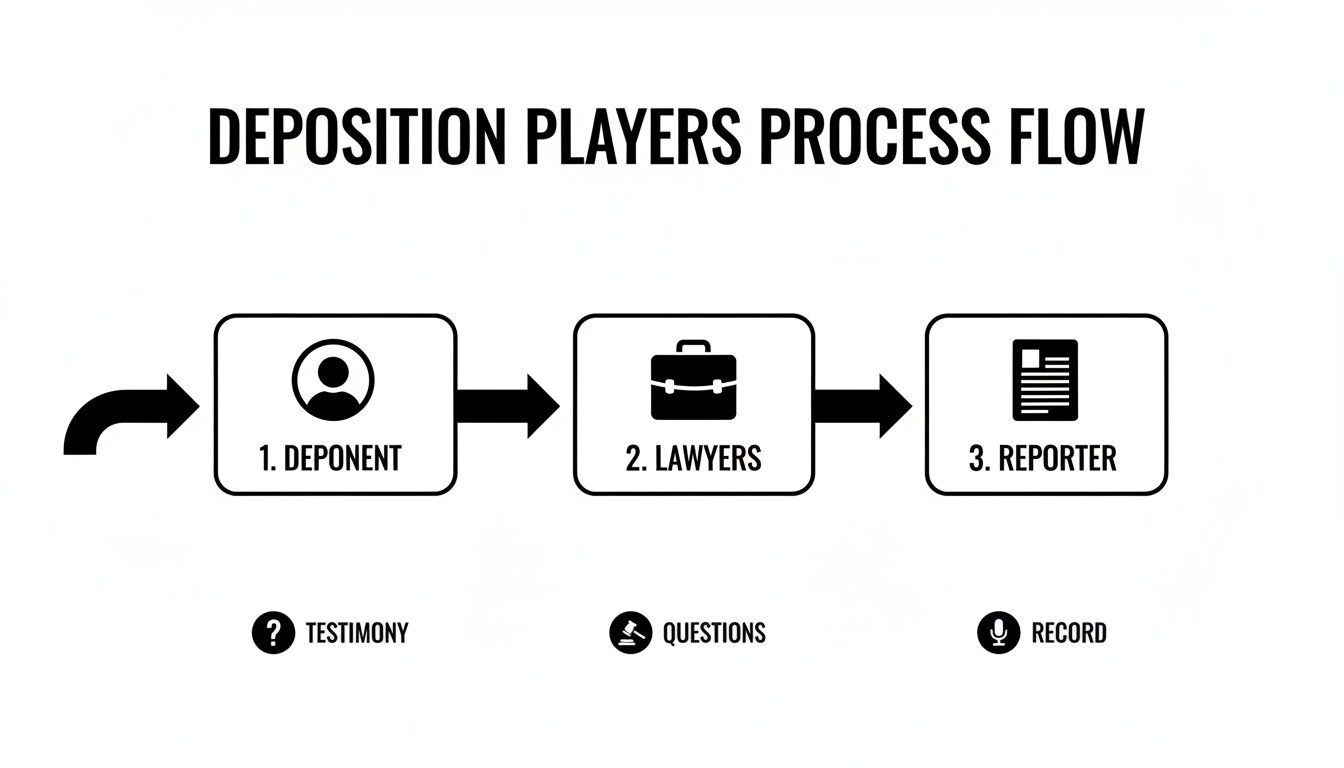
Everyone in that room plays a part in making sure the testimony—built on the foundation of your documents—is captured accurately.
Creating Your Factual Timeline
One of the first things your attorney will help you do is build a timeline. Think of this as your roadmap; it grounds everything you say in solid facts and specific dates. It doesn’t have to be fancy, just accurate.
Your timeline will probably hit these major milestones:
- The Accident: The exact date, time, and location, along with what happened right after, all confirmed by the police report.
- First Medical Care: That initial trip to the ER or urgent care, including what the doctors first found.
- Ongoing Treatment: A list of your follow-up appointments, physical therapy sessions, and any visits to specialists.
- Life Impact: Important dates you couldn't go to work, had to skip important family events, or paid for major expenses related to the accident.
Going through these documents does more than just organize them—it jogs your memory. Instead of fumbling for a date, you can say with confidence, "My physical therapy started the first week of March, right after I saw the orthopedic specialist." That kind of precision makes your testimony incredibly credible.
Distilling the Data into a Narrative
Modern lawsuits are swimming in data. A recent survey showed that 93% of litigation support professionals are seeing the sheer volume of data in cases explode. For you, this means deposition prep is really an exercise in filtering. The goal is to boil down potentially thousands of pages into a tight chronology of 20–40 key events that you know cold.
Your lawyer is the expert here and will guide you toward the documents that truly matter. These usually include:
- The Official Police Report: It sets the basic, undisputed facts of the crash.
- Key Medical Records: Think of the big ones—the initial ER report, an MRI that shows the injury, or a surgeon's summary.
- Major Medical Bills: These show the real financial cost of what happened.
- Vehicle Repair Estimates: This is the proof of the property damage.
Key Takeaway: You don't need to become a medical expert or a legal scholar. Your only job is to know the core facts of your own story so you can talk about them honestly and consistently.
By focusing on this curated list of documents, you're building a strong, unshakable foundation for your testimony. It ensures that when the other side's lawyer asks about your first doctor's visit or the cost of fixing your car, your answer will line up perfectly with the evidence. That consistency is what builds a trustworthy case. If you're curious about how legal documents fit into the bigger picture, our guide on how to find public court records offers some great context.
Navigating Remote and Hybrid Depositions
The old picture of a deposition—everyone gathered around a long conference table—is becoming a thing of the past. These days, you're just as likely to give your testimony through a screen. This shift means your technical setup is now a critical piece of your preparation. A stable internet connection and a professional setting are no longer optional; they're essential for making a strong, credible impression.
Just a few years ago, remote legal proceedings were rare. Now, they're the norm. A 2023 industry survey found that over 70% of law firms are now conducting at least some of their depositions remotely. Courts take these virtual proceedings just as seriously as in-person ones, so treating your tech setup as an afterthought can genuinely hurt your case. You can learn more about the rise of remote depositions and see how they are reshaping the legal process.
Setting the Stage for Success
Your environment says a lot about you before you even speak. It needs to look professional and show that you're focused. You have to control your surroundings just like you would in an office.
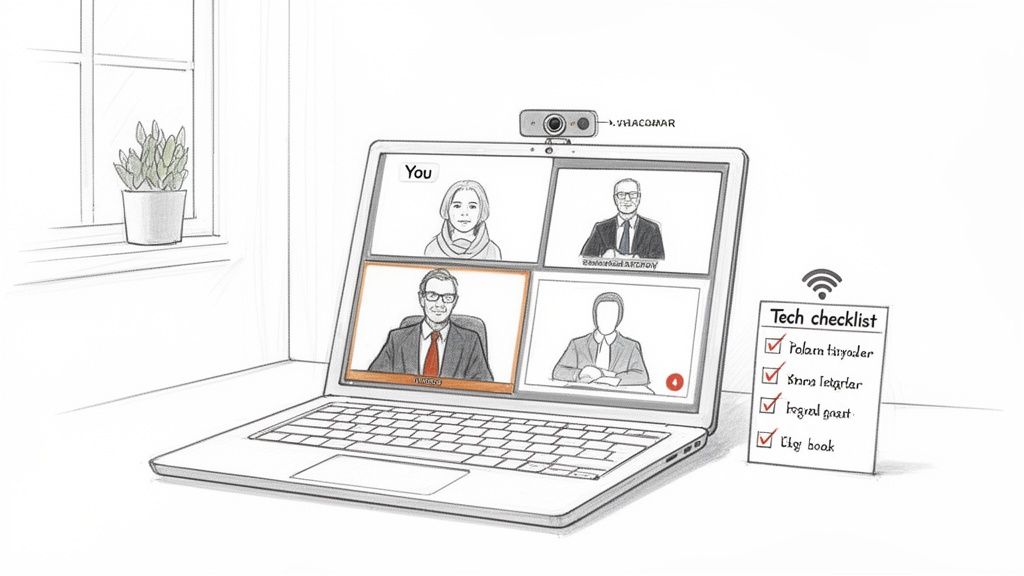
Here’s a practical checklist to run through before logging on:
- Find a Quiet Space: Pick a room where you can shut the door. You need a guarantee that you won't be interrupted by family, pets, or the mailman ringing the doorbell.
- Check Your Background: Keep what's behind you neutral and clean. A plain wall or a tidy bookshelf works perfectly. Steer clear of personal photos, messy areas, or virtual backgrounds, which can be distracting.
- Test Your Lighting: Natural light is best, so try to face a window. If you can't, place a lamp in front of you. If the main light source is behind you, you'll look like a silhouette, and no one will be able to see your face clearly.
- Position Your Camera: Get your webcam to eye level. You can use a stack of books or a laptop stand. This creates a natural line of sight and helps you appear more confident and engaged.
One of the most important things you can do is a full tech run-through with your attorney beforehand. This isn't just about making sure your Wi-Fi works. It's a chance to practice with the video platform, get comfortable viewing digital exhibits, and iron out any kinks before it's "go time."
Key Takeaway: In a remote deposition, your technology is part of your testimony. A clear video feed, good audio, and a distraction-free space ensure your story is what gets the attention—not technical glitches.
Virtual Etiquette and Best Practices
A remote deposition has its own set of rules. You have to treat it with the same gravity as if you were walking into a courtroom. That starts with what you wear. Dress professionally, at least from the waist up. Business casual is always a safe bet.
You also need to be much more aware of your body language. Look into the camera when you speak, not at your own picture on the screen—this is the virtual equivalent of making eye contact. Try not to fidget, check your phone, or do anything else that could be seen as multitasking. Every little movement is amplified on video.
And when a break is called, always mute your microphone and turn off your camera to ensure your private conversations stay private. Following these simple rules shows you respect the process and helps you come across as credible and trustworthy.
Answering Difficult Questions with Confidence
The moment of truth in any deposition is when the other side's lawyer starts asking questions. This is where all your prep work really shines. With the right approach, you can turn what feels like a high-stakes interrogation into a controlled and effective step in your case.
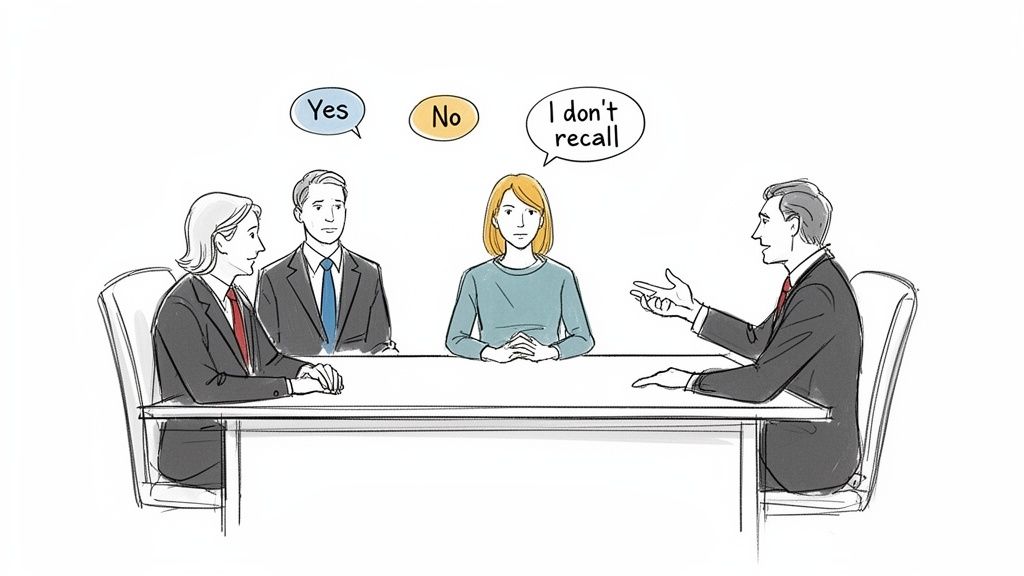
Remember, the lawyer asking the questions isn't just making conversation; they have a very specific goal—to get information that helps their case and to see how you hold up as a witness. Your goal is much simpler: provide truthful, direct answers based only on what you personally know. This isn't a chat; it's a formal Q&A session.
The Golden Rules of Testimony
Think of these as your guardrails for every single answer. They seem basic, but they are incredibly effective at keeping you in control and ensuring your testimony is rock-solid.
Burn these rules into your memory before you walk into that room:
- Listen to the Entire Question. Don't jump ahead or assume you know what's coming. Let the lawyer finish their sentence completely before you even start to process the question.
- Pause Before You Speak. Always. Take a breath. This small beat gives you a moment to collect your thoughts and, just as importantly, gives your own attorney a chance to object if the question is out of line.
- Answer Only the Question Asked. This one is crucial. If a question can be answered with a simple "yes" or "no," then that's your answer. Fight the natural urge to explain or add extra details. Don't volunteer anything.
- Never, Ever Guess. If you don’t know something, the answer is "I don't know." If you can't remember, the answer is "I don't recall." These are complete, honest answers. A wrong guess can do far more damage than admitting you don't have the information.
For example, if the attorney asks, "What time was your doctor's appointment on Tuesday?" and you're not 100% sure, don't say, "I think it was around 2:00 p.m." The only correct answer is, "I don't recall the exact time."
The Power of the Pause: A simple three-second pause before answering is your best friend. It accomplishes two things: it makes you look thoughtful and credible, and it creates a critical window for your lawyer to jump in and object to an improper question before you've answered it.
Handling Common Questioning Tactics
The other lawyer will use certain techniques to try and box you in or get you to say more than you should. When you see these tactics coming, you can stay calm and give a precise answer without falling for the trap.
Leading Questions These are questions that suggest the answer. "You were speeding through the intersection, weren't you?" is a classic example. Your lawyer will probably object, but you still need to answer truthfully. A firm "No" is a full and complete answer.
Compound Questions This is a lawyer's trick of rolling two or more questions into one, like, "When you left your house that morning, were you running late and did you forget to check your mirrors?" Don't try to untangle it yourself. Just put the ball back in their court by saying, "That's two questions. Which one would you like me to answer first?"
If a question is ever confusing, vague, or just makes no sense to you, it is perfectly fine to say, "Could you please rephrase the question?" or "I don't understand the question." Your job is to be a truthful witness, not to decipher confusing legal jargon.
How Your Attorney Prepares You to Win
You’re not going into this blind. A good personal-injury lawyer is your most critical ally in deposition prep, acting as both a coach and a strategist. Their entire job is to make sure you walk into that room feeling prepared, confident, and ready to tell your story without getting tripped up.
This isn't a one-way street; preparing for a deposition is a team effort between you and your legal counsel. They bring the legal strategy, and you bring the facts. More and more, legal teams are also bringing powerful technology to the table to make these prep sessions laser-focused.
Smarter Legal Prep is the New Standard
Technology has seriously changed how lawyers get ready for big moments like a deposition. For someone injured in a Texas car wreck, this shift is a huge advantage. It means less of your attorney's time is spent buried in paperwork and more of it is spent practicing with you and sharpening the case strategy.
The data backs this up. The 2025 Vals Legal AI Report found that AI tools actually performed 24%–27% higher than humans on tasks like summarizing documents and analyzing transcripts. With surveys showing that over 30% of legal professionals are already using generative AI, the old, manual way of doing things is on its way out. You can read more about AI's role in legal support on uslegalsupport.com.
This efficiency frees up your lawyer to focus on what really matters: you. This focused approach is especially vital when you consider the stakes. As our guide on hiring a personal injury attorney explains, a great lawyer does more than just file documents; they prepare you for the make-or-break moments of your case.
What a Mock Deposition Looks Like
One of the most valuable things your attorney will do is run you through a mock deposition. Think of it as a dress rehearsal. Your attorney, or maybe another lawyer from their firm, will play the part of the opposing counsel and ask you the tough questions. It can feel a little intense, but that’s the whole point.
This practice session is incredibly useful for a few reasons:
- It mimics the real thing: You’ll get used to the unique rhythm of being questioned under oath. It’s a very different way of communicating.
- It spots potential issues: Your attorney can see which parts of your story are crystal clear and which areas might be confusing or need more work.
- It tests your memory: It’s one thing to remember the facts, but it's another to recall them accurately under pressure. This practice helps lock them in.
- It builds your confidence: Once you’ve been through a tough practice round, the real thing will feel much less intimidating. You’ve seen it all before.
Key Takeaway: A mock deposition isn’t about memorizing a script. It’s about practicing the process of listening, pausing before you speak, and giving answers that are both truthful and precise.
By the end of this rehearsal, you and your legal team will be on the exact same page. When you finally raise your hand to be sworn in, you’ll know what’s coming and be ready to handle whatever the other side throws at you.
Answering Your Top Deposition Questions
Even with the best preparation, some practical, last-minute questions always seem to pop up. Let's run through some of the most common things people worry about before they sit down for their deposition. Getting these sorted out ahead of time will help you walk in feeling much more confident.
What Should I Wear to My Deposition?
Think business casual, or what you might wear to a church service. The idea is to look credible and show that you're taking this seriously.
You don't need to buy a new suit, but your clothes should be clean, ironed, and conservative. A collared shirt and slacks work well for men, and a modest blouse with a skirt or slacks is a great choice for women. Stay away from anything that could be distracting—that means no big logos, loud prints, or flashy jewelry. The focus should be on what you say, not what you're wearing.
Can I Talk to My Lawyer During the Deposition?
This is a big one, and the rules are specific. Generally, you cannot have a private chat with your lawyer while a question is pending. In other words, once the other attorney asks you something, you have to answer it on your own, without any coaching.
That said, you are absolutely allowed to speak with your lawyer during breaks. If you're feeling confused, overwhelmed, or just need to regroup, you can always ask for a short break to talk things over with your attorney. It’s your right, so don't hesitate to use it.
Key Insight: That rule is there to make sure the testimony is 100% yours. Your breaks are your chance to get clarification or guidance from your lawyer, so use them wisely.
What If I Make a Mistake in My Testimony?
It happens to everyone. You’re under pressure, and you might get a date wrong or mix up a detail. Don't panic. The most important thing is to fix the mistake as soon as you catch it.
Just say something like, "Excuse me, I need to correct something I said a moment ago." Then, simply state the correction clearly. Your credibility is built on being honest and accurate, not on being perfect. The court reporter can then make a note of the change in the official transcript.
How Long Will the Deposition Last?
This really depends on the case. For a fairly standard Texas car wreck case, you can probably expect it to last anywhere from two to four hours.
But if the case is more complex—maybe there are multiple serious injuries or the facts are heavily disputed—it could easily take up a full day, sometimes even longer. Your attorney will have a much better feel for the timing based on your specific situation and can give you a solid estimate beforehand.
Preparing for your deposition is one thing, but knowing what your case is truly worth is another. Verdictly gives you a powerful advantage by providing real verdicts and settlement data from personal injury cases right here in Texas. You can see what juries and insurance companies have actually paid in situations like yours. By searching our database, you can build a negotiation strategy based on facts, not guesswork. Explore Texas case outcomes on Verdictly.
Related Posts

Kinds of Negligence (kinds of negligence): How They Impact Your Injury Claim
Discover kinds of negligence in Texas personal injury cases and how they can impact your motor vehicle claim. Get clear guidance on your rights now.

Calculating pain and suffering car accident: A Practical Guide to Damages
Learn how calculating pain and suffering car accident damages works, with factors and tips to maximize your settlement.

How to guide: how to negotiate with insurance adjuster
Learn how to negotiate with insurance adjuster effectively to maximize your settlement, protect your rights, and avoid common claim pitfalls.