

How Auto Accident Attorney Fees Actually Work in Texas
Confused about auto accident attorney fees in Texas? This guide breaks down contingency fees, hidden costs, and how to calculate what you actually take home.
Let's get right down to it. When you hire a personal injury lawyer in Texas for a car accident case, you're almost always going to work on a contingency fee basis. This means their fee is a percentage of what they recover for you, typically ranging from 33.3% to 40%.
The best part? You pay absolutely nothing unless they win your case. This setup ensures your attorney is just as motivated as you are to get the best possible outcome.
Decoding Texas Auto Accident Attorney Fees

After an accident, the last thing you need is another bill piling up. The contingency fee system is specifically designed to remove that financial stress, giving everyone a fair shot at quality legal help, no matter their bank account balance.
Think of it as a partnership. Your lawyer invests their time, expertise, and resources into building your case, and their payment is a piece of the final award. This "no win, no fee" promise is the gold standard in personal injury law because it perfectly aligns your lawyer's interests with yours. They only get paid if you get paid.
Standard Fee Percentages in Texas
So, what determines if the fee is 33.3% or 40%? It usually comes down to how much work your case requires. A straightforward case that settles quickly before a lawsuit is even filed is less work than one that goes all the way to a courtroom. The fee reflects that.
Most attorneys use a tiered structure that looks something like this:
Typical Texas Contingency Fee Structure
Here’s a quick breakdown of what you can generally expect the fee percentage to be at different points in the legal process.
| Case Stage | Common Fee Percentage | Example Fee on a $100,000 Settlement |
|---|---|---|
| Settled Before Lawsuit | 33.3% (or 1/3) | $33,330 |
| After Lawsuit is Filed (Litigation) | 40% | $40,000 |
| After an Appeal | 45% | $45,000 |
This table shows how the attorney’s share increases as the case demands more intensive work, like court filings, depositions, expert witnesses, and trial preparation.
This tiered approach makes sense when you think about it. Filing a lawsuit kicks off a whole new phase of work—a much bigger investment of time and resources for the law firm. For example, as explained in this guide on Texas attorney costs from Cyclistlaw.com, a $100,000 settlement before a lawsuit might mean a $33,330 fee, but that number climbs to $40,000 once the case enters litigation.
Key Takeaway: The more complex your case gets, the higher the attorney's fee percentage will likely be. Settling early usually means you keep a larger portion of the recovery, but fighting longer can sometimes lead to a much larger settlement, making the higher fee well worth it.
Decoding Your Contingency Fee Agreement
When you hire an auto accident attorney, you’re not just getting a lawyer—you’re forming a partnership. The most common arrangement in this world is the contingency fee. Forget about hefty retainers or paying by the hour; this model is completely different.
Simply put, your attorney's pay is contingent on winning your case. They invest their firm’s time, money, and resources upfront to fight for you. If they secure a settlement or a court award, their payment is a pre-agreed percentage of that amount. If they don't win, you don't owe them a fee. This "no win, no fee" promise is the bedrock of personal injury law for a very good reason.
It opens the courthouse doors to everyone. This structure gives regular people the power to take on massive insurance companies without needing a small fortune just to get started.
Why Aligned Interests Matter
The real beauty of a contingency fee is that it puts you and your attorney on the exact same team, fighting for the exact same goal. Because their fee is a direct cut of your recovery, they are laser-focused on getting you the maximum compensation possible. The more they win for you, the more they earn. It’s that simple.
This system is built on shared risk. Your lawyer is essentially betting on you, your case, and their own ability to deliver a win.
Think of it this way: when an attorney takes your case on contingency, they are saying, "I believe in your case so strongly that I'm willing to fund it myself. We only get paid when we win this together."
That's a world away from other billing models where a lawyer gets paid for their time, win or lose. A contingency fee keeps everyone’s eyes on the prize: results.
Contingency Fees vs. Other Ways Lawyers Get Paid
To really get why this model is so common for accident cases, it helps to see what the alternatives look like in other legal fields.
-
Hourly Rate: This is the classic "lawyer on the clock" model. The attorney bills you for every minute they work on your case. It’s standard for corporate or divorce law, but it would be a disaster for an injury victim who is already out of work and facing a mountain of medical bills.
-
Flat Fee: You pay one set price for a specific task, like drafting a will or handling a simple traffic ticket. This doesn’t fly for auto accident cases because it’s impossible to know at the start if a case will take 10 hours or 1,000.
The contingency fee is king in personal injury law because it removes the financial barrier. Your access to justice is determined by the strength of your case, not the size of your bank account.
It's one of the biggest points of confusion I see with clients, and it's a completely understandable one: the difference between an attorney's fee and the costs of a case. They aren't the same thing.
Think of it this way: when you hire a contractor to build a deck, you pay them for their labor and expertise. But you also have to pay for the lumber, screws, and stain. The lawyer's contingency fee is their "labor"—it's payment for their time, skill, and effort. Case costs are the "lumber"—the necessary materials they have to buy to build your case.
These are real, out-of-pocket expenses your law firm pays upfront to move your claim forward. They are essentially investing in your case to make it as strong as possible.
What Are Common Case Costs?
Every case is different, but most personal injury claims involve a fairly standard set of expenses. Your attorney fronts this money, and they get reimbursed for it out of the final settlement or court award.
Here’s a look at the most common costs you'll likely see on an itemized list:
- Court Filing Fees: Just starting a lawsuit costs money. Courts charge a fee to officially file the necessary documents.
- Record Retrieval Costs: We need official copies of everything—the police report, all your medical records, billing statements, and sometimes even your employment files to prove lost wages.
- Deposition Costs: This is a big one. It involves paying a court reporter to transcribe every word of sworn testimony from witnesses, the at-fault party, and experts.
- Expert Witness Fees: Sometimes, you need a specialist to win. This could be an accident reconstruction expert to prove how the crash happened or a medical expert to explain the long-term impact of your injuries. These professionals charge for their analysis and testimony.
- Trial Exhibits: If your case heads to a jury, you can't just talk at them. You need to show them. Creating professional charts, visual aids, and presentations for trial comes with a price tag.
The key takeaway is that these costs are completely separate from your lawyer's percentage-based fee. They are the direct, operational expenses of building and litigating a case, and they are deducted from the total settlement amount.
How Costs Affect Your Final Payout
So how does this all shake out in the end? Knowing the math is crucial so there are no surprises when you get your final check.
First, the gross settlement amount comes in. From that total, the attorney's contingency fee is calculated and deducted. Next, the law firm is reimbursed for all the itemized case costs they paid for along the way.
What's left after those two deductions is your net recovery. That's the money that goes into your pocket.
Getting a clear handle on these potential expenses from day one is non-negotiable. For a more detailed breakdown, you can learn more about what an accident lawyer costs in our complete guide. Any good fee agreement will spell out exactly how costs are handled, giving you a full financial picture before you sign anything.
Calculating What You Actually Take Home
It’s one thing to talk about percentages and case costs in theory, but seeing how the numbers play out in a real-world scenario makes all the difference. Let's walk through a realistic Texas car wreck case to see how these concepts translate into actual dollars and cents.
This is all about understanding your net recovery—the final amount that goes into your pocket after all the deductions are made.
We’ll start with a hypothetical gross settlement of $90,000. Think of this as the top-line number, the full amount the insurance company agrees to pay before anyone gets a slice. From here, the money gets distributed.
This flow chart gives a great visual of how the money moves from the initial settlement to your final payout.
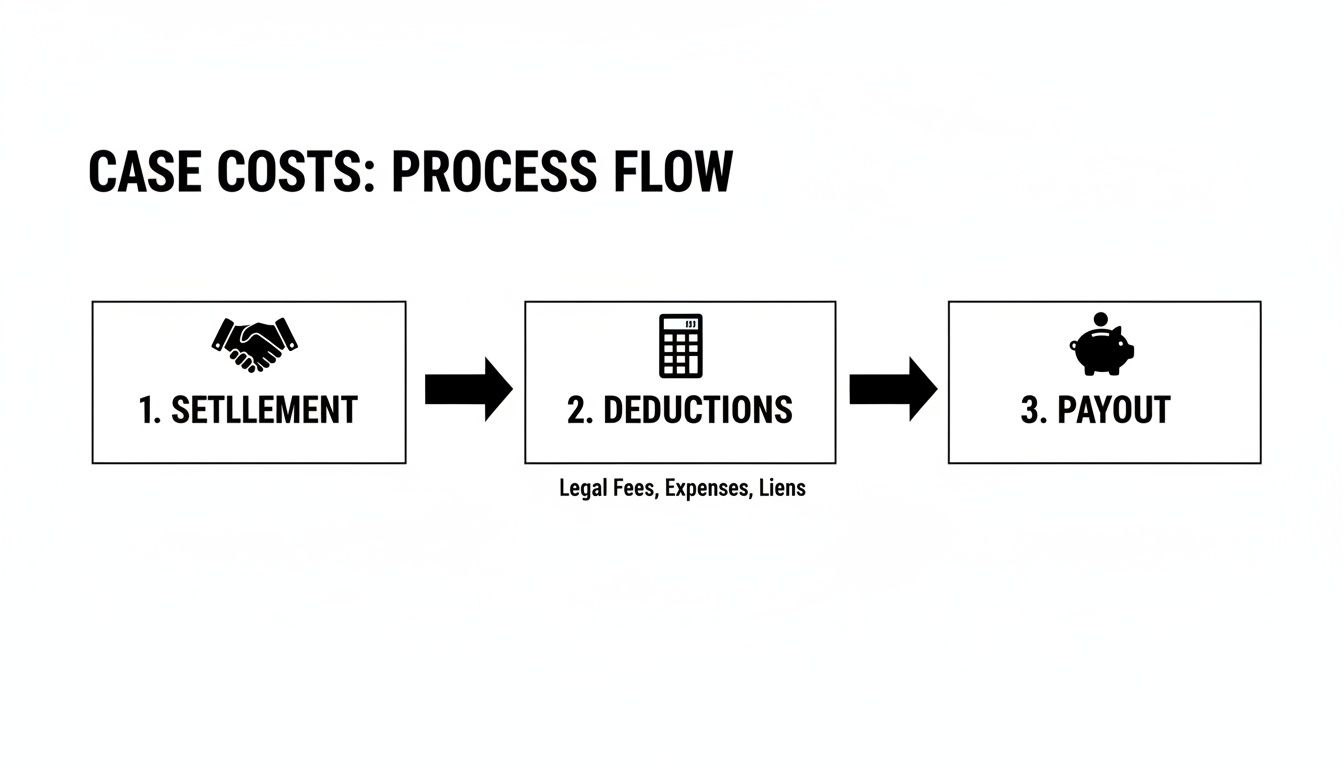
As you can see, the gross amount is first reduced by legal fees and case costs, leaving you with the final net payout.
From Gross Settlement To Your Net Payout
Okay, let's put some real numbers to this. Imagine your case settled before a lawsuit had to be filed, so your lawyer’s contingency fee is the standard 33.3%, or one-third. We also need to account for typical case costs and any medical bills that have to be paid back from the settlement.
Here’s a simple table that breaks down the math step-by-step.
Sample Settlement Calculation for a $90,000 Recovery
| Item | Amount | Remaining Balance |
|---|---|---|
| Gross Settlement Amount | $90,000 | |
| Attorney's Fee (33.3% of $90,000) | -$29,970 | $60,030 |
| Case Costs (e.g., records, filing fees) | -$2,500 | $57,530 |
| Medical Liens/Bills Repaid | -$15,000 | $42,530 |
| Client's Net Recovery (Take-Home) | $42,530 |
In this scenario, after everything is paid, your final take-home amount is $42,530. This really drives home why it's so crucial to have a clear, written fee agreement that spells out exactly how fees and costs are calculated and deducted. No surprises.
Does Hiring a Lawyer Actually Pay Off?
Seeing a big chunk of the settlement go toward fees, costs, and medical bills can be a bit jarring at first glance. It's easy to wonder if you'd be better off on your own.
But here’s the thing: study after study confirms that injury victims who hire a lawyer typically end up with far more money, even after the attorney's fee is paid. The Insurance Research Council, for instance, found that represented victims get average settlements around $77,600, while those who go it alone average just $23,000. That's a 3.4-fold difference, which more than covers the cost of expert legal help.
This highlights a critical point: the goal isn’t just to avoid paying a fee; it's to maximize your total financial recovery. An experienced attorney accomplishes this by building a stronger case and negotiating more effectively than a victim could alone.
Ultimately, what you take home depends on a lot of things, like the skill of your attorney and the unique facts of your case. For a personalized estimate grounded in real Texas case data, you can use our car accident settlement calculator to get a better sense of what similar cases have been worth. It's a great data-backed starting point for understanding your potential outcome.
What to Look For in Your Fee Agreement
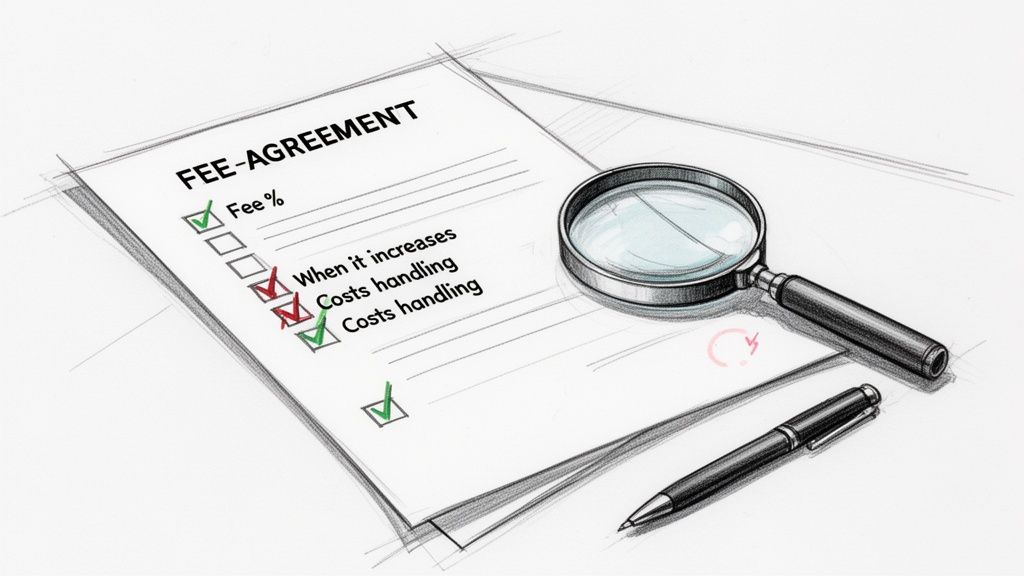 An attorney fee agreement isn't just a piece of paper you sign and forget. It's a legally binding contract that spells out the entire financial side of your relationship with your lawyer. Before you put pen to paper, you absolutely have to read every single line and know what you're agreeing to. This document should leave zero doubt about how the auto accident attorney fees will be managed.
Don't let the legalese scare you. Any lawyer worth their salt will be more than happy to walk you through the agreement, line by line, and clear up anything that seems confusing. Think of this contract as the financial roadmap for your case—clarity is everything.
Core Components of the Agreement
Your fee agreement needs to clearly define a few crucial elements. I tell my clients to treat it like a checklist to make sure everything is on the up-and-up. Never, ever sign an agreement that's vague about the important stuff.
Here are the non-negotiables you need to find and fully understand:
- The Exact Fee Percentage: The contract must state the precise percentage the firm will take. It should also be crystal clear about whether that percentage changes based on how far the case goes. For example, does it jump from 33.3% to 40% if a lawsuit has to be filed?
- How Case Costs are Handled: It should explain who pays for case expenses as they come up (it's almost always the law firm) and confirm that these costs are paid back out of the settlement after the attorney’s fee is calculated.
- Fee Calculation Method: This one is huge. Does the attorney take their percentage from the gross (total) settlement amount, or from the net amount after case costs have been deducted? This single detail can make a real difference in how much money ends up in your pocket.
Gross vs. Net Calculation: A Quick Example Let's say you have a $100,000 settlement with $5,000 in case costs and a 33.3% fee:
- Gross Calculation: The fee is $33,300. Your take-home is $61,700.
- Net Calculation: The fee is $31,635. Your take-home is $63,365. It might not seem like a massive difference here, but believe me, on larger settlements, it can add up to thousands of dollars.
Key Questions to Ask Before Signing
Your first meeting with a potential lawyer is basically an interview—and you're the one doing the hiring. You’re entrusting them with a critical job, so you have every right to ask tough questions. A good lawyer will appreciate it; it shows you’re engaged. Our guide on how to pick a personal injury lawyer has even more advice on vetting candidates.
Make sure you bring this list of questions with you:
- Is your fee calculated on the gross settlement or the net amount after costs?
- Can you give me a rough, itemized estimate of what the case costs might be?
- What happens if we lose? Am I on the hook for any of the case costs?
- Tell me the exact circumstances that would cause your fee percentage to go up.
- What’s the process if I decide to switch attorneys partway through the case?
Getting straight answers to these questions is your best defense against future headaches. It allows you to sign with confidence, knowing there won’t be any nasty financial surprises waiting for you down the road.
Can You Negotiate Your Lawyer's Fee?
So, is that 33.3% to 40% contingency fee completely set in stone? While it’s the industry standard for a reason, it’s not always a hard-and-fast rule. The right set of circumstances can definitely open the door for a conversation.
You have to look at it from the attorney's point of view. Their fee is directly tied to the risk they're taking on. When a case looks like it's going to be less of a gamble and require less upfront work, some lawyers are willing to be more flexible on their percentage.
When a Lower Fee Might Be on the Table
So, when does it actually make sense to talk about the fee? Your best shot is when your case has a unique combination of low risk for the attorney and a high potential for a big payout.
It's probably worth bringing up if your case involves:
- Massive Potential Damages: If you're looking at a catastrophic injury case with a potential recovery in the multi-millions, an attorney might consider a lower percentage. Even a slightly smaller slice of a very large pie is still a substantial payday for the firm.
- Slam-Dunk Liability: Think about a case where the other driver's fault is painfully obvious. For example, you were rear-ended by a drunk driver who admitted everything at the scene. When the lawyer doesn't have to spend a ton of time and resources just proving the other guy was wrong, that reduced risk can sometimes translate into a lower fee.
A quick tip: approach this as a professional conversation, not a demand. You’ll get much further by pointing out the strengths of your case and then politely asking if those factors could be reflected in the fee structure.
It's also crucial to understand why a good lawyer might not budge. Complex cases are another story entirely. If fault is hotly contested, the investigation is going to be a beast, or it looks like you're heading for a full-blown trial, that standard fee is what allows the firm to pour in the necessary time and money.
At the end of the day, an attorney who stands by their rate is often one who's confident they have what it takes to win.
Answering Your Top Questions About Attorney Fees
It's completely normal to have questions about the money side of things. Let's tackle some of the most common ones that come up when you're hiring an auto accident attorney.
What Happens If We Lose?
This is the most important question, and the answer gets to the very heart of a contingency fee agreement. Simply put, if your attorney doesn't win you any money—either through a settlement or a court verdict—you owe them zero in attorney fees.
That "no win, no fee" promise is what allows regular people to take on giant insurance companies. Your law firm takes on all the financial risk. Just be sure to double-check how they handle case costs if you lose. A good firm typically won't ask you to pay them back, but you absolutely need to see that in writing in your agreement.
Why Do the Fees Go Up if a Lawsuit Is Filed?
You'll often see the percentage jump from 33.3% before a lawsuit to 40% after one is filed. This isn't just a random increase; it reflects a monumental shift in the amount of work, time, and money your lawyer has to pour into your case.
Filing a lawsuit kicks things into a whole new gear. Suddenly, the work involves:
- Formal Discovery: This is a deep-dive investigation phase involving depositions (sworn testimony), subpoenas for records, and hiring expensive expert witnesses to analyze the crash or your injuries.
- Court Filings and Appearances: Your lawyer will be drafting complex legal documents, arguing motions in front of a judge, and managing strict court deadlines.
- Trial Preparation: If your case is heading to trial, the preparation is all-consuming. We're talking hundreds of hours developing a strategy, preparing witnesses for the stand, and creating trial exhibits.
The higher percentage compensates the firm for taking on that much bigger fight and fronting the considerable costs that come with it.
Litigation is a completely different ballgame than pre-suit negotiations. The tiered fee structure is what enables your attorney to go the distance and fund the battle properly.
Do I Have to Pay Taxes on My Settlement?
For the most part, the answer is no. The IRS generally does not tax the money you receive for physical injuries. That means the parts of your settlement meant to cover medical bills, pain and suffering, and emotional distress are typically tax-free.
Where it can get a little tricky is with compensation for lost wages or if you are awarded punitive damages (which are meant to punish the defendant). Those portions might be taxable. It’s always a smart move to run this by a tax advisor to be sure about your specific situation.
At Verdictly, we believe that transparent data leads to fairer outcomes. Our platform gives you access to real Texas verdicts and settlements, so you can understand what similar cases are worth before you negotiate. Empower your claim with data-driven insights. Explore Verdictly's case database today.
Related Posts

How Much Can I Get From a Car Accident Settlement?
Wondering how much can I get from a car accident? This guide breaks down settlement factors, damages, and claim values to help you estimate your compensation.

Calculating Pain and Suffering: calculating pain and suffering in Texas
Learn how to calculate pain and suffering damages in a Texas car accident. See key factors and how calculating pain and suffering affects your claim.

Using a Compensation Calculator for Car Accident Claims
Discover how to use a compensation calculator for car accident claims in Texas. Get practical steps for estimating your settlement value with real-world data.