

What Is the Real Accident Lawyer Cost and Is It Worth It
Confused about accident lawyer cost? This guide demystifies contingency fees, case expenses, and how to calculate what you'll really pay.
After a crash, the last thing you should worry about is how to afford a lawyer. The big question of accident lawyer cost is often the first one people ask, and thankfully, the answer is designed to help victims, not add to their stress.
Most experienced personal injury attorneys work on what’s called a contingency fee basis. This is a fancy way of saying you pay them nothing out of your own pocket. Their fee is simply a percentage of the money they win for you. It's a true "no win, no fee" system that gives you access to top-notch legal help right when you need it most.
Demystifying How Accident Lawyer Fees Work

When you're juggling doctor's appointments, medical bills, and lost time from work, another huge bill is the last thing you need. The contingency fee model was created for exactly this situation. It puts you and your lawyer on the same team with the exact same goal: to get you the best possible outcome.
Think of it as a partnership. Your attorney fronts all the costs of building a strong case—from investigating the accident and hiring experts to filing court documents. They invest their own time and money into your claim without asking you for a dime upfront. Only when they win your case, either through a settlement or a court verdict, do they get paid their agreed-upon percentage.
The Standard Fee Percentage
So, what’s the typical cut? Contingency fees usually fall somewhere between 25% and 40% of the total amount recovered. The most common rate you'll see, especially for a standard car accident case that settles before trial, is 33.3%—or one-third.
This percentage covers the lawyer's expertise, time, and the significant financial risk they took on by funding your case. You can find more details on how these fees are calculated in personal injury cases to get a fuller picture.
The best part of this arrangement is that it completely removes the financial risk from your shoulders. If, for any reason, your lawyer doesn't win your case, you owe them zero dollars in fees. This is a critical protection for anyone facing the uncertainty that follows an accident.
Other Fee Models You Might Encounter
While contingency is the gold standard for accident cases, it's helpful to know about other ways lawyers charge. You'll rarely see these for a personal injury claim, but understanding them gives you a complete view of legal billing.
To make it simple, here’s a quick breakdown of the most common legal fee structures.
Common Legal Fee Structures at a Glance
| Fee Type | How It Works | Typical Use Case |
|---|---|---|
| Contingency Fee | The lawyer receives a percentage of the final settlement or verdict. You pay nothing if you lose. | The standard for nearly all personal injury and accident cases. |
| Hourly Rate | You pay the lawyer for every hour they work on your case, regardless of the outcome. | Common in business law, family law, or criminal defense. |
| Flat Fee | A single, predetermined price is charged for a specific legal service. | Used for simple, predictable tasks like drafting a will or handling a traffic ticket. |
As you can see, each model fits a different legal need.
For anyone hurt in an accident, the contingency fee is by far the most practical and fair approach. It levels the playing field, allowing you to take on massive insurance companies without ever having to worry about the upfront accident lawyer cost.
Decoding the Contingency Fee Agreement
The term you'll hear most often is "contingency fee," and it's the key to understanding how much an accident lawyer really costs. The best way to think about it is like a real estate agent’s commission—they only get paid a slice of the pie after the house sells. Your lawyer works the same way, tying their payday directly to a successful outcome for you.
This setup means their fee is contingent on winning. They pour their own time, money, and expertise into building your case without asking you for a dime upfront. It’s a powerful model that opens the courthouse doors to everyone, not just those who can afford to write a big check.
The Standard Percentage Explained
For most personal injury cases that settle out of court—which is the vast majority of them—the industry standard fee is 33.3%, or one-third, of the total recovery.
That number isn't just pulled out of a hat. It's a balancing act. It makes top-tier legal help affordable for you while covering the massive risk the law firm takes on. They're fronting all the costs and dedicating countless hours with zero guarantee of seeing a single dollar in return. The 33.3% fee is what makes this risk-based business model work.
Here's a critical detail: the percentage is almost always calculated from the gross settlement. That’s the total amount of money recovered before any medical bills or other costs are paid back. Make sure you're clear on this when you review your agreement.
Why the Percentage Can Change
While one-third is the baseline, that number isn't set in stone. The fee can shift, usually climbing higher as the case gets more complicated and demands more of the firm's resources.
The most common reason for an increase? A lawsuit. If your case can’t be settled through negotiation and has to go to court, many fee agreements will bump the percentage up to 40%.
That jump from 33% to 40% happens because filing a lawsuit is a whole different ballgame. It signals a major escalation in the time, effort, and money the law firm has to invest. This includes:
- Formal Discovery: This is the legal process of digging for facts, which involves depositions, written questions, and formal document requests. It’s expensive and incredibly time-consuming.
- Expert Witnesses: Taking a case to trial often means hiring experts—doctors, accident reconstructionists, economists—to testify on your behalf. Their fees can run into the thousands.
- Trial Preparation: The hours spent preparing for a courtroom battle are immense. We're talking about drafting motions, creating exhibits, and mapping out a complex legal strategy.
The higher percentage simply reflects the bigger gamble and heavier workload the firm accepts when they agree to take your fight to a judge and jury.
Factors That Influence the Fee
Lawyers look at a few key things when setting the final contingency percentage. Think of it like an investor sizing up a deal—they're assessing the risk versus the potential reward.
Here’s what goes into their calculation:
- Case Complexity: A simple rear-end collision where fault is obvious is a much lower-risk case than a multi-vehicle pileup with conflicting stories and a commercial trucking company involved.
- Likelihood of Success: If the evidence is stacked in your favor, the firm's risk is lower. But if liability is murky and could go either way, the risk of them working for free goes way up.
- Expected Case Duration: A claim that’s likely to settle in six months requires a smaller investment than a complex case that could drag on for years.
The personal injury industry has become a major part of the economy, projected to reach a market size of $61.7 billion in 2025. This shows just how much demand there is for skilled attorneys. With average motor vehicle accident settlements hovering around $37,248, a lawyer's 33% fee on a typical case would be over $12,000.
You can also explore our guide on the nuances of personal injury lawyer fees for a deeper understanding.
Understanding Costs Beyond the Lawyer's Fee
When you hire a personal injury lawyer on a contingency basis, it’s easy to get fixated on that one percentage. But the attorney's fee is only part of the story. The total accident lawyer cost is more than just what your lawyer earns for their work.
Think of it this way: your lawyer is like the general contractor for your case. Their fee is for their expertise, strategy, and time. But every construction project needs materials—the lumber, pipes, and wiring. In a legal case, those "materials" are what we call case costs.
These are the out-of-pocket expenses your law firm pays upfront to investigate, build, and argue your claim. They are completely separate from the attorney's fee, but they are absolutely essential. Without them, your lawyer can't gather the proof needed to win.
What Are Common Case Costs?
Your law firm essentially fronts the money for these operational expenses, like an interest-free loan to fund your case. When you win, the firm is paid back for these costs right out of the settlement or verdict amount.
The exact costs depend entirely on your specific accident and how complex the case becomes. Some common expenses you'll likely see are:
- Filing Fees: Courts charge a fee just to file the initial lawsuit paperwork.
- Costs for Obtaining Records: Your team needs to collect police reports, every page of your medical records, and billing statements. Each of these institutions charges for their time and copies.
- Deposition Costs: A deposition is formal, sworn testimony taken outside of court. You have to pay a court reporter to create a transcript and sometimes a videographer to record the session.
- Expert Witness Fees: This is often the biggest single expense. If you need an accident reconstructionist to prove the crash wasn't your fault or a medical specialist to explain your future care needs, they command high fees. Their retainers alone can cost thousands.
- Investigator Fees: Sometimes, a private investigator is needed to find hard-to-reach witnesses, document the accident scene, or dig up critical evidence.
- Postage and Service Fees: There are formal costs associated with legally "serving" documents to the other side to ensure they've received them.
While one copying fee might be minor, these expenses add up quickly over the months or years it takes to resolve a case.
How Case Costs Impact Your Final Payout
This is a critical detail: you need to know when these costs are deducted. Most law firm agreements state that expenses are taken out of the gross settlement after the attorney calculates their percentage. A more client-friendly approach is to deduct them before calculating the fee. Make sure you ask about this.
Let's see how this plays out with a simple example.
Example Car Accident Scenario You were injured in a wreck, and your case settles for $100,000. The contingency fee is 33.3%. Over the life of the case, your law firm spent $5,000 on costs, mostly for an expert opinion and deposition transcripts.
Here's how the math usually works:
- Gross Settlement: $100,000
- Attorney's Fee: $100,000 x 33.3% = $33,300
- Case Costs Reimbursement: $5,000
- Your Net Recovery: $100,000 - $33,300 - $5,000 = $61,700
As you can see, that $5,000 in costs comes directly out of the final number. A good, transparent lawyer will provide you with a running tally of these expenses and should always get your sign-off before committing to a major cost, like hiring an expensive expert. This kind of financial partnership is a sure sign you've found a trustworthy attorney.
How Your Final Settlement Payout Is Calculated
It’s one thing to talk about fees and expenses in theory, but it’s another to see how it all shakes out when a settlement check arrives. Let's pull back the curtain and walk through exactly how the money from a successful claim is divided. The process is pretty straightforward, and understanding it helps set realistic expectations for what you’ll actually take home.
The journey from a "gross settlement" (the total amount the other side agrees to pay) to your "net recovery" (the money in your pocket) follows a clear path. Once you see the math, it demystifies the entire process.
Sample Settlement Payout Scenarios
To make this tangible, let's look at a few examples. These scenarios show how a final settlement is typically distributed between you, your attorney's fees, and the case costs that were fronted on your behalf. We'll use the standard 33.3% contingency fee for these breakdowns.
| Settlement Scenario | Gross Settlement Amount | Attorney Fee (33.3%) | Case Expenses | Client's Net Recovery |
|---|---|---|---|---|
| Moderate Car Accident | $50,000 | $16,650 | $3,000 | $30,350 |
| Complex Injury Case | $150,000 | $49,950 | $8,500 | $91,550 |
As you can see, the attorney's fee is calculated first from the total settlement amount. After that, the case expenses are reimbursed to the law firm. What's left is your final, take-home recovery.
These examples give you a solid framework. For a more customized estimate based on the specifics of your situation, a personal injury lawsuit calculator can offer a more detailed projection.
Visualizing the Key Case Costs
So, what are these "case costs" we keep mentioning? Think of them as the investments your lawyer makes to build the strongest possible case for you. These are the out-of-pocket expenses required to gather evidence and move your claim forward.
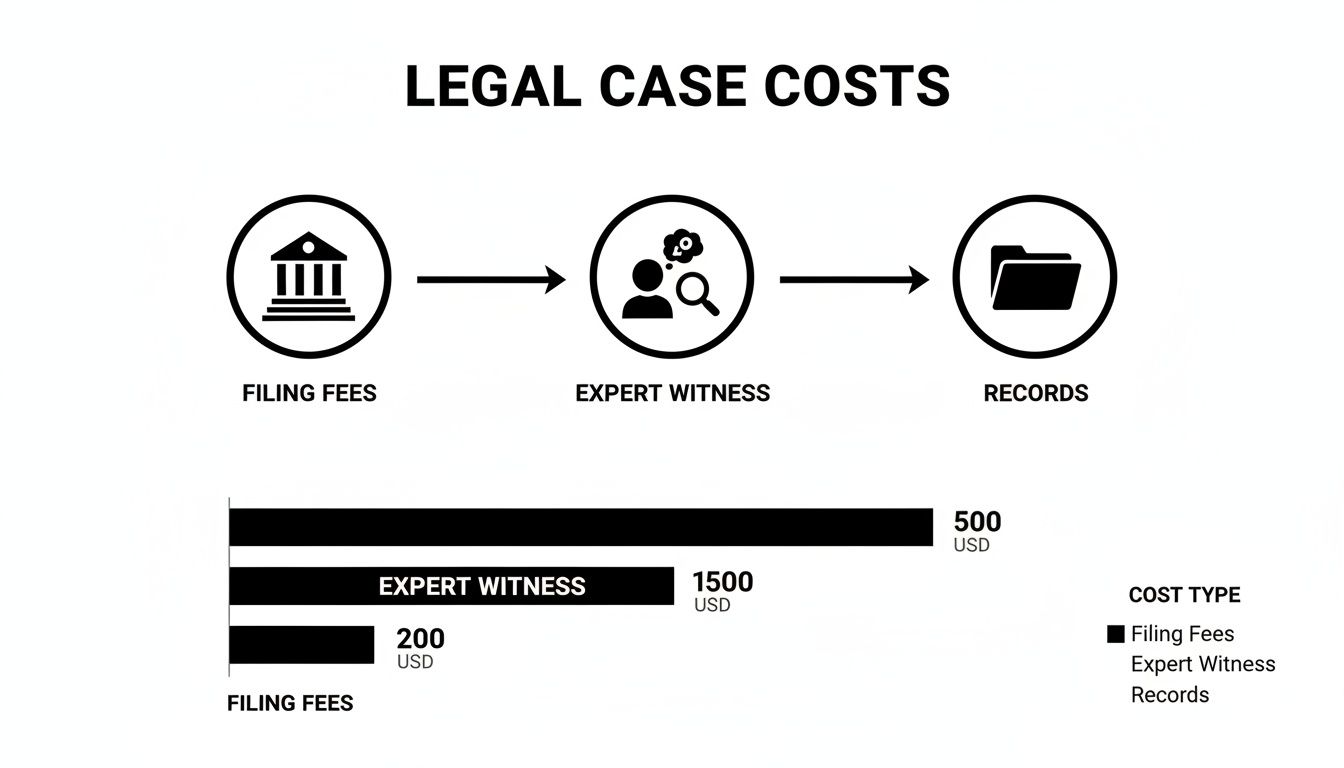
From simple court filing fees to the high cost of hiring an expert witness to testify, these expenses are crucial for maximizing your settlement.
What About Medical Liens and Bills?
There’s one final, critical piece of the puzzle: outstanding medical bills. Before you get your check, your attorney has a legal duty to resolve any medical liens or unpaid bills related to your accident.
A medical lien is a legal right held by a hospital, doctor, or insurance company to get paid back for the cost of your care out of your settlement funds.
Let's say your health insurance paid $10,000 worth of medical bills after your accident. They will place a lien for that amount on your settlement.
This is where a great lawyer provides enormous value. An experienced attorney doesn't just accept that $10,000 figure. They get on the phone and negotiate that lien down. If they can successfully reduce it to $6,000, that extra $4,000 they saved goes directly to you, boosting your net recovery even further.
Why a Lawyer Is Often a Smart Financial Investment

When you're dealing with the fallout of an accident, the last thing you want is another bill. You've got medical expenses piling up and lost paychecks, so the thought of the accident lawyer cost can feel overwhelming. It’s a completely fair question: Is it worth it?
The answer, backed by years of data and experience, is a resounding yes. Think of hiring a good lawyer not as an expense, but as a strategic investment in your own recovery—both physical and financial. Their job is to make sure you walk away with a payout that truly reflects everything you've lost.
Maximizing Your Claim's Value
Here’s a hard truth: insurance adjusters are not on your side. Their goal is to protect their company's bottom line by paying out as little as possible. When you try to handle a claim yourself, you’re an amateur stepping into the ring with a professional trained in minimizing payouts.
Hiring an attorney instantly levels the playing field. They know how to build a rock-solid case by documenting every single loss, including damages you probably wouldn't think to claim on your own.
This goes way beyond just the obvious medical bills. A skilled lawyer looks at the big picture:
- Future Medical Expenses: What about the physical therapy you'll need next year? Or a potential future surgery? They calculate these long-term costs.
- Lost Earning Capacity: Your injury might affect your ability to work for years, not just weeks. An attorney proves how that impacts your financial future.
- Pain and Suffering: This is the big one. How do you put a price on your physical pain, emotional trauma, and the loss of joy in your life? An attorney knows how to translate that very real suffering into a concrete dollar amount the insurance company has to respect.
Insurance companies rarely make a fair offer for these non-economic damages unless a legal professional forces their hand.
The real game-changer is a lawyer's negotiation skill. They've seen every trick in the adjuster's playbook and know how to shut down lowball offers with cold, hard evidence. They make the insurance company take your claim seriously.
The Data Proves the Point
You don't have to take my word for it—the numbers speak for themselves. Study after study shows that accident victims who hire a lawyer end up with far more money in their pockets, even after the attorney's fee is paid.
How much more? Research consistently finds that having legal help can triple the final settlement. On average, car accident victims with a lawyer get a $44,600 payout, while those who go it alone receive just $13,900. That's a massive difference, and it comes from an expert's ability to prove long-term damages and fight back against insurance company tactics. You can learn more about how legal representation impacts settlement statistics to see the full picture.
Let's do some quick math on those averages. A standard 33% contingency fee on a $44,600 settlement comes out to $14,718. After paying your lawyer, you’re left with $29,882—more than double the $13,900 you would have likely gotten by yourself.
Handling the Hidden Financial Traps
A great lawyer's job doesn't stop at negotiating with the insurer. They also manage the complex financial webs that can quietly eat away at your settlement. The perfect example of this is a medical lien.
If you used your health insurance to pay for treatment, that insurance company has a legal right to get its money back from your settlement. This is called subrogation. Left on your own, you might have to pay them back in full.
But an experienced attorney will go to bat for you, actively negotiating with the insurance company to reduce the lien amount. Every dollar they save you is a dollar that goes directly into your pocket. By managing these hidden traps and fighting for every last cent, a lawyer ensures your final recovery is as high as it can possibly be.
Key Questions to Ask Before You Hire a Lawyer
Think of your first meeting with a potential lawyer as an interview—where you're the one doing the hiring. This is your one shot to get ahead of any surprises and ask direct questions about how they charge. You want to walk away with a crystal-clear understanding of their fees.
This isn't just about finding the cheapest option. It’s about finding a transparent, fair partner who you can trust. The way they answer these questions will tell you everything you need to know about their communication style and whether they're the right fit.
Clarifying the Fee Structure
The most important part of this conversation is the contingency fee agreement. Never assume you know how it works. You need to pin down the exact terms to avoid any confusion later on about how your lawyer gets paid.
Start with the basics before you dig into the details.
-
What is your exact contingency fee percentage? Most personal injury lawyers charge 33.3%, but you need to hear their number. A good, straightforward attorney will give you a direct answer without any dancing around the question.
-
Does that percentage change if my case goes to trial? This is a huge follow-up question. It's common for the fee to jump to 40% if a lawsuit has to be filed. Make them explain exactly what event triggers that increase. Is it filing the lawsuit? Starting discovery? The first day of trial?
-
Is your fee calculated from the gross settlement or after costs are deducted? This little detail can make a massive difference in how much money you actually take home. A client-first agreement deducts expenses before calculating the attorney's fee, leaving more in your pocket.
Understanding Case Expenses
Beyond the lawyer's fee, there are the operational costs of building your case. The law firm typically fronts this money, but it's crucial to understand how it's being spent, tracked, and eventually paid back.
A trustworthy attorney will treat case expenses like a shared investment, not a blank check. They should be willing to discuss costs openly, provide regular updates, and get your approval before incurring major expenses, such as hiring a high-priced expert witness.
Here are the essential questions to ask about these case-related costs:
- How are case expenses handled and approved? Find out if they provide a detailed, itemized list of every single cost when the case is over. Full transparency is non-negotiable.
- What happens if we lose the case? Do I owe you for the case expenses? The vast majority of reputable firms will eat these costs if you lose, but you absolutely have to confirm this. Some agreements might try to stick you with the bill, so you need to hear a clear "no, you won't owe us for expenses."
Asking these questions is the first step toward making a smart, confident decision. For more advice on navigating this process, check out our guide on how to pick a personal injury lawyer.
A Few Lingering Questions About Accident Lawyer Costs
Even after breaking it all down, you probably still have a few questions rolling around in your head. That's completely normal. Let's tackle some of the most common ones I hear from clients to make sure you're feeling confident and clear about the process.
Is the Contingency Fee Percentage Set in Stone?
Sometimes, but not always. You can certainly ask about negotiating the contingency fee. While the standard 33.3% is pretty common for a good reason—it’s how firms cover their risk and the massive upfront investment in your case—there can be some wiggle room.
For instance, if your case is a slam dunk with rock-solid evidence of liability and significant damages, the firm is taking on less risk. In that situation, an attorney might be open to a slightly lower percentage. It never hurts to have a polite conversation about it during your first meeting, but be prepared for many top-tier firms to stick to their standard rates.
What if We Don't Win? Do I Owe Anything?
This is the single biggest advantage of the contingency fee model. If your lawyer doesn't win your case—meaning no settlement and no court award—you owe them zero in attorney fees.
That’s right. Even if they've poured hundreds of hours and their own money into your claim, their fee is nothing if you don't get a recovery. It’s a true "no win, no fee" guarantee that takes all the financial risk off your plate.
However, you absolutely need to clarify how case expenses are handled if you lose. Most good firms will absorb those costs as well, but it's a crucial question to ask before you sign anything.
Is It Ever a Good Idea to Pay a Personal Injury Lawyer by the Hour?
For an accident case? Almost never. The entire point of the contingency fee system is to give injured people, who are already struggling financially, a fair shot at justice. Can you imagine getting a bill for hundreds of dollars an hour while you're out of work and facing a mountain of medical debt? It would be impossible for most folks.
Hourly billing is the norm in other areas like corporate or family law, but it’s just not built for the unpredictable nature of personal injury claims.
Will I Have to Pay Taxes on the Settlement Money?
For the most part, no. According to the IRS, the money you receive as compensation for physical injuries isn't considered taxable income. This means the parts of your settlement covering medical bills, lost income, and your pain and suffering are usually tax-free.
There are a few rare exceptions, though. If a part of your award is for punitive damages (which are meant to punish the at-fault party), that specific amount might be taxable. It’s always smart to have a quick chat with a tax advisor after your case wraps up, just to be safe.
Figuring out your next steps after an accident is tough, but knowing what your case is truly worth doesn't have to be. Verdictly gives you a look at real Texas motor vehicle verdicts and settlements, so you have the same data the pros use for fair negotiations. See what similar cases are worth and build your claim from a position of strength by visiting https://verdictly.co.
Related Posts

What to Do After a Hit and Run Car Accident in Texas
A complete guide on what to do after a hit and run car accident in Texas. Learn the critical first steps, your legal options, and how to file a claim.

What Is Mediation in a Lawsuit? Learn what is mediation in lawsuit
Understand what is mediation in lawsuit and how this process helps Texans resolve motor vehicle accident cases without trial.

8 Critical Signs of a Bad Attorney in 2025 You Can’t Afford to Ignore
Are you getting the best legal help? Learn the top signs of a bad attorney and how to verify their competence with these actionable steps and warning signs.