
How to pick a personal injury lawyer: A practical guide
Learn how to pick a personal injury lawyer who will fight for you. Vet candidates, ask key questions, and understand fee structures.
Before you even think about calling a lawyer, the most important work starts with you. Your first step in picking the right personal injury attorney is to get all your ducks in a row. Gather every single document related to your accident—think police reports, medical records, photos from the scene. Walking into a consultation prepared like this makes the conversation immediately productive and focused on the facts.
Your First Moves After an Injury
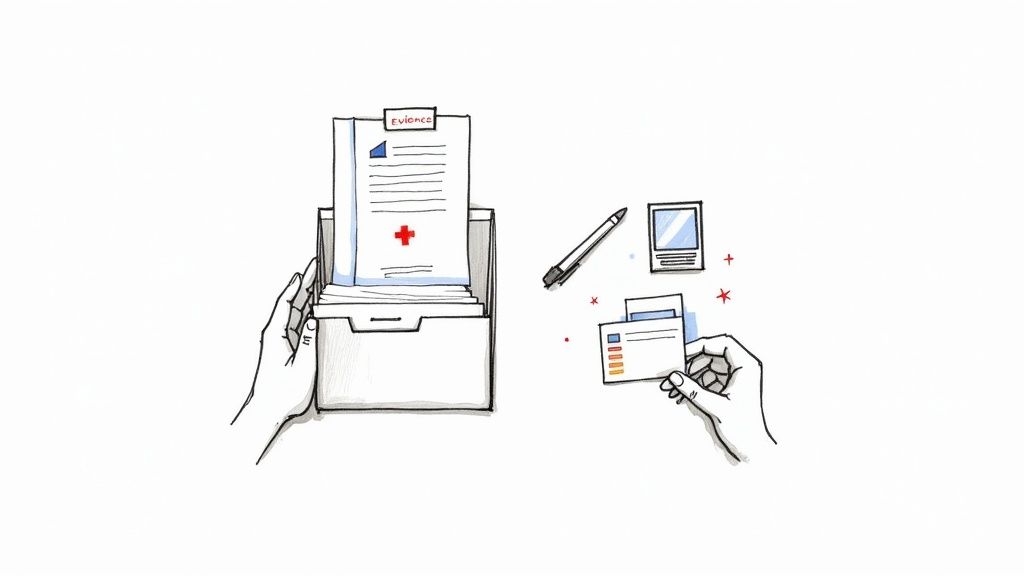
Before you start googling law firms, a few key actions can seriously strengthen your future claim. This isn't just about shuffling papers; it’s about laying a solid foundation. A well-organized case file helps you clearly explain what happened and makes it easier to find a lawyer who is genuinely the right fit for your specific situation.
Think of it as preparing a briefing for the person who will fight for you. The more organized you are from the start, the quicker an attorney can tell you if you have a case and what they think it might be worth.
Create Your Case File
Your first mission is to collect every piece of information connected to the accident. Don't self-edit or try to decide what’s important yet—just gather it all. This paperwork is the objective evidence that will form the backbone of your story. For a complete picture of why this evidence is so crucial, you can read our guide on what is a personal injury claim.
Here’s a simple checklist to get you started:
- Official Reports: The police or incident report is a must-have. It locks in the date, time, location, and the officer’s initial assessment of who was at fault.
- Medical Documentation: Hold on to every single bill, doctor's note, prescription receipt, and hospital discharge summary. These are the documents that directly tie your injuries and their costs to the accident.
- Visual Evidence: Photos and videos are incredibly powerful. Take pictures of the vehicle damage, your injuries, the road conditions, skid marks—anything that helps paint a clear picture of the scene.
- Witness Information: If anyone saw what happened, get their name, phone number, and address. A neutral third-party account can be a game-changer.
Document Everything That Follows
The initial evidence collection is just the beginning. The real impact of an injury unfolds over weeks and months, and you need to document that journey just as carefully.
Keep a simple daily journal. Seriously. Just a few notes each day about your pain level, doctor's visits, days you couldn't work, and even small things like not being able to pick up your kids. This log becomes powerful proof of your pain and suffering.
This simple habit is the best way to capture the "non-economic" damages—the real-life impact of the injury. These are often the hardest to prove but can be a huge part of your compensation. Taking these steps puts you in the driver's seat, ready to choose a lawyer with confidence.
Finding and Researching Potential Lawyers

Now that you've got your initial evidence organized, it’s time to start building a shortlist of attorneys who could be a good fit. A quick Google search will give you an overwhelming number of options, so you need a smart way to cut through the clutter. The point isn't to find every lawyer in your city—it's to identify a few highly qualified candidates you can dig into.
Finding the right person is a big deal. There are over 164,000 personal injury lawyers practicing in the U.S., handling hundreds of thousands of claims every year. Doing your homework is the only way to find someone who will genuinely fight for you. You can learn more about the industry from Clio's report on the personal injury law landscape.
Start with Trusted Sources
Forget the flashy billboards and paid ads for a moment. You want to start your search with places that already do some of the vetting for you. This gives you a much stronger foundation for building your list.
Here are a few high-quality places to kick off your search:
- State Bar Association Directories: Every lawyer has to be licensed by their state bar. These official directories are a great way to confirm an attorney is in good standing and to check for any public disciplinary actions against them.
- Professional Referrals: Do you know another lawyer you trust? Maybe someone who handled your house closing or drafted a will? Ask them for a referral. Lawyers know who the heavy hitters are in different fields.
- Peer-Reviewed Legal Directories: Websites like Avvo or Martindale-Hubbell offer ratings based on reviews from other lawyers. That inside perspective on someone’s skill and professional conduct is incredibly valuable.
Conduct Your Initial Vetting
Once you have a few names, it’s time for a quick but critical background check. This first pass will help you weed out any obvious non-starters before you spend time on a full consultation.
Go to each attorney’s website. Is it crystal clear that they focus on personal injury, or do they have a laundry list of a dozen different practice areas? True specialization is a sign of deep expertise.
Look past the five-star ratings. Dig into the actual reviews—both good and bad—to see if there are any recurring themes. A pattern of complaints about poor communication or clients feeling ignored is a huge red flag, no matter how many glowing testimonials they have.
Finally, look for proof of their work. A "Case Results" or "Verdicts and Settlements" page is where the rubber meets the road. Of course, past results don’t guarantee future outcomes, but they show the firm has a proven history of handling and winning cases like yours. If a lawyer isn't upfront about their track record, you have to wonder why. This initial vetting should leave you with a solid list of the strongest contenders.
The Consultation Questions That Reveal Everything

Think of the free consultation as a job interview—but you're the one doing the hiring. This is your one real chance to look past the fancy website and TV ads to see how a lawyer actually thinks and operates.
Walking in unprepared is a mistake. If you ask generic questions, you'll get generic, rehearsed answers. To truly understand who you're dealing with, you need to ask pointed questions that reveal their real-world experience, their strategic approach, and how their firm actually functions.
Digging into Relevant Experience and Strategy
Don't just ask if they handle "personal injury." That's too broad. A lawyer who is a master of car accident cases might be completely out of their depth in a complex medical malpractice claim. You need to know if they have specific, recent experience with cases just like yours.
These questions will help you cut through the fluff:
- How many cases just like mine have you personally handled in the last three years? This question is about recent, relevant experience. A single slip-and-fall case from a decade ago doesn't make someone an expert. You want someone who is in the trenches with these types of claims right now.
- From what you've heard so far, what’s your initial strategic outlook? A sharp lawyer will be able to map out a preliminary plan. They should identify potential hurdles and outline the immediate steps they'd take to start building your case.
- What percentage of your cases settle versus go to trial? The reality is that over 95% of personal injury cases settle out of court. But here's the catch: you need a lawyer who isn't afraid to go to trial. Insurance companies keep tabs on which lawyers will roll over for a quick settlement and which ones are willing to fight in front of a jury. Their settlement offers reflect that.
A lawyer who talks about preparing every case as if it's going to trial is signaling strength. This preparation leads to better-negotiated settlements because the other side knows they are ready and willing to litigate if the offer isn't fair.
Clarifying Who Will Actually Work on Your Case
One of the most common complaints I hear is from clients who meet with a senior partner, only to have their case immediately passed off to a junior associate or even a paralegal. You have a right to know exactly who will be your champion from start to finish.
Be direct with these questions:
- Will you be the primary attorney handling my case? Get a straight yes or no.
- If not, who is my main point of contact, and can I meet them now? It's crucial that you feel comfortable with the person managing the day-to-day progress of your claim.
- How often can I expect to receive updates, and in what format? This simple question sets communication expectations early, preventing a lot of anxiety and frustration down the line.
To help you stay organized, I've put together a checklist of the most important questions to bring with you to any consultation.
Essential Questions for Your Lawyer Consultation
This table breaks down the key areas you need to cover to get a complete picture of each attorney you meet with.
| Category | Question to Ask | What to Listen For |
|---|---|---|
| Experience | How many cases like mine have you personally handled in the last 3 years? | Look for specific numbers and recent, relevant experience, not vague answers about the firm's overall history. |
| Strategy | What is your initial strategic outlook for a case like this? | A clear, logical process. They should identify strengths, weaknesses, and a plan of action. |
| Trial Record | What percentage of your cases settle versus go to trial? Are you willing to take this to court if necessary? | Confidence and a willingness to fight. An attorney who always settles might not get you the best offer. |
| Case Management | Will you be the main lawyer on my case? If not, who is, and can I meet them? | A direct answer. You need to know and trust the person who will actually be doing the work. |
| Communication | How often will I receive updates, and who will they come from? | A clear communication plan (e.g., "monthly calls," "updates after every major development"). |
| Fee Structure | Can you walk me through your contingency fee agreement and explain all potential case costs? | Total transparency. They should clearly explain their percentage and what expenses you might be responsible for. |
| Case Value | Based on what you know, what is a realistic range of outcomes for my case? | A cautious, data-informed estimate, not a wild promise. They should explain the factors that influence value. |
| Resources | What resources does your firm have to handle a case like mine (e.g., expert witnesses, investigators)? | Evidence that they have the financial backing and professional network to build a strong case. |
Asking these specific questions will give you the data you need to compare lawyers apples-to-apples and choose the one who is truly the best fit to fight for you.
Why a Lawyer's Specialization and Track Record Are Non-Negotiable
You wouldn't ask a heart surgeon to set a broken arm. The same logic applies to personal injury law. An attorney who’s a wizard with car accident claims might be totally lost in the complexities of a medical malpractice lawsuit. This is why digging into a lawyer’s specific focus is one of the most critical parts of your decision.
A general practitioner might know the law, but a specialist lives and breathes the nuances of your specific type of case. They know the insurance adjusters, the best expert witnesses, and the arguments that have won cases just like yours time and time again.
Specialization Is a Game Changer
The statistics on trial outcomes paint a very clear picture. According to the Bureau of Justice Statistics, plaintiffs win about 61% of motor vehicle accident trials. But for medical malpractice claims? That win rate drops off a cliff to just 19%. These surprising personal injury statistics show just how different the legal battle is depending on the injury.
That massive gap isn't a coincidence. It highlights just how much deep, focused experience matters. The lawyer who successfully handles car wrecks uses a completely different playbook than the one who goes up against powerful hospitals and their legal teams. Finding someone with a proven track record in your specific area isn't just a good idea—it’s a strategic necessity.
Look for a Relevant and Proven Track Record
Talk is cheap. You need to see proof that a lawyer can deliver. Most law firm websites will have a "Case Results" or "Verdicts & Settlements" page. Don't just get dazzled by the big dollar signs; look for results in cases that look a lot like yours.
The point isn't to find a lawyer with a perfect, undefeated record. What you're really looking for is a pattern of consistent, solid wins in the exact legal arena you're about to step into. It proves they know how to take on a case like yours and, more importantly, how to win it.
As you look through their past results, keep these points in mind:
- Case Similarity: Are their biggest victories in truck accidents, slip-and-falls, or defective product cases? Make sure their success aligns with your situation.
- Trial vs. Settlement: A history of high-value settlements shows they’re skilled negotiators. A few big trial verdicts show they aren’t afraid to go to the mat for their clients when the insurance company won’t play fair. A good mix is often the best sign.
- Use of Experts: Winning complex cases often comes down to the strength of expert testimony. If a lawyer’s case results mention working with accident reconstructionists, medical specialists, or financial experts, that's a huge plus. We have a great breakdown of what is expert witness testimony and why it's so crucial.
Doing this homework ensures you're teaming up with an attorney who doesn't just promise results but actually has a history of achieving them.
Decoding Fee Agreements and Making Your Final Choice
You’ve done the interviews, checked the reviews, and now you’re down to the final contenders. This is where the practical details and your gut feeling come together. The fee agreement is a huge part of this, but so is your personal connection with the attorney who will be fighting for you.
Let's start with the money. Most personal injury lawyers work on a contingency fee basis. Simply put, they don’t get paid unless you do. Their fee is a percentage of the money they recover for you, whether it’s from a settlement or a jury verdict.
Understanding the Contingency Fee Structure
The industry standard for a contingency fee usually falls between 33% and 40% of the total recovery. If your case settles for $100,000 and the lawyer’s fee is 33.3%, they’ll receive $33,300. This model is what allows most people to afford top-tier legal help when they need it most.
But the percentage isn't the whole story. You also need to talk about case costs. These are the expenses a law firm fronts to build your case, and they can add up. Think of things like:
- Expert Witness Fees: Paying a doctor to testify about your injuries or an engineer to reconstruct the accident.
- Court Filing Fees: The administrative costs required to formally start a lawsuit.
- Deposition Costs: The price of hiring a court reporter to create transcripts of sworn testimony.
- Investigation Expenses: The cost of tracking down evidence or hiring a private investigator.
Here’s the million-dollar question you must ask: "Are these costs taken out of the settlement before or after your fee is calculated?" It makes a real difference in how much money lands in your pocket. A good lawyer won't hesitate to walk you through their process. For a deeper dive into this, check out our guide on personal injury lawyer fees.
It’s About More Than Just the Numbers
While the fee agreement is critical, don't let it be the only factor. You're entering a partnership that could last for a long time. Your ability to communicate with and trust your lawyer is just as vital as their win-loss record. Do they listen to you? Do they break down confusing legal jargon into plain English?
Trust your gut. An attorney might have a stellar reputation, but if you don't feel that sense of rapport, it's going to make a stressful process even harder. The right fit is someone who is not only a sharp advocate but also an advisor you feel comfortable with.
It's also worth remembering a key statistic: a staggering 95% of personal injury lawsuits are resolved through a settlement before ever seeing the inside of a courtroom. This tells you that the best lawyers are often masters of negotiation, not just trial attorneys. Ask them about their track record with settlements—it reveals a lot about their ability to get results efficiently.
This decision tree can help you visualize how to match the specifics of your injury to a lawyer's expertise.
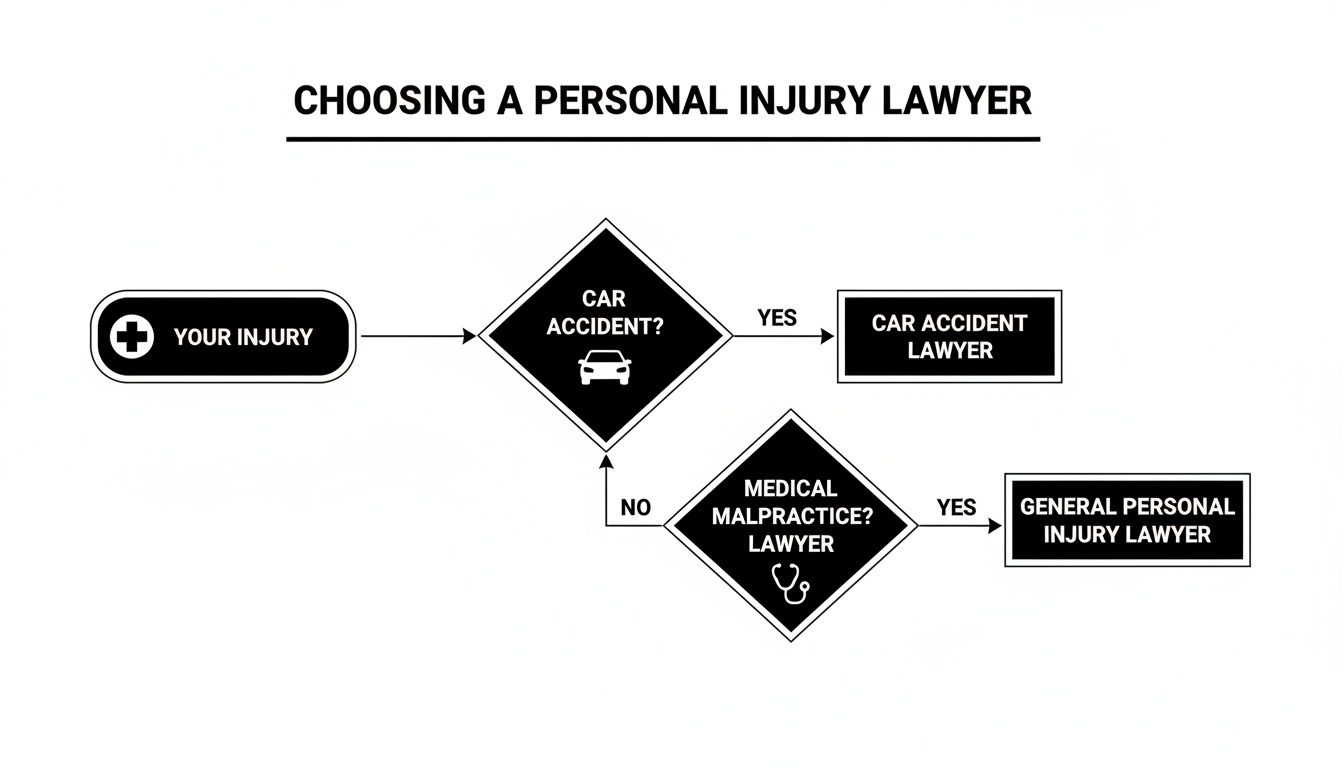
As the flowchart shows, the smartest first move is always to clearly define your case so you can find a true specialist who knows how to win.
Common Questions About Hiring a Personal Injury Lawyer
After an accident, your head is probably swimming with questions. Even after you've done some research, a few key concerns almost always pop up when you're deciding on a lawyer. Let's tackle some of the most common ones I hear from clients.
Is It "Too Soon" to Call an Attorney?
This is a big one, and the answer is almost always a hard no. In fact, waiting is one of the biggest mistakes you can make.
Evidence has a short shelf life. Skid marks fade, security camera footage gets overwritten, and witnesses' memories get fuzzy. A good lawyer knows how to lock down crucial evidence right away, which can make or break your case down the road. Calling early just protects your options.
What's This Going to Cost Me?
The fear of legal bills keeps too many people from getting the help they deserve. But here's the reality for personal injury cases:
Nearly every personal injury lawyer works on a contingency fee basis. This means you don’t pay a dime out of pocket. Their fee is a percentage of what they win for you. If you don't get a settlement or verdict, they don't get paid. Simple as that.
This setup means your lawyer is just as motivated as you are to get the best possible outcome. It aligns your interests perfectly and removes the financial risk from your shoulders.
When Is It Too Late to Hire a Lawyer?
While it’s never too soon, there is definitely a "too late." Every state has a strict legal deadline for filing a personal injury lawsuit, known as the statute of limitations.
In Texas, for example, you typically have just two years from the date of the injury to file your claim. Miss that deadline by even one day, and your case is likely dead in the water, no matter how strong it is. This isn't a soft guideline; it's a hard legal cutoff. Consulting a lawyer ensures all the paperwork is filed correctly long before that clock runs out.
Can I Switch Lawyers if I'm Unhappy?
Absolutely. You are never stuck with a lawyer you've lost faith in. If your attorney is dodging your calls, seems unprepared, or you just have a gut feeling that they aren't the right fit, you have every right to find someone new.
The transition is usually handled between the two law firms. Your new attorney will request your file and sort out the fee arrangements with the old firm behind the scenes, so it shouldn’t impact your final recovery. Your case is too important to leave in the hands of someone you don't trust.
Empower your negotiations with real data. Verdictly provides access to thousands of real verdicts and settlements from across Texas, so you can benchmark your case value against similar accidents and injuries. See what your case could be worth.
Related Posts

What to Do After a Hit and Run Car Accident in Texas
A complete guide on what to do after a hit and run car accident in Texas. Learn the critical first steps, your legal options, and how to file a claim.

8 Clear Signs of a Bad Lawyer in 2026 You Can’t Afford to Ignore
Are you getting the best representation? Learn the top signs of a bad lawyer, how to verify them, and what to do next to protect your case and your rights.

What Is Mediation in a Lawsuit? Learn what is mediation in lawsuit
Understand what is mediation in lawsuit and how this process helps Texans resolve motor vehicle accident cases without trial.