
A Texas Guide to Your Hit and Run Auto Accident Claim
Involved in a hit and run auto accident in Texas? This guide walks you through the critical steps, your legal rights, and how to value your claim.
When another driver hits your car and speeds away, it's a shocking and infuriating experience. Your mind races, adrenaline kicks in, and it’s tough to think clearly. But what you do in those first few minutes and hours is absolutely critical. Getting it right can make all the difference for both your health and your ability to get the compensation you deserve.
What To Do Immediately After a Hit and Run Auto Accident
Think of your immediate response as a simple, three-step mission: Stay Safe, Gather Clues, and Make it Official. Getting rattled is normal, but focusing on this sequence will help you protect yourself and build a strong foundation for your claim.
The process boils down to these core actions, which are crucial for your well-being and any future legal steps.
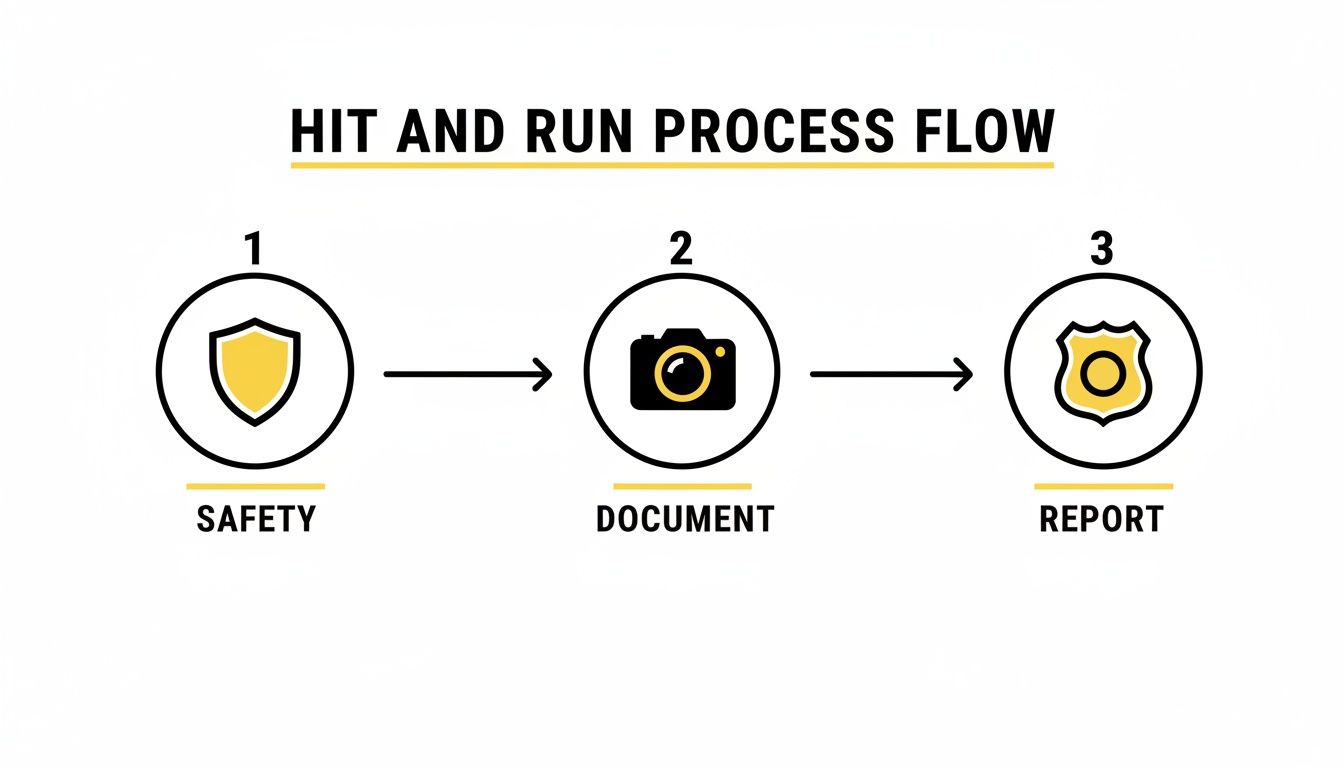
This visual really hammers home the priority: get yourself out of harm's way before you start worrying about anything else. Safety first, always.
Prioritize Safety and Medical Care
Before you do anything else, you have to get out of danger. If you can still drive your car, pull over to the shoulder or the nearest safe spot, well away from moving traffic. Flip on your hazard lights right away.
Now, do a quick check on yourself and anyone else in the car. Are you hurt? Keep in mind, the adrenaline surging through you right now can easily hide the pain of serious injuries like whiplash or even a concussion. Something that feels like a minor ache could be a sign of something much worse.
Don't ever skip a medical evaluation. Getting checked out by a doctor or at an urgent care clinic creates a professional, time-stamped record of your injuries. This medical report is the bedrock of any insurance claim or lawsuit that follows.
Even if you think you’re perfectly fine, get seen by a professional. It's the smartest thing you can do for your health and for the strength of your case.
Become an Investigator at the Scene
Once you're safe and have called for help, it's time to switch gears. While you wait for the police to arrive, your job is to become a detective. The details you can capture right now are priceless and might be the only chance you have to identify the driver who left you behind.
Here’s a quick-reference checklist of what to do at the scene. It's your best shot at gathering the evidence needed to protect your rights and help law enforcement find the person responsible.
Immediate Action Checklist for Hit and Run Victims
| Action Step | Why It's Critical | Pro Tip |
|---|---|---|
| Document the Vehicle | This is the most direct link to the fleeing driver. Even partial details can help police narrow down their search significantly. | Voice-record notes on your phone immediately. Say out loud the make, model, color, and any partial license plate numbers you saw. |
| Take Photos & Videos | Photographic evidence is undeniable. It proves the extent of the damage and captures the scene exactly as it was. | Walk around the scene and take a video. It captures angles and context that still photos might miss, like road conditions and traffic flow. |
| Find Witnesses | An independent witness can confirm your story and may have seen details you missed, like the full license plate. | If someone stops, ask them to wait for the police. If they can't, get their name and number—their testimony is invaluable. |
This checklist isn't just busy work; it's you taking control of the situation and building the case needed to hold the other driver accountable.
File an Official Police Report
This is a non-negotiable step: you must call 911 and have an officer come to the scene to file an official report. Don't let anyone talk you out of it, and don't leave until you know a report is being filed.
This police report is the cornerstone of your entire claim. It's the official document that proves a hit and run auto accident happened. Your insurance company will ask for it almost immediately. Without it, you're facing an uphill battle just to prove the incident occurred.
Before the officer leaves, make sure you have their name, badge number, and the official police report number. You'll need it.
The Two Legal Battles in a Texas Hit and Run Case
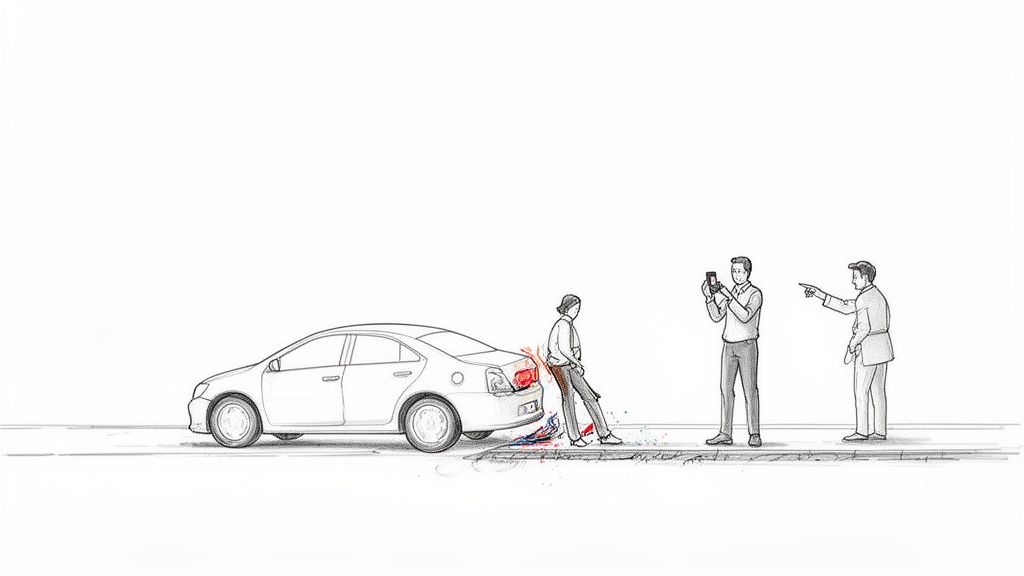
When another driver hits you and flees, they don't just create one problem. They kick off two entirely separate legal processes that run on parallel tracks. Think of it like this: one track is for the criminal case, where the State of Texas goes after the driver for breaking the law. The other is for the civil case, which is your personal fight to get compensated for everything you've lost.
It's absolutely crucial to understand this dual system from the start. A conviction on the criminal side can be a huge help to your civil claim, but your main goal—getting money to cover your injuries and damages—happens completely on the civil track. Winning one doesn't guarantee you'll win the other, but they are definitely connected.
The Criminal Case Against the Driver
The criminal side of things is all about punishment and protecting the public. When a driver takes off after a hit and run auto accident in Texas, they aren't just being irresponsible—they're committing a crime called Failure to Stop and Render Aid.
This is the state's fight, not yours personally. The police investigate, a district attorney files charges, and the objective is to hold the driver accountable to society. Your role is mostly as a key witness, providing the evidence and testimony they need to get a conviction.
The penalties can be incredibly harsh and get worse depending on the damage done:
- Property Damage Only: This is usually a misdemeanor, but don't underestimate it.
- Minor Injury: Things get more serious here, often escalating to a state jail felony.
- Serious Injury or Death: This is a major felony, carrying the potential for significant prison time and massive fines.
If the driver is convicted or pleads guilty in criminal court, it’s a powerful piece of evidence for your civil claim. It establishes that the driver acted wrongfully, making it much tougher for them to deny they’re responsible for your damages.
The Civil Fight for Your Compensation
While the criminal case is moving forward, your personal battle for financial recovery is happening in the civil court system. This is where you sue for money to cover your losses. The goal isn't to put the other driver in jail; it's to make you financially whole again.
Your civil case is built on the legal idea of negligence. In simple terms, you have to prove that the other driver was careless, their carelessness caused the crash, and you suffered real, measurable damages because of it.
The core difference is the objective. In a criminal case, the state seeks justice through punishment like fines or jail time. In a civil case, you seek justice through financial compensation to cover your medical bills, lost income, and suffering.
And here’s a critical point: even if the driver is never found, you can still file a civil claim against your own insurance policy through your Uninsured Motorist (UM) coverage.
Key Differences Between Criminal and Civil Actions
Getting a handle on these distinctions is key to managing your expectations and planning your strategy. The two systems operate independently with different rules, goals, and burdens of proof.
| Aspect | Criminal Case | Civil Case |
|---|---|---|
| Who Files the Case | The State of Texas (prosecutor) | You, the injured victim |
| Primary Goal | Punish the offender | Compensate the victim |
| Burden of Proof | "Beyond a reasonable doubt" | "Preponderance of the evidence" |
| Possible Outcome | Fines, jail, probation | Monetary damages (compensation) |
That "burden of proof" is a massive difference. "Beyond a reasonable doubt" is an extremely high bar to clear. But the standard in civil cases, "preponderance of the evidence," just means you have to show it's more likely than not (over 50%) that your side of the story is true. This is exactly why it's possible to win your civil case for damages even if the criminal case is never filed or ends in an acquittal. Your fight for compensation follows its own path.
Why Hit and Run Accidents Are a Growing Threat on Texas Roads
If you've been the victim of a hit and run, it’s easy to feel like you were singled out by a stroke of bad luck. The truth is, you’re not alone. You're part of a deeply disturbing trend that's playing out on roads across Texas and the rest of the country. These aren't just isolated incidents of bad judgment; they're a serious and growing threat to public safety.
Understanding just how big this problem has become is the first step. It validates what you've gone through and underscores why it’s so important to take action. The numbers don't lie: drivers who flee the scene of an accident are becoming frighteningly common.
The Post-Pandemic Surge in Hit and Runs
In recent years, we've seen a troubling spike in drivers who crash and then choose to run rather than face the music. This trend really took off after 2019, creating a whole new set of headaches for victims and law enforcement.
Take a look at the nationwide data. The portion of all crashes involving a hit-and-run driver shot up to 14.5% in 2022. That’s a huge jump from 12.1% back in 2019, right before the pandemic. It gets worse when you look at fatal accidents. In those tragic cases, hit-and-run involvement soared by nearly 24% in that same timeframe. You can dig deeper into the rise in these incidents and pedestrian fatality statistics by reviewing the research.
This isn't just a blip on a chart; it's a real shift in driver behavior, and it leaves real victims behind. More people are being abandoned at the scene, left to sort out medical bills, car repairs, and the emotional shock all by themselves.
Why Are More Drivers Fleeing the Scene?
Every situation is different, of course, but there are a few common threads that seem to be driving this trend. While it's tough to pin down one single cause, the reasons a driver might flee usually boil down to a handful of bad choices:
- No Insurance: They know they're driving illegally without insurance and can't possibly pay for the damage. They panic and run to dodge the financial bullet.
- Driving Under the Influence (DUI): A driver who is drunk or high on drugs often flees to avoid a DUI charge, which comes with life-altering criminal penalties.
- Other Legal Trouble: The driver might already have a warrant out for their arrest, be driving on a suspended license, or even be in a stolen car. For them, any contact with the police is a risk they won't take.
- Pure Panic: In the shock and chaos of a crash, some people just freeze up. Their fight-or-flight response takes over, and they make the terrible split-second decision to hit the gas.
No matter what their reason is, the moment a driver flees, they turn a bad situation into a complex legal mess. They are intentionally trying to dodge the consequences, leaving the entire burden—physical, emotional, and financial—squarely on your shoulders.
When a driver takes off, they aren't just leaving a crash site. They are actively trying to escape accountability. It’s a cowardly act that forces you, the victim, into a much more complicated insurance process and a potentially longer, harder road to recovery. Knowing this background makes it crystal clear why you have to be your own best advocate: gather every shred of evidence, file that police report right away, and understand all your legal options to get the justice you deserve.
Finding the Driver and Getting What You're Owed
After a hit-and-run, finding the person who fled can feel like an impossible task. But let's be clear: this is the single most important step you can take to get the compensation you deserve.
When you find the at-fault driver, you gain access to their liability insurance. This is crucial because their policy limits are often much higher than what your own Uninsured/Underinsured Motorist (UIM) coverage can provide. It's the difference between just covering a few medical bills and getting a settlement that truly makes you whole again.
Your Role: The Most Important Witness
In the moments after the crash, you are the lead detective on your own case. The details you give the police can be the key that unlocks the entire investigation. Even a small, seemingly insignificant detail can be the one thing that helps them crack the case.
Think of it as giving the police actionable intelligence. The more concrete details you can provide, the better.
Here’s what law enforcement needs from you:
- A Partial Plate: Even just two or three characters from a license plate can narrow the search dramatically.
- The Car's Description: Make, model, color, and even the approximate year are incredibly helpful.
- Unique Features: Was there a big dent on the bumper? A roof rack? A peeling clear coat? These are the details that make a car stand out.
- A Look at the Driver: If you saw them, note their approximate age, gender, or anything else that stood out.
- Which Way They Went: Tell the police the exact street and direction the car was headed after it hit you.
These details are the puzzle pieces. The more you can give the police, the better their chances of putting it all together.
Using Today's Tech to Your Advantage
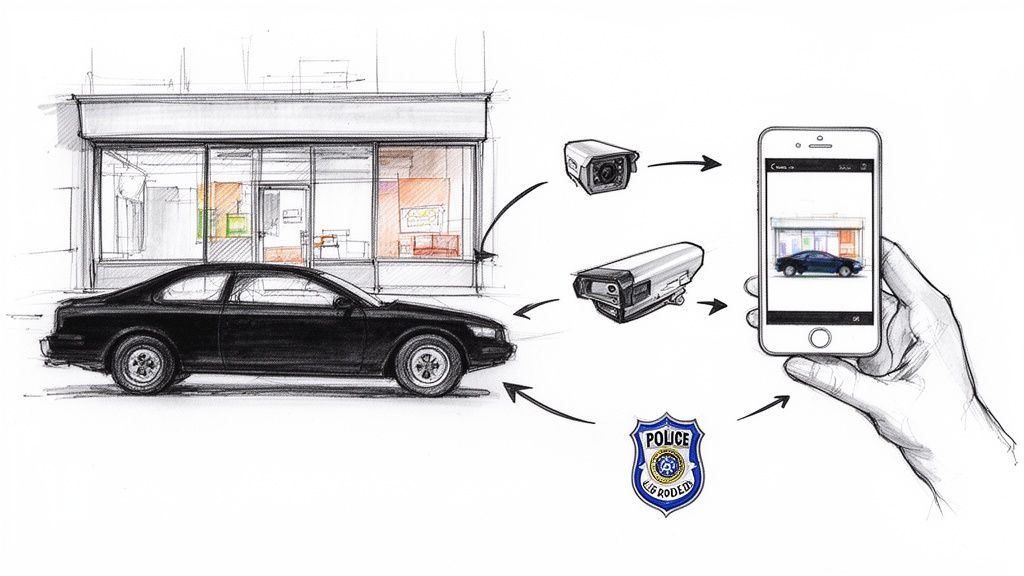
Don't just rely on your memory. We live in a world full of cameras, and you can use that to your advantage. Actively look for any potential sources of video that might have caught the accident or the car as it sped away.
Ask for footage from:
- Local Businesses: Gas stations, corner stores, and strip malls almost always have security cameras pointed at the road.
- Traffic Cams: Police can pull footage from city-operated traffic and red-light cameras at nearby intersections.
- Doorbell Cameras: Don't underestimate the power of Ring and other smart doorbells. They often capture clear video of passing cars.
Finding the driver is about more than just accountability; it’s a strategic move to maximize your financial recovery. Their liability policy is the key to covering the full scope of your damages, from medical bills and lost wages to pain and suffering.
Hit-and-run crashes are a serious problem. In 2022, over 14% of all accidents in the United States involved a driver who fled the scene, leading to thousands of injuries. You can find more data on the global scale of this issue in various road safety reports.
Once the police have a suspect, public records can help fill in the gaps. For instance, once a vehicle is identified, its registered owner can be found. To get a sense of what's available, read our guide on how to find public court records. Taking these extra steps can turn a hopeless situation into a solvable case with a much better outcome for you.
Navigating Your Insurance Options After a Hit and Run
When the driver who hit you takes off, the first question that probably pops into your head is, "Who's going to pay for all this?" It's a scary thought, but the good news is your own car insurance policy likely has coverage built for this exact nightmare. Filing a claim after a hit and run auto accident is different from a typical crash, though. You'll need to lean on specific parts of your policy that act as a financial safety net.
The two most critical coverages to understand are Uninsured/Underinsured Motorist (UM/UIM) and Personal Injury Protection (PIP). These are your lifelines when you can't find the other driver to make a claim against their liability insurance.
Uninsured Motorist Coverage: The Hero of Your Claim
Think of your Uninsured Motorist (UM) coverage as a stand-in for the insurance policy the hit-and-run driver should have had. In the world of insurance, a "phantom driver" you can't identify is treated the same as a driver with no insurance at all. This legal quirk is what allows you to turn to your own insurance company for help.
This is exactly why carrying plenty of UM coverage is so important, especially for drivers in Texas. It’s not just for dealing with people driving illegally without insurance; it's your single best tool for getting back on your feet after a hit-and-run.
From your insurance policy's perspective, a phantom driver is an uninsured driver. Your UM coverage steps into the shoes of the at-fault party's missing insurance, so you can recover money for your injuries and damages directly from your own provider.
Your UM policy is designed to cover the very same things you would have claimed from the other driver's insurance. This includes a wide range of costs:
- Medical Bills: From the ambulance ride and ER visit to surgery and physical therapy.
- Lost Wages: Getting you back the income you missed out on while you were recovering.
- Pain and Suffering: Compensation for the physical agony and emotional trauma the crash caused.
- Future Medical Expenses: Paying for any long-term care or future procedures you might need.
Without UM coverage, you’d be stuck paying these massive bills yourself. If you're curious about the other side of the coin, you can read our guide on what liability insurance covers when you’re the one at fault.
Personal Injury Protection for Immediate Needs
While the UM claim process unfolds, which can take some time, you've got bills that need to be paid right now. That's where Personal Injury Protection (PIP) saves the day. PIP is "no-fault" coverage, meaning it kicks in to pay for your initial medical bills and a chunk of your lost wages, no matter who caused the crash.
PIP benefits usually get paid out fast, giving you the immediate cash you need to see a doctor without hesitation. It's the perfect bridge to cover your urgent expenses while your larger UM claim is being investigated.
Communicating with Your Insurance Company
How you report the hit-and-run to your own insurance company is critical. You need to be factual, clear, and very careful with your words to protect the full value of your claim.
When you pick up the phone, keep these tips in mind:
- Report It Immediately: Don't delay. Most policies have tight deadlines for reporting claims, and they're often even stricter for hit-and-runs.
- Stick to the Facts: Tell them when and where it happened. Give them the police report number. Describe the damage to your car and let them know you’re hurt and getting medical attention.
- Avoid Guessing: Don't speculate about things you don't know for sure or admit any amount of fault. The facts are simple: another vehicle hit you and fled the scene.
- Decline a Recorded Statement: You are not obligated to give a recorded statement on that first call. It's wise to politely say you'd prefer to wait until you've had a chance to speak with an attorney for guidance.
Following these steps helps you meet your obligations under the policy without accidentally saying something that an adjuster could use against you later on.
How to Value Your Texas Hit and Run Auto Accident Case
Figuring out what your claim is worth after a hit and run can feel like you're navigating in the dark. The other driver is gone, and so is their insurance company. So, how do you even begin to land on a fair number for your injuries and losses?
It’s not about pulling a number out of thin air. Valuing a case is a methodical process. It involves tallying up every concrete financial loss and then attaching a reasonable figure to the intangible harm you've been through. This gives you a solid, evidence-based range to start from when you file a claim with your own insurance under your UM/UIM policy.
The Two Buckets of Damages
Think of your total compensation as coming from two different buckets: economic damages and non-economic damages. Both are critical to reaching a fair settlement, but we figure them out in completely different ways.
Economic damages are the black-and-white costs. These are the straightforward financial hits you’ve taken that can be proven with bills, receipts, and pay stubs.
This bucket usually includes:
- All medical bills from the accident, both past and future.
- Lost wages from the time you had to take off work to recover.
- Loss of future earning capacity if your injuries keep you from doing your old job.
- The cost to repair your car or, if it was totaled, its replacement value.
Non-economic damages are trickier because they deal with the human cost of the accident. There's no receipt for pain or emotional trauma, but these losses are just as real and deserve compensation.
Putting a Number on Intangible Losses
So, how do you put a dollar amount on things like chronic pain, anxiety, or not being able to enjoy your hobbies anymore? This is easily the most challenging part of any personal injury claim.
Insurance adjusters often use a "multiplier method" as a starting point. They'll add up your medical bills and multiply that total by a number, typically between 1.5 and 5. A minor whiplash injury might get a 1.5x multiplier, while a catastrophic injury that causes a permanent disability could justify a 5x multiplier, or even higher.
The multiplier is just a formula, a rough starting point. The real value of your case hinges on the specific facts, how severe your injuries are, and—most importantly—what juries and insurance companies have actually paid for similar cases right here in your part of Texas.
This is where guesswork fails and real-world data becomes your best friend.
Using Real Case Data to Pinpoint Your Value
The most reliable way to figure out what your hit and run case is truly worth is to look at what similar cases have settled for or what juries have awarded. This is where objective data from past verdicts and settlements is indispensable.
When you can analyze outcomes from cases in your specific Texas county that involved similar injuries, you create a powerful benchmark. This data-driven approach takes the speculation out of the equation. It shows you what’s realistic, which is especially vital in hit-and-run cases. Tragically, in 2023, 25% of all pedestrian fatalities were caused by hit-and-run drivers. You can read more about these troubling traffic fatality trends.
Platforms like Verdictly are built for this. They gather all this public legal data and make it easy to search. You can find cases that mirror your own situation and see the typical award ranges.
For example, here’s the kind of data you can use to benchmark your own case.
This kind of information gives you a fact-based starting point for any negotiation. When you walk into a discussion armed with actual data, you can confidently argue for a settlement that reflects the true value of your claim, backed by real-world precedent.
To learn more about this process, take a look at our complete guide on how much your car accident case is worth.
Common Questions About Texas Hit and Run Accidents
When you're the victim of a hit-and-run, your mind races with questions. The uncertainty can be overwhelming, but getting clear answers is the first step toward taking control of the situation. Let's walk through some of the most pressing concerns that drivers in Texas face after a crash.
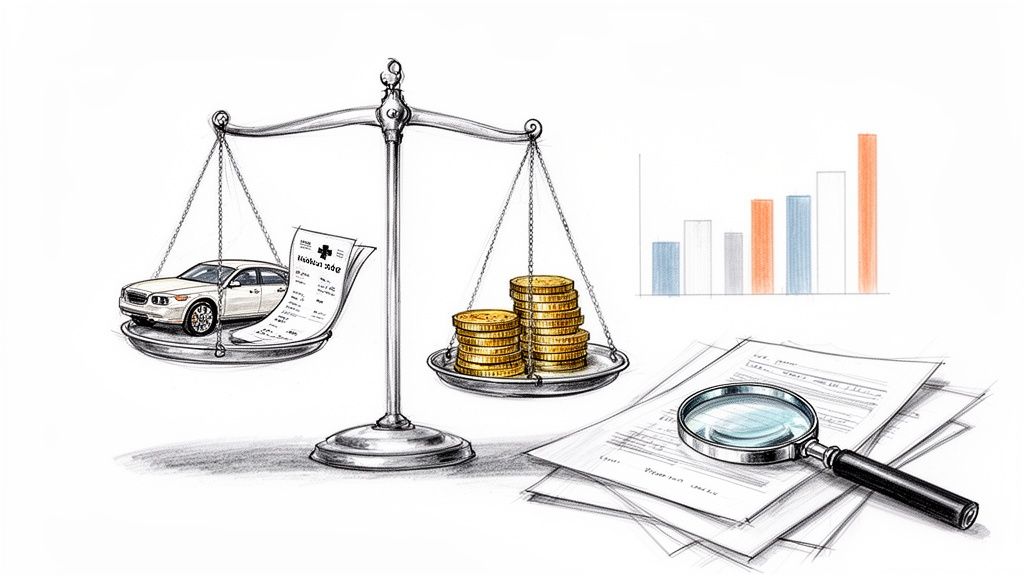
We'll cover everything from crucial deadlines to how your insurance works, giving you the practical knowledge you need to protect your rights and make informed decisions.
What Is the Statute of Limitations for a Hit and Run in Texas?
In Texas, the clock starts ticking the moment the accident happens. You generally have two years from the date of the crash to file a personal injury lawsuit. This isn't just a guideline; it's a hard deadline.
If you let that two-year window close, the courts will almost certainly bar you from seeking compensation for your injuries. That’s why it’s so important to get the ball rolling quickly, leaving enough time for a thorough investigation and to build your case.
Will My Insurance Rates Go Up If I File a UM Claim?
This is a huge worry for many people, but you can put it to rest. Texas law is on your side here—it actually forbids insurance companies from jacking up your rates for filing a claim when you weren't at fault.
By definition, you are never at fault in a hit-and-run. So, filing a claim under your Uninsured/Underinsured Motorist (UM) or Personal Injury Protection (PIP) coverage shouldn't cost you a penny more in premiums.
You’ve paid for this coverage precisely for situations like this. Don't be afraid to use the benefits you're entitled to.
What if I Was a Pedestrian or Cyclist Who Was Hit?
Your situation might feel more complicated, but you likely have more options than you realize. If you own a vehicle with UM coverage, that policy often extends to protect you even when you're not in your car—it follows you as a person.
And if you don't own a car yourself? You might still be covered under the auto policy of a family member in your household. A good attorney will know to explore all of these potential avenues to help you recover your losses.
Knowing what your case could be worth is fundamental to getting a fair result. With a tool like Verdictly, you can stop guessing. It gives you access to real Texas case data, allowing you to see what outcomes others have had in similar hit-and-run accidents. This kind of insight empowers you to negotiate from a position of strength.
Related Posts
What to Do After a Hit and Run Car Accident in Texas
A complete guide on what to do after a hit and run car accident in Texas. Learn the critical first steps, your legal options, and how to file a claim.
Hit and Run What Happens: Steps After an Accident - hit and run what happens
Hit and run what happens: A concise guide to immediate actions, the investigation process, and how to pursue fair compensation. (hit and run what happens)
Navigating Texas Parking Lot Accident Law A Complete Guide
Feeling lost after a crash? Unpack Texas parking lot accident law, from proving fault to fighting for fair compensation. Your practical guide starts here.