
Can You Sue Someone For a Car Accident? A Practical Guide
Can you sue someone for a car accident? Learn the steps to take, who you can sue in Texas, and how to determine what your case might be worth.
Yes, you can absolutely sue someone for a car accident, especially if their carelessness is the reason you're hurt. It all comes down to a basic promise every driver makes when they get on the road: to operate their vehicle safely. When someone breaks that promise by texting, speeding, or running a red light, the legal system gives you a path to hold them accountable.
Understanding Your Right to Sue After a Car Accident
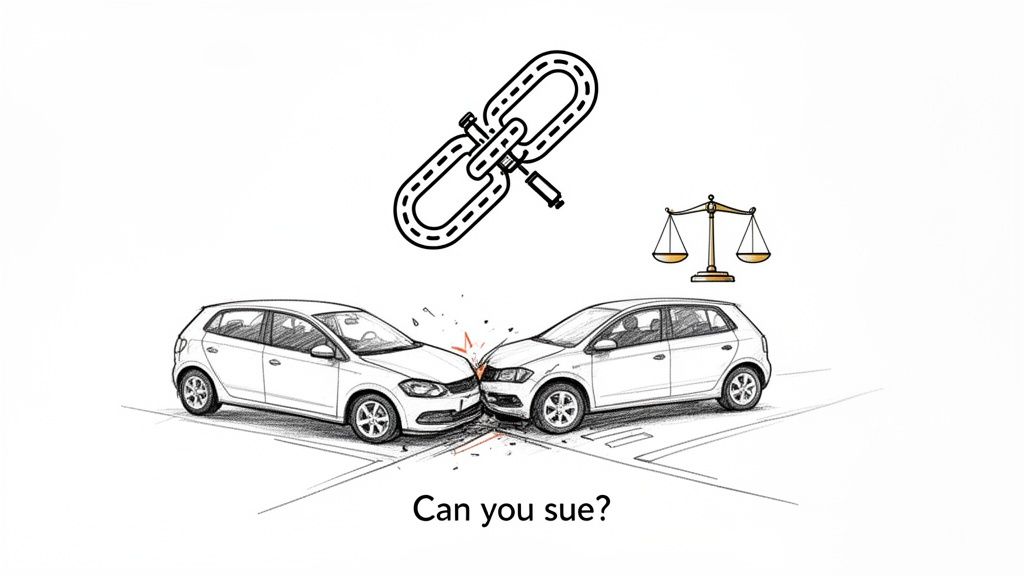
This guide is designed to walk you through what that legal path looks like here in Texas. We’ll cut through the complex legal jargon to talk about who you can sue (it’s not always as simple as just the other driver), the crucial deadlines you have to meet, and how to get a realistic idea of what your claim might be worth.
Is It Actually Common to File a Lawsuit?
The idea of filing a lawsuit can feel overwhelming, but it's a standard and often necessary step for accident victims to get the compensation they deserve. The numbers show just how common this is.
Nationally, there are nearly 400,000 personal injury claims filed every year, with car accidents being one of the biggest reasons. In 2022 alone, the number of medically consulted injuries from crashes hit 5.2 million. These aren't just abstract figures; they represent real people whose lives were disrupted and who needed to take action to cover medical bills and lost income. You can explore more details about personal injury case statistics to see these trends for yourself.
But here’s something most people don’t realize: filing a lawsuit rarely means you'll end up in a dramatic courtroom trial. In reality, about 95% of personal injury lawsuits are resolved through a pre-trial settlement. This means your lawyer and the at-fault party's insurance company will almost certainly negotiate and agree on a fair payment without ever seeing a judge or jury.
What Does "Suing" Really Mean?
So, what happens when you "sue" someone? In simple terms, you're starting a formal legal process—a civil lawsuit—to get financial compensation, legally known as damages, from the person responsible for your injuries and losses. The lawsuit is your official demand for them to pay for the harm they caused.
This isn’t a one-step event. The process usually unfolds in a few key stages:
- Filing the Petition: Your attorney drafts and files a legal document with the court that officially states your case against the at-fault party (the "defendant").
- Discovery: This is the investigation phase. Both legal teams exchange information, gather evidence like police reports and medical records, and interview key people under oath (depositions).
- Negotiation: Armed with evidence from discovery, your lawyer and the insurance company will negotiate to try and reach a settlement.
- Trial: If a fair settlement can't be reached, the case moves to trial, where a judge or jury will hear the evidence and make a final decision.
Knowing these steps helps demystify the experience. Suing is just a structured, official way to enforce your right to be made whole again after a crash. Before diving deeper, it's helpful to understand the basic building blocks of a successful case.
Key Factors for a Successful Car Accident Lawsuit
For any car accident lawsuit to succeed, you have to prove a few core things. Think of them as the essential ingredients in a recipe—if one is missing, the whole thing falls apart. This table breaks down what you and your lawyer need to establish.
| Element | What It Means for Your Case | Simple Example |
|---|---|---|
| Duty of Care | You must show the other driver had a legal responsibility to act with reasonable care to avoid harming others. | All drivers on Texas roads have a duty to follow traffic laws and pay attention. |
| Breach of Duty | You need to prove the other driver failed to meet that standard of care. This is the negligence. | The other driver ran a stop sign, was texting, or was speeding. |
| Causation | You have to connect the driver's breach of duty directly to your injuries. Their action caused the crash, which in turn caused your harm. | The driver running the stop sign T-boned your car, and the force of that impact caused your broken arm. |
| Damages | You must demonstrate that you suffered actual, measurable losses because of the accident. | You have medical bills, lost wages from missing work, and experienced pain and suffering. |
These four elements—duty, breach, causation, and damages—are the foundation of every personal injury claim. Without proving all of them, there is no case.
Looking Beyond the Other Driver: Who's Really at Fault?
After a car wreck, it’s natural to point the finger at the other driver. They were the one who ran the red light or rear-ended you, after all. But in the legal world, the chain of responsibility can be much longer and more complex. A skilled investigation often uncovers other parties who share the blame, and identifying them is key to getting the full compensation you need to recover.
The most obvious person to hold accountable is, of course, the at-fault driver. Their negligence—whether it was texting, speeding, or just not paying attention—is the direct cause of the crash. So, you’ll almost always start by making a claim against them and their auto insurance.
But what happens if the driver was working at the time? That changes everything.
When the Driver Was on the Clock
Think about getting hit by a company truck, a delivery driver, or a salesperson speeding to their next appointment. In these situations, the driver’s employer can often be held responsible right alongside them. This legal concept is known as respondeat superior.
It’s a Latin phrase that simply means "let the master answer." What it means for you is that an employer is on the hook for the mistakes an employee makes while doing their job.
- Here's a classic example: A pizza delivery driver, rushing to get an order out, blows through a stop sign and T-bones your car. Under respondeat superior, you can sue both the driver and the pizza company. This is a huge advantage, as the company's commercial insurance policy will have much higher limits than the driver's personal policy, giving you a much better chance of covering all your medical bills and lost wages.
The logic here is that companies have a duty to hire competent people and train them properly. When they put a negligent driver on the road, they share the responsibility for the damage that driver causes.
What if the Car Itself Failed?
Sometimes, the driver did everything right, but their vehicle let them down. A sudden brake failure, a tire blowout, or an airbag that doesn't deploy can turn a minor incident into a catastrophe. When a mechanical failure is part of the story, the list of potential defendants grows.
This is where a simple negligence claim can evolve into a product liability case.
The core idea behind product liability is that companies are held to a strict standard when they put a product on the market. If that product is defective and injures someone, the manufacturer is responsible, regardless of whether they were "careless" in the traditional sense.
In a car accident case, this means you might be able to file a lawsuit against several different companies involved in getting that vehicle on the road:
- The vehicle manufacturer (like Ford or Toyota)
- The maker of the specific faulty part (the company that made the brakes or tires)
- Even the car dealership that sold the defective vehicle
Proving a product defect case is tough. It requires deep investigation, expert analysis, and a legal team ready to take on massive corporations. But when a faulty part is to blame for your injuries, it's the only way to get true justice.
When the Road Itself is the Hazard
We trust that our roads are safe, but that's not always the case. Government bodies—from your local city all the way up to the state—have a fundamental duty to design, build, and maintain roads that don't put drivers in unnecessary danger. When they fail, they can be held accountable.
Imagine these situations:
- A blind curve on a country road with no warning signs.
- A massive, unrepaired pothole that causes a driver to swerve into your lane.
- A malfunctioning traffic light at a busy intersection.
Suing the government is never easy. There are special rules, strict notice requirements, and much shorter deadlines. But if a poorly designed or dangerously maintained road was a significant factor in your crash, it's an avenue that absolutely must be explored.
And finally, if you were hit by a drunk driver, don't forget to look at where they were drinking. Under Texas "dram shop" laws, you may have a case against the bar, restaurant, or store that sold alcohol to a person who was already obviously intoxicated. That business made a choice to prioritize a sale over public safety, and they can be held financially responsible for the consequences.
Building the Foundation of Your Legal Claim
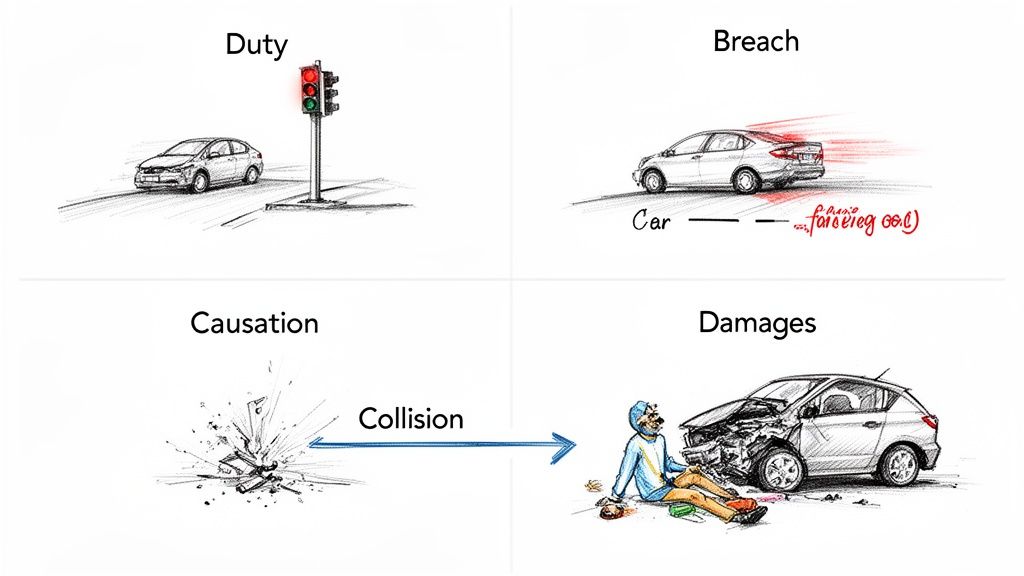
At the core of almost every car accident lawsuit lies one powerful legal concept: negligence. You can forget the dense legal jargon for a moment. Just think of it as a basic "carefulness test" that every single driver agrees to take when they get behind the wheel.
When you sue another driver, you’re essentially arguing that they failed that test—and their failure caused you real harm. To win your case, you have to prove four key things. Imagine them as the four legs of a table; if even one is missing, the whole thing comes crashing down.
Let's walk through a common scenario to see how these pieces come together. Picture this: you're driving through an intersection with a green light when another car blows through their red light and T-bones you. Here's how we'd start building your legal claim.
The Four Essential Elements of Negligence
1. Duty of Care First, we have to show the other driver had a legal duty of care. This is usually the easiest part. Anyone who gets a driver's license and operates a car on a public road automatically takes on a responsibility to drive with reasonable caution to keep others safe.
This duty means following traffic laws, paying attention, driving at a safe speed, and generally not being reckless. In our red-light example, the other driver had a crystal-clear duty to stop for their red light. It's that simple.
2. Breach of Duty Next, you have to prove the driver breached that duty. This is the moment they failed the carefulness test. A breach is any action—or a failure to act—that a reasonably prudent person wouldn't do in the same situation.
When the other driver sped through the red light, they breached their duty of care. That decision was a direct violation of the law and a complete failure to drive safely.
There's actually a legal shortcut here called negligence per se. This rule says that if someone breaks a safety law (like running a red light) and causes the exact type of accident that law was designed to prevent, the breach is considered automatically proven.
3. Causation The third leg of the table is causation. It’s not enough to show the other driver was careless; you have to directly connect their carelessness to your injuries. You have to draw a straight line from their action to your harm.
In our crash scenario, the connection is obvious. The driver running the red light caused the collision. The force of that collision, in turn, caused your car to be wrecked and you to suffer a broken arm. If they hadn't breached their duty, the accident and your injuries simply wouldn't have happened.
4. Damages Finally, you must show you suffered actual, quantifiable losses, legally known as damages. You can't sue someone just for driving badly if you weren't harmed. The damages are what you're asking to be compensated for.
These losses can include everything from the obvious—medical bills and the cost to fix your car—to the less tangible. Think about lost wages from being out of work, the cost of physical therapy, and even the physical pain and emotional distress you've been through.
Documenting all of this is critical as your case moves forward. Eventually, you may need to learn what is a deposition in a lawsuit, as this is a key step where your attorney will formally question the other party to lock down the facts about their breach and the damages it caused you.
How Texas Law Shapes Your Car Accident Case
Where an accident happens is just as important as how it happens. Every state has its own rulebook for personal injury claims, and if you’ve been in a crash in Texas, you need to understand the local laws that will directly control your case. They can be the difference between a successful claim and walking away with nothing.
Two rules, in particular, tower over everything else: the deadline for filing your lawsuit and the state's unique way of handling shared blame. Think of them as the ground rules. If you don't know them, you're at a serious disadvantage from day one.
The Unforgiving Two-Year Countdown
In Texas, the moment a car crash occurs, a legal stopwatch starts ticking. This deadline is called the statute of limitations, and for most car accident injury claims, you have exactly two years from the date of the wreck to file a lawsuit.
This isn't a friendly suggestion—it's a hard and fast deadline. If you miss it by even a single day, the court will almost certainly throw out your case. You lose your right to seek compensation forever, no matter how strong your claim was.
This two-year window is precisely why you can't afford to sit on your rights. Building a solid case takes time. Your legal team needs to conduct a thorough investigation, gather police reports and medical records, and negotiate with the at-fault driver's insurance company. Waiting until the last minute is one of the biggest and most heartbreaking mistakes you can make.
Understanding Texas's 51% Fault Rule
What happens when you’re partially to blame for an accident? It’s an incredibly common scenario, and how Texas law answers this question is one of the most critical parts of any car accident case. Texas uses a system called modified comparative fault, but most lawyers know it simply as the 51% Bar Rule.
Picture the total blame for an accident as a pie. A judge or jury has to slice it up and assign a percentage to everyone involved. The 51% Bar Rule then kicks in with two simple, but powerful, consequences:
- Your Payout Gets Reduced: Your final compensation is reduced by your percentage of fault.
- You Could Get Nothing at All: If you are found to be 51% or more responsible for the crash, you are completely barred from recovering any money. Zero.
This rule turns the fight over who was at fault into a high-stakes battle in every single case.
How Comparative Fault Works in the Real World
Let's put this into practice. Imagine a driver was texting and blew through a stop sign, T-boning your car and leaving you with serious injuries. After reviewing everything, a jury decides your total damages—for medical bills, lost wages, and pain and suffering—come out to $100,000.
But, during the investigation, evidence showed you were going just five miles per hour over the speed limit. The jury believes your speed made the crash slightly worse, so they assign 20% of the fault to you.
Here's how the math breaks down under the 51% Bar Rule:
- Total Damages: $100,000
- Your Percentage of Fault: 20%
- Amount Reduced: $100,000 x 0.20 = $20,000
- Your Final Recovery: $100,000 - $20,000 = $80,000
You still recover a substantial amount. But what if the jury decided your speeding was a much bigger factor and put you at 51% fault? In that case, your recovery would be $0.
This all-or-nothing cliff at 51% is exactly why insurance adjusters fight so hard to shift even a little bit of blame onto you. They know if they can push your fault percentage past that 50% tipping point, they owe you nothing. It’s the single biggest reason why having a skilled attorney to defend you against unfair blame is absolutely essential if you plan to sue after a car accident in Texas.
Determining What Your Car Accident Lawsuit Is Worth
This is usually the first question on everyone's mind after a crash: "What is my case actually worth?" The answer isn't just a number pulled from thin air. The value of a lawsuit is a careful calculation of every single loss you've experienced, from the obvious bills to the less tangible, human costs.
When you sue someone for a car accident, the legal system's goal is to make you "whole" again by awarding compensation, which lawyers call damages. Think of these damages as falling into two main buckets you'll need to fill to show the true, full impact of the accident on your life.
Let's break down how we figure this out.
The Tangible Costs: Economic Damages
First up are the straightforward losses, what we call economic damages. These are all the out-of-pocket costs you can prove with a paper trail—receipts, invoices, pay stubs, you name it. They represent the direct financial hit you took because of someone else's negligence.
To get a clearer picture of what you can claim, take a look at the different types of damages available in a Texas personal injury lawsuit.
| Type of Damage | What It Covers | Real-World Example |
|---|---|---|
| Economic | All measurable financial losses directly resulting from the accident. | The $8,000 bill for your emergency room visit, the $1,200 in wages you lost while out of work, and the $5,500 it cost to repair your car's front end. |
| Non-Economic | The intangible, human suffering that doesn't come with a price tag. | The daily pain from a back injury, the anxiety you now feel when driving, or the inability to play with your kids like you used to. |
| Exemplary (Punitive) | An additional award meant to punish the defendant for extreme negligence or intentional harm. | A drunk driver with a history of DUIs causes a catastrophic wreck. A jury might award punitive damages to send a strong message and deter that behavior. |
As you can see, economic damages are the foundation of your claim because they are concrete and easy to add up.
The Human Costs: Non-Economic Damages
The second bucket is for non-economic damages, and this is where things get more personal and complex. How do you put a dollar value on pain? Or the emotional trauma of a crash? These damages are meant to compensate for the very real, but non-financial, ways the accident has upended your life.
This is also where Texas's specific fault rules can have a huge impact on your final recovery.
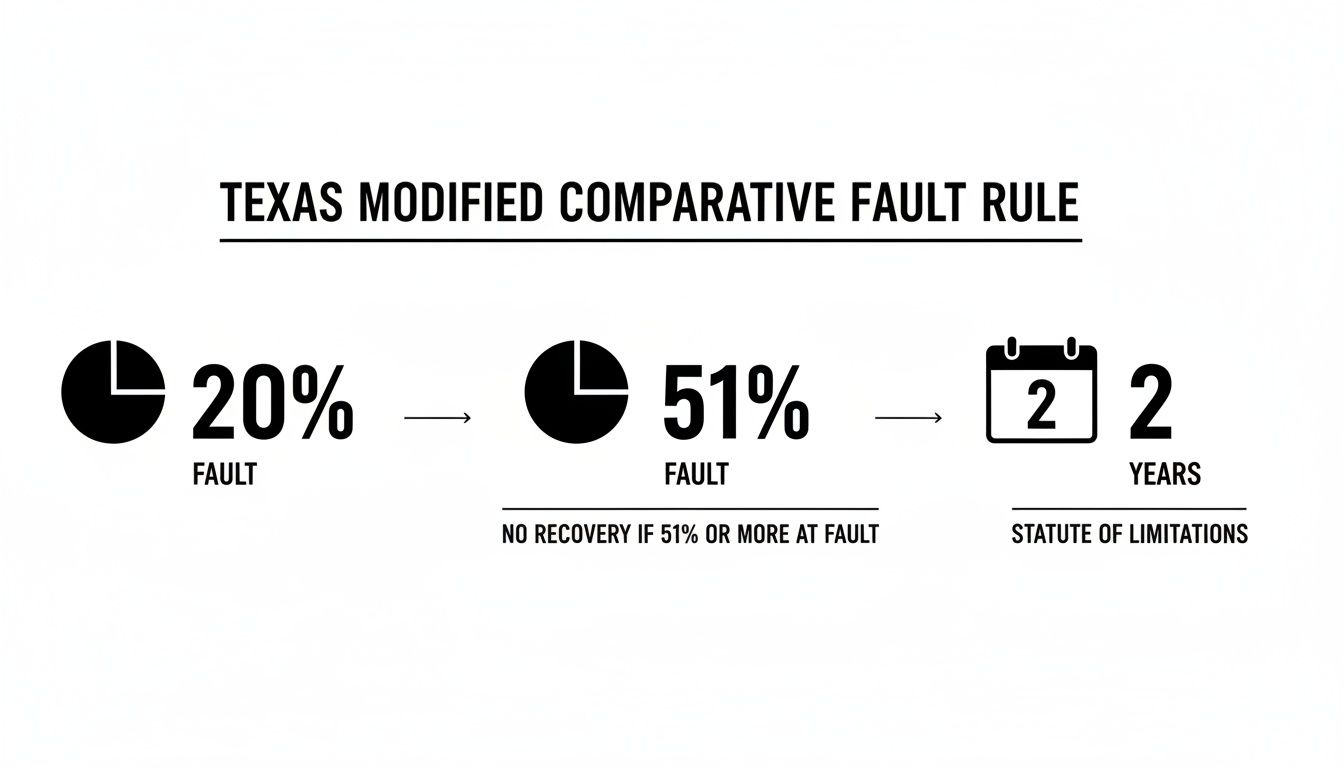
As the graphic shows, if you are found to be 51% or more at fault, you get nothing. This "all-or-nothing" cliff at 51% makes proving the full extent of your non-economic suffering absolutely critical to securing a fair outcome.
Examples of non-economic damages include:
- Pain and Suffering: For the physical pain you've had to live with since the accident.
- Mental Anguish: Covers the emotional toll, like anxiety, depression, or PTSD.
- Physical Impairment: If you've lost the ability to do things you once could, like running or lifting.
- Disfigurement: For permanent scarring or other changes to your appearance.
- Loss of Enjoyment of Life: For being robbed of the ability to enjoy your hobbies and daily activities.
Transforming Guesswork into a Data-Backed Strategy
So, how do you assign a number to something as personal as "pain and suffering"? For years, this was a guessing game where insurance companies held all the power. They had access to vast internal databases of past cases and used that information to make lowball offers, knowing you had no way to check their math.
That information imbalance is a thing of the past. Today, we can analyze huge databases of real Texas verdicts and settlements to see what juries have actually awarded for cases just like yours. We can benchmark your injuries, the type of accident, and the county where it happened against similar resolved cases.
This data is an absolute game-changer in negotiations. Instead of just saying your pain is worth a certain amount, a skilled attorney can walk into a mediation and point to a dozen recent jury awards in that same courthouse for similar injuries. It turns a subjective argument into an objective, data-backed demand for what your case is truly worth. If you're curious about this process, you can get a better understanding of how case value is calculated in our detailed guide.
The numbers don't lie. Research shows that the average payout for surveyed plaintiffs who pursued a claim was $52,900, with the average bodily injury claim in 2022 reaching $26,501. These figures show that when you stand up for your rights after an accident, there is a clear, statistically proven path to getting the compensation you deserve.
Protecting Your Right to Sue After an Accident
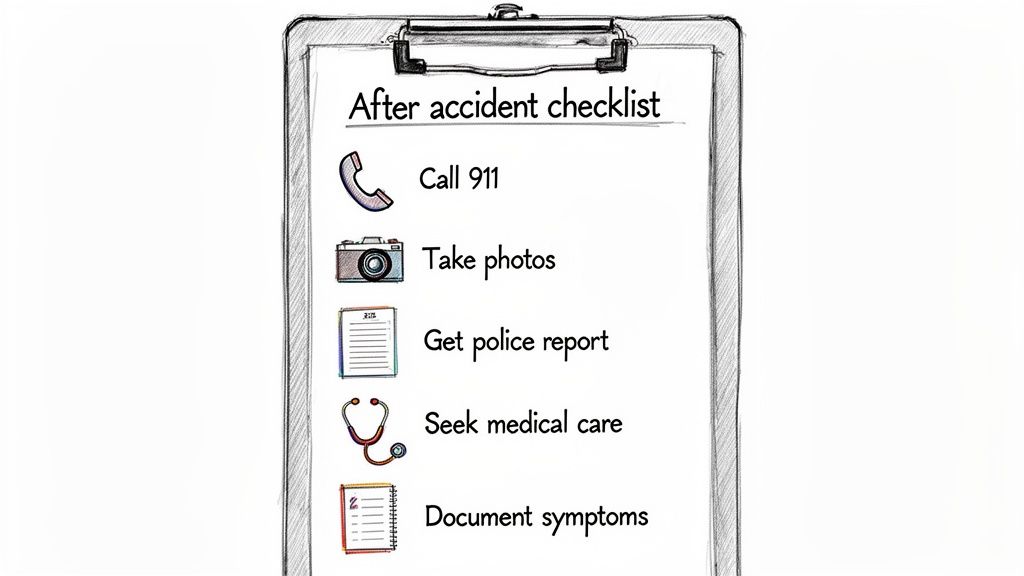
The moments right after a car crash are a blur of chaos and stress. With your adrenaline pumping, it’s tough to think straight. But what you do right then and there can make or break your ability to get fair compensation down the road.
Evidence has a very short shelf life. Skid marks get washed away by rain, cars are towed, and people’s memories of what happened start to fade almost immediately. Taking a few methodical steps can mean the difference between having a solid case and having no case at all.
What to Do Immediately at the Scene
Safety first, always. Check on yourself and your passengers. But once the immediate danger has passed, your job is to become an evidence collector. Every detail you gather is another piece of the puzzle for your potential claim.
-
Call 911. No Exceptions. Even if it seems like a minor fender-bender, make the call. A police report is an objective, official document that details the scene, the parties involved, and sometimes the officer’s initial take on who was at fault. It’s one of the first things an insurance company or a lawyer will ask for.
-
Turn Your Phone into an Investigation Tool. Take pictures of everything. And I mean everything. Get wide shots of the entire scene, then zoom in on the damage to all vehicles. Snap photos of skid marks, broken glass on the road, traffic signs, and even the weather conditions. If you have any visible injuries, document those, too.
-
Get the Essentials. Calmly exchange information with the other driver. You'll need their full name, address, phone number, driver's license number, and their insurance company and policy number. Just stick to the facts. It’s human nature to want to apologize, but you must resist the urge—saying "I'm sorry" can be twisted into an admission of fault later.
In the Days and Weeks After the Crash
The work doesn't stop when you leave the scene. The next few weeks are critical for establishing the full extent of your injuries and organizing all the proof you’ll need.
The biggest mistake people make is toughing it out. Adrenaline is a powerful painkiller and can easily mask serious injuries for hours or even days. Getting checked by a doctor creates an official medical record linking your injuries directly to the accident—that connection is absolutely essential for any claim.
Get a Medical Evaluation Right Away. Even if you feel "fine," go see a doctor, visit an urgent care clinic, or go to the ER within 24 to 48 hours. Then, follow their instructions to the letter. Go to every follow-up appointment, do your physical therapy, and fill your prescriptions.
Create an "Accident File." Get a folder and keep every single scrap of paper related to the crash. This means medical bills, car repair estimates, receipts for a rental car or Uber rides, and proof of any time you missed from work.
Track Your Pain. Start a simple journal where you jot down your daily pain levels, what symptoms you're experiencing, and how the injuries are impacting your day-to-day life. Can't lift your child? Can't sleep through the night? Write it down. This diary becomes powerful proof when it’s time to talk about compensation for pain and suffering.
Finally, remember that the clock is ticking. You have a limited window of time to file a lawsuit. To understand these critical deadlines, check out our guide on the statute of limitations for a Texas car accident. Missing that deadline is just as damaging to your case as having no evidence at all.
Your Car Accident Lawsuit Questions, Answered
After a crash, your head is probably swimming with questions. It's a confusing and stressful time, and figuring out the legal side of things can feel overwhelming. Let's cut through the noise and get straight to the answers for some of the most common questions people ask.
What's This Going to Cost Me? Can I Even Afford a Lawyer?
For nearly everyone, the upfront cost is zero. Most experienced car accident lawyers work on what's called a contingency fee.
Think of it this way: the attorney's fee is contingent on them winning money for you. They get paid a percentage of the final settlement or court award, usually somewhere between 33% and 40%. If they don't win your case, you don't owe them a dime in attorney fees. This system gives everyone, regardless of their financial situation, a fair shot at getting expert legal help.
The Other Driver Doesn't Have Insurance. Now What?
This is an infuriating situation, and unfortunately, it happens all the time. When the driver who caused the crash is uninsured, your own insurance policy is often your best bet for getting compensated.
This is exactly why Uninsured/Underinsured Motorist (UM/UIM) coverage is so critical to have on your own Texas auto policy. It's designed to step in and pay for your medical bills, lost income, and pain when the at-fault driver can't. You'll essentially make a claim against your own insurance company to cover the damages.
A quick word of caution: even though it's your own insurer, their primary goal is still to pay out as little as possible on a UM/UIM claim. Having an attorney fighting for your best interests is just as important here.
If I Sue, Does That Mean I'm Going to Court?
Almost certainly not. The image of a dramatic courtroom trial is mostly for TV. The reality is that around 95% of personal injury cases end in a settlement without ever seeing the inside of a courtroom.
Filing a lawsuit is more of a strategic step. It’s a formal way of telling the insurance company you're not backing down. This kicks off legal processes that pressure them to negotiate seriously and make a fair offer. For everyone involved, settling is faster, cheaper, and far more predictable than a jury trial.
I Might Have Been a Little Bit at Fault. Can I Still Sue?
Yes, you can, but there's a key threshold you need to know about. Texas operates under a modified comparative fault rule, which is also known as the 51% bar. In plain English, you can recover damages as long as you are found to be 50% or less responsible for the accident.
Your final award, however, gets reduced by whatever percentage of fault is assigned to you. For instance, if a jury decides your damages are worth $100,000 but also finds you were 10% at fault, your recovery would be docked by 10%, leaving you with $90,000. But if they decide you were 51% or more to blame, you get nothing. It’s a harsh cutoff.
At Verdictly, we believe that transparent data leads to fairer outcomes. Our platform provides access to real Texas verdicts and settlements, empowering you to understand what your case might be worth based on thousands of similar past results. Level the playing field in your negotiations by exploring real case data at https://verdictly.co.
Related Posts
Can You Sue Someone in a Car Accident? A Guide to Your Rights
Can you sue someone in a car accident? Learn the critical steps for filing a claim and what it takes to secure fair compensation for your injuries and damages.

What To Do If Someone Hit Your Car and Run in Texas
Discover the crucial steps to take if someone hit your car and run in Texas. Our guide covers gathering evidence, filing reports, and handling insurance claims.