
Pain and Suffering Settlement Amounts: How They're Calculated
Discover pain and suffering settlement amounts and how they're calculated. Learn key factors, methods, and real examples to strengthen your claim.
When you’re hurt in an accident, the costs aren't just about medical bills and lost paychecks. The real human toll—the pain, the stress, the sleepless nights—is just as significant, and that's what pain and suffering settlement amounts are meant to address.
This is compensation for the non-financial side of your injury, like the physical discomfort, emotional trauma, and the simple loss of being able to enjoy your daily life.
What Pain and Suffering Really Means in a Settlement
In any personal injury claim, lawyers and insurance adjusters talk about two main types of damages. The first kind is straightforward. Imagine your car gets wrecked; the mechanic gives you an itemized bill for parts and labor. It's a clear, definite number.
In a personal injury case, these are your economic damages—things like hospital bills, prescription costs, and pay stubs showing lost income. They all have a paper trail.
Pain and suffering is the other side of the coin. It's what we call non-economic damages. This is the compensation for everything that doesn't come with a receipt: the chronic pain that keeps you from lifting your kids, the fear you feel every time you get in a car now, or the frustration of not being able to do the hobbies you once loved.
The Two Sides of Suffering
To get a better handle on it, pain and suffering is usually broken down into two distinct categories of harm.
-
Physical Pain and Suffering: This is for the actual, physical hurt you feel. It covers everything from the sharp, immediate pain of the injury itself to the chronic aches, nerve damage, or migraines that linger for months or even years.
-
Mental Pain and Suffering: This part addresses the accident's psychological fallout. We're talking about emotional distress, anxiety, depression, insomnia, and even post-traumatic stress disorder (PTSD). It also includes compensation for the "loss of enjoyment of life"—the impact on your ability to engage in activities that once brought you joy.
While economic damages are about paying you back for what you lost financially, pain and suffering damages are about acknowledging the very real, very personal impact the injury has had on your life.
This compensation can't turn back the clock and undo what happened. What it does is provide a formal, legal recognition of the intangible harm you've been forced to endure. Because this part of a claim is so subjective, it's almost always the most contentious part of any settlement negotiation.
Understanding what it truly covers is the first step toward figuring out how pain and suffering settlement amounts are actually calculated.
How Pain and Suffering Settlement Amounts Are Calculated
Figuring out what a person’s pain is worth in dollars is one of the trickiest and most human parts of any personal injury claim. There’s no official "pain calculator" you can plug numbers into. Instead, attorneys and insurance adjusters have developed a few common-sense methods to put a logical frame around something that’s deeply personal and subjective.
These approaches aren’t foolproof, but they give everyone a place to start the conversation. Once you understand them, the numbers that get thrown around in negotiations start to make a lot more sense. The two most popular methods you'll hear about are the Multiplier Method and the Per Diem Method.
The infographic below does a great job of showing the two different pots of money in a settlement: the hard-and-fast economic damages and the more abstract pain and suffering damages we're breaking down here.
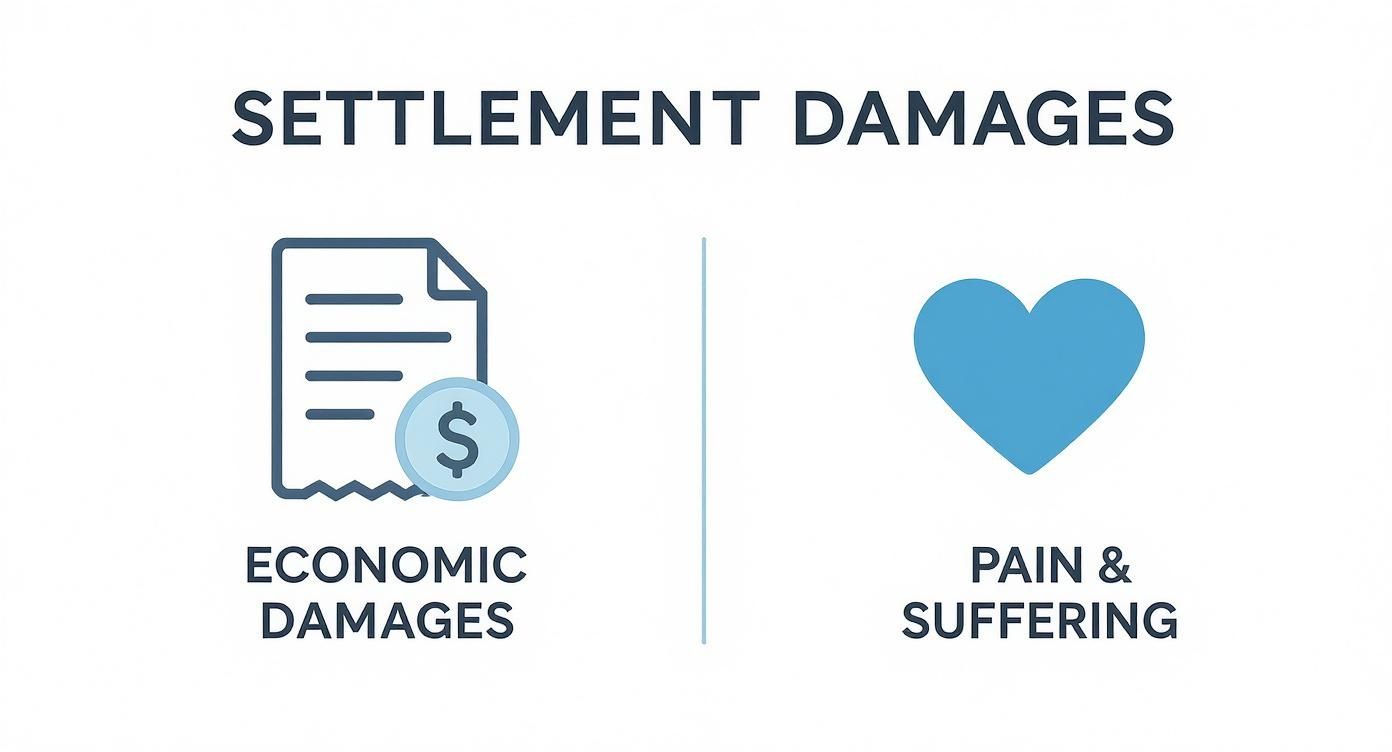
As you can see, the economic damages are all about receipts and verifiable costs. Pain and suffering, on the other hand, is about quantifying the human cost of an injury using established valuation models.
The Multiplier Method
The Multiplier Method is easily the most common approach you’ll encounter. It’s pretty straightforward: you start by adding up all your concrete financial losses, known as economic damages. This includes every dollar spent on medical care, wages you lost from being out of work, and any other direct expenses.
That total is then multiplied by a number, which usually falls somewhere between 1.5 and 5.
So, where does that multiplier come from? It’s a reflection of how severe your injuries are and how long they will affect your life.
- A low multiplier (think 1.5 to 2) is typically for more minor injuries where you make a full and relatively quick recovery—like a sprain or whiplash.
- A high multiplier (like a 4 or 5) is reserved for life-altering injuries. We're talking about things like traumatic brain injuries, paralysis, or severe burns that have a permanent impact.
Let's say you broke your leg, needed surgery, and racked up $20,000 in medical bills and lost wages. An attorney might reasonably argue for a multiplier of 3, given the pain and difficult recovery. That would put the pain and suffering estimate at $60,000 ($20,000 x 3).
The Per Diem Method
Another way to look at it is the Per Diem Method. "Per diem" is just Latin for "per day." This technique assigns a daily dollar amount to your suffering, then multiplies it by the number of days you were in pain until you reached what doctors call "maximum medical improvement."
Think of it as getting paid a daily wage for the grueling job of recovery. Often, the daily rate is pegged to your actual daily earnings. The argument is simple: if you earn a certain amount for a day's work, then enduring a day of pain and limitation is worth at least that much.
For instance, if you earn $200 a day and your recovery took 150 days, the per diem calculation would land at $30,000 ($200 x 150). This method works best for injuries that have a clear, definable timeline from the accident to recovery.
While these two methods provide a solid starting point, they can feel a bit abstract. To help you see how they stack up against each other, here's a quick comparison.
Comparison of Settlement Calculation Methods
| Method | How It Works | Best Suited For | Potential Drawback |
|---|---|---|---|
| Multiplier | Calculates pain and suffering by multiplying total economic damages (medical bills, lost wages) by a number from 1.5 to 5. | Cases with significant medical expenses and long-term or permanent injuries. | Can undervalue claims where medical bills are low but the emotional trauma is high. |
| Per Diem | Assigns a daily rate for pain and multiplies it by the number of days of recovery until maximum medical improvement. | Short-term injuries with a clear and predictable recovery period. | Becomes less practical for chronic or permanent injuries where the end date is unknown. |
Ultimately, both methods are just tools to start a negotiation. The final number will always depend on the specific details of your case.
Grounding Calculations in Reality
While formulas are a useful guide, modern legal practice adds a critical reality check: real-world data. Both attorneys and insurance companies lean heavily on jury verdicts and settlement data from similar past cases. This helps them benchmark what a reasonable outcome actually looks like. A data-driven approach keeps the theoretical calculations from flying off into fantasy land.
Average personal injury settlement amounts can vary wildly depending on the injury. For example, a typical car accident settlement might fall in the $15,000 to $50,000 range, whereas a medical malpractice case could easily exceed $250,000. The most severe cases, like those involving traumatic brain injuries or spinal cord damage, often result in settlements from $100,000 to $500,000 or even more. Learning about the different factors that influence average personal injury settlements can provide more context for these ranges.
Key Factors That Drive Your Settlement Value

Ever wonder why two people in nearly identical car accidents can walk away with vastly different pain and suffering settlement amounts? It’s because the final number has less to do with the accident itself and everything to do with its unique, personal impact on the victim. Think of it like a recipe: the final dish depends entirely on the specific ingredients and how they come together.
Several key factors are the primary "ingredients" an insurance adjuster or jury will look at. Getting a handle on these elements makes it clear why one claim might be worth so much more than another, even when the crashes seem the same on the surface.
Severity and Permanence of Injuries
The biggest driver of your claim’s value is, without a doubt, the nature of your physical injuries. A broken arm that heals perfectly in eight weeks is one thing; a spinal cord injury causing permanent paralysis is something else entirely. The real question is always: how bad is the harm, and how long is it going to last?
- Duration: Pain that sticks around for a few months is valued differently than a chronic condition you'll manage for the rest of your life.
- Visibility: It's a simple fact that injuries people can see—like severe burns, noticeable scars, or amputations—often lead to higher awards because their impact is so immediate and undeniable.
- Permanence: Any injury that leaves you with a long-term limitation, permanent disfigurement, or a disability will dramatically increase the potential settlement value.
Impact on Your Daily Life
This is where the story moves beyond medical charts and into the real-world disruption the injury has caused. It’s about the "loss of enjoyment of life." If a passionate marathon runner can no longer even walk without a limp, or a dedicated gardener can’t kneel to tend to their plants, that specific, personal loss carries serious weight.
The more an injury gets in the way of your work, your family life, or the hobbies that bring you joy, the stronger the case for a higher settlement. This is where testimony from friends and family can be so powerful, as they can speak to the person you were before versus the person you are now.
A settlement isn't just about the injury; it's about the life the injury took from you. The more profound that loss, the greater the compensation should be.
Documented Medical Treatment and Evidence
You absolutely must have consistent medical treatment. If you have big gaps in your care or ignore your doctor's advice, you're handing the insurance company an argument on a silver platter—they'll claim your injuries must not be that bad.
Detailed records from your doctors, physical therapists, and counselors build a clear, documented timeline of your pain and recovery. This documentation turns your personal experience into objective proof that is very hard to argue with. Acting quickly is also key, as waiting too long can sometimes result in a court dismissing a motor vehicle accident case for good.
In the end, it's the combination of strong evidence, severe injuries, and the clear impact on your life that truly shapes the final settlement amount.
What Real-World Payouts Can Teach Us
https://www.youtube.com/embed/y3-Zuk2Zd48
Theories and formulas are great starting points, but they don't tell the whole story. The best way to really understand how pain and suffering settlement amounts are determined is to look at actual cases. Seeing how real-life facts translate into dollars and cents helps ground all the concepts we've been talking about.
When you look at high-value settlements, you start to see just how heavily catastrophic, life-changing injuries weigh in the final calculation. These aren't just numbers on a page; they represent the legal system’s attempt to place a monetary value on an immense, often unimaginable, human loss.
Anatomy of a High-Value Settlement
Take, for example, a major New York car accident case from 2017. A woman suffered a devastating spinal injury, and the case ultimately settled for a total of $71 million. A huge piece of that—$11 million—was specifically for her pain and suffering. The other $60 million was earmarked for her staggering medical costs. You can read more about how severe injuries impact large settlements.
That $11 million figure didn't come out of thin air. It was a direct reflection of several key factors that dramatically increased the value of her non-economic damages:
- Permanent Impairment: Her spinal injury meant a permanent, lifelong loss of mobility and function.
- Extreme Physical Pain: An injury of that magnitude involves a level of intense, chronic pain that's hard for most of us to comprehend.
- Profound Loss of Life Quality: Her ability to live a normal, independent life and enjoy even simple daily activities was gone forever.
This is a textbook example of how the multiplier method can lead to a massive award. When you start with economic damages as high as $60 million, even a conservative multiplier results in a huge number for pain and suffering.
Looking Beyond Individual Cases
This idea of putting a price on suffering isn't limited to individual lawsuits. Think back to the landmark Tobacco Master Settlement Agreement of 1998. In that agreement, the major tobacco companies committed to paying states more than $206 billion.
While that wasn't a single personal injury case, it’s a powerful illustration of the same principle at work on a massive scale. It shows the legal system grappling with how to assign financial liability for a widespread public health crisis that caused immeasurable, collective harm.
Seeing how different cases resolve provides valuable context. Whether it's a multi-million dollar award for a catastrophic injury or a more common settlement for a less severe crash, the underlying principles remain the same.
Of course, most cases don't involve nine-figure settlements. Everyday accidents, like a typical rear-end collision, often result in more modest—but still very significant—payouts. For a look at a more common scenario, you can see how an Atlanta rear-end collision settled for $100,000. Every single settlement, big or small, tells a story about the true impact of an injury.
How to Document and Prove Your Pain and Suffering

When you're trying to get a fair settlement, you can't just tell an insurance company you're in pain; you have to show them. Proving the true extent of your suffering is all about building a powerful, undeniable collection of evidence. This is what justifies the pain and suffering settlement amounts you rightfully deserve.
The goal here is to transform your personal experience into something an adjuster or jury can clearly understand and connect with. You’re building a detailed narrative that leaves no doubt about how profoundly this accident has changed your life.
Start a Detailed Personal Journal
Right after an accident, grab a notebook and start a journal. Seriously. This one document can become one of the most persuasive pieces of evidence in your entire claim. Think of it as your day-to-day record of how the injury has disrupted your world, capturing the real-life details that medical records never will.
Make your journal a consistent, honest account of your experience.
- Daily Pain Levels: How bad is the pain today on a scale of 1 to 10? Where does it hurt? Is it a sharp, dull, or throbbing sensation?
- Emotional State: Write down feelings of anxiety, frustration, depression, or fear. Did you lie awake last night because of the pain or stress?
- Life Disruptions: Make a note of every single activity you couldn't do. Did you miss your kid's soccer game? Were you unable to cook dinner, take a walk, or even tie your own shoes?
This isn't just a diary; it’s a logbook of your damages. It provides a human story and a consistent timeline that makes your suffering tangible and much harder for an insurer to downplay.
Leverage Your Medical Records
Your medical file is much more than a stack of bills—it's the professional validation of your pain. Consistent medical treatment is non-negotiable. If there are big gaps in your care, an insurance company will argue it’s a sign that your injuries aren't as serious as you claim.
But don't just go to the appointments; pay attention to what's in your records. Doctors' notes describing your reported pain, your limited range of motion, and your emotional state are incredibly valuable. This official documentation provides a credible, third-party account of your suffering over time.
Gather Testimony from Friends and Family
Sometimes, the most compelling evidence comes from the people who see you every day. Ask your friends, family, or even trusted coworkers to write down what they’ve observed since the accident. Their perspective can paint a vivid "before and after" picture for someone who doesn't know you.
They can talk about the changes in your personality, your inability to join in on family activities, or the daily struggles they witness firsthand. This outside perspective backs up your claims and adds a powerful layer of emotional truth. Even seemingly small awards, like the $1,063 a Dallas County jury awarded for medical care in a rear-end collision, depend on having clear, solid evidence.
When you look at the bigger picture, large-scale legal actions demonstrate just how significant liability can be when harm is widespread. Consider the Tobacco Master Settlement Agreement of 1998, where major tobacco companies agreed to pay states over $206 billion for public health damages. While your individual claim is different, you can find out more about how this monumental settlement reflects corporate responsibility. By meticulously documenting your personal harm, you lay the same kind of foundation for a just and fair outcome.
Your Top Questions About Settlement Amounts, Answered
When you're dealing with a pain and suffering claim, a lot of questions pop up. It’s natural. Getting straight answers helps you see the road ahead and make decisions with more confidence.
Let’s tackle some of the most common questions we see. Each one hits on a key part of how pain and suffering settlement amounts actually work, from legal limits to your own bank account.
Is There a Cap on Pain and Suffering Damages?
This is a big one, and the answer is a classic "it depends"—specifically, on your state's laws. Some states have put firm limits, or caps, on non-economic damages, especially in medical malpractice cases, to keep jury awards in check.
Texas, for example, has caps for malpractice claims. But for most other personal injury cases, like a typical car wreck, there's generally no cap on pain and suffering. This is why knowing the rules in your state is absolutely critical; it can completely change the potential value of your claim.
How Is Emotional Distress Different from Pain and Suffering?
It’s easiest to think of "pain and suffering" as the big-picture term for all the non-economic harm an accident causes. "Emotional distress" is a specific, and often significant, piece of that puzzle.
- Pain and Suffering (The Big Picture): This covers everything from the physical agony of a herniated disc to the frustration of not being able to pick up your kids.
- Emotional Distress (A Specific Piece): This zeroes in on the psychological fallout—the anxiety, depression, sleepless nights, or even Post-Traumatic Stress Disorder (PTSD) that follows a traumatic event.
When you file a claim, you're not just asking for money for a broken bone. You're seeking compensation for the entire impact, both physical and emotional, that falls under the umbrella of pain and suffering.
The legal system gets it: the mental anguish from an accident is just as real and damaging as the physical injury. Both are weighed when figuring out a fair settlement.
Will I Pay Taxes on My Pain and Suffering Settlement?
For the vast majority of personal injury cases, the answer is a clear no. The IRS states that compensation received for physical injuries or sickness is not considered taxable income. So, as long as your pain and suffering award stems directly from a physical injury, you generally won't owe taxes on it.
But there's an important catch. If a settlement is for purely emotional harm without any related physical injury, that portion of the award could be taxable. It’s always smart to run this by a tax professional to see how the rules apply to your specific situation.
Ready to see what cases like yours are worth in Texas? Verdictly gives you access to real motor vehicle accident verdicts and settlements from across the Dallas-Fort Worth area and beyond. Use our AI-powered legal data platform to benchmark your claim with real-world data and negotiate from a position of knowledge.
Article created using Outrank
Related Posts
How Much Can I Get From a Car Accident Settlement?
Wondering how much can I get from a car accident? This guide breaks down settlement factors, damages, and claim values to help you estimate your compensation.

A Guide to Medical Records Reviews in Personal Injury Claims
Learn how medical records reviews can strengthen your Texas injury claim. This guide explains the process, key findings, and how to build a stronger case.

Why Insurance Companies Deny Claims: why insurance companies deny claims
Learn why insurance companies deny claims and how to overcome common denials with proven appeals and tips to maximize your compensation.