
6 Texas Settlement Demand Letter Example Scenarios for 2025
Explore our Texas-focused settlement demand letter example scenarios. Learn how to justify demands using real data and handle insurer responses.
Navigating a motor vehicle injury claim in Texas can feel overwhelming, especially when it comes to valuation. The settlement demand letter is your first, most critical tool for setting the stage for negotiations. It's more than just a request for money; it's a strategic narrative that outlines liability, details your damages, and justifies your claim's value. A generic letter often gets a generic, lowball offer. A data-backed, well-structured demand, however, forces the insurance adjuster to take your claim seriously from the start.
This guide moves beyond theory and breaks down six specific Texas motor vehicle accident scenarios, providing a detailed settlement demand letter example for each one. For every example, we will dissect the strategy behind the language, show you how to articulate damages, and explain how to justify your settlement figure.
More importantly, we will demonstrate how to anchor your demand in reality using real-world Texas case data, similar to the insights found on Verdictly. This approach ensures your demand is not just a number, but a compelling, fact-based argument designed to secure a fair outcome. You will learn not just what to write, but precisely why it works and how to apply these tactics to your own situation.
1. Scenario 1: The Clear-Cut Rear-End Collision with Whiplash (Soft Tissue Injuries)
This scenario is arguably the most frequent type of motor vehicle accident in Texas. A driver is lawfully stopped at an intersection in a busy area like Houston or Dallas and is struck from behind. Liability is rarely in dispute. The primary challenge is convincing the insurance adjuster to offer fair value for "soft tissue" injuries like whiplash, which they often try to minimize. A well-crafted settlement demand letter is crucial here.
Situational Summary
Your client, Jane Doe, was stopped at a red light on the I-610 service road in Houston when a distracted driver in a commercial van rear-ended her vehicle. The impact caused significant damage to her sedan and resulted in immediate neck and back pain. Over the next three months, Jane underwent a course of physical therapy and chiropractic care for diagnosed cervical and lumbar strains (whiplash).
Key Elements for Your Demand Letter
A strong settlement demand letter example for this case must proactively counter the insurer's expected arguments.
- Liability: State clearly that their insured's liability is 100% and not in question, citing the Texas Transportation Code regarding following distance.
- Medical Timeline: Create a detailed, chronological list of every medical appointment, from the initial ER visit to the final physical therapy session. This demonstrates consistent treatment and refutes any "gap in treatment" defense.
- Impact on Daily Life: Quantify the pain. Describe Jane's inability to perform daily tasks, such as lifting her toddler, sitting at her desk without pain, or enjoying hobbies like gardening. This translates abstract pain into tangible, compensable losses.
- Data-Driven Valuation: Use objective data to anchor your demand. This prevents the adjuster from dismissing your figure as arbitrary.
Suggested Demand Language & Justification
When demanding compensation for pain and suffering, ground your request in real-world case data.
Sample Language: "Ms. Doe’s injuries required 12 weeks of consistent medical care and significantly disrupted her quality of life. The pain prevented her from caring for her young child and caused persistent sleep loss. Considering these factors, we demand $22,500 to resolve this claim."
Justification using Verdictly: To support this number, you can leverage data from similar Texas cases. You might include a blockquote in your letter to the adjuster:
Based on Verdictly's statewide data for Texas rear-end collisions involving cervical and lumbar sprains with similar medical expenses, the median jury verdict award for pain and suffering is approximately $15,000. Our demand reflects this median value, plus Ms. Doe's economic damages.
This tactic shifts the negotiation from subjective opinion to objective data, making your demand harder to dismiss. For a deeper dive into the components of a demand letter, you can explore our comprehensive guide on how to write a settlement demand letter.
2. Scenario 2: The Disputed Property Damage Claim (Vehicle Total Loss)
While personal injury is often the focus, property damage disputes are a frequent and frustrating hurdle for Texans. This is especially true in a total loss scenario where the insurance company's valuation of a vehicle is significantly lower than its actual market value. An adjuster might use a flawed valuation service or ignore recent upgrades, forcing the vehicle owner to fight for fair compensation. A powerful settlement demand letter example is key to challenging a lowball offer.
Situational Summary
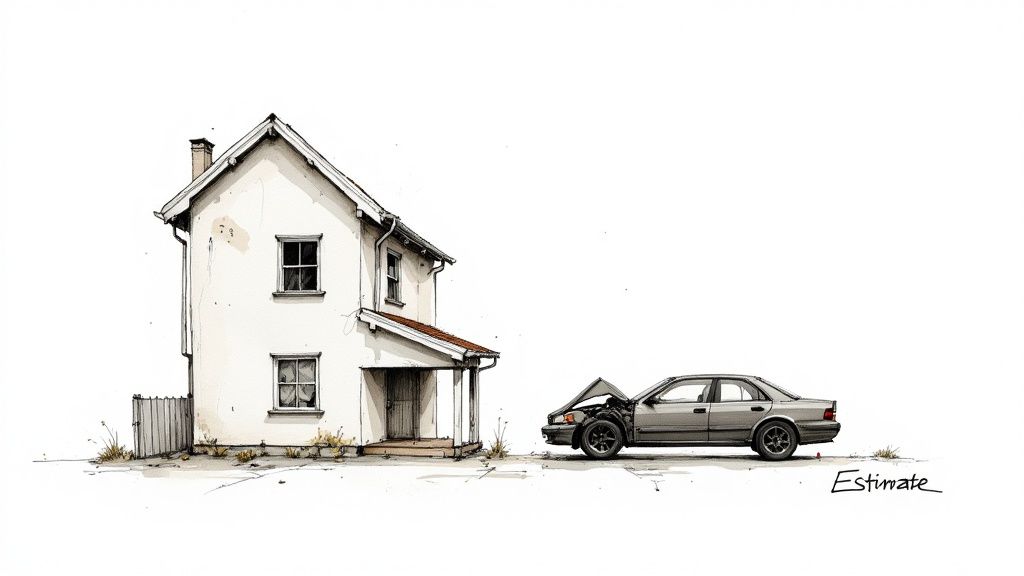
Your client, John Martinez, was involved in a collision on the President George Bush Turnpike in Dallas where the other driver ran a red light. His well-maintained Ford F-150 was declared a total loss by the at-fault driver's insurance. The insurer offered $28,000 for the truck, but comparable vehicles for sale in the Dallas-Fort Worth area are listed for closer to $35,000. John also recently invested in new, high-end tires and a bed cover.
Key Elements for Your Demand Letter
A successful property damage settlement demand letter must be built on a foundation of credible evidence and clear documentation.
- Evidence of Value: Don't just say the offer is too low; prove it. Attach listings for at least three to five comparable vehicles from local dealerships and private sellers. This creates a powerful market-based argument.
- Document Upgrades: Itemize all recent improvements and provide receipts. The cost of new tires, a bed liner, or an upgraded audio system should be added to the vehicle's base value.
- Invoke the Appraisal Clause: Politely reference the appraisal clause in the insurance policy. This provision allows both parties to hire independent appraisers to resolve a valuation dispute and shows the insurer you are serious.
- Demand Incidental Costs: Include a request for reimbursement for sales tax and title transfer fees on a replacement vehicle. These are legitimate parts of the "make whole" doctrine in Texas.
Suggested Demand Language & Justification
When disputing a vehicle's value, your demand must be specific, well-documented, and grounded in market reality.
Sample Language: "Your offer of $28,000 for Mr. Martinez's 2019 Ford F-150 is insufficient as it fails to reflect the vehicle's actual cash value in the Dallas-Fort Worth market. As documented by the attached comparable listings, similar trucks are valued between $34,000 and $36,000. Considering these factors and his recent upgrades, we demand $35,500 to resolve the property damage portion of this claim."
Justification using Verdictly: You can strengthen your position by citing data on how such disputes are resolved, showing the insurer the risk of undervaluing a claim.
Based on Verdictly's analysis of Texas property damage disputes that proceed to litigation, juries frequently award claimants the full replacement cost based on local market comparables, plus associated fees. Ignoring clear market evidence often results in unfavorable outcomes for the insurer.
This approach demonstrates that your demand is not arbitrary but is based on verifiable data and legal precedent. For more on structuring this type of claim, our guide on writing an auto accident demand letter provides further examples.
3. Employment Dispute Settlement Demand Letter
This type of demand letter moves beyond personal injury into the complex realm of workplace conflicts. Whether addressing wrongful termination, discrimination, or wage violations in Texas, this letter serves as a formal precursor to litigation or filing a complaint with an agency like the EEOC. Its purpose is to clearly articulate the legal violations, quantify the resulting damages, and propose a resolution before escalating the matter.

Situational Summary
Your client, a highly-qualified software engineer in Austin's tech sector, was abruptly terminated. The stated reason was "restructuring," yet his position was filled by a younger, less-experienced employee within weeks. Your client has a history of excellent performance reviews and recently made internal complaints about age-related comments from his direct supervisor. This fact pattern suggests a clear case of age discrimination.
Key Elements for Your Demand Letter
A successful employment dispute settlement demand letter example must be built on a foundation of irrefutable evidence and legal precedent.
- Establish a Prima Facie Case: Clearly outline the elements of the claim. For discrimination, this means showing your client is in a protected class, was qualified for the job, suffered an adverse employment action, and was replaced by someone outside the protected class.
- Chronology of Events: Detail the timeline, from positive performance reviews to the discriminatory actions or comments, the internal complaint, and the subsequent termination. This narrative connects the illegal act to the adverse outcome.
- Cite Specific Laws: Reference the specific statutes the employer violated, such as the Age Discrimination in Employment Act (ADEA) and the Texas Commission on Human Rights Act (TCHRA).
- Quantify All Damages: Calculate and itemize all economic losses. This includes back pay (salary from termination to settlement), front pay (projected future lost earnings), and the value of lost benefits like health insurance and 401(k) matching.
Suggested Demand Language & Justification
Your demand must be assertive and grounded in a realistic valuation of the claim, including both economic and non-economic damages.
Sample Language: "Our client’s termination was a clear violation of the ADEA and TCHRA. Given his excellent performance record and the pretextual nature of his dismissal, we demand $185,000 to resolve this matter. This figure includes 12 months of back pay and benefits, projected front pay, and compensation for emotional distress."
Justification using Verdictly: Leverage case data to show the employer the potential cost of litigation, making your pre-suit demand appear reasonable.
Based on Verdictly's analysis of Texas age discrimination cases resulting in termination, the median jury verdict is approximately $250,000, with many exceeding this figure. Our demand of $185,000 represents a significant discount compared to the client’s potential recovery at trial, offering a swift and confidential resolution.
This data-backed approach frames the settlement not as a cost, but as a prudent financial decision for the employer to avoid the higher risk and expense of a public lawsuit. It transforms your settlement demand letter example from a simple request into a compelling business proposition.
4. Medical Malpractice Settlement Demand Letter
Medical malpractice claims are fundamentally different from standard personal injury cases. They require proving that a healthcare provider deviated from the accepted standard of care, directly causing the patient's injury. This type of settlement demand letter example is therefore a highly specialized document, heavily reliant on expert medical testimony and meticulous documentation to establish both negligence and causation.
Situational Summary
Your client, John Smith, a 55-year-old resident of San Antonio, underwent a routine knee replacement surgery. Post-operatively, he developed a severe surgical site infection that was not timely diagnosed or treated by the hospital staff, despite his repeated complaints of fever and extreme pain. This negligence led to sepsis, requiring emergency surgery, a prolonged hospital stay, and permanent damage to his knee joint, severely limiting his mobility.
Key Elements for Your Demand Letter
A medical malpractice demand letter must be an irrefutable, evidence-based argument that leaves little room for the insurer to dispute the core facts of the case.
- Standard of Care & Breach: Clearly define the accepted medical standard of care for post-operative monitoring in a Texas hospital. Use an expert affidavit to explain precisely how the healthcare providers breached this standard by ignoring clear signs of infection.
- Causation: Draw a direct, undeniable line from the breach of care to the resulting harm. The letter must articulate that but for the delayed diagnosis, Mr. Smith would not have developed sepsis or suffered permanent joint damage.
- Life Care Plan: For injuries with long-term consequences, include a comprehensive life care plan developed by a medical economist. This details future medical costs, from physical therapy and assistive devices to potential future surgeries, translating future needs into a present-day dollar amount.
- Damages: Meticulously itemize all damages. This includes economic damages (medical bills, lost wages, future care costs) and non-economic damages, noting the severe physical pain, emotional distress, and loss of enjoyment of life caused by the provider's negligence.
Suggested Demand Language & Justification
The demand must be substantial, reflecting the profound impact of the malpractice and the strength of your expert-supported case.
Sample Language: "The failure to timely diagnose and treat Mr. Smith's post-operative infection represents a clear deviation from the established standard of care. This breach directly caused a cascade of catastrophic and life-altering injuries, including sepsis and permanent disability. Consequently, we demand $1,250,000 to resolve this claim."
Justification using Verdictly: Your justification must reference comparable verdicts to show the demand is reasonable within the Texas legal landscape.
According to Verdictly's analysis of Texas medical malpractice verdicts involving hospital-acquired infections leading to sepsis and permanent injury, jury awards frequently exceed $1,000,000. Our demand is aligned with these established verdict ranges, reflecting Mr. Smith's significant economic losses and the profound, permanent nature of his non-economic damages.
This data-driven approach frames your demand not as an emotional plea but as a calculated figure based on precedented jury outcomes, compelling the malpractice insurer to negotiate seriously.
5. Contractual Breach Settlement Demand Letter
While personal injury claims are common, business disputes often revolve around broken promises and unmet obligations. A contractual breach settlement demand letter is a formal, pre-litigation tool used when one party fails to uphold its end of a legally binding agreement. This letter precisely outlines the breach, quantifies the resulting financial harm, and proposes a resolution to avoid costly litigation. It is a critical first step in enforcing commercial rights.
Situational Summary
Your client, a Dallas-based general contractor, hired a subcontractor to complete the electrical work for a commercial build-out with a firm completion date. The subcontractor failed to meet the deadline, causing a two-month delay. This delay triggered penalty clauses in the general contractor's primary contract with the property owner and forced the hiring of a more expensive replacement electrician to finish the job.
Key Elements for Your Demand Letter
A successful contractual breach demand letter must be built on a foundation of clear evidence and precise calculations.
- Identify the Breach: Pinpoint the exact contract articles and clauses the subcontractor violated. This could include clauses related to project timelines, performance standards, or staffing requirements.
- Establish a Clear Timeline: Create a chronological history of events. Document the original deadline, notices of delay provided to the subcontractor, their responses (or lack thereof), and the date the breach officially occurred.
- Calculate and Document Damages: This is the most critical component. Itemize every dollar of loss, including the penalty fees paid to the property owner, the cost difference for the replacement electrician, and any other direct financial impact. Attach invoices, revised contracts, and bank statements as evidence.
- Reference Contractual Remedies: Review the original contract for clauses specifying remedies for a breach, such as liquidated damages, dispute resolution procedures, or entitlement to attorney's fees.
Suggested Demand Language & Justification
Your demand should be firm, professional, and grounded entirely in the contract and documented financial losses.
Sample Language: "Your failure to complete the electrical scope by the contractually mandated date of March 1st constitutes a material breach of Article 4.1 of our agreement. As a direct result, our firm incurred $15,000 in contractual penalties and an additional $7,500 in costs to hire a replacement firm. Accordingly, we demand payment of $22,500 to resolve this matter."
Justification using Precedent: While business dispute data is more private, you can still anchor your demand by referencing standard industry practices and the clear language of the contract.
The damages sought are not speculative; they are a direct and foreseeable consequence of the breach, calculated precisely from the penalties we were forced to pay and the increased costs required to mitigate further delays. This demand strictly adheres to the remedies for breach outlined in Article 9.2 of our signed agreement, which makes your firm liable for all consequential damages resulting from non-performance.
This approach demonstrates that your demand is not an arbitrary figure but a calculated sum based on the legal agreement between the parties. It presents a strong, evidence-based position that will be difficult for the other party to dispute.
6. Insurance Claim Denial Appeal Settlement Demand Letter
This is a specialized type of settlement demand letter example used not to initiate a claim, but to challenge an insurer's decision to deny one. When a carrier like State Farm or Allstate denies a claim based on policy exclusions, alleged pre-existing conditions, or procedural missteps, a meticulously crafted appeal letter is the first step in reversing the decision. It serves as a formal rebuttal to the denial, laying the groundwork for a potential bad faith claim if the insurer fails to reconsider.
Situational Summary
Your client, a Dallas homeowner, filed a claim for significant water damage after a pipe burst behind a wall. The insurance company denied the claim, citing a general "water damage" exclusion in the policy. However, your client had purchased a specific "water backup and sump overflow" endorsement, which should cover this exact scenario. The denial appears to be based on an incomplete or incorrect reading of the full policy.
Key Elements for Your Demand Letter
Your appeal letter must dismantle the insurer's justification for denial, point by point, using their own policy language against them.
- Cite Specific Policy Language: Directly quote the relevant sections from the policy and the specific endorsement that provides coverage. Contrast this with the exclusion they cited in their denial letter.
- Document Bad Faith Indicators: Detail any unreasonable delays in the investigation, failure to communicate, or misrepresentation of policy terms. This builds pressure by highlighting potential violations of the Texas Insurance Code.
- Rebuttal of Denial Basis: Clearly state, "The denial is improper because..." and then provide a point-by-point explanation of why their reasoning is flawed. Address their exclusion directly and explain why the endorsement supersedes it for this specific loss.
- Formal Request for Reconsideration: Explicitly demand that the insurer reopen the claim, conduct a fair review in light of the policy language cited, and issue payment for the covered damages.
Suggested Demand Language & Justification
The goal is to be firm, factual, and legally precise, leaving no room for misinterpretation.
Sample Language: "We are in receipt of your denial letter dated [Date], which incorrectly applies the general water damage exclusion (Section I - Exclusions, 1.c.). This denial overlooks the superseding coverage provided by the Water Backup and Sump Pump Overflow Endorsement (Form H-1234) attached to the policy. Pursuant to this endorsement, the damages are clearly covered. We demand an immediate reversal of this improper denial and full payment of the claim."
Justification using Verdictly: While a direct jury verdict for a similar policy dispute might be hard to find, you can reference bad faith case data to show the insurer the potential financial risk of their position.
Data from Verdictly shows that Texas juries have awarded significant punitive damages in cases where insurers have been found to act in bad faith by unreasonably denying valid claims. The potential exposure for refusing to honor the explicit terms of the purchased endorsement far exceeds the original claim value.
This approach transforms the letter from a simple request into a formal notice of the legal and financial consequences of continued non-compliance. You can find more detail on structuring these arguments in our full guide to settlement demand letters.
Comparison of 6 Settlement Demand Letter Types
| Document | Complexity 🔄 | Resource requirements ⚡ | Expected outcomes ⭐📊 | Ideal use cases 💡 | Key advantages ⭐ |
|---|---|---|---|---|---|
| Personal Injury Settlement Demand Letter | Moderate — clear structure but requires medical causation and damage calc 🔄 | Medical records, bills, photos, moderate expert input; attorney optional ⚡ | Often settles pre-litigation; faster relief but insurers may counter-offer ⭐⭐⭐ 📊 | Auto accidents, slip‑and‑fall, workplace injuries 💡 | Organizes evidence, creates negotiation paper trail, reduces court costs ⭐ |
| Property Damage Settlement Demand Letter | Low–Moderate — objective valuation focused process 🔄 | Photographs, 2–3 repair estimates, receipts; appraisals when needed ⚡ | Frequently resolved quickly with repair/replacement payment ⭐⭐📊 | Homeowner claims, vehicle collision, landlord‑tenant damage 💡 | Clear monetary figures; easier to defend valuation; quick insurer response ⭐ |
| Employment Dispute Settlement Demand Letter | High — legal citations, sensitive facts, potential confidentiality issues 🔄 | Workplace records, emails, performance reviews, legal counsel; witness statements ⚡ | May yield reinstatement/severance or avoid litigation; employer may ignore ⭐⭐📊 | Wrongful termination, discrimination, wage disputes, harassment claims 💡 | Preserves employment options, demonstrates good‑faith before charges, supports mediation ⭐ |
| Medical Malpractice Settlement Demand Letter | Very high — requires expert causation and detailed medical proof 🔄 | Full medical records, expert physician affidavits, life‑care plans, medical economists ⚡ | Potentially large settlements but long pre‑litigation review and strong defenses ⭐⭐📊 | Surgical errors, misdiagnosis, anesthesia or hospital‑acquired injuries 💡 | High policy limits, early credibility with experts, avoids traumatic public trial ⭐ |
| Contractual Breach Settlement Demand Letter | Moderate–High — contract interpretation and damages analysis 🔄 | Complete contract, financial records, communications, possible expert accountants ⚡ | Financial remedies, potential arbitration or preservation of business relationship ⭐⭐⭐📊 | Construction delays, vendor non‑performance, licensing/escrow disputes 💡 | Objective standards from contract terms; liquidated damages/arbitration can expedite resolution ⭐ |
| Insurance Claim Denial Appeal Settlement Demand Letter | High — policy law analysis and regulatory references needed 🔄 | Full policy, point‑by‑point rebuttal, regulatory research, possible experts; documentation of communications ⚡ | Coverage reversals or regulatory action possible; may still lead to litigation ⭐⭐📊 | Denied homeowner, life, disability, flood, or business‑interruption claims 💡 | Leverages policy language and regulator oversight; bad‑faith exposure increases settlement leverage ⭐ |
Transform Your Demand from a Request into a Roadmap for Resolution
As the diverse scenarios explored in this article illustrate, a powerful settlement demand letter is far more than a simple request for money. It is a meticulously constructed legal narrative, a strategic document that builds a compelling case for your valuation, piece by piece. It's a proactive demonstration of your preparedness and a clear signal to the insurance adjuster that your claim is grounded in facts, not feelings.
The examples provided, from the rear-end collision with straightforward liability to the complex commercial vehicle accident with disputed fault, share a common, critical thread: objective justification. Simply stating your injuries and demanding a large sum is an invitation for a lowball offer. The key to unlocking a fair settlement is to show, not just tell, the adjuster why your number is reasonable and defensible.
From Subjective to Strategic: Key Takeaways
Mastering the art of the demand letter means shifting your approach from a subjective plea to a strategic presentation. The most effective demands accomplish three core objectives:
- Establish Unassailable Liability: Clearly and concisely present the evidence that proves the other party’s fault. This includes police reports, witness statements, and citations.
- Document Damages Comprehensively: Go beyond a simple list of medical bills. Weave a narrative that details the full human cost of the injury, including pain and suffering, lost enjoyment of life, and future medical needs, all supported by documentation.
- Justify Your Valuation with Data: This is the game-changer. By incorporating real-world, localized settlement and verdict data, you anchor your demand in precedent. Referencing outcomes from similar cases in the same jurisdiction, such as Dallas County or Tarrant County, transforms your valuation from an opinion into an evidence-based projection of what a jury might award.
This data-driven approach is what elevates a standard settlement demand letter example into a tactical tool. It preemptively counters the adjuster's arguments and frames the negotiation on your terms, showing them that going to trial presents a significant and quantifiable risk for their side.
Your Next Steps: Building a Bulletproof Demand
Moving forward, remember that your demand letter is the cornerstone of your pre-litigation strategy. It sets the tone for all future negotiations. The ultimate goal is to present the insurance carrier with a clear choice: resolve the claim for a fair and well-supported figure now, or face a well-prepared plaintiff who has the evidence and data to win in court. By meticulously crafting your arguments and substantiating your valuation, you create a clear roadmap for resolution that the opposing side cannot ignore.
Ready to replace guesswork with data and build a demand letter backed by real Texas case outcomes? Verdictly provides the localized settlement and verdict data you need to justify your claim's value with confidence. Explore Verdictly to see how data-driven insights can transform your negotiation strategy.
Related Posts
A Guide to Medical Records Reviews in Personal Injury Claims
Learn how medical records reviews can strengthen your Texas injury claim. This guide explains the process, key findings, and how to build a stronger case.
What Is Mediation in a Lawsuit? Learn what is mediation in lawsuit
Understand what is mediation in lawsuit and how this process helps Texans resolve motor vehicle accident cases without trial.