
Do Texts Hold Up in Court? A Guide to Text Evidence (do texts hold up in court)
Wondering if do texts hold up in court? Learn how text messages become admissible evidence in injury cases, from authentication to courtroom strategy.
Yes, text messages can absolutely hold up in court, and in a Texas injury case, they can be a make-or-break piece of evidence. But just having the text on your phone isn't enough. It has to meet specific legal standards before a judge will even let a jury see it. Think of it like this: you might have a key witness, but they still have to take the stand and swear an oath before their testimony counts.
Why Your Texts Can Make or Break Your Case
Picture this: you’re at the scene of a car wreck, and minutes later, the other driver texts you, “So sorry, I was looking at my phone and didn’t see you.” That message is a goldmine for your injury claim. It's a direct admission of fault that can slice right through the typical denials and deflections you’ll get from their insurance company.
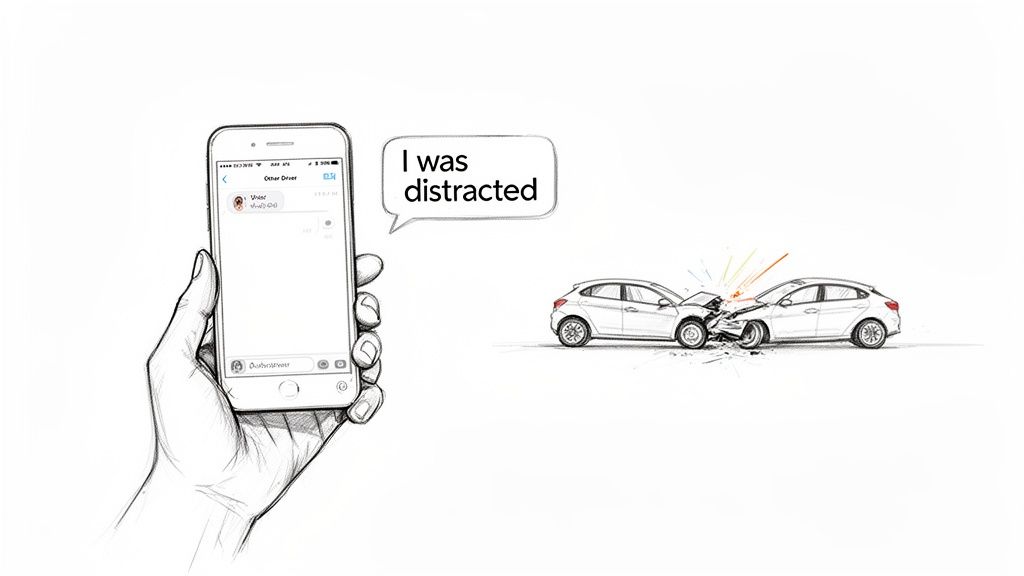
But here's the catch: the power of that text isn't automatic. For it to be legally effective, it has to clear several hurdles. My goal here is to walk you through exactly what those hurdles are and how to clear them, so a crucial piece of evidence doesn’t get thrown out on a technicality.
Understanding the Legal Hurdles
To get a text message admitted into evidence, we have to navigate a few core legal principles. These aren't just arbitrary rules; they're safeguards designed to make sure the evidence presented in court is fair and reliable. We'll be digging into these three main challenges:
- Authentication: How do you prove the text is what you say it is and was actually sent by the person you claim sent it?
- Hearsay: Why are most out-of-court statements barred from evidence, and more importantly, what are the key exceptions that let your texts in?
- Preservation: What’s the right way—and the wrong way—to save your text messages to ensure they’re considered credible?
For instance, a lot of people think a simple screenshot will do the trick. The reality is, screenshots can be a weak form of proof and are often challenged. In fact, some studies show that roughly 15% of disputed texts in civil suits are manipulated screenshots. That’s a huge problem. This is why forensic extraction, which can authenticate messages with 98% reliability, is the gold standard in a contested case.
The impact of this kind of evidence can be massive. In many Texas motor vehicle cases, text messages that prove distracted driving or other forms of negligence have been shown to increase settlement awards by an average of 25-40%.
The table below breaks down these core challenges into a quick-glance summary.
Key Hurdles for Using Texts as Evidence
This table summarizes the core legal tests a text message must pass to be admissible in court, giving you a quick reference for the concepts explained in this guide.
| Legal Requirement | What It Means for Your Texts | Why It Matters for Your Case |
|---|---|---|
| Authentication | You must prove the text is real, unaltered, and came from the person you claim it did. | Without proof of origin, the other side can claim the text is fake or from someone else, making it worthless as evidence. |
| Hearsay | The text must fall under a legal exception to the rule that normally bars out-of-court statements. | If the text is classified as inadmissible hearsay, a judge won't allow the jury to see it, no matter how helpful it is. |
| Preservation | The message must be preserved in its original form, with metadata intact. | Deleting or altering texts (even accidentally) can lead to penalties for "spoliation" and weaken your credibility. |
Understanding these rules is the first step toward protecting this critical evidence. When you know its value and what it takes to get it in front of a jury, you’re in a much stronger position for negotiations or trial. You can find more details on how these rules apply to different kinds of digital communications by exploring how digital evidence is used in court.
Proving Your Text Message Is Authentic
Before a text message can ever influence a judge or jury, it has to clear a critical first hurdle: authentication. Think of it like a detective verifying a crucial piece of evidence at a crime scene. You have to prove the message is what you say it is and—most importantly—that it actually came from the person you claim sent it.
Without this proof, even a text with a crystal-clear admission of fault is useless. It’s just a digital ghost the court can't legally consider. It's not enough to just wave a screenshot in front of a judge; the other side's lawyer will immediately pounce, arguing it could be doctored, fake, or sent by someone else. Your job is to build a case for its legitimacy that leaves no room for reasonable doubt.
Common Methods for Authenticating Texts
So, how do you actually prove a text is the real deal? The Texas Rules of Evidence lay out several ways to do this, and you don’t need to be a tech genius. More often than not, it comes down to common sense and straightforward testimony.
Here are the most reliable methods used in Texas courts:
- Witness Testimony: The most direct route. Someone with firsthand knowledge—like the person who sent or received the text—simply testifies under oath. Even a third person who saw the message being sent can do the trick.
- Distinctive Characteristics: Does the message have a unique "flavor" that points to the sender? Think about their specific way of talking, inside jokes, nicknames, or references to things only they would know. These details act like a conversational fingerprint.
- Reply Authentication: This one is pretty intuitive. If you text a number you know belongs to someone and get a response that makes sense in the context of your message, the court will generally assume the owner of that phone sent the reply. It’s often called the "reply doctrine."
These methods aren't mutually exclusive. In fact, they often work together to paint a convincing picture for the court that the message is both genuine and from the right person.
The Power of Technical Data
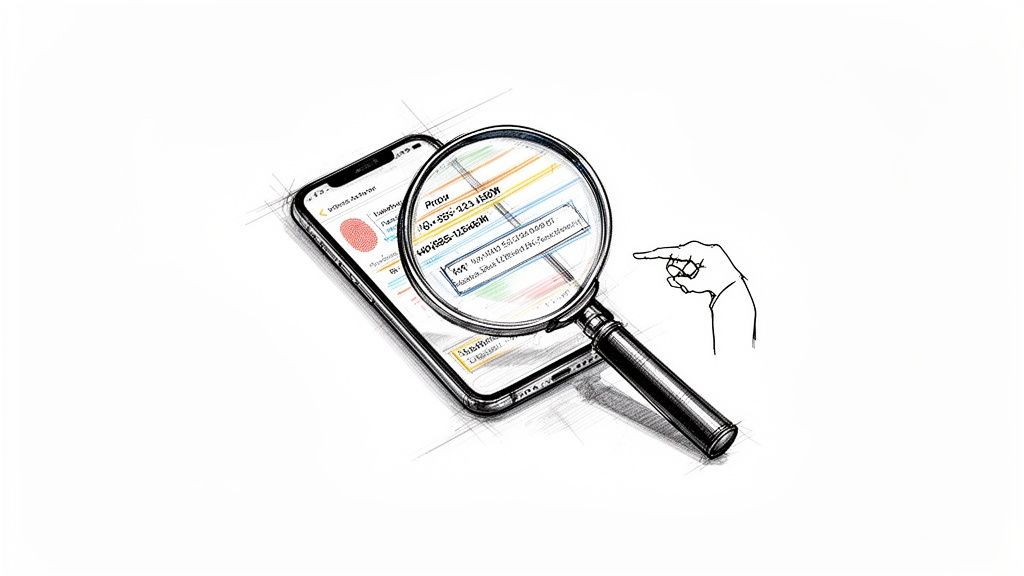
While testimony from a witness is good, hard technical data is even better. It provides a much stronger foundation for your evidence. Every text message you send carries a hidden trail of information known as metadata. This digital footprint contains details that are incredibly difficult to fake.
The landmark case United States v. Vayner was a real wake-up call, demonstrating how a simple screenshot without any "confirming circumstances" could easily be thrown out. Today, thanks to better technology like metadata extraction, authentication success rates have climbed to an impressive 88% in U.S. federal cases.
That famous 2014 case, United States v. Vayner, made waves when a Facebook screenshot was rejected because there was no other evidence tying it directly to the defendant. Since then, using metadata to back up digital evidence has become standard procedure. In Texas car wreck cases, a text admitting "I was speeding, sorry" can be a game-changer. Public records show these kinds of messages have influenced outcomes in 34% of DFW rear-end collision lawsuits, often leading to significantly higher settlement awards.
When the stakes are high and the other side is fiercely disputing the text's authenticity, your attorney might bring in a digital forensics expert. These specialists can pull data directly from the phone itself, creating a pristine, unaltered record that's virtually impossible to challenge. The expert can then explain their findings in court, lending an authoritative, unbiased voice to your evidence. For more on how this works, take a look at our guide on what is expert witness testimony.
Getting Past the Hearsay Rule: The Real Test for Your Texts
Okay, so you’ve proven the text message is authentic. Now comes the next, and often trickier, hurdle: a rule of evidence called hearsay.
The concept sounds intimidating, but it’s pretty simple at its core. Hearsay is any statement made outside of court that a lawyer tries to use in court to prove a fact. The court system generally wants live testimony—witnesses on the stand, under oath, who can be cross-examined. An out-of-court statement, like a text, doesn't allow for that.
Let’s say a friend witnessed your accident and texted you, "That other car totally ran the red light." If your lawyer tries to show that text to the jury to prove the other driver ran the light, the defense will immediately object. Why? Because the court wants to hear from your friend directly, not just read their text. That text is classic hearsay.
But don't worry, the story doesn't end there. The hearsay rule is riddled with exceptions, and that’s exactly how most text messages make their way into evidence.
The Most Common Exception: Admission by a Party-Opponent
This is the big one, especially in injury cases. It’s called an "admission by a party-opponent," and it’s a game-changer. Simply put, any statement the other driver (the "opposing party") made can be used against them. Under the rules in Texas and federal court, these statements aren't even technically considered hearsay at all.
Let's go back to that car crash. Imagine the at-fault driver sends you a text a few minutes after the collision:
"So sorry about that. I was texting my boss and didn't even see the light change. Hope you're okay."
This text is pure gold. It’s the other driver’s own words, and you are offering it to prove they were at fault. Because it's their own admission against their own interest, the court sees it as reliable and lets it in. This single exception is what makes a text admitting fault one of the most powerful pieces of evidence you can have.
Other Important Ways Texts Can Get In
While the admission rule is the star of the show, other exceptions can also open the door for text messages. These often focus on someone's immediate reaction or state of mind at the time of an event.
Here are a few that often come into play:
- Excited Utterance: This is a statement someone blurts out while they are still under the stress of a startling event. A text fired off moments after a wreck, like "OMG I just hit someone I can't believe it!!", would likely qualify. The idea is that the shock of the moment prevents them from having time to think up a lie.
- Present Sense Impression: This covers a statement that describes something as it’s happening or immediately after. If a passenger in the other car texted a friend, "Our driver is going way too fast," just seconds before the impact, that message could potentially be admitted.
- Then-Existing State of Mind: This exception allows statements that reveal the sender's plan, intent, or emotional state. A text like, "I'm so angry I'm going to speed all the way there," could be used to show a reckless mindset that contributed to a crash.
Texting is just a part of modern life. With an estimated 3.51 billion users expected globally by 2025, it’s no surprise messages are constantly popping up in legal cases. While the hearsay rule initially blocks around 18% of texts submitted as evidence, powerful exceptions like party admissions ultimately allow about 70% of those to be admitted.
The impact is real. In Texas motor vehicle cases, texts swayed jury verdicts in 29% of Dallas-Fort Worth trials between 2020 and 2025. And when those fault-proving messages were presented, injury claims saw an average payout increase of 35%. You can learn more by reading the full analysis of how texts are used as evidence in court.
Knowing these exceptions is what turns a simple text from inadmissible chatter into the kind of hard evidence that can make or break your case.
Why Metadata Is Your Evidence's Best Friend
The words you see on the screen are just the tip of the iceberg. Every text message has a hidden layer of data—a digital fingerprint called metadata. In a legal fight, this information is often what makes your text message evidence compelling and, frankly, undeniable.
Think of it like this: a screenshot is just a picture of a letter. It shows the words, sure, but it's easy to fake and misses all the crucial context. Metadata, on the other hand, is the original letter still in its sealed envelope, complete with the postmark, return address, and official stamp. It tells the whole, verifiable story.
This "digital postmark" contains details that are nearly impossible to fake and directly prove a text’s authenticity. A forensic expert can pull this data straight from the phone, creating a complete and trustworthy record for the court.
What's Hiding in the Metadata?
The metadata attached to a text message provides a rich backstory that a simple screenshot just can't capture. This is the information your legal team will dig into to build a rock-solid foundation for your evidence.
Here’s what they’re looking for:
- Timestamps: We're not just talking about the time you read the message. Metadata shows the exact moment it was sent, delivered, and read, often down to the millisecond.
- Sender and Receiver Info: This includes the specific phone numbers tied to the conversation, confirming exactly who sent what to whom.
- Device Details: The data can include information about the specific phones used, like the model and unique identifiers, which helps tie the message directly to a person.
- Message Type: The metadata will specify if the message was a standard SMS text or an MMS that included a photo or video.
This is why getting a forensic download of a phone is the gold standard. It captures all this rich data, creating a verifiable chain of custody that’s far more persuasive than a simple screenshot could ever be.
Originals vs. Screenshots: The "Best Evidence Rule"
Courts have a long-standing principle called the Best Evidence Rule. At its core, the rule is simple: if you want to prove what a document says, you need to produce the original if you can. A copy is usually only allowed if the original has been lost or destroyed.
When it comes to digital evidence, a screenshot is always considered a secondary copy. A forensic download that captures the original message and its metadata is far closer to the "original" and much harder for the other side to claim is fake or has been altered.
While taking a screenshot is a good first step to preserve a message, it’s a weak link in court. It’s surprisingly easy for someone to edit the text in a screenshot or even use an app to create an entirely fake conversation. A sharp lawyer can easily attack a screenshot as unreliable, and without the metadata to back it up, you might be stuck.
This is exactly why your attorney will insist on getting access to the actual phone where the messages are stored. It’s not about distrusting you or your screenshots; it's about securing the strongest, most defensible evidence possible. By getting a forensic copy, they preserve the metadata that makes the text messages hold up under scrutiny, turning a simple claim into powerful, verifiable proof.
How to Properly Preserve Your Text Message Evidence
That text message where the other driver admits fault is gold for your injury claim, but it's completely worthless if it vanishes. Protecting that evidence isn’t just a good idea—it’s a legal necessity. The second you realize a message could be important, the clock starts on your duty to preserve it.
Your first move, right away, is to take clear, comprehensive screenshots. Don't just snap a picture of the one key message. You need the whole story. Scroll up and down to capture the full conversational context leading up to and following the admission. Crucially, make sure every screenshot clearly shows the sender's name or number at the top and the full date and timestamps on every single message. This creates an immediate, easy-to-access record.
But don't stop there. Screenshots are your first line of defense, but they can be challenged in court. Think of them as a starting point, not the final word.
Going Beyond Basic Screenshots
To really solidify your evidence, you need to create more durable backups. Modern smartphones make this easy, and these methods create a much more complete and verifiable copy of your data than a simple picture. These backups are tougher for the other side to dispute and can be a lifesaver if a forensic expert needs to get involved.
Take these next steps as soon as you can:
- Back Up to the Cloud: Whether you have an iPhone or an Android, turn on automatic cloud backups. Services like iCloud and Google Drive will save your entire message history, creating an off-site copy that’s safe even if your phone gets lost, smashed, or stolen.
- Use Third-Party Software: There are plenty of trusted apps out there designed to download and export text conversations from your phone straight to a computer. These tools often save the messages in formats that preserve crucial metadata, which is the digital fingerprint that helps prove the texts are authentic.
This three-tiered approach—screenshots, cloud backups, and exports—builds a strong foundation for your evidence. The process moves from a simple snapshot to a forensically sound record that can stand up to scrutiny.
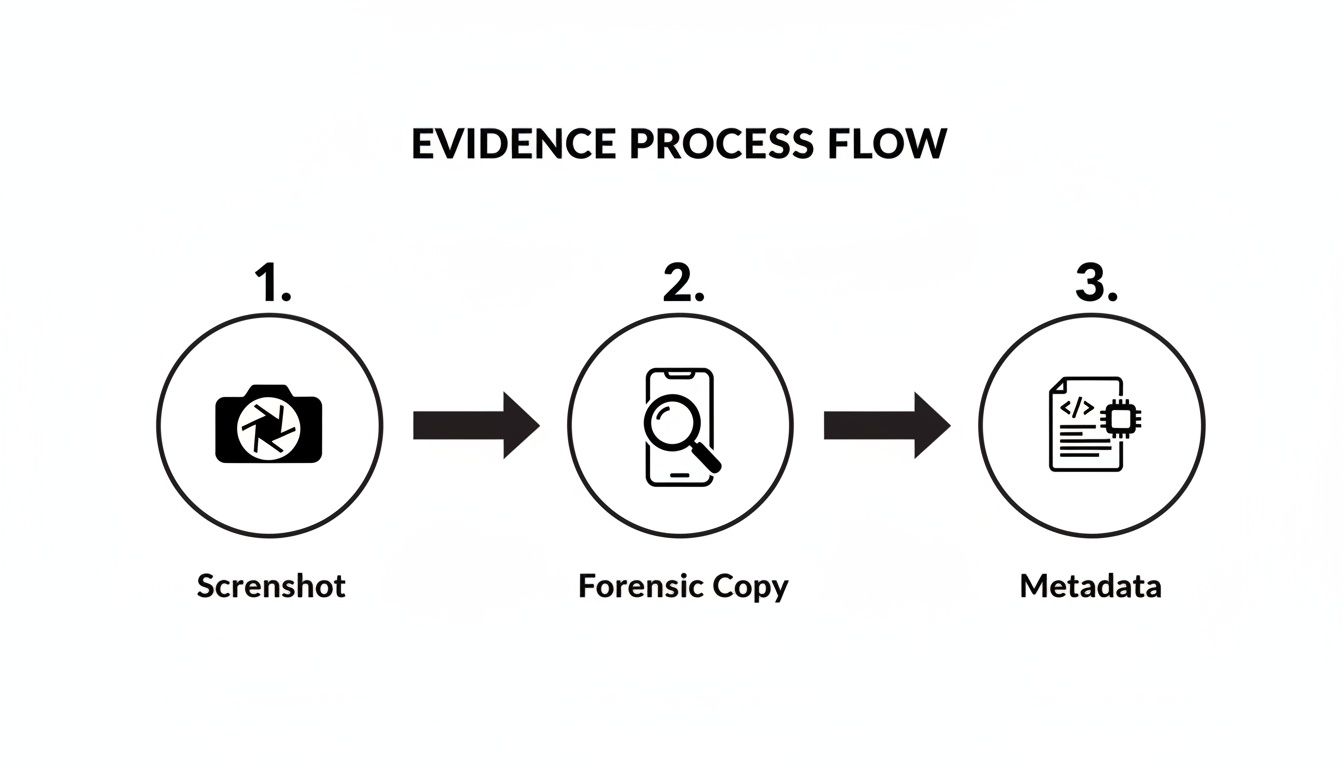
As the chart shows, each step builds on the last, taking you from a basic visual record to a complete digital file that’s much harder for an opposing lawyer to attack.
The Golden Rule: Never Delete Anything
This is the most critical rule of all: do not delete the original text messages from your phone. Ever. Even with screenshots and backups, the original conversation living on the original device is the ultimate piece of evidence. Deleting it can have devastating consequences for your case.
The legal term for destroying evidence is "spoliation." If a judge finds you intentionally got rid of relevant messages, the penalties can be severe. The court might instruct the jury to assume the deleted texts would have hurt your case, or in the worst-case scenario, your entire claim could be thrown out.
Follow these immediate steps to secure your text message evidence after an accident and prevent it from being lost or challenged.
Text Message Preservation Checklist
| Action Step | Why It's Important | Pro Tip |
|---|---|---|
| Take Full Screenshots | Creates an immediate visual record that captures context, sender ID, and timestamps. | Don't crop anything out. Make sure the phone's status bar (time, battery) is visible to add another layer of authenticity. |
| Enable Cloud Backups | Secures a complete copy of your message history off-device, protecting it from phone loss or damage. | Check your settings to ensure backups are running automatically and frequently. Don't just assume it's on. |
| Do NOT Delete the Original | The original message on the device is the best evidence. Deleting it is called spoliation and can sink your case. | Move the conversation to an "archive" folder if your app allows it. This gets it out of sight without deleting it. |
| Inform Your Attorney | Your lawyer needs to know about this evidence immediately to take formal steps to preserve it. | Tell your attorney the exact date and time of the messages so they can draft a preservation letter to the other party. |
Properly preserving evidence is a fundamental part of the legal process, and it starts long before you ever see a courtroom. You will almost certainly be asked about these messages under oath. To get a better handle on what that’s like, review our guide on how to prepare for a deposition.
By taking these careful steps, you ensure this powerful evidence remains intact and ready to support your fight for fair compensation.
Using Texts to Strengthen Your Texas Injury Claim
So, how does all this legal talk about authentication, hearsay, and preservation actually help you win your Texas injury claim? It's simple, really. A text message that’s been properly saved and deemed admissible in court is one of the most powerful pieces of evidence you can have.
Suddenly, your case isn't just a "he said, she said" argument. It's backed by concrete proof.
Imagine sitting down with an insurance adjuster. Their whole job is to find holes in your story and pay out as little as possible. But what happens when you show them a text from their own client that reads, "So sorry, I was looking at my GPS, it was my fault"? Their entire game plan crumbles. That one message seals up many of the holes they were planning to poke in your claim, making it incredibly difficult for them to argue you were at fault.
This kind of evidence is a massive lever. It puts immense pressure on the insurance company to offer a fair settlement, and to do it quickly. They know that if your case ends up in front of a jury, that text message will be front and center. That’s a gamble they rarely want to take, often leading them to offer a much better settlement to avoid a bigger loss in court.
Turning Texts into Tangible Value
In any personal injury case, the strength of your evidence directly impacts the value of your claim. A single text can significantly boost that value by proving the most important parts of your case without leaving any room for argument. It's no longer just your version of events against the other driver's—you have their own words fighting for you.
Think about these common situations in Texas car wrecks:
- Proving Distracted Driving: A text admitting they were on their phone is a slam dunk. It's a direct confession of negligence and a violation of Texas law, leaving their insurance company with very little room to contest liability.
- Locking Down a Timeline: Timestamps on messages can show that an admission of fault was sent just minutes after the crash. This makes it a highly credible "excited utterance" in the eyes of the court.
- Shutting Down Changing Stories: It’s not uncommon for an at-fault driver to change their story when the police arrive. If their initial text to you says one thing, but the official report says another, that message becomes powerful evidence to destroy their credibility.
This is exactly why having a sharp legal team in your corner is so important. A seasoned attorney knows precisely how to use this evidence in a demand letter to the insurance company to get the maximum impact. If you're weighing your options, learning more about hiring a personal injury attorney can show you how they build a winning strategy around crucial evidence like this.
A text message isn't just another piece of evidence; it can be the cornerstone of your entire negotiation strategy. It offers undeniable proof of who was at fault, which is the bedrock of any successful injury settlement.
In the end, whether your case settles or goes to trial, that text message is your truth. It backs up your story, dismantles the other side's arguments, and gives you a serious upper hand. It completely shifts the balance of power, forcing them to face their own client’s words and pay you what you’re rightfully owed.
Frequently Asked Questions About Text Message Evidence
Even after getting the basics down, you probably still have some specific questions about using text messages in your Texas injury case. Let's walk through a few of the most common ones that pop up once a case gets rolling.
Getting a handle on these details can make a real difference in how confident you feel about the evidence you’ve gathered. The more you understand, the better you can work with your attorney and navigate the road ahead.
What If the Other Person Deletes the Texts?
This is a huge fear for many people, but it’s often not the dead end you might think. For one, the messages are still on your phone, and you should save them right away. But more importantly, if the other person intentionally deletes messages after they’ve been notified to save them, they've just committed what’s called spoliation of evidence.
Courts do not take this lightly. A judge has the power to penalize the person who deleted the evidence, and those penalties can be severe.
- A judge might tell the jury to assume the deleted messages would have hurt that person's case.
- They could be ordered to pay your attorney’s fees for the time wasted on this issue.
- In really blatant situations, a judge could even issue a default judgment against them on liability.
To prevent this, your lawyer will send a formal “preservation letter” at the start of your case. This letter puts the other party on legal notice, making it their responsibility to preserve every relevant text, email, or other communication.
Can My Old or Deleted Texts Be Used Against Me?
Yes, absolutely. The rules cut both ways. If you sent a text that even hints at partial fault—something like, "So sorry, I was distracted for a second"—the defense lawyers will want it. This is a standard part of the legal process known as discovery, where both sides have to show their cards.
This is exactly why you must never delete messages related to your accident, even if you’re worried they could make you look bad. The act of deleting evidence is almost always more damaging than whatever the message said. The best policy is to be completely honest with your attorney about all your communications. That’s the only way they can prepare for what the other side might throw at you.
Your legal team needs the full story—good, bad, and ugly—to build a solid case and anticipate the other side's moves. Trying to hide a "bad" text just creates a ticking time bomb that could blow up your case later.
Do I Have to Hand Over My Entire Phone?
Usually, no. You’re only obligated to turn over evidence that is directly relevant to the case. A court won’t typically order a full "phone dump" unless there's a compelling reason to suspect someone is hiding crucial information. Your attorney will argue forcefully to protect your privacy and limit what the other side gets to see.
Typically, your lawyer will review the relevant message threads and produce only those specific texts. If a more technical approach is needed, a neutral, third-party forensic expert is often hired. They can extract only the data from an agreed-upon timeframe or conversation, making sure the rest of your personal life stays private.
Understanding the real-world value of evidence is the first step toward a fair outcome. Verdictly provides access to a searchable database of real Texas motor vehicle case verdicts and settlements, helping you see what similar cases are worth. Empower your negotiations by exploring the data at Verdictly.