
Your Guide to a Rear End Collision Settlement
Understand your rear end collision settlement. Learn how Texas law impacts your case, how compensation is calculated, and when you need an attorney.
When you're hit from behind, the aftermath can be overwhelming. A rear-end collision settlement is the financial resolution that helps you put the pieces back together, with typical personal injury claims ranging from $10,000 to over $75,000.
Think of it as a comprehensive financial agreement—a way to cover all your accident-related costs without enduring a long, drawn-out court battle.
What a Rear End Collision Settlement Includes
After the jolt of a rear-end crash, your first priority is getting better. A settlement is what makes that financial recovery possible, but what exactly does it cover? It's not just a single check; it's a carefully calculated package meant to restore what you've lost.
This agreement, negotiated between you and the at-fault driver's insurance company, is built by piecing together every single cost and loss you've faced. The goal is to make you "whole" again, at least in a financial sense. Each part of the settlement addresses a specific way the crash has impacted your life, from the obvious repair bills to the more personal emotional toll.
Key Components of a Settlement
So, what are the building blocks of a fair settlement? They fall into two main categories: economic damages (the tangible, out-of-pocket costs) and non-economic damages (the intangible, personal losses).
The table below breaks down the most common components that are negotiated as part of a settlement.
Key Components of a Rear End Collision Settlement
| Damage Category | What It Covers |
|---|---|
| Medical Expenses | Covers everything from the ambulance ride and ER visit to ongoing physical therapy, surgeries, medications, and future medical care. |
| Lost Wages | Reimburses you for the income you lost while out of work recovering from your injuries. It can also cover lost future earning ability. |
| Property Damage | Pays for the full cost to repair your vehicle. If your car is a total loss, it covers the fair market value at the time of the crash. |
| Pain and Suffering | This compensates for the physical pain, emotional distress, anxiety, and general loss of enjoyment of life caused by the accident. |
Understanding what you're owed is the first step toward getting what you deserve.
Rear-end collisions are startlingly common, accounting for 20% to 30% of all car accidents. The severity of injuries from these crashes can range from minor whiplash to serious spinal trauma, which directly impacts the final settlement amount.
Learning how each of these components is valued is crucial for building a strong claim. For a more detailed look, our complete guide to car accident settlements breaks down the entire process.
How Texas Calculates Your Settlement Value
https://www.youtube.com/embed/x_3vlYlddyU
After you’ve been in a rear-end collision, the most pressing question is almost always the same: "How much is my claim actually worth?" It's not just a random number pulled out of a hat. Insurance companies and lawyers use a specific formula to turn all your losses and suffering into a dollar amount.
In Texas, every settlement is built on two core types of damages: economic and non-economic. Getting a handle on what these mean and how they're added up is the first real step toward figuring out what a fair settlement offer should look like for you.
Tallying the Economic Damages
Think of economic damages as everything you can prove with a paper trail. They're the hard, tangible costs that have come out of your pocket because of the accident. If you have a bill, a receipt, or a pay stub for it, it goes into the pile.
These concrete losses are the foundation of your claim. They typically include:
- Medical Bills: This covers everything from the ambulance ride and ER visit to surgery, physical therapy sessions, and prescription drugs.
- Future Medical Care: If you’ll need more treatment down the road, like a future surgery or ongoing rehab, the estimated cost of that care is included.
- Lost Wages: All the income you missed out on because you were too injured to work.
- Loss of Earning Capacity: This is a big one. If your injuries permanently limit your ability to do your job or earn what you used to, this compensates you for that future loss of income.
- Property Damage: This is simply the cost to fix your car or, if it was totaled, its fair market value right before the crash.
This infographic breaks down how these financial pillars come together to build your total settlement value.
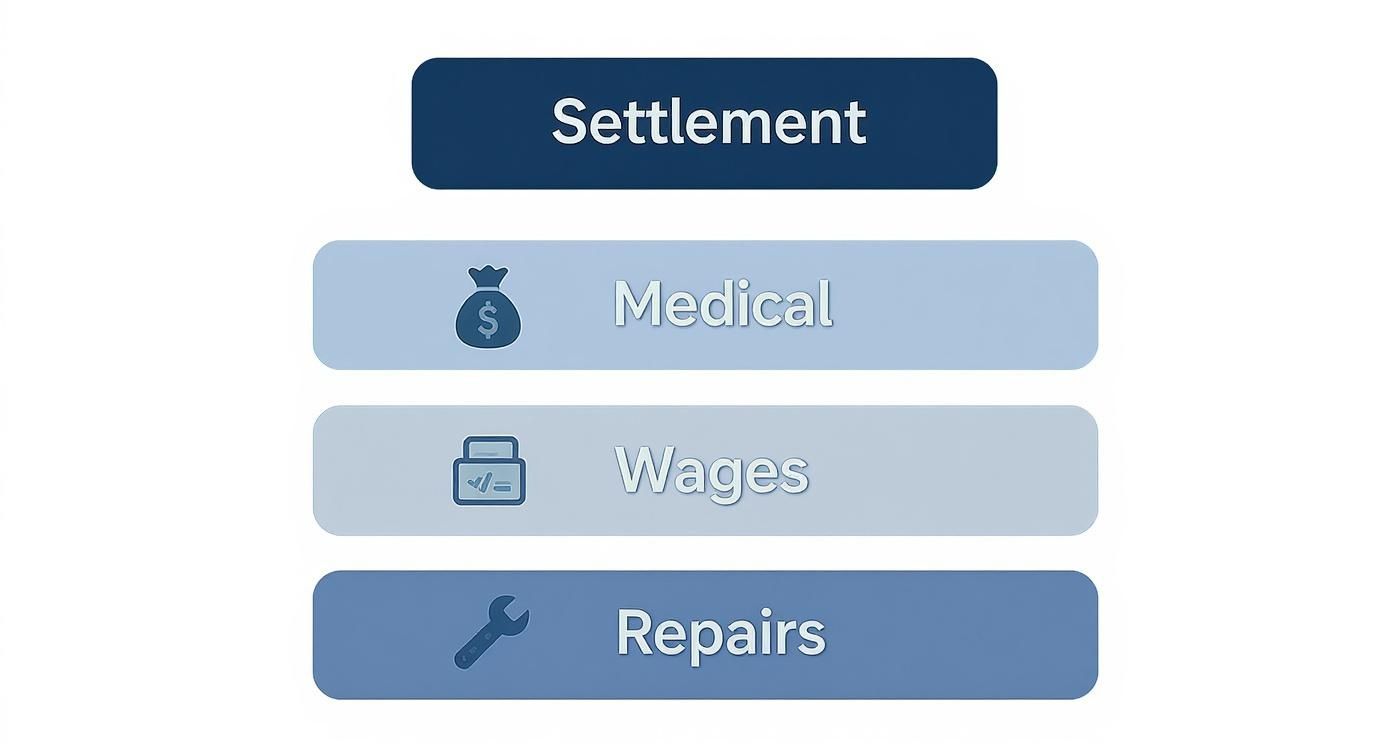
As you can see, the core of any settlement starts with the concrete financial losses you've suffered—medical expenses, lost income, and the cost of getting your car fixed.
Calculating Non-Economic Damages with the Multiplier Method
Economic damages cover what you paid. Non-economic damages are meant to cover what you endured. This is the compensation for intangible things like your physical pain, emotional distress, and the simple loss of being able to enjoy your daily life.
Since you can't get a receipt for suffering, attorneys and insurance adjusters often use the multiplier method to assign a dollar value to it.
Here’s the basic idea:
- Total Up Economic Damages: First, you add up all your provable financial losses (medical bills, lost wages, etc.).
- Apply a Multiplier: That total is then multiplied by a number, which usually falls somewhere between 1.5 and 5.
- Choose the Right Multiplier: The number used isn't arbitrary. It directly reflects how severe your injuries were and how much they’ve upended your life.
A minor whiplash injury that heals in a few weeks might get a multiplier of 1.5. But a herniated disc that causes chronic pain and requires surgery? That could easily justify a multiplier of 4 or 5.
This method creates a logical starting point for negotiation, turning your personal experience of pain and suffering into a number the insurance company can understand and work with. The more severe and life-altering your injuries, the higher the multiplier.
Putting It All Together: A Calculation Example
Let's walk through a quick, hypothetical example to see how this works in a real-world scenario involving a moderate rear-end crash.
Let's say your total economic damages add up like this:
- Medical Bills: $15,000
- Lost Wages: $5,000
- Total Economic Damages: $20,000
You suffered a herniated disc in the accident, which now causes you significant daily pain and requires ongoing physical therapy. Based on this, your lawyer argues for a multiplier of 3.
The calculation for non-economic damages would be:
- $20,000 (Economic Damages) x 3 (Multiplier) = $60,000 (Non-Economic Damages)
Finally, you add both types of damages together to get the initial settlement demand:
- $20,000 + $60,000 = $80,000
This $80,000 is the starting point for negotiations. While the final amount might be negotiated down, this calculation provides a strong, evidence-based foundation for why you're asking for that amount.
The financial fallout from these accidents is staggering. Across the United States, car accidents cost the economy roughly $340 billion every year. That number covers everything from medical bills and lost productivity to legal fees and administrative costs. You can discover more insights about the national economic impact of vehicle accidents and see exactly how those costs are broken down.
What Kind of Injuries Drive Up a Settlement?

While we talk about settlements in dollars and cents, that number is really a reflection of something much more personal: the real, physical toll the accident took on you. The value of any rear end collision settlement is tied directly to the seriousness of your injuries. And make no mistake, the insurance adjuster isn't just going to take your word for how much it hurts.
This is why your medical records are your single most important tool. Every single doctor's appointment, physical therapy session, prescription, and X-ray builds an undeniable paper trail. This documentation turns your pain and suffering into concrete, provable facts that justify the settlement you deserve.
Whiplash and Other Soft Tissue Troubles
By far, the most common injury in a rear-end crash is whiplash. It happens when the impact violently snaps your head forward and back, straining the muscles, tendons, and ligaments in your neck. It’s easy to dismiss as a minor issue, but whiplash can lead to chronic pain, persistent headaches, and stiffness that can drag on for months, or even years.
The tricky part? These are "soft tissue" injuries, meaning they don't show up on a standard X-ray. Because of this, insurance companies love to downplay them or argue they aren't that serious. The only way to fight back is with a consistent treatment history and detailed notes from your doctors that clearly link your pain to the accident.
When Injuries Get Serious: Brain and Spine Damage
On the other end of the spectrum are severe injuries that can completely change your life, and as a result, dramatically increase a settlement's value. These injuries often mean a lifetime of medical care and can permanently affect your ability to work, live independently, and enjoy your life.
Here are three of the most significant injury types that drive settlement values way up:
- Traumatic Brain Injuries (TBIs): Even a "mild" concussion can leave you with lingering problems like memory fog, trouble concentrating, and mood swings. A more severe TBI can cause permanent disabilities, requiring a settlement that provides for a lifetime of specialized care.
- Herniated Discs: The sheer force of being hit from behind can cause the soft, gel-like discs between your vertebrae to bulge or rupture. This puts pressure on your nerves and can cause excruciating pain, numbness, or weakness that often requires steroid injections, intense physical therapy, or even surgery to fix.
- Spinal Cord Damage: In the worst-case scenarios, the crash can damage the spinal cord itself, leading to partial or total paralysis. These catastrophic injuries lead to the highest settlement awards because the victim will need millions of dollars for future medical treatment, home modifications, and to cover a total loss of earning capacity.
The bottom line is this: the need for future medical care is what really drives the value of a settlement. If your doctor says you'll need ongoing physical therapy for a herniated disc or full-time care for a TBI, getting that recommendation documented is absolutely essential.
It's Not Just About Your Bumper
The crash didn't just hurt you; it hurt your car. The property damage portion of your rear end collision settlement is a critical piece of the puzzle, and it’s about more than just getting a dent pulled out. You have the right to be compensated for all of your property-related losses.
Obviously, this includes the cost to repair your vehicle or, if it's totaled, its fair market value before the crash. But there's another piece of the property damage puzzle that people often miss—one that can add thousands to your claim.
Don't Forget About Diminished Value
Here’s a hard truth: even if your car is repaired perfectly, it's now worth less than an identical car that's never been in an accident. That permanent drop in resale value is called diminished value, and under Texas law, you have a right to recover that loss from the at-fault driver's insurance.
Think about it. If you were shopping for a used car and had two identical options, but one had a major rear-end collision on its vehicle history report, you’d expect a serious discount. That discount is its diminished value. To make your case, you'll need an independent appraisal from an expert who can calculate exactly how much market value your car has lost, giving you solid proof to include in your settlement demand.
Real-World Rear-End Settlement Examples

Knowing the formulas for a rear-end collision settlement is one thing, but seeing how the numbers shake out in the real world is where it all clicks. The truth is, settlement values are never one-size-fits-all; they’re as unique as the accidents themselves. Two people in nearly identical wrecks can end up with completely different outcomes, and it often comes down to the severity of their injuries and the strength of their documentation.
Let's walk through a few realistic scenarios to give you a feel for how a settlement amount can swing dramatically based on the medical care involved.
Case Example: Minor Soft-Tissue Injuries
Picture this: a driver named Mark is stopped at a red light in Austin. Someone hits him from behind at a low speed, leaving him with whiplash and a strained lower back. The pain is real, but thankfully, his injuries are classified as minor soft-tissue damage.
- Treatment: Mark goes to an urgent care clinic right after the crash, has a follow-up with his family doctor, and completes six weeks of physical therapy. He has to take a few days off work to recover.
- Economic Damages: His total medical bills and lost wages add up to about $5,000.
- Outcome: Because the injuries were straightforward and his recovery was quick, the insurance adjuster might apply a multiplier of 2. This would put the starting point for settlement negotiations around $15,000, which covers his direct costs and provides fair compensation for his pain and suffering.
For a real-life look at a case just like this, you can read about an Austin rear-end collision that settled for $15,000 right here on Verdictly. It’s a perfect example of how even "simple" cases need careful calculation.
Case Example: Moderate Injuries With Lasting Effects
Now, let's look at another situation. A woman named Sarah is rear-ended on a Dallas highway, and the impact is much harder. She ends up with a herniated disc in her neck, an injury that causes chronic pain and numbness that shoots down her arm.
Her road to recovery is a lot longer than Mark's. It involves multiple MRIs just to get a clear diagnosis, a series of epidural steroid injections to manage the pain, and nearly a full year of specialized physical therapy. As a graphic designer, she missed several weeks of work simply because she couldn't sit at her desk for long stretches.
In cases like Sarah's, the settlement isn't just about paying back old medical bills. It has to account for the possibility of future flare-ups and the ongoing hit to her quality of life. The need for long-term care completely changes the game.
With a thick stack of medical records clearly linking the crash to her ongoing pain, her case is worth a lot more. An adjuster would likely use a multiplier of 3 or 4, pushing her potential settlement well into the $75,000 to $100,000 range.
Case Example: Severe Injuries Requiring Surgery
Finally, let’s consider a truly severe case. A family is hit from behind by a commercial truck, resulting in a high-impact collision. One of the passengers suffers multiple herniated discs in their lower back, leading to debilitating pain and a serious loss of mobility.
- Treatment: The injury is so severe that it requires major spinal fusion surgery. This means a long hospital stay, followed by months of grueling post-op rehab and a permanent restriction on how much they can lift.
- Economic Damages: The surgery and follow-up care alone can easily top $100,000. When you add in months of lost income and a permanently reduced ability to earn a living, the economic damages become massive.
- Outcome: A life-altering injury like this demands the highest multiplier, often 5 or even more. The settlement has to cover a lifetime of potential medical costs and compensate for a permanent loss of physical function. It's not uncommon for these cases to settle for $300,000 or significantly more, depending on the details.
Example Settlement Ranges by Injury Severity
To give you a clearer picture, here’s a table that illustrates how these settlement ranges can look based on the severity of the injuries. Keep in mind, these are just illustrative examples—every case is different.
| Injury Severity | Common Injuries | Typical Settlement Range (Illustrative) |
|---|---|---|
| Minor | Whiplash, minor sprains, strains, bruising | $10,000 - $25,000 |
| Moderate | Herniated discs, concussions, simple fractures | $50,000 - $100,000+ |
| Severe | Spinal cord injuries, TBI, surgical needs | $250,000 - $1,000,000+ |
As you can see, the value of a claim climbs steeply with the seriousness of the injury and the amount of medical intervention required. This is why thorough documentation is absolutely crucial from day one.
Why an Attorney Can Get You a Better Settlement

After a crash, the thought of handling the insurance claim yourself is tempting. It seems simple, right? The other driver hit you from behind, so their insurance should cover everything.
But what starts as a straightforward process can quickly turn into a frustrating fight. You’re up against an insurance adjuster whose entire job is to minimize payouts and protect their company's profits—not to look out for you.
This is where a good personal injury attorney becomes your biggest ally. Think of them as a professional negotiator in a high-stakes deal. You could go it alone, but someone who knows all the industry tactics, pressure points, and true value of your claim is going to get a much better outcome. An attorney does exactly that for your rear end collision settlement.
They step in to be your advocate and your shield, dealing with the aggressive phone calls and mountains of paperwork. This frees you up to focus on the one thing that truly matters: your recovery.
The Strategic Advantage of Legal Representation
An experienced attorney does a lot more than just fill out forms. They bring a deep understanding of legal strategy to the table, leveling the playing field against massive insurance companies. Their entire focus is on building a rock-solid, evidence-backed case that leaves the insurer with no choice but to offer a fair settlement.
This process involves critical actions you likely can't manage on your own:
- Projecting Future Costs: An attorney will often work with medical and financial experts to get a realistic picture of your future medical needs. This is a huge component of a settlement that initial insurance offers almost always ignore.
- Hiring Expert Witnesses: If the other driver tries to dispute fault, a lawyer can bring in an accident reconstruction expert to prove exactly what happened.
- Managing All Communication: Once you have an attorney, all communication from the insurance company goes through them. This stops adjusters from harassing you, pressuring you into a lowball offer, or tricking you into a recorded statement that could be used against you.
Taking these steps completely changes the negotiation dynamic. It signals to the insurance company that you're serious and fully prepared to fight for what you deserve.
One of the most vital jobs an attorney has is watching the clock. If you miss a critical filing deadline, known as the statute of limitations, your case can be thrown out forever. You get nothing.
This isn’t just a scare tactic; it’s a harsh reality of the legal system. For a real-world example of what happens when a deadline is missed, you can read about this case where a court dismissed a motor vehicle accident due to the statute of limitations.
Warning Signs You Need to Hire an Attorney
While having a lawyer is almost always a good idea, some situations make it non-negotiable. If you run into any of these red flags, it’s time to call an attorney immediately.
- Your Injuries are Questioned: The adjuster is telling you your injuries aren't that bad or, worse, that they came from a pre-existing condition.
- You Get a Fast, Low Offer: The insurer dangles a quick check in front of you, often before your doctors even know the full extent of your injuries. This is a classic move to get you to settle for pennies on the dollar.
- They Try to Blame You: The insurance company starts suggesting you’re partially at fault for braking too hard or having a broken tail light. This is an attempt to reduce what they have to pay you.
- Your Injuries are Serious: If you're dealing with anything major like a herniated disc, a traumatic brain injury (TBI), or any condition that needs surgery, the stakes are simply too high. The value of your claim is significant, and you need an expert to make sure every penny is accounted for.
At the end of the day, an attorney ensures your claim is valued based on the total impact the accident has had on your life—not just the bare minimum an insurance company hopes you’ll accept.
Common Questions About Collision Settlements
After a rear-end collision, you're suddenly thrown into a world of confusing legal terms and unpredictable timelines. Even after learning how settlements work, you're bound to have practical questions. Let's tackle some of the most common concerns that pop up during the settlement process.
How Long Does a Rear-End Collision Settlement Take?
This is usually the first question on everyone's mind: "How long is this going to take?" The honest answer is, it depends entirely on your specific case. There's no one-size-fits-all timeline, but most cases fall into one of two general paths.
If your case is straightforward—think minor injuries, clear-cut fault, and a cooperative insurance company—you might see a settlement in as little as three to six months. This is most likely when your medical treatment is finished and you have a clear, final number for all your costs.
But if your injuries are serious, require ongoing medical care, or the other driver’s insurance company decides to fight you on who’s at fault, the process can really drag on. It’s not uncommon for more complex cases to take over a year to finally resolve. Several things can slow it all down:
- Reaching Maximum Medical Improvement (MMI): You never want to settle before your doctor says you've reached MMI. This is the point where your condition has stabilized and isn't expected to get any better. Waiting for MMI ensures all your future medical needs are factored into the final number.
- Gathering Evidence: It simply takes time to collect all the necessary medical records, police reports, and expert opinions needed to build a strong case.
- Negotiation Games: A difficult insurance adjuster can intentionally slow-walk the process, using delays and unreasonable demands as a tactic to wear you down.
The key is to set realistic expectations from the start. A fast settlement is tempting, but a fair settlement is what truly matters.
Should I Take the First Settlement Offer?
It won't be long before the at-fault driver's insurance adjuster calls with an offer. When you're staring at a pile of medical bills, that initial number can feel like a lifesaver. But be careful. The first offer is almost always a lowball tactic.
Their goal is simple: close your case as quickly and cheaply as possible. Adjusters know you're under financial pressure and hope you’ll take a fraction of what your claim is actually worth just to get it over with.
Accepting that first offer is a trap. It's made before you—or even your doctors—fully understand the long-term impact of your injuries. Once you sign that release, you can never ask for more money, even if you find out later you need surgery.
Before you even think about accepting, you need a complete and total picture of your damages. That means every medical bill you have now, the estimated cost of any future care, all your lost wages, and fair compensation for your pain and suffering.
What if I Was Partially at Fault?
In the vast majority of rear-end collisions, the driver in the back is assumed to be at fault. But what if the insurance company tries to argue you played a part—say, you braked too suddenly or one of your brake lights was out?
Luckily, Texas law has a system designed for exactly this situation. It's called the modified comparative fault rule.
Put simply, this rule allows you to recover damages as long as you are not 51% or more responsible for the crash. If you are found to be partially at fault, your settlement is just reduced by your percentage of the blame.
Here’s how it works in practice:
- Let's say your total damages add up to $100,000.
- The insurance company manages to prove you were 10% at fault.
- Your final settlement would be reduced by that 10%, leaving you with $90,000.
This rule prevents you from being completely shut out of compensation just because you might carry a tiny bit of the responsibility.
Will I Have to Go to Court for My Settlement?
The idea of going to court is enough to make most people anxious. But here's the good news: it's incredibly rare for personal injury claims to end up in a courtroom trial.
In fact, well over 95% of personal injury cases are settled out of court. Filing a lawsuit isn't a one-way ticket to a trial; it's a strategic move in the negotiation process.
Filing a suit sends a clear message to the insurance company that you're serious and won't be pushed around. It also gives your attorney powerful tools, like the ability to formally demand evidence (discovery) and question people under oath (depositions). More often than not, just taking this step is enough to get a stubborn adjuster to come back to the table with a much more reasonable offer. The goal is always to secure a fair rear end collision settlement without the time, cost, and stress of a full-blown trial.
Trying to navigate a rear-end collision claim on your own is tough, but you don't have to go in blind. The most powerful tool you have is real-world data. At Verdictly, we pull back the curtain on the settlement process. Our database of actual Texas verdicts and settlements lets you see what cases just like yours are truly worth, empowering you and your attorney to negotiate from a position of strength.
You can explore similar case outcomes and benchmark your own claim by visiting us at https://verdictly.co.
Article created using Outrank
Related Posts

What to Do After a Hit and Run Car Accident in Texas
A complete guide on what to do after a hit and run car accident in Texas. Learn the critical first steps, your legal options, and how to file a claim.

Can You Sue Someone For a Car Accident? A Practical Guide
Can you sue someone for a car accident? Learn the steps to take, who you can sue in Texas, and how to determine what your case might be worth.

Calculating pain and suffering car accident: A Practical Guide to Damages
Learn how calculating pain and suffering car accident damages works, with factors and tips to maximize your settlement.