

car accident settlement calculator texas: A Quick Guide
car accident settlement calculator texas: Learn how damages are calculated in Texas, apply the law, and estimate your claim with confidence.
A Texas car accident settlement calculator can give you a quick, rough estimate of what your claim might be worth. In essence, it takes your hard financial losses—things like medical bills and missed paychecks—and uses a simple formula to put a number on your pain and suffering. Think of it as a first-glance estimate, not a final number.
What a Settlement Calculator Can Actually Tell You
Before you start plugging in figures, it’s important to set your expectations. The main job of a settlement calculator is to give you a ballpark figure by adding up your costs and applying a basic multiplier for the non-financial side of your injuries.
What it can't do, however, is understand the nuances of your case. An online tool has no way of knowing the legal arguments that could make your claim stronger, the negotiation tactics the insurance adjuster will use, or how a jury in, say, Harris County versus Travis County might react to your situation.
The Two Pillars of a Claim
Every personal injury claim, whether in Texas or elsewhere, is built on two core types of damages. A calculator gives you a simplified look at these, but you need to understand the difference to negotiate effectively.
- Economic Damages: These are the clear-cut, provable financial hits you’ve taken. I call these the "receipt damages"—medical bills, lost wages from being out of work, and the cost to repair your car. They're tangible and have a paper trail.
- Non-Economic Damages: This is where things get more subjective. This category covers the human toll of the accident—the physical pain, the emotional trauma, and the ways your life has been negatively impacted. Calculators try to nail this down with a formula, but it’s an imperfect science.
A calculator spits out a number based on the data you feed it. It doesn’t see the quality of your evidence, the credibility of your witnesses, or the skill of the insurance adjuster on the other side of the table. These are the factors that truly shape the final settlement offer.
This visual breaks down how the process generally works, from putting your numbers into the calculator to getting an estimate that you can use as a starting point for real-world negotiations.
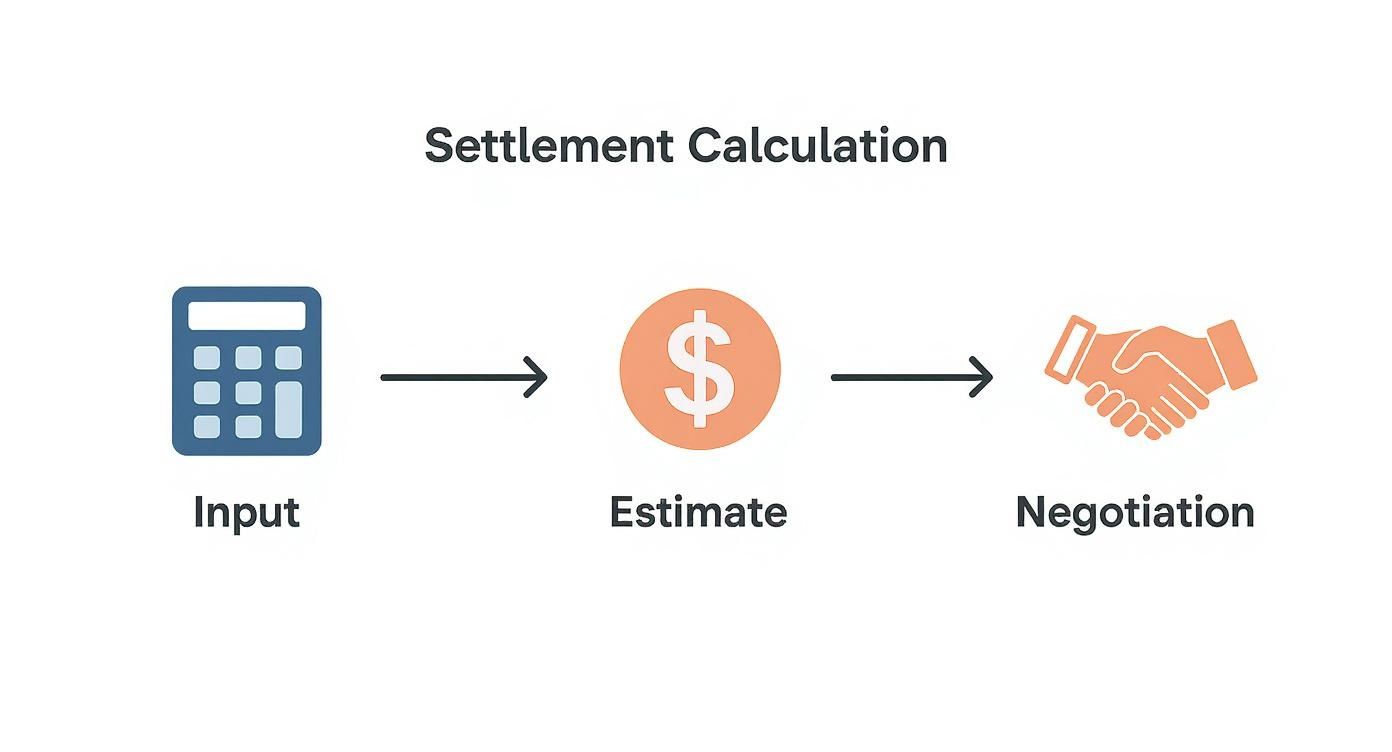
The key thing to remember is that the calculator's estimate is just one piece of a much larger puzzle. For a more detailed breakdown of the entire journey, check out our complete guide to car accident settlements. Using a calculator wisely means seeing its output not as the destination, but as the very first step on the road to understanding your claim's potential value.
Calculating Your Economic Damages: The Foundation Of Your Claim

This is where you have to roll up your sleeves and get to work. Before any car accident settlement calculator in Texas can spit out a number that means anything, it needs a solid foundation of real-world costs. These are your economic damages—the tangible, black-and-white financial losses you’ve racked up because of the crash.
Think of it as building the factual core of your claim. Unlike the more subjective "pain and suffering," these damages aren't up for debate. They're the cold, hard numbers with a paper trail, from the bill for the ambulance ride to the invoice from your last physical therapy session. Meticulously gathering and adding up these figures is absolutely essential for a strong claim.
Tracking Every Penny Of Your Medical Expenses
For most people, the biggest chunk of economic damages comes from medical bills. It's critical to account for every single cost tied to your treatment, covering both what you've already paid and what you'll need in the future. It’s surprisingly easy to overlook the small stuff, but those smaller expenses can add up to a significant amount over time.
Start by creating a dedicated folder—either a physical one or a digital one on your computer—for every single piece of paper you get. Don't just toss receipts in a drawer. You need to get organized.
Your file should include:
- Emergency room and ambulance bills
- Hospital stays, including any surgical costs
- Follow-up appointments with your primary doctor and any specialists
- Receipts for prescription medications and medical devices (like crutches or a brace)
- Bills for physical therapy, chiropractic care, or other rehabilitation services
When it comes to future medical care, your doctor's prognosis is everything. If they expect you'll need another surgery down the road or ongoing therapy for the next year, those projected costs have to be included in your demand. An insurance company won't just hand over money for future needs unless it's properly documented and justified by a medical professional.
Pro Tip: I always tell my clients to create a simple spreadsheet to log every expense as it comes in. Have columns for the date, service provider, a quick description of the service, and the amount billed. This running tally will be an invaluable tool for you and your attorney later on.
Before we move on, let's put this into a checklist. Keeping these documents organized is half the battle.
Checklist for Documenting Economic Damages
| Damage Category | Required Documentation | Pro Tip |
|---|---|---|
| Medical Bills | Itemized bills from all providers (hospital, doctors, labs), pharmacy receipts, invoices for medical equipment. | Request itemized statements, not just summary bills. They show every single charge and are harder for insurers to dispute. |
| Future Medical Care | A written prognosis from your doctor detailing expected treatments, surgeries, therapies, and their estimated costs. | Your doctor's report should explicitly state that these future treatments are necessary as a direct result of the accident. |
| Lost Wages | Pay stubs, a letter from your employer verifying time missed and pay rate, W-2 forms. | If you used sick days or PTO, you can still claim those as lost wages—you were forced to use benefits you otherwise would have kept. |
| Lost Earning Capacity | Tax returns (3-5 years), testimony from a vocational expert, performance reviews showing your career trajectory. | This is complex. An expert can provide a report showing how your injuries will impact your lifetime earnings, which is a powerful piece of evidence. |
| Property Damage | Repair estimates from at least two reputable body shops, a total loss statement from the insurer, Blue Book value reports. | Don't forget the contents of your car. If a laptop or car seat was destroyed, document its replacement cost. |
| Out-of-Pocket Costs | Receipts for rental cars, ride-sharing services for appointments, parking fees at the hospital, over-the-counter medications. | Keep a small notebook or use a phone app to track these minor expenses. They add up quickly and are fully compensable. |
Having this paperwork in order gives your claim undeniable weight and makes it much more difficult for the insurance adjuster to lowball you.
Accounting For Lost Wages And Earning Capacity
If the accident kept you from working, those lost wages are a major part of your economic damages. The math is pretty straightforward if you're an hourly or salaried employee: just multiply your pay rate by the number of hours or days you couldn't work because of your injuries.
Things get a bit more complicated for people who are self-employed, work on commission, or have an income that fluctuates. In those situations, you'll need to clearly show your average earnings using past tax returns, client invoices, and bank statements to establish a credible financial loss.
But it goes beyond just the time you missed. You also have to consider your lost earning capacity. If your injuries are permanent and prevent you from going back to your old job or working at the same level, you can seek compensation for that diminished future income. This is a big deal, and it often requires an analysis from vocational experts to prove exactly how your injuries will impact your financial stability for years to come.
Calculating the "Pain and Suffering" Part of Your Claim

Once you've added up all the hard numbers—the medical bills, lost paychecks, and repair costs—you get to the most difficult part of any settlement estimate: putting a dollar value on your pain and suffering. This is where a car accident settlement calculator in Texas can feel incredibly impersonal, because how can an algorithm truly understand what you've been through?
The short answer is, it can't. Instead, these tools use a common insurance industry formula called the multiplier method. Think of it as a shortcut to translate your documented financial losses (economic damages) into a rough figure for your physical pain and emotional distress. Knowing how this works is crucial for seeing a calculator's output for what it is: a starting point.
The math is simple. The calculator totals up your economic damages and multiplies that figure by a number, typically between 1.5 and 5. This number is the "multiplier," and choosing the right one is where things get subjective.
How Is the Multiplier Chosen?
The multiplier is all about the severity and lasting impact of your injuries. A minor fender-bender with a quick recovery gets a low multiplier. A life-altering crash gets a high one.
Let's look at a few real-world examples to see how this plays out:
- Multiplier of 1.5 to 2: Imagine a minor rear-end collision. You get whiplash, feel sore for a few weeks, and need some physical therapy, but you’re back to normal pretty quickly. The disruption was real, but temporary.
- Multiplier of 3 to 4: Now picture a T-bone crash that leaves you with a broken leg. You needed surgery, faced months of tough rehab, missed a ton of work, and now you can't go for your morning run anymore. The impact here is significant and affects your daily life.
- Multiplier of 5 (or higher): This is reserved for the most devastating accidents. A high-speed highway collision causes a permanent injury like a traumatic brain injury (TBI) or leaves severe, visible scarring. We're talking about chronic pain, permanent physical limitations, and deep emotional trauma like PTSD.
The multiplier is the battleground of negotiation. Your attorney will argue for a higher multiplier by presenting evidence of your suffering, while the insurance adjuster will push for a lower one to minimize the payout.
It’s no surprise, then, that settlement values in Texas are all over the map. We see minor injury cases settle for around $20,000, while a moderate injury needing surgery often lands closer to $45,596. For severe or catastrophic injuries, it’s not uncommon for settlements to range from $100,000 to well over $1 million. You can find more details about how injury severity impacts Texas settlements to get a better feel for these numbers.
What the Multiplier Method Misses
While the multiplier gives us a basic framework, it's a blunt instrument. It can't possibly capture the unique and personal ways an accident has turned your life upside down.
A simple formula doesn't see things like:
- Emotional Distress: The panic attacks you now have when you get behind the wheel, or the depression that set in during your recovery.
- Loss of Enjoyment of Life: The inability to play with your kids, work in your garden, or go on vacation like you used to.
- Disfigurement and Scarring: The permanent physical reminders of the trauma that affect your confidence every time you look in the mirror.
- Loss of Consortium: The strain and damage the accident and your injuries have placed on your marriage and relationship with your spouse.
These are the intangible, but very real, losses that form the core of your non-economic damages. They are fully compensable under Texas law, and they are exactly why a good attorney will build a case that tells your whole story—something no online calculator can ever do.
How Texas Law Shapes Your Final Payout

An online calculator spits out a raw number, but that figure is just a starting point. It becomes meaningful only when you filter it through the reality of Texas law. The state’s legal framework can dramatically alter your final payout, and not knowing the rules is a mistake that could cost you everything.
There are two major Texas laws that have a huge impact on your claim’s actual value. The first, and arguably most important, is how our state handles shared fault. It’s rarely a simple case of one person being 100% to blame, and Texas has a specific legal doctrine for that.
Understanding The 51% Fault Rule
Texas operates under a rule called modified comparative negligence. It's often referred to as the "51% bar rule," and it's as harsh as it sounds. The rule says your total compensation gets reduced by your percentage of fault. Simple enough. But if you are found to be 51% or more at fault for the accident, you get nothing. Zero.
Here’s how that plays out in the real world:
- Scenario: A jury awards you $100,000 in total damages. But they also decide you were 20% at fault—maybe you were going a few miles over the speed limit when the other driver blew through a red light.
- Outcome: Your $100,000 award is cut by your 20% share of the blame, so you walk away with $80,000.
- The Cliff: Now, imagine that same jury decided you were 51% at fault. Your recovery drops instantly to $0.
This rule is exactly why insurance adjusters will fight tooth and nail to pin even a tiny bit of the blame on you. Every percentage point they shift in your direction is real money saved for them.
The 51% bar is unforgiving. Being found just one percentage point over the halfway mark for fault means your entire claim, no matter how severe your injuries, is legally worthless in Texas.
The Two-Year Countdown Clock You Cannot Ignore
The second critical rule is the statute of limitations. In Texas, you have a strict deadline of two years from the date of the crash to file a lawsuit. This isn't a suggestion—it's a hard legal cutoff.
If you miss this deadline, you lose your right to pursue compensation in court forever. It doesn't matter if you have a slam-dunk case with video evidence and catastrophic injuries. A judge will toss it out without a second glance if it's filed even one day late.
Insurance companies are well aware of this ticking clock. As you near that two-year mark, they might start dragging their feet on negotiations, hoping you'll miss the window and lose all your leverage.
Understanding these legal realities is crucial. They can also lead to complicated financial arrangements, like a structured settlement. For more on that, you can read our breakdown of a Galveston court case involving a structured settlement transfer.
From Calculator Estimate To Actual Settlement
https://www.youtube.com/embed/S5vrVjBqosM
Think of the number a car accident settlement calculator in Texas gives you as a starting point, not the finish line. It's a great tool for getting a ballpark figure, but real-world factors immediately come into play, and one of them is an absolute showstopper.
The single biggest factor an online tool can't account for is the at-fault driver's insurance policy limit. You can have a claim legitimately worth $200,000, but if the driver who hit you only carries $30,000 in liability coverage, that's often the most the insurance company will ever pay. It's a hard ceiling.
Sure, you can technically sue the driver for their personal assets, but that's a tough, expensive legal road. Unless they're independently wealthy, it's usually not a practical option. That's why identifying the policy limits early on is one of the most crucial steps in the entire process.
Averages Versus Medians: A Tale of Two Numbers
Here’s another reason to take those calculator results with a grain of salt: the "average settlement" figures you often see are wildly misleading. When you look at how Texas calculates these figures, you'll see a massive gap between the average and the median.
For example, a few massive, multi-million dollar verdicts can drag the average Texas personal injury award to over $800,000. But the median—the number right in the middle of all settlements—is a far more realistic $12,281.
When we look specifically at motor vehicle accidents, the median settlement is closer to $16,000. The median is a much better benchmark for what a more typical case actually settles for, as it isn't skewed by those rare, high-dollar outliers.
Think of your calculator's estimate as a strategic tool for opening negotiations. It’s the number you use to start the dialogue, armed with the knowledge that the final figure will be shaped by real-world factors like policy limits and legal arguments.
How An Attorney Bridges The Gap
This is where a good personal injury lawyer earns their keep. An insurance adjuster is trained to minimize every aspect of your claim, especially the "pain and suffering" part. They'll start with the lowest possible multiplier and dare you to prove you deserve more.
A seasoned attorney knows how to fight back. They don’t just present medical bills; they build a compelling story around your injuries. They gather testimony from family, friends, and coworkers to paint a picture of how the accident has truly impacted your life—turning subjective pain into a concrete argument for a higher multiplier.
They know what local juries are awarding and can point to recent verdicts, like a Harris County rear-end collision that settled for $2 million, to show the insurance company you're serious. This expertise is what turns a calculator's estimate into a final settlement that truly reflects what you've been through.
Common Questions About Texas Car Accident Claims
When you're dealing with the aftermath of a car accident, your head is probably spinning with questions. A Texas car accident settlement calculator can give you a rough idea, but it won't answer the practical, real-world questions that inevitably come up.
Let's walk through some of the most common concerns we see from people in your exact situation.
How Long Does A Car Accident Settlement Take In Texas?
Honestly, it's all over the map. There’s no single, simple answer. If your case is straightforward—say, a rear-end collision with minor injuries and a clear at-fault driver—it might wrap up in just three to six months. In these scenarios, the insurance company can see the writing on the wall and usually wants to get the claim off their desk.
But that's the best-case scenario. Most claims have a few wrinkles. If your injuries are serious and require ongoing treatment, or if the other driver is trying to pin some of the blame on you, things get complicated. When the insurance company decides to dig in its heels and play hardball, the process can easily drag out for a year or even longer. Often, the only way to get them to the table with a fair number is to file a lawsuit, and that adds a whole new chapter to the timeline.
Should I Take The First Settlement Offer?
Let me make this simple: almost never. The insurance adjuster's first offer isn't a good-faith attempt to value your claim; it's a business tactic. They toss out a low number to test the waters and see if you’re desperate enough to take a quick, cheap payout and just go away.
Think of the first offer as the starting whistle for negotiations, not the finish line. Never, ever accept an offer until you've finished all your medical treatment or at least have a crystal-clear prognosis from your doctors. If you settle too soon, you're on the hook for any future medical bills, and you can't go back for more.
What If The Other Driver Is Uninsured?
This is a tough spot to be in, and unfortunately, it happens a lot. Your best bet is to look at your own insurance policy. If you have Uninsured/Underinsured Motorist (UM/UIM) coverage, you're in a much better position. You can file a claim directly with your own insurance company, and they will cover your damages up to your policy limits, essentially acting as the insurance the other driver should have had.
This is exactly why having solid UM/UIM coverage is so crucial in Texas. Without it, your only other path is to sue the at-fault driver directly. You can certainly do that, but actually collecting money from someone who doesn't have insurance or many assets is often a long, frustrating, and ultimately fruitless exercise.
Do I Really Need A Lawyer To Get A Fair Settlement?
If you were in a minor parking lot fender-bender with zero injuries, you can probably manage the property damage claim on your own. But the moment you introduce significant injuries, disputed fault, or the need for future medical care, the game changes entirely. Trying to go it alone against a major insurance company is like stepping into a professional boxing ring without any training—they have entire teams dedicated to paying you as little as possible.
Time and time again, studies have shown that people who hire an experienced car accident attorney walk away with significantly higher settlements. Yes, even after the attorney's fees are paid. A good lawyer knows the local courts, understands how to build a powerful claim, and isn't intimidated by the insurance company's tactics. They create the leverage you need to force a fair outcome.
Trying to figure out a car accident claim on your own is a tough road. At Verdictly, we're firm believers that access to real data creates fairer results for everyone. Our platform gives you a look behind the curtain at actual Texas verdicts and settlements, so you can understand what your case might truly be worth. See what similar cases have settled for and walk into your negotiation armed with facts, not just guesses.
Related Posts

Do Texts Hold Up in Court? A Guide to Text Evidence (do texts hold up in court)
Wondering if do texts hold up in court? Learn how text messages become admissible evidence in injury cases, from authentication to courtroom strategy.

How Much Is My Car Accident Case Worth in Texas?
Wondering how much is my car accident case worth? This Texas guide explains damages, fault, and data to help you estimate your claim's potential value.