

Average settlement for car accident back injury: key factors
average settlement for car accident back injury: Learn the factors, typical value ranges, and how settlements are calculated to estimate your claim.
When you're dealing with a back injury from a car accident, one of the first questions on your mind is, "What's my case worth?" While you might see broad averages thrown around, a typical settlement for a car accident back injury usually lands somewhere between $12,000 and $90,000.
That's a huge range, and for good reason. A minor sprain that heals in a few weeks is worlds away from a herniated disc that requires surgery. Cases involving catastrophic injuries, like paralysis, can easily soar past $500,000.
Why "Average" Settlement Numbers Don't Tell the Whole Story
Searching for an "average settlement" is a natural starting point, but it can be incredibly misleading. A few multi-million dollar verdicts for the most severe injuries can pull the overall average way up, making it a poor benchmark for most people. It's like trying to guess the weather in Texas by averaging the temperature in July and January—the number you get isn't very useful for any given day.
A much smarter approach is to think in terms of settlement ranges. Your case isn't a single, predetermined number; it’s a spectrum. The final value is directly tied to how badly you were hurt and how much the injury has upended your life.
Your settlement is built from several key components, each unique to your situation:
- Your Medical Bills: This is the foundation. It includes everything from the ambulance ride and ER visit to surgery, physical therapy, and any future care you'll need.
- Your Lost Income: We're not just talking about the days you missed work right after the crash. If your injury prevents you from earning what you used to, that loss of future earning capacity is a huge factor.
- Your Pain and Suffering: This is the human element. It’s compensation for the physical pain, the emotional toll, and the simple fact that you can't do the things you once enjoyed.
Typical Back Injury Settlement Ranges by Severity
To give you a more realistic picture, let's break down settlement ranges based on how severe the back injury is. This table shows how different medical realities lead to vastly different financial outcomes and helps you see where your own situation might land.
Typical Back Injury Settlement Ranges by Severity
This table breaks down common back injury settlement amounts based on the level of severity, showing how medical needs and long-term impact influence compensation.
| Injury Severity | Common Injury Types | Typical Settlement Range | Key Factors |
|---|---|---|---|
| Minor | Muscle strains, whiplash, soft tissue bruising | $10,000 – $25,000 | Short-term treatment, minimal lost work, full recovery |
| Moderate | Herniated discs, simple fractures, chronic pain | $25,000 – $100,000 | Injections, physical therapy, significant lost wages |
| Severe | Multiple herniated discs, spinal fusion surgery | $100,000 – $500,000+ | Major surgery, permanent limitations, long-term care |
| Catastrophic | Spinal cord damage, paralysis, severe nerve compression | $500,000+ | Permanent disability, loss of earning capacity, life care |
This framework helps ground your expectations in reality. National data consistently shows that minor back and neck injuries often resolve in the $10,000 to $25,000 range. Moderate injuries that demand more intensive care, like steroid injections or extensive physical therapy, can easily push a settlement toward $100,000. You can explore these figures in more detail in our complete guide to car accident settlements.
As you can imagine, the most severe cases—especially those involving paralysis—frequently result in settlements far exceeding $500,000. These larger amounts reflect the profound, permanent, and life-altering impact the injury has on a person's life. You can discover more insights about settlement statistics from personal injury experts.
The 5 Factors That Drive Your Settlement Value
Knowing the average settlement ranges is a good starting point, but to really understand what your case might be worth, you need to look at it through the eyes of an insurance adjuster or a trial lawyer. They don't just pick a number. They carefully analyze a specific set of factors that form the building blocks of any settlement offer.
Think of it like building a case for the value of a house. Some elements are concrete and easy to price, like the cost of lumber and bricks. Others are more subjective, like the quality of the craftsmanship or the desirability of the neighborhood. Your settlement is a combination of both hard numbers and these more nuanced details.
1. Medical Expenses: Past and Future
This is the bedrock of your claim—the hard, provable costs of your medical treatment. It's the most straightforward factor and includes every single bill connected to your back injury.
These costs aren't just about the ER visit right after the crash. They paint a full picture of your medical journey, typically broken down into two main areas:
- Past Medical Bills: This is a running total of all the care you've already received. It covers everything from the ambulance ride and hospital stay to diagnostic imaging (MRIs, CT scans), prescription medications, and physical therapy sessions. Every invoice is a piece of the puzzle.
- Future Medical Needs: A serious back injury rarely resolves quickly. If your doctor says you’ll need ongoing care—like future surgeries, long-term pain management, or years of physical therapy—the estimated cost of that future treatment becomes a massive driver of your settlement value.
An average settlement for a car accident back injury that involves a recommendation for future surgery will be worlds apart from a case that only required a few weeks of chiropractic adjustments. The clearer your doctor is about your long-term prognosis, the stronger this part of your claim becomes.
This infographic gives you a visual on how the need for more intensive medical care dramatically changes the financial outcome.
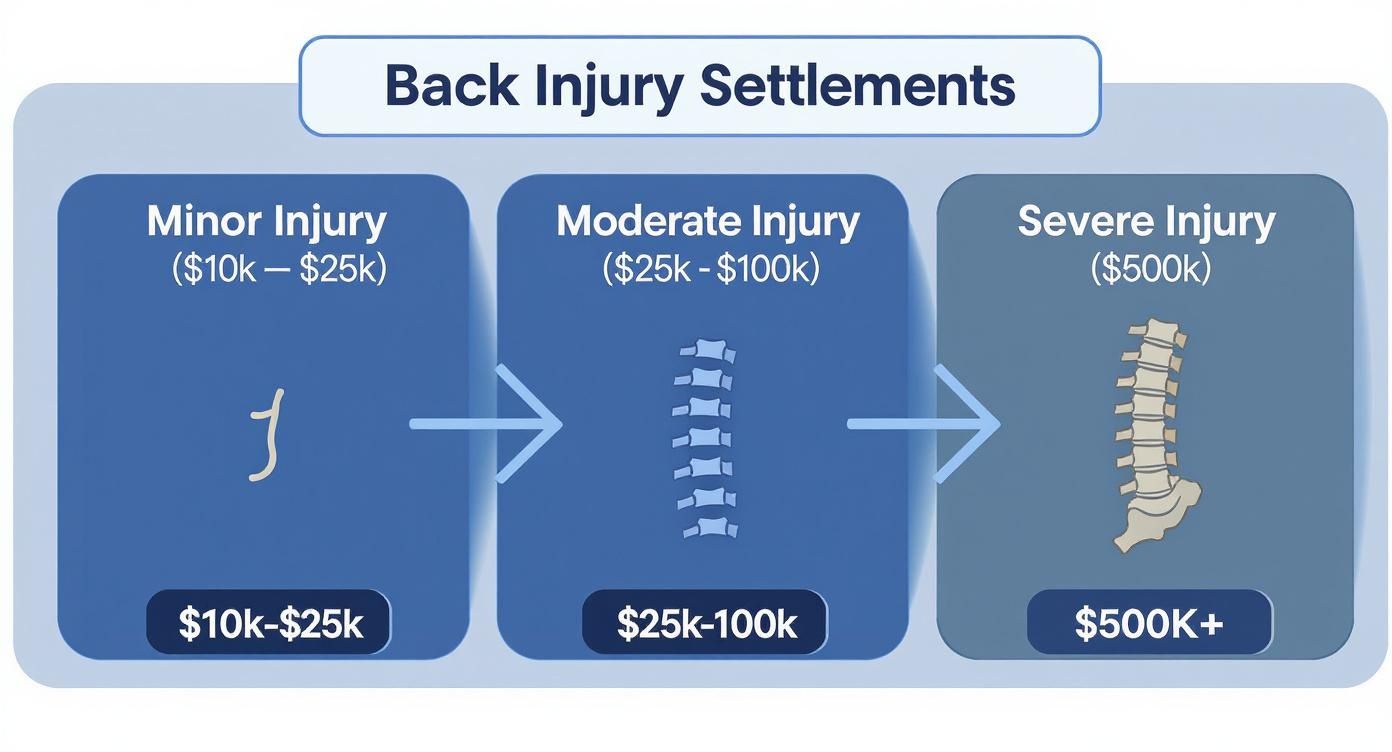
As you can see, the value skyrockets as an injury moves from something temporary to a condition requiring permanent, life-altering medical support.
2. Lost Wages and Earning Capacity
A back injury doesn't just hurt your body; it hits your wallet. It can sideline you from work and threaten your ability to provide for your family. This financial damage is another core part of your settlement.
First, there are the lost wages you've already incurred. This is a straightforward calculation: your hourly or daily pay rate multiplied by the amount of work you were forced to miss while you were recovering. Your pay stubs tell this part of the story.
Then there’s the more complex, and often much larger, component: loss of future earning capacity. If your back injury leaves you with permanent limitations—preventing you from returning to your old job or working the same number of hours—you deserve to be compensated for that lifetime of diminished income. For a construction worker who can no longer do heavy lifting or an office manager who can't sit for eight hours a day, this can easily become the single biggest piece of their settlement.
3. Pain and Suffering
This is where things get less about spreadsheets and more about the human cost. "Pain and suffering" is the legal term for everything you've been through: the physical pain, the emotional distress, and the simple loss of enjoyment of life. How do you put a dollar figure on not being able to pick up your toddler, go for a jog, or enjoy your favorite hobby without a shooting pain in your back?
Insurance companies often use a "multiplier" method to get a starting number. They add up all your concrete medical bills and then multiply that total by a number, typically between 1.5 and 5, based on how severe your injury is.
A minor back strain that heals up in a month might get a 1.5x multiplier. But a herniated disc that requires spinal fusion surgery and leaves you with permanent nerve damage? That could easily justify a multiplier of 4x or 5x. As you can imagine, this multiplier is one of the most heavily negotiated points in any back injury case.
4. Liability and Fault
The fourth piece of the puzzle is all about who caused the wreck. The facts of the accident are critically important. Was it a clear-cut rear-end collision where the other driver was 100% to blame? Or was it a chaotic intersection crash where fault might be shared?
Here in Texas, we operate under a modified comparative negligence rule. This means you can still get compensation even if you were partly at fault, but only as long as you were 50% or less responsible. Your final award is then reduced by your percentage of fault. For instance, if a jury awards you $100,000 but decides you were 20% at fault for the accident, your final recovery is cut to $80,000. If you're found to be 51% or more at fault, you get nothing.
5. The Quality of Your Documentation
Finally, the strength of your entire claim hangs on the quality of your proof. A compelling story isn't enough; you need organized, thorough documentation to back up every single claim you make.
This includes:
- Comprehensive Medical Records: Detailed notes from every single doctor, specialist, and therapist you see.
- Clear Financial Records: A complete file of every medical bill, pharmacy receipt, and pay stub.
- Strong Accident Evidence: The official police report, photos of the scene and vehicle damage, and any witness statements.
A well-documented case is simply harder for an insurance company to argue with. It leads to smoother negotiations and almost always results in a higher average settlement for a car accident back injury. Without the proof, even the most serious and legitimate claim can fall flat.
How Different Back Injuries Impact Your Claim
When your doctor gives you a diagnosis, it’s far more than just a medical term—it’s the cornerstone of your entire settlement negotiation. An insurance adjuster sees a "lumbar strain" and a "herniated disc with nerve root impingement" in two completely different lights. Getting a handle on this difference is the first step to setting realistic expectations.
Think of it this way: each type of injury tells a unique story about your pain, your road to recovery, and the potential for lifelong problems. That medical narrative is what ultimately drives the dollar value of your case.

Let's walk through the most common back injuries we see after car accidents and break down how they typically play out in a settlement.
Soft Tissue Injuries: Strains, Sprains, and Whiplash
Soft tissue injuries are, by far, the most common culprits in auto accidents, especially in those jarring rear-end collisions. This category covers damage to the muscles, ligaments, and tendons in your back and neck. While some people might dismiss them as "minor," the pain can be intense and seriously disrupt your daily life.
- The Medical Story: For these injuries, your treatment plan usually involves a combination of rest, physical therapy, chiropractic adjustments, and anti-inflammatory meds. The evidence that matters most here are the notes from your physical therapist and your own detailed records of pain and physical limitations.
- The Settlement Impact: Because these injuries tend to heal within weeks or months without causing permanent damage, settlements generally fall on the lower end of the scale. The value is almost entirely driven by your documented medical bills, plus a modest amount for your pain and suffering.
For example, a Dallas jury awarded just $6,500 for soft tissue injuries from a rear-end crash—a number that very closely mirrored the plaintiff's medical expenses. You can see from cases like this (https://www.verdictly.co/dfw/mva/dallas-jury-awards-6-500-for-soft-tissue-injuries-in-rear-end-crash) that when the injury is straightforward with a clear recovery path, the settlement figures are often modest.
Herniated Discs: A Much More Serious Diagnosis
A herniated disc—sometimes called a slipped or ruptured disc—is a whole different ballgame. This happens when one of the soft, rubbery cushions between your vertebrae gets damaged, letting the gel-like center push out and press on sensitive spinal nerves.
This diagnosis immediately changes the conversation and raises the potential settlement value. It’s a clear signal of a more severe, and possibly permanent, structural injury.
A herniated disc is a game-changer in a settlement negotiation. It's objective proof of a structural injury, visible on an MRI, which is far more compelling to an insurance company than a patient's subjective complaints of pain.
The treatment for a herniated disc is also much more intensive and costly. It might start with conservative care, but it can escalate quickly to things like:
- Epidural Steroid Injections: These are medical procedures aimed at calming the inflammation around the affected nerve root.
- Pain Management: This often means long-term prescriptions and appointments with specialized doctors.
- Surgical Intervention: In more severe cases, a surgeon might recommend a discectomy or even a spinal fusion.
Just the recommendation for surgery, even if you haven’t gone through with it, can dramatically increase your claim's value. It tells the insurance company that you're facing significant future medical bills, a long recovery, and the very real possibility of permanent physical limitations.
Spinal Fractures and Cord Injuries: The Most Severe Cases
At the absolute highest end of the severity spectrum are vertebral fractures and spinal cord injuries. These are catastrophic events with life-altering consequences, and as a result, they lead to the largest settlements.
A spinal fracture means one or more of the bones in your spine have actually broken. The severity can vary wildly, from a more stable compression fracture to a severe "burst" fracture that requires emergency surgery to install rods and screws for stabilization.
Spinal cord damage is the most devastating outcome of all. An injury to the spinal cord itself can lead to:
- Paraplegia: Paralysis of the lower body.
- Quadriplegia: Paralysis from the neck down.
- Chronic Nerve Pain: Lifelong, debilitating pain conditions that are difficult to manage.
- Loss of Bodily Functions: Impacting control over the bladder, bowels, and other critical systems.
In these tragic situations, the settlement has to cover a lifetime of costs. We're talking about ongoing medical care, wheelchairs and other assistive devices, major home modifications, in-home nursing care, and a total loss of earning capacity. The financial and human toll is immense, and the settlement values reflect that reality, often reaching well into the millions of dollars.
Making Sense of Real Settlement Data
It's easy to get excited by headlines about multi-million dollar verdicts, but those sensational stories often paint a misleading picture for the average person. If you want to get a real handle on what your case might be worth, you have to learn to look past the hype and interpret settlement data like a pro. The first step? Understanding the critical difference between an "average" and a "median."
An average settlement is just the total of all settlement amounts divided by the number of cases. The problem is that this number gets wildly skewed by a few massive, outlier verdicts. Imagine nine cases that settle for $50,000 each, but a tenth, catastrophic case settles for $5 million. The average settlement suddenly becomes a whopping $545,000—a figure that isn't a realistic benchmark for anyone involved.
Why Medians Tell a More Accurate Story
This is where the median settlement comes in. The median is simply the middle number in a sorted list of all the settlement values. In that same example, the median would be $50,000, which is a far more representative figure for what a typical case in that group actually settled for. The median filters out the extreme highs and lows that distort the average, giving you a much more grounded view of reality.
When you're trying to set realistic expectations for a car accident back injury, looking at the median is almost always the smarter approach. It shows you what a truly "typical" case looks like financially, which is the kind of insight you need for productive negotiations.
By focusing on median values, you ground your expectations in reality. This prevents the disappointment that can come from chasing an inflated "average" that doesn't reflect the specifics of most claims.
Regional Data Provides Critical Context
National statistics are a decent starting point, but settlement values can swing dramatically depending on your location. State laws, local court precedents, and even the tendencies of juries in a specific county can have a huge impact. Digging into regional data gives you a much sharper picture of what’s actually happening in the courtrooms near you.
For instance, data from markets like Washington State shows a common pattern. Minor back and neck sprains often settle in the $2,500 to $10,000 range. Cases with herniated discs and a longer course of physical therapy frequently land somewhere between $20,000 and $100,000. And, of course, severe injuries that require surgery or lead to paralysis can soar well over $100,000, sometimes into the millions. You can discover more insights about these regional settlement patterns to see these trends for yourself.
This local context is invaluable. Here in the Dallas-Fort Worth area, for example, a jury might award around $11,533 for neck and back injuries from a rear-end collision. You can read about a specific Burleson jury award for a neck and back injury case to see exactly how a local jury valued that specific claim.
By layering broad statistics with specific, local case outcomes, you can build a much more accurate and defensible estimate for your own potential settlement. It’s a data-driven approach that moves you from guesswork to a negotiation strategy rooted in real-world evidence.
A Practical Guide to Calculating Your Settlement
Trying to figure out what your back injury claim is actually worth can feel like you're trying to solve a puzzle in the dark. But it doesn't have to be that complicated. While no two cases are identical, attorneys and insurance adjusters use a surprisingly consistent method to arrive at a starting number for settlement talks. Once you understand their playbook, you're in a much better position to have a meaningful conversation about the average settlement for a car accident back injury and where your specific case fits in.
Think of it less as a complex legal theorem and more as a practical worksheet. It all boils down to a fundamental formula that acts as the starting block for nearly every personal injury claim.

The Basic Damages Formula
At its heart, the calculation is a two-part equation. It combines your real, provable financial losses with a factor that accounts for the human toll of the injury—the pain, the stress, the disruption to your life.
The Formula: (Total Special Damages) x (The Multiplier) = Estimated Settlement Value
First, you add up your Special Damages, which is just another name for all the specific, out-of-pocket costs the accident caused. Then, you multiply that total by a number—the Multiplier—which is meant to represent your pain and suffering. Let's pull back the curtain on each of these components.
Step 1: Tallying Your Special Damages
Special damages, also called economic damages, are the concrete financial losses you can prove with a paper trail. This is the most straightforward part of the process because it's based on actual bills, receipts, and pay stubs. Your job here is to be a detective, tracking down every single dollar the accident has cost you.
Your list of special damages needs to include:
- All Past Medical Expenses: This is the big one. Gather every single bill—from the ambulance ride and the ER visit to the hospital stay, MRIs, doctor's appointments, and prescriptions.
- Estimated Future Medical Costs: This is crucial. If your doctor says you'll need surgery down the road, ongoing physical therapy, or long-term pain management, the projected cost of that future care is a huge part of your damages.
- Past Lost Wages: Simply calculate the income you lost because you couldn't work while recovering. This is your hourly rate or salary multiplied by the time you missed.
- Loss of Future Earning Capacity: If your back injury permanently limits your ability to do your job or even work at all, this calculation estimates that lifetime financial hit.
- Out-of-Pocket Expenses: Don't let the small stuff slip through the cracks. This includes things like prescription co-pays, mileage driving to and from the doctor, or any medical equipment you had to purchase.
Adding all this up gives you a hard number that becomes the foundation of your claim. For perspective, the national average for car accident personal injury settlements is around $30,000 to $37,000 across all injury types. But serious back injuries often result in much higher settlements because the special damages, particularly future medical care, can be so immense.
For instance, a 2021 analysis of over 4,500 cases found an average payout of about $37,248. Back and neck injuries were a key reason claims often exceeded that average, simply because the need for expensive, long-term care drives the numbers up. You can read the full analysis on personal injury settlement amounts to see how different factors influence these figures.
Step 2: Understanding The Multiplier
This second part of the formula, the multiplier, is where the "art" of negotiation really comes into play. This number, which usually falls somewhere between 1.5 and 5, is used to assign a dollar value to your general damages—all the non-economic harms like your pain, suffering, emotional distress, and loss of enjoyment of life.
There's no magic calculator for this part. The multiplier is all about the severity of your injury, how long it has affected you (and will continue to affect you), and the overall impact it has had on your day-to-day existence.
Here’s a rough guide to how multipliers are typically applied:
- Low Multiplier (1.5 - 2): This is for more minor injuries, like a back strain that heals up completely in a few weeks or months with minimal treatment.
- Mid-Range Multiplier (2 - 4): This is the most common range. It applies to more serious injuries, like a herniated disc that requires steroid injections, a long course of physical therapy, and leaves you with nagging, chronic pain.
- High Multiplier (4 - 5 or more): This is reserved for the most severe and permanent injuries. A back injury requiring spinal fusion surgery, causing permanent nerve damage, or leaving you with a lifelong disability would absolutely justify a high multiplier.
Let's put it into practice. Say your total special damages (medical bills plus lost income) add up to $20,000. If you suffered a moderate herniated disc, your attorney might argue for a multiplier of 3. That gives you a starting point for negotiations of $60,000. This formula provides a logical framework that helps turn abstract concepts like "pain" into a concrete number you can start a discussion with.
Common Questions About Back Injury Claims
After a car wreck, you’re trying to heal while suddenly facing a mountain of questions about your case. It’s completely normal to feel overwhelmed. Let's cut through the noise and tackle some of the most common concerns we hear from people dealing with a back injury claim.
Think of this as a straightforward chat about the things that are probably on your mind right now.
How Does a Pre-existing Condition Affect My Claim?
This is a big one, and it's a source of major anxiety for many people. You might be worried that an old back problem, like degenerative disc disease or a previous injury, will torpedo your case. Let me set your mind at ease: it doesn't automatically kill your claim. Not even close.
There’s a legal concept called the "eggshell skull rule." In simple terms, it means the person who caused the accident is responsible for the damage they actually did, even if you were more fragile than someone else. The focus isn't on your old condition, but on how the crash aggravated or worsened it. The key is having solid medical evidence that draws a clear line between how you were before the accident and how you are now.
Will I Have to Go to Court to Get a Settlement?
It’s highly unlikely. The image of a dramatic courtroom trial is mostly for TV. In reality, the overwhelming majority of personal injury cases—well over 90%—are settled out of court through negotiations.
Going to trial is the exception, not the rule. It usually only happens when the insurance company digs in its heels and absolutely refuses to offer a fair amount. A good lawyer prepares every case as if it's going to trial, but the most probable outcome is reaching a settlement agreement without you ever having to testify before a jury.
Is My Settlement Money Taxable?
For the most part, you can breathe a sigh of relief here. The IRS generally does not consider money from a personal injury settlement to be taxable income. This protection applies to the money meant to compensate you for:
- Medical bills
- Physical injuries
- Pain and suffering
- Emotional distress tied to your physical injuries
Now, there are a couple of exceptions. If a portion of your settlement is specifically for lost wages, that part could be taxed as income. Also, if you took a tax deduction for medical expenses in a previous year and your settlement reimburses you for them, you might have to report that amount. It's always smart to run the final numbers by a tax professional.
The logic behind this is that a settlement is designed to make you "whole" again after a loss—it isn't considered new income. The money is replacing something you lost, not creating new wealth.
How Long Will It Take to Settle My Case?
There’s no magic number here. The timeline for a back injury claim can be anything from a few months to a couple of years. Anyone who gives you a hard-and-fast deadline right at the beginning isn't being straight with you.
Several key things dictate the pace:
- Your Medical Treatment: The more serious the injury, the longer the treatment. You should never, ever settle until you've reached what doctors call Maximum Medical Improvement (MMI). That’s the point where you're as healed as you're going to get.
- The Negotiation Dance: If liability is clear and the damages are straightforward, things can move quickly. But if there’s a fight over who was at fault or how much your pain is worth, expect a much longer back-and-forth.
- Filing a Lawsuit: If negotiations stall and your attorney has to file a lawsuit, a new clock starts. The formal legal process of discovery and depositions has its own timeline that can add significant time to your case.
Patience really is a virtue here. The biggest mistake you can make is rushing to take a quick check before you know the true, long-term cost of your injury.
At Verdictly, we believe that real data is the best tool for a fair negotiation. Our platform gives you and your attorney a clear view of what motor vehicle cases like yours are actually worth in Texas. Don't guess—benchmark your claim against real-world outcomes. Start your research at https://verdictly.co and build your case from a position of strength.
Article created using Outrank
Related Posts

How Much Can I Get From a Car Accident Settlement?
Wondering how much can I get from a car accident? This guide breaks down settlement factors, damages, and claim values to help you estimate your compensation.

Calculating Pain and Suffering: calculating pain and suffering in Texas
Learn how to calculate pain and suffering damages in a Texas car accident. See key factors and how calculating pain and suffering affects your claim.

Using a Compensation Calculator for Car Accident Claims
Discover how to use a compensation calculator for car accident claims in Texas. Get practical steps for estimating your settlement value with real-world data.