
Auto Accident Demand Letter Sample: Free Guide & Template
Looking for auto accident demand letter sample? Get a practical guide to calculate damages and negotiate a fair settlement with confidence.
Your demand letter isn't just a formality or a simple request for payment. Think of it as the critical opening move in a high-stakes negotiation with the insurance company. This one document single-handedly frames your entire Texas car accident claim, laying out the facts, proving the other driver was at fault, and spelling out the full scope of your damages—all on your terms.
Why Your Demand Letter Is a Game-Changer
This letter officially kicks off your settlement talks. It’s your first and best opportunity to present a powerful, evidence-backed story to the insurance adjuster.
If you send a vague or sloppy letter, you're basically telling the adjuster you're not prepared, which is an open invitation for a lowball offer. On the other hand, a persuasive, detailed, and professionally organized letter signals that you're serious, you know your rights, and you're ready to fight for what you deserve.
This is about much more than just adding up your medical bills. A well-executed demand letter accomplishes several crucial goals all at once:
- You control the story. You get to frame the narrative of the accident and your injuries from your point of view, backed by solid evidence, before the insurance company tries to spin it their way.
- You prove you're ready. By including meticulously organized documents—the police report, medical records, proof of lost income—you show the adjuster you mean business.
- You set the financial anchor. The letter clearly calculates your hard costs (medical bills, lost wages) and your non-economic damages (pain and suffering), establishing a firm baseline for all negotiations that follow.
- You can avoid a lawsuit. A strong demand often results in a fair settlement because it shows the insurer you have a case that would likely win in court. This gives them a powerful incentive to resolve the claim efficiently.
Setting the Right Tone for Negotiation
The impact of a thoughtfully written letter is hard to overstate. It immediately forces the adjuster to treat your claim with the seriousness it deserves. They'll see you not as an easy mark, but as a well-prepared claimant who understands the process and has the proof to back it all up. This shift in perception can dramatically change the entire dynamic of the negotiation, putting you in a much stronger position.
Key Takeaway: A strategic demand letter is your most effective tool for settling a case without going to court. It changes you from a passive victim into an active participant who is steering the direction of your own claim.
To put it in perspective, the average Texas auto accident settlement can be substantial. Verdictly's data shows the median award in a Texas motor vehicle case is $37,249. Your demand letter is the primary vehicle for justifying why your claim meets or exceeds that kind of value. Learn more by exploring real Texas MVA case data here: https://www.verdictly.co/texas/mva
Considering that over 98% of civil cases settle before ever seeing the inside of a courtroom, this letter is very often the most important document you will draft for your case.
In the end, this document is your chance to make an undeniable case for the compensation you are owed. By presenting the facts clearly and persuasively, you build the foundation for a successful outcome—one that avoids the time, stress, and expense of a full-blown lawsuit.
Anatomy of a Powerful Demand Letter
To get this right, you need to include several key pieces of information. Each component serves a specific purpose, working together to build a compelling argument for the adjuster.
| Component | Purpose | Example Information |
|---|---|---|
| Factual Summary | Establishes a clear, concise timeline of the accident. | Date, time, location, road conditions, and a step-by-step account of how the collision occurred. |
| Liability Argument | Proves the other driver was at fault, citing specific evidence. | Reference the police report, traffic laws violated by the other driver (e.g., failure to yield), and witness statements. |
| Injury Description | Details the physical and emotional harm you suffered. | Diagnosis from your doctor, description of pain, limitations on daily activities, and emotional distress. |
| Medical Treatment | Outlines all medical care received, connecting it directly to the accident. | List of providers (ER, primary care, specialists, physical therapy), dates of service, and summaries of treatment plans. |
| Damages Calculation | Quantifies all your losses into a specific monetary demand. | Itemized list of medical bills, lost wages, out-of-pocket expenses, and a calculated amount for pain and suffering. |
| Supporting Documents | Provides the evidence to back up every claim made in the letter. | Copies of police report, medical records and bills, photos of injuries and vehicle damage, and pay stubs. |
A letter that methodically includes each of these elements is far more likely to be taken seriously and lead to a productive negotiation from the outset.
Building an Unshakeable Evidence File
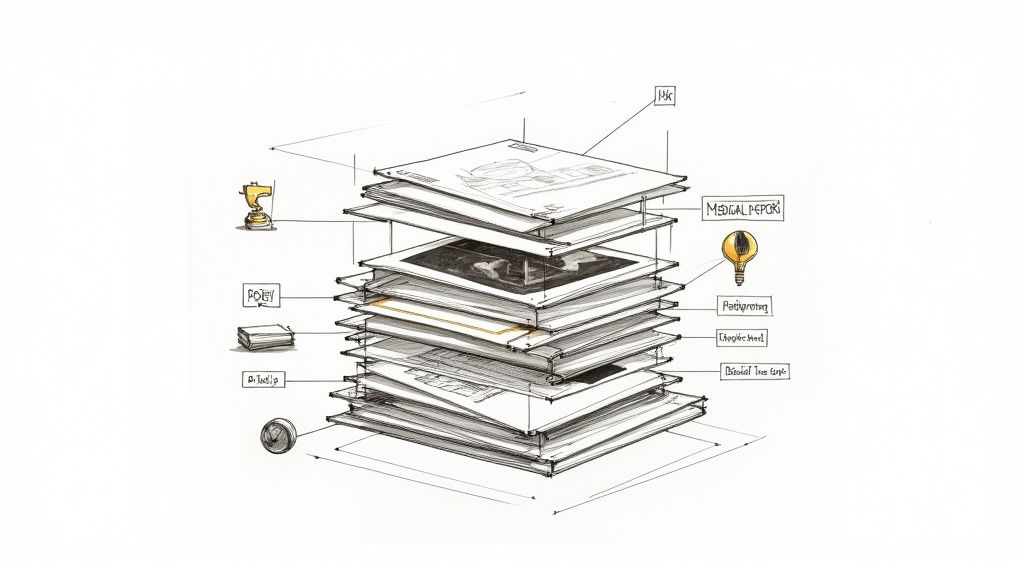
Before you even think about writing your demand letter, you have to shift your mindset from victim to investigator. A strong demand isn't built on a sob story; it’s built on a mountain of undeniable proof. The insurance adjuster on the other side is trained to poke holes in your story, so your goal is to hand them a file so tight and well-documented that it leaves no room for questions.
This is about much more than just the police report and the ER bill. You're creating a complete narrative—backed by evidence—that shows what happened, how you were hurt, and the ripple effect it’s had on every part of your life.
Think of each document as a brick. A single receipt for Tylenol doesn't seem like much, but when you stack it with medical records, photos, and lost wage statements, you build a fortress the adjuster can't breach. This evidence is the foundation of any auto accident demand letter sample worth its salt.
Start with the Crash Itself
First things first: you have to lock down the story of the accident and nail down who was at fault. This is where you establish the other driver's liability, making everything else possible.
The key here is gathering official, objective proof that backs up your side of the story. These are the documents that adjusters respect because they come from third parties.
Your Liability Toolkit:
- The Official Police Report: This is your cornerstone document. Get a certified copy and take a highlighter to the important parts—any citations the other driver got, witness statements, and the officer’s own conclusions about what caused the wreck.
- Scene Photos and Videos: A picture is worth a thousand words, and in this case, maybe thousands of dollars. You need clear shots of the vehicle damage (both cars), skid marks, traffic signs, road conditions, and any visible injuries right after the crash.
- Witness Information: Get the name and number of anyone who saw what happened. A quick written statement, even on a piece of notebook paper, from an independent witness can shut down any attempt by the other driver to change their story later.
Documenting Every Medical Detail
This is where so many claims fall apart. You need to meticulously track every single step of your medical treatment, from the ambulance ride to your last physical therapy appointment. Gaps in your medical records are red flags for adjusters.
You’re trying to draw a clear, unbroken line connecting the accident to your injuries. Every bill, every doctor’s note, and every prescription receipt reinforces that connection. With vehicle crashes causing an estimated 5.2 million medically consulted injuries in the U.S. in 2023, you can bet that insurers are looking for any excuse to downplay your claim. For a deeper dive, you can read more about these personal injury statistics.
My Advice From the Trenches: Get a cheap accordion folder the day after the accident. Label it "Car Wreck." Every single piece of paper you get—a bill, an Explanation of Benefits (EOB), a doctor’s note, a pharmacy receipt—goes straight into that folder. Staying organized from the jump will save you a world of headaches down the road.
Your medical file must have:
- All Medical Bills: Don't just get the final amount. Get the itemized bills from everyone: the ambulance, the ER, the hospital stay, any specialists, your chiropractor, and all physical therapy.
- Complete Medical Records: This is more than just bills. You need the doctors' clinical notes, MRI and X-ray reports, official treatment plans, and all discharge paperwork.
- Proof of Out-of-Pocket Costs: Did you buy a knee brace? Crutches? Prescription pain medication? Save every single receipt. It all adds up.
Proving Your Financial Losses
Finally, you have to show them the money you lost because you couldn't work. This isn't theoretical; it’s a hard, calculable number that you have a right to get back. Just saying "I missed two weeks of work" is useless. You have to prove it.
The best way to do this is by establishing a baseline of your normal earnings with past pay stubs. Then, you show exactly what you lost with a formal letter from your job.
Your Lost Income Checklist:
- Pay Stubs: Grab copies from the two months right before the accident.
- Employer Letter: Ask your HR department or manager for a letter on company letterhead. It should state your job title, how much you make, and the exact dates you were out of work because of your accident-related injuries.
- Tax Returns: If you work for yourself, your recent tax returns are the best way to prove your earning history.
How to Calculate What Your Claim Is Really Worth
Putting a dollar amount on your losses can feel strange, almost clinical, especially when you're trying to quantify your pain. But this calculation is the absolute heart of your demand letter. It's how you translate your experience into a concrete, justifiable number that an insurance adjuster has to take seriously.
We'll walk through how to build a fair and strategic demand figure, starting with the hard numbers and then moving into the more nuanced (but equally important) valuation of your suffering.
Tallying Your Economic Damages
Let's start with the easy part: the math. Economic damages, also called special damages, cover every single verifiable, out-of-pocket expense you've had because of this accident. There’s no guesswork here; it’s all about meticulous record-keeping.
Your goal is to account for every cent you're out. Don't dismiss small expenses—they add up.
- Medical Expenses: This is usually the biggest category. Gather every single bill: ambulance, ER, hospital stays, surgeons, specialists, physical therapy, chiropractic care, and prescriptions.
- Future Medical Costs: Is your doctor recommending future surgery or long-term physical therapy? You need to include a professional estimate of these anticipated costs. You can't be compensated for them later if you don't include them now.
- Lost Wages: Calculate the exact income you lost because you couldn't work. This isn't just your salary. It includes any missed overtime, commissions, or bonuses you realistically would have earned.
- Property Damage: This is the cost to repair or replace your vehicle. Don't forget other personal items that were damaged in the crash, like your laptop, phone, or car seat.
- Miscellaneous Costs: Did you pay for parking at the hospital? Hire a babysitter or a lawn service because your injuries prevented you from doing it yourself? These are real, recoverable costs. Add them to the list.
Valuing Your Pain and Suffering
This is where art meets science. Non-economic damages—what most people call "pain and suffering"—are meant to compensate you for the physical pain, emotional trauma, and the general upheaval the accident caused in your life.
Insurance adjusters don't have a magic formula, but they lean heavily on a common starting point: the multiplier method.
Basically, you take your total economic damages (especially the medical bills) and multiply them by a number, which usually falls between 1.5 and 5. The more severe, painful, and permanent your injuries, the higher the multiplier you can justify.
A Note From Experience: The multiplier isn't some random number. It's a tool to translate your human experience into a value the insurance system understands. A minor whiplash that clears up in a month might get a 1.5x multiplier. A catastrophic injury involving a spinal cord issue could demand a 5x multiplier or even higher.
How to Justify a Higher Multiplier
So, how do you make the case for a multiplier of 3, 4, or 5 instead of the lowball 1.5 the adjuster will want to use? You do it by painting a vivid picture of how this injury has derailed your life, using facts and evidence.
Several factors will push that number up:
- Injury Severity: A documented fracture, a surgery with hardware, permanent scarring, or any lasting disability is a powerful justification.
- Lengthy Recovery: If your recovery dragged on for months or is still ongoing, that demonstrates prolonged suffering. It’s a simple but effective point to make.
- Disruption to Your Life: Can you no longer pick up your toddler, enjoy your weekend hiking trips, or manage basic chores without pain? These are profound losses.
- Emotional & Psychological Trauma: A diagnosis of anxiety, depression, or PTSD from a professional is a significant factor. Even documented insomnia or a new fear of driving adds weight to your claim.
Let’s say you have $10,000 in medical bills for a broken arm that needed surgery and three months of painful physical therapy. You could very reasonably apply a 3x multiplier. That gives you $30,000 for pain and suffering. Add that to your economic damages, and you have your total settlement demand.
Mastering how these numbers fit together is crucial for a successful outcome. You can dive deeper into this topic in our complete guide to car accident settlements.
Think of your final demand as your opening bid in a negotiation. It should be ambitious but firmly rooted in the evidence you've gathered. This shows the insurance company that you've done your homework and you're serious about getting what you've truly lost.
Putting It All Together: Real-World Demand Letter Samples
Theory is great, but seeing it in practice is where the rubber meets the road. To give you a real feel for how these letters work, we're going to move beyond generic templates. Let's walk through a few auto accident demand letter samples I’ve modeled after real Texas cases, each one tailored to a different level of injury.
Think of these less as fill-in-the-blank forms and more as strategic blueprints. We'll break them down piece by piece to show you why certain phrases are used, how the information flows, and how you can build a powerful story that connects the other driver's mistake directly to your losses.
At its core, calculating your demand is a simple formula: you add up all your hard costs (the "economic damages") and then apply a multiplier to account for your pain and suffering. The result is your total settlement demand.
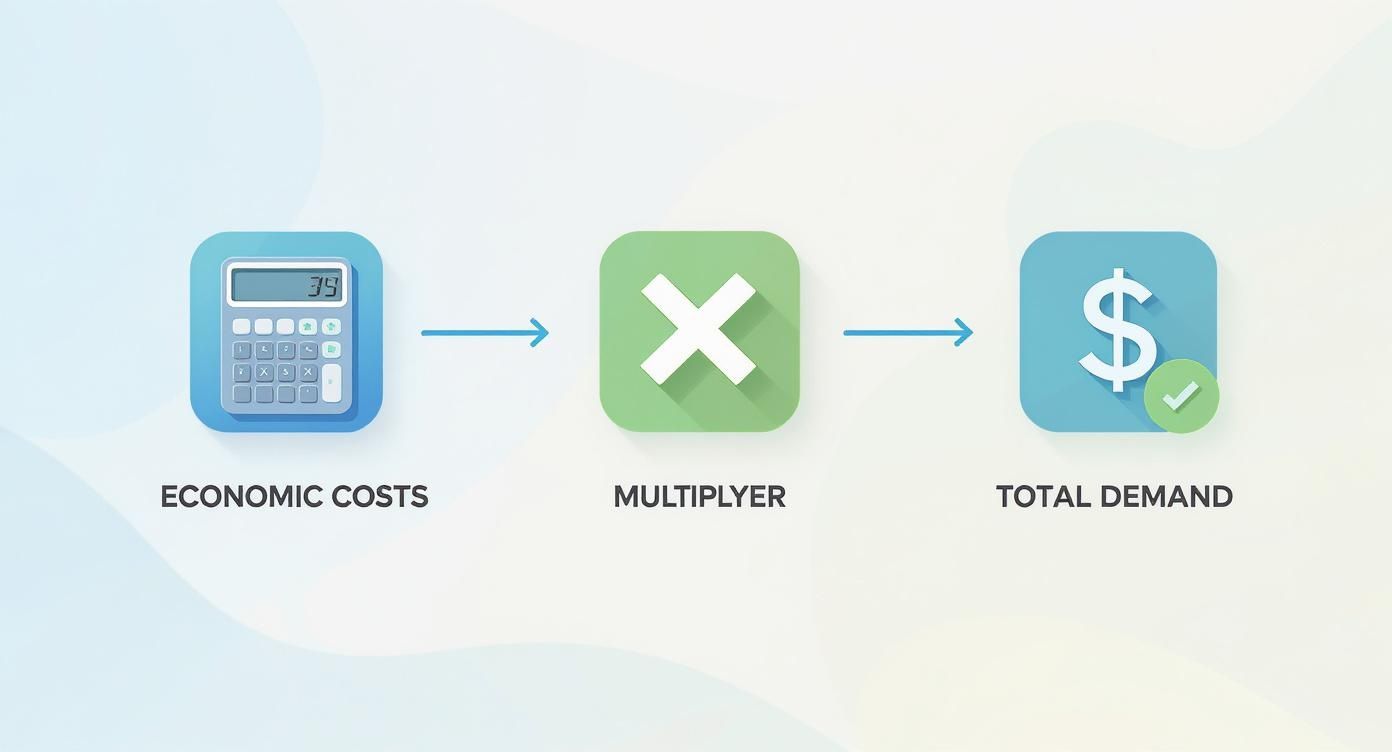
This method ensures you’re accounting for everything—not just the bills you can hold in your hand, but the very real human suffering you endured.
Sample for Minor Injuries (Whiplash and Soft Tissue Damage)
Minor injury cases are everywhere. Unfortunately, they're also the claims that insurance adjusters love to downplay or dismiss. Your job is to draft a letter that is firm, packed with facts, and makes it impossible for them to ignore the real pain and disruption that even a "minor" sprain or strain can cause.
The key here is to show how this injury, despite not being life-threatening, genuinely upended your daily routine. You need to give weight to the pain and suffering portion of your claim, even when the medical bills aren't sky-high.
A Look Inside the Letter
The Opener (Paragraph 1):
- What it says: "This letter is a formal demand for settlement regarding the injuries I sustained in the collision on January 15, 2024, caused by your insured, John Smith. As a direct result of Mr. Smith’s failure to stop at a red light, I have suffered significant neck and back pain, diagnosed as cervical and lumbar strain."
- Why it works: It's direct and professional. In one breath, you've established the date, the at-fault driver, and your specific medical diagnosis. No fluff.
Pinning Down Liability (Paragraph 2):
- What it says: "According to the official police report (Case #12345), Mr. Smith was issued a citation for violating Texas Transportation Code § 544.007. The report clearly states there were no adverse weather or road conditions, and his negligence was the sole cause of this incident."
- Why it works: You aren't just pointing fingers; you're backing it up with hard evidence. Citing the police report and the specific traffic law violation makes their insured’s fault virtually undeniable.
Telling Your Medical Story (Paragraph 3):
- What it says: "Following the collision, I sought immediate medical attention at Baylor Scott & White Emergency Department. Over the next six weeks, I attended twelve physical therapy sessions at Texas Physical Therapy Specialists to regain mobility and manage the persistent pain, which severely disrupted my sleep and ability to perform my duties as an accountant."
- Why it works: This creates a clear timeline of your treatment. More importantly, it connects the injury to tangible, real-life problems like poor sleep and trouble at work. This is how you start building the case for your pain and suffering.
Sample for Moderate Injuries (Broken Bone and Recovery)
When you're dealing with a more obvious injury like a broken arm, the physical evidence speaks for itself. The goal of your demand letter shifts. Now, you need to paint a vivid picture of the entire ordeal—the initial shock, the surgery, the long and often painful road of rehabilitation, and how it has limited you.
Your strategy is to highlight the full domino effect of the injury. It’s not just a broken bone; it was weeks or months of disruption. Your damages are going to be significantly higher, and you need to document why.
- Medical Bills: These will be much larger, likely including costs for an orthopedic surgeon, a hospital stay, and maybe even surgical hardware.
- Lost Wages: You probably missed a serious amount of work, and you'll need pay stubs to prove it.
- Pain and Suffering: The multiplier gets a bump here, often to 3x or 4x your economic damages, because the severity and recovery time are so much greater.
From the Expert's Desk: When a fracture is involved, I always tell clients to focus on the loss of independence. Use language like: "For eight weeks, I was unable to drive, cook for my family, or even dress myself without assistance. This complete loss of autonomy was profoundly distressing and placed an immense burden on my spouse."
That kind of personal detail transforms your claim from a simple medical case into a human story, making it much harder for an adjuster to lowball you.
Sample for Serious Injuries (Requiring Extensive Treatment)
With catastrophic injuries, the demand letter becomes a much heavier lift. It’s no longer just a letter; it's a comprehensive summary of a life-changing event and its devastating, ongoing consequences.
The strategy here has to be exhaustive. You must detail every single medical procedure, the need for future care, the loss of your ability to earn a living, and the profound emotional and physical toll. Often, this letter must also describe the impact on the victim's entire family.
Globally, the automotive industry has seen a surge in product recalls and liability claims, reflecting wider trends that can impact auto accident demand letters where vehicle defects contribute to an incident. These trends show that a demand may need to address complex liability issues beyond just driver error, requiring an even more thorough, evidence-based approach. You can discover more insights about these global liability claim trends and their impact on the auto industry.
The Building Blocks of a Serious Injury Demand:
- State the Catastrophic Impact Upfront: Make it clear from the beginning that the injuries are permanent or carry lifelong consequences.
- Provide an Exhaustive Medical History: This section will be long. You need to detail every single hospitalization, surgery, specialist visit, and therapy session.
- Outline Future Care Needs: This is absolutely critical. You'll need reports from life care planners or medical experts to project the costs of future surgeries, in-home nursing, medications, and specialized equipment.
- Calculate Lost Earning Capacity: This is different from just lost wages. If you can no longer work in your profession, a vocational expert must calculate the total income you will lose over the rest of your working life.
- Detail the Profound Non-Economic Damages: Here, you describe the immense suffering—the loss of enjoyment of life, permanent disfigurement or scarring, and the deep emotional trauma. The pain and suffering multiplier here will be at the top of the scale (5x or even higher).
Drafting a demand for a serious injury is a massive undertaking. While these points give you a roadmap, the stakes are simply too high to go it alone. This is the point where hiring an experienced personal injury attorney is not just a good idea, it's essential. They have the resources to bring in the necessary experts to prove the full, true value of your claim and fight for every dollar you deserve.
How to Handle the Insurance Adjuster's Response
Hitting 'send' on your demand letter feels like a finish line, but it's really the starting gun for negotiations. The ball is now in the insurance company's court, and you need to be ready for the adjuster's professional playbook. Their job, plain and simple, is to protect their employer's bottom line by paying out as little as they can get away with.
You've done the hard work of building a solid, evidence-backed case. Now, it's time to stand your ground.
The Inevitable Lowball Offer
It is almost unheard of for an insurer to accept your initial demand. Don't be surprised. Their first move is often a long silence, followed by a counteroffer that feels downright insulting.
This is a calculated test. They're probing to see if you're desperate, impatient, or, most importantly, unsure of what your claim is actually worth.
Do not panic. A lowball offer is just an opening gambit, not the final word. Reacting with anger or frustration plays right into their hands and weakens your position. See it for what it is: an invitation to start the real negotiation.
Politely reject the offer in writing. Then, ask the adjuster to provide the specific, evidence-based reasons for their valuation. This simple move shifts the conversation away from their low number and back to the facts of your case.
Common Adjuster Arguments and How to Deflect Them
When the adjuster finally justifies their low offer, they'll pull from a standard list of arguments. Knowing what's coming is half the battle.
-
Pre-Existing Injuries: They'll comb through your medical history, trying to blame your pain on an old back problem or a sports injury from college. The antidote? A clear, direct statement from your doctor connecting your current injuries specifically to this accident.
-
"Unnecessary" Medical Treatment: Expect them to question the validity of your care. They might argue your physical therapy was excessive or that your visit to a specialist wasn't needed. Your medical records and your doctor's detailed notes are your best defense here.
-
Disputed Lost Wages: If your documentation is sloppy, they will pounce. This is why a formal letter from your employer detailing your role, pay rate, and missed time is so much more effective than just handing over a few pay stubs.
An Insider's Warning: Never, ever give an adjuster a blanket authorization to access your entire medical history. This is a fishing expedition, plain and simple. Only provide records directly relevant to the injuries sustained in this accident.
Crafting Your Counteroffer and Controlling the Narrative
Once you have their low offer and their reasoning, it's your turn to fire back with a counteroffer. Resist the temptation to just split the difference.
Your counter should be a measured step down from your original demand. This signals that you're willing to be reasonable, but it also reinforces that your initial calculation was well-founded and not just a number you pulled out of thin air.
Accompany your counteroffer with a point-by-point rebuttal to their arguments. For example:
"Regarding the physical therapy, this treatment was prescribed by Dr. Smith to treat the cervical strain diagnosed after the collision, as documented in the treatment plan I already provided."
Keep every email and phone call professional and fact-based. This isn't a personal feud; it's a business transaction. Each time you respond, you're building a record that reinforces the strength of your claim and shows the adjuster you won't be intimidated.
Stay calm, stay organized, and always bring the conversation back to the evidence.
Common Insurer Tactics and How to Respond
Adjusters are trained negotiators with a well-defined playbook. This table is a quick-reference guide to help you anticipate and counter their most common moves.
| Insurer Tactic | Their Goal | Your Strategic Response |
|---|---|---|
| The "Friendly" Approach | To build rapport and get you to say something damaging or admit partial fault. | Remain polite but professional. Stick to the facts. Never admit any fault or speculate. |
| Requesting a Recorded Statement | To lock you into a story early and find inconsistencies to use against you later. | Politely decline. Offer to answer specific questions in writing. |
| Delay, Delay, Delay | To frustrate you into accepting a lower offer out of sheer exhaustion or financial pressure. | Follow up politely but persistently in writing. Create a paper trail and reference claim-handling deadlines required by the Texas Insurance Code. |
| Misrepresenting the Law or Policy | To convince you that your claim isn't covered or is worth less than it is. | Don't take their word for it. Read your policy. If a legal issue is raised, tell them you'll need to review it with your attorney (even if you don't have one yet). |
| Making a Quick, Low Offer | To close the file cheaply before you understand the full extent of your injuries or financial losses. | Never accept the first offer. Thank them and state you'll review it and respond in writing after careful consideration. |
By understanding these tactics, you take back control. You're no longer just reacting to their moves; you're navigating the negotiation with a clear strategy.
Common Questions About Texas Demand Letters
After a car wreck, you’re bound to have a ton of questions. When it comes to writing a demand letter, the practical concerns and "what-if" scenarios can be overwhelming. I've been through this process countless times, so let's walk through the most common questions people have about demand letters in Texas.
When Is the Best Time to Send My Demand Letter?
This is all about strategy. You absolutely must wait until you've reached what doctors call Maximum Medical Improvement (MMI). This is just a formal way of saying you're as healed as you're going to get, and your doctor can predict what, if any, future medical care you'll need.
Jumping the gun is a huge mistake. If you fire off a demand letter before you know the full scope of your injuries and future costs, you could be leaving a serious amount of money on the table. You only get one bite at the settlement apple, so make sure you have the complete financial picture before you even think about negotiating.
But don't drag your feet, either. Texas has a two-year statute of limitations for personal injury claims. That means you have two years from the crash date to either settle your case or file a lawsuit. Sending your letter well before that deadline gives you the time you'll need for the back-and-forth of negotiations.
What Should I Do If the Insurance Company Ignores My Letter?
First off, don't panic. This is a classic insurance company tactic. They sometimes use silence and delays to frustrate you into either taking a lowball offer or just giving up. If your deadline—usually around 30 days—comes and goes with no response, it's time to start creating a paper trail.
Here's what I recommend:
- Send a Follow-Up Letter: Mail another letter, this time via certified mail. Keep it professional but firm. Reference your original demand and point out that you haven't heard back.
- Pick Up the Phone: Follow up with a call to the adjuster. Make sure you document the date, time, and exactly what was said.
- Mention the Law: In your follow-up, it doesn't hurt to politely remind the adjuster of their legal duty to acknowledge claims and negotiate in good faith under the Texas Insurance Code.
If they still give you the silent treatment, take it as a clear signal they aren't taking your claim seriously. This is often the point where you need to bring in an attorney to show them you mean business.
Key Takeaway: Consistent, professional follow-up is your best friend. It shows you're organized and won't be pushed around. Plus, it builds a record of the insurer’s bad faith tactics, which can be powerful leverage down the road.
How Does Texas Fault Law Impact My Claim?
This is a big one. Texas operates under a modified comparative fault rule, which is also called proportionate responsibility. In simple terms, it means you can still get paid even if you were partially at fault for the accident, but only if your share of the blame is 50% or less.
Here's the catch: your final settlement gets reduced by your percentage of fault. For example, if you have $50,000 in damages but a jury decides you were 20% at fault, your recovery is cut by that 20%, leaving you with $40,000. If they decide you were 51% or more at fault, you get zero.
Insurance adjusters live and breathe this rule. They will look for any opportunity to shift more of the blame onto you to lower their payout. This is precisely why the liability section of your demand letter has to be rock-solid, backed by the police report, photos, and any witness statements you can get.
Fault can get tricky in less common scenarios, too. You can learn more about how it works by reading our guide on handling a single-car accident.
When Should I Stop and Call a Lawyer?
While you can definitely handle a straightforward, minor injury claim on your own, there are some clear red flags that tell you it's time to lawyer up. You should seriously consider getting professional help if:
- Your injuries are severe, permanent, or will require long-term medical care.
- The insurance company is denying they're at fault or is trying to pin an unfair amount of blame on you.
- The adjuster is ignoring you or using obvious delay tactics.
- You receive a settlement offer that is insultingly low and nowhere near the value you calculated.
An experienced personal injury attorney can take over the stressful back-and-forth, hire experts to prove the true value of your damages, and won't hesitate to file a lawsuit if the insurance company refuses to play fair.
At Verdictly, we believe transparency is the key to a fair negotiation. Our AI-powered platform gives you access to real Texas motor vehicle case outcomes, so you can see what similar claims are actually worth. Stop guessing and start negotiating from a position of strength. Explore real verdicts and settlements today at https://verdictly.co.