
How to handle being pulled over: a driver's guide
How to handle being pulled over: protect your rights and navigate the next steps with our practical driver's guide.
It’s a feeling every driver dreads: the sudden flash of red and blue lights in the rearview mirror. Your heart might start pounding, but the next few moments are critical. How you react sets the stage for the entire stop, and the goal is always to keep things calm, safe, and professional for everyone.
Handling the Initial Moments of a Traffic Stop
When you see those lights, your first instinct might be panic. Take a deep breath. Your immediate job is to show the officer you're cooperative and not a threat. This starts the second you realize you're being pulled over. The best way to do that is to flip on your right turn signal to acknowledge you see them and are looking for a safe place to stop.
Getting pulled over is far more common than you might think. Data collected by the Stanford Open Policing Project reveals that police stop more than 50,000 drivers on an average day. That adds up to over 20 million traffic stops every single year in the U.S. alone. Knowing this can help put the experience in perspective—it's a routine part of traffic enforcement.
Finding a Safe Place to Stop
Your first move is to find a safe spot to pull over. On a highway, that means getting to the right shoulder as safely and quickly as you can. You want to avoid stopping in a live traffic lane, on a narrow bridge, or right around a blind curve.
If you can't find a good spot right away, don't just slam on the brakes. Slow down, turn on your hazard lights to communicate your intent, and keep driving at a low speed until you find a better location. A well-lit parking lot is an excellent choice if one is close by.
The whole point is to make the stop safe for you and the officer. Pulling over in a dangerous spot elevates the risk for everybody and can start the interaction off on a tense footing before a single word is exchanged.
Preparing for the Officer's Approach
Once you're safely stopped, put your car in park and turn off the engine. If it's nighttime, switch on your interior dome light. This is a small gesture, but it goes a long way in showing transparency and de-escalating the situation right from the start.
Next, place both of your hands on the steering wheel where they can be easily seen. Fight the urge to immediately start digging through your glove compartment or console for your license and insurance. Any sudden movements an officer can't see can be easily misinterpreted. Wait until they ask you for your documents.
This simple visual guide reinforces the right way to begin a traffic stop.
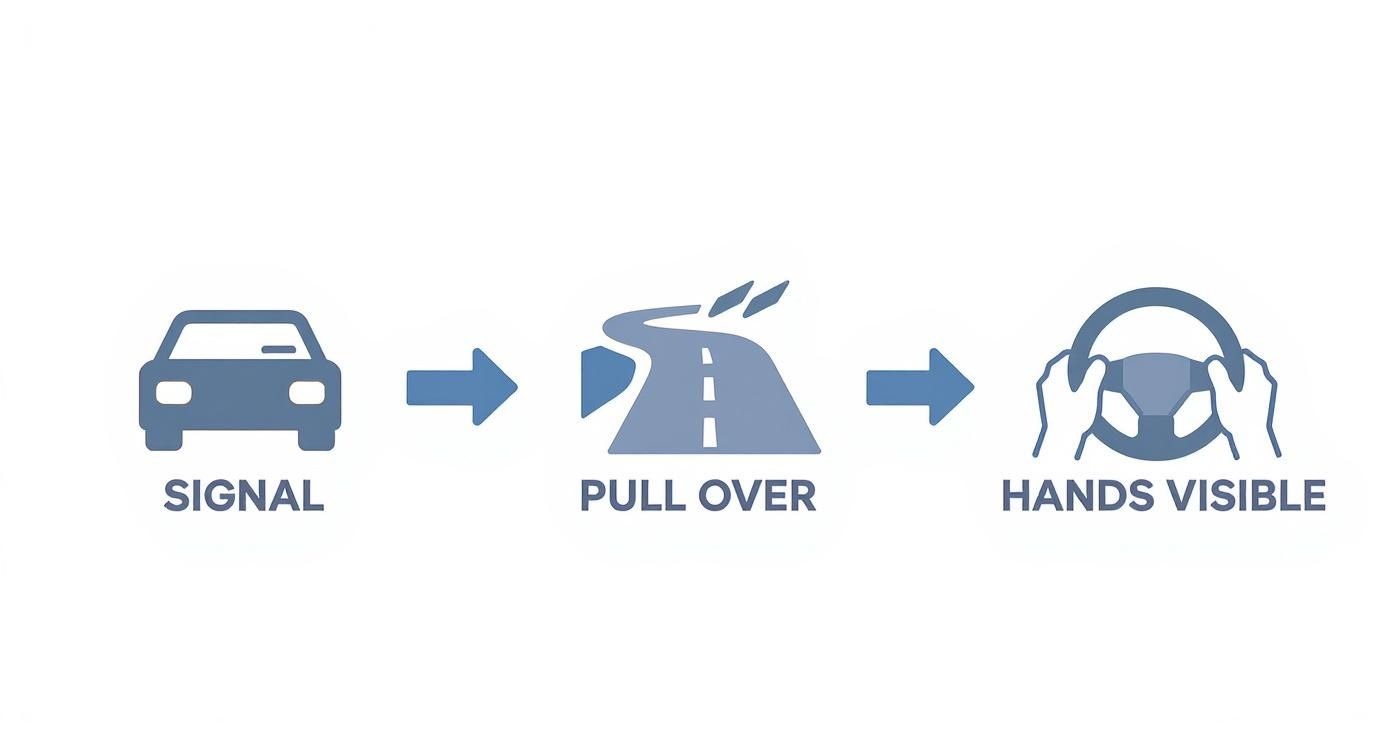
Following these three steps—signal, pull over, hands visible—is the foundation for a smooth and non-confrontational traffic stop.
Texas Traffic Stop Do's and Don'ts
To keep things simple, here's a quick cheat sheet for what to do—and what not to do—when you get pulled over in Texas.
| Action (Do) | Avoid (Don't) |
|---|---|
| Do pull over to the right side of the road as soon as it's safe. | Don't stop in a high-traffic lane, on a bridge, or in a no-shoulder area. |
| Do turn on your interior light at night. | Don't make sudden movements or reach for things before being asked. |
| Do place your hands on the steering wheel. | Don't get out of your vehicle unless specifically instructed to do so. |
| Do keep your license, registration, and proof of insurance accessible. | Don't argue with the officer or be confrontational. |
| Do provide your name and required documents when requested. | Don't admit guilt (e.g., "I know I was speeding"). |
| Do remain calm and polite throughout the interaction. | Don't consent to a search of your vehicle or person. |
Keeping these simple guidelines in mind can help ensure the stop is handled safely and efficiently, protecting your rights along the way.
Communicating with the Officer and Knowing Your Rights
Once you're pulled over and see the officer walking up to your car, how you handle the next few minutes can set the tone for the entire stop. The goal is to be polite and follow lawful commands, but you also need to be firm in protecting your constitutional rights. It's a balancing act—be respectful without accidentally giving away information that could make things worse for you.
Getting pulled over feels personal, but it's one of the most common ways people interact with law enforcement. It happens all the time. One national survey found that about 19 million drivers were stopped by police in a single year, which was roughly 10% of all drivers on the road. You can dig into the numbers yourself by checking out these traffic stop statistics from the Bureau of Justice Statistics.
Answering Questions Selectively
When the officer asks for your license, registration, and proof of insurance, Texas law requires you to hand them over. Just do it calmly, and avoid making any quick, sudden movements.
After that, the questions usually start. A classic opener is, "Do you know why I pulled you over?" This question is a trap, designed to get you to admit you did something wrong. You don't have to answer it. A simple, polite response is your best bet.
- Don't say: "I guess I was speeding a little."
- Instead, try: "No, officer, I'm not sure."
This is a perfectly honest and respectful answer. It makes the officer state their reason for the stop without you incriminating yourself. The same goes for questions about where you're coming from or where you're going. You’re not legally required to share those details for a simple traffic violation.
Keep this in mind: The Fifth Amendment gives you the right to not incriminate yourself. You can use that right by staying quiet when asked questions that aren't about identifying yourself or your ability to drive. Politeness doesn't mean you have to give up your rights.
Asserting Your Right to Refuse a Search
This is one of the most important things to remember during a stop: you have the right to refuse a search of your car. To legally search your vehicle, an officer needs either your permission or probable cause—which means they have a solid, reasonable belief that a crime has been committed. If they don't have a warrant or probable cause, they have to ask for your consent.
If the officer asks, "Do you mind if I take a look inside your vehicle?" you have every right to say no. Saying no cannot be used against you or as a reason to hold you there any longer.
Be crystal clear with your words.
- "Officer, I do not consent to any searches."
- "I understand, but I am not giving you my consent to search my car."
You need to be firm, but stay calm. There's no need to give a long speech or an excuse. A simple "no" is all you need to protect your Fourth Amendment rights against unreasonable searches.
Now, what if they search anyway? If you've clearly said no and they decide to search your car, do not try to physically stop them. That can escalate things dangerously. Just repeat, "I do not consent to this search," and let them proceed. Later on, your attorney can challenge the legality of that search in court.
How to Safely and Legally Document the Stop
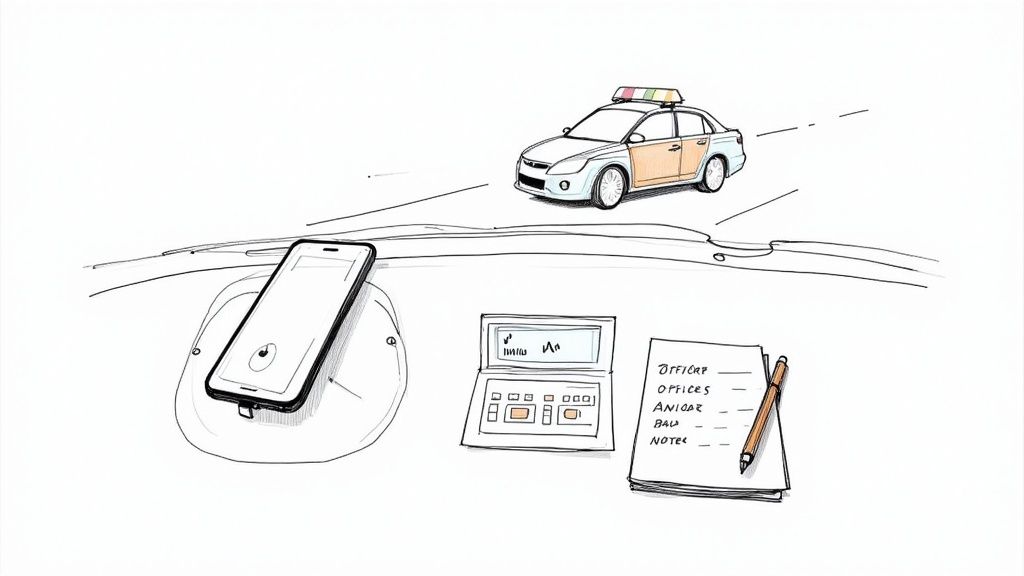
Once the initial interaction is over and you're waiting for the officer, your smartphone can be your best friend. Creating a clear, objective record of the traffic stop is one of the smartest things you can do, especially if you later need to challenge a ticket or question an officer’s behavior.
It’s important to know your rights here. In Texas, you are legally allowed to record police officers while they are performing their duties in a public space. This right is firmly protected by the First Amendment. That said, how you record can make all the difference in keeping the encounter calm and professional.
Best Practices for Recording the Stop
The trick is to start recording without making any sudden moves that could be misinterpreted as a threat. If you have a passenger, have them handle the recording. If you’re alone, a dashboard or vent-mounted phone holder is the ideal setup. This keeps the camera stable and, more importantly, allows you to keep both hands visible on the steering wheel—a key part of de-escalation.
You're not legally required to announce that you're recording in Texas, but you shouldn't try to hide it either. A phone on a dash mount is in plain view, and that’s perfectly fine. Your goal is simply to document what happens, not to provoke a confrontation.
An accurate recording can mean the difference between your word and the officer's. It provides an unbiased account of the conversation, the reason given for the stop, and the conduct of everyone involved.
Try to capture both audio and video, but if you have to choose, clear audio is often more valuable. The exact words exchanged can be far more critical than a perfect video. Just make sure your phone is positioned to pick up the conversation as clearly as possible.
Mentally Documenting Key Details
While your phone is recording, your brain is the other critical tool. The stress of being pulled over can make details fuzzy later, so make a conscious effort to lock in specific facts as they happen.
Think of it as creating a mental checklist. This practice will help you build a complete picture of the encounter. Then, as soon as the officer has driven away, pull over somewhere safe and jot down everything you remember while it's still fresh.
Here are the essential details to capture:
- Officer's Name and Badge Number: You can politely ask for this. If the officer provides it, write it down immediately.
- Patrol Car Number: This helps identify the specific vehicle involved.
- Location and Time: Be as precise as possible—the street, nearest cross-street or mile marker, city, and time.
- Reason for the Stop: What was the exact reason the officer gave for pulling you over? Quote it if you can.
- Key Statements: Try to recall important questions the officer asked and statements made by both of you.
- Witness Information: If you had passengers or saw other potential witnesses, get their names and phone numbers.
This level of detail creates a solid foundation if you decide to consult with an attorney. You'd be surprised how often a small, seemingly insignificant detail you captured during or right after the stop becomes a crucial piece of evidence in your case.
What to Do Immediately After the Stop Ends
Just because you see the officer’s taillights fade into the distance doesn’t mean the whole ordeal is over. What you do in the moments, hours, and days after a traffic stop can make all the difference for your driving record and your wallet. Your very first move should be to document everything you can while it's still fresh.
Pull over into a safe spot—the next parking lot, a quiet side street—and just take a deep breath. Your adrenaline was probably pumping, but now’s the time to calmly jot down the details. Write down the time, the exact location, the officer's name and badge number if you got it, and the reason they gave for pulling you over. These details can feel small, but they paint the full picture if you need it later.
Deciphering the Citation and Understanding Your Options
Okay, now take a look at that piece of paper they handed you. A traffic ticket can feel intimidating, like it’s written in a foreign language, but it holds some critical information. You're looking for three key things: the violation you're being accused of, the fine, and—most importantly—the court date or deadline to respond. Blowing past that deadline can turn a simple ticket into a warrant for your arrest, and nobody wants that.
Here in Texas, you’ve basically got three roads you can go down:
- Pay the Fine: This is the path of least resistance. You pay the ticket, but you’re essentially pleading "guilty" or "no contest." The downside is that the violation will almost certainly land on your driving record, which is a great way to watch your insurance rates creep up.
- Request Deferred Disposition: Think of this as a probationary period. You pay some fees, stay out of trouble for a set amount of time, and if you do, the court can dismiss the ticket. For a lot of minor infractions, this is a fantastic option to keep your record clean.
- Contest the Ticket: This is where you plead "not guilty" and prepare to argue your side of the story in court. It takes more effort, but if you genuinely believe the citation was unjust, it's the right move to make.
Don't feel singled out—traffic stops are incredibly common. As an example, recent data from Portland showed police conducted 24,182 driver stops in just one year. That was a 41 percent jump from the year before. And get this: the report found that 98 percent of those stops were for traffic violations alone. You can dig into these policing strategy shifts and stop data yourself to see just how routine these encounters are.
Creating Your Post-Stop Action Plan
What you do next really hinges on what happened. If the stop was simple and just resulted in a ticket, you'll focus on that. But if there was an accident involved, your to-do list gets longer. You'll need to meticulously document vehicle damage and any injuries, which adds a whole new layer of complexity. If you're in that situation, you might find our article on what to do after a single-car accident really helpful.
The most important takeaway is to be proactive. Don't just stuff the ticket in your glove compartment and hope it goes away. Making a deliberate, informed choice about how to proceed gives you the best chance of minimizing the long-term impact.
Take a moment to weigh your options. Think about the cost of the fine versus the potential hike in your insurance premiums, and factor in the time and energy it would take to fight the ticket in court. A clear plan, made with a cool head once the stress of the stop has faded, is always your best bet.
When You Should Hire a Traffic Ticket Attorney

Look, a lot of minor traffic tickets can be handled without hiring a lawyer. But simply paying the fine isn’t always the best move, especially when you start thinking about the long-term pain of insurance hikes and points stacking up on your license. Knowing when to pick up the phone and call an attorney can save you a world of hurt down the road.
When the stakes are high, you need someone who knows the system inside and out. A good traffic lawyer can navigate the local courts, spot procedural errors you’d never catch, negotiate with prosecutors, and build a defense that could get your charges reduced or even dismissed entirely.
Clear Signs You Need Legal Counsel
Not every ticket is a five-alarm fire. A simple rolling stop might not warrant a legal battle. However, if your traffic stop involves any of the situations below, you should seriously consider getting professional help on your side. These aren't just about a fine; they can affect your freedom, your job, and your ability to drive.
- You were arrested for any reason. This is the big one. Think DWI, driving with a suspended license, or anything else that puts you in cuffs.
- The citation is for a serious moving violation. We're talking about things like reckless driving or clocking a speed that's 30+ mph over the limit.
- You're a commercial driver (CDL holder). For you, even a seemingly minor ticket can put your entire livelihood on the line.
- The stop involved an accident, especially if someone was injured or there was major property damage.
When a crash is involved, you need to understand the potential financial fallout. You might find our complete guide to car accident settlements helpful for getting a sense of what's at stake. An attorney’s job here is to protect you from liability and make sure you don't get taken advantage of.
Your time to fight is in the courtroom with a lawyer, not on the side of the road. Arguing with an officer or resisting—even if you feel the arrest is unlawful—is a guaranteed way to make things worse and pile on more charges.
Finding the Right Attorney for Your Case
When you meet with a potential attorney, remember that you're interviewing them for a job. This is a critical hire, so you need to feel confident in their experience and their plan for your case. Don't be shy about asking tough questions.
Show up prepared. Bring every piece of paper you have from the stop—the ticket, your notes, anything. A good lawyer will want to hear every detail. This is your chance to size them up and see if they're the right fit.
Key Questions to Ask a Traffic Attorney
- How much of your practice is actually focused on Texas traffic law?
- Based on what I've told you, what's your gut feeling about my case?
- How do you charge? Is it a flat fee for this kind of case, or am I paying by the hour?
- What are all the possible outcomes here—the good, the bad, and the ugly?
Picking the right lawyer after a traffic stop is a huge decision. The right one can take a chaotic, stressful mess and turn it into a manageable process that ends with a much better result than you could have gotten on your own.
Common Questions About Texas Traffic Stops
Getting pulled over is nerve-wracking, even when you handle it perfectly. After the flashing lights are gone, you're often left replaying the encounter in your head, wondering about the specifics. The law isn't always common sense, and knowing the right answers ahead of time can make all the difference in the future.
Let’s clear up some of the most common questions and gray areas Texas drivers run into.
Do I Have to Get Out of My Car if Asked?
The short answer is yes. In Texas, a police officer can legally order you and your passengers to exit the vehicle during a traffic stop. This is a long-standing rule based on officer safety, and you are required to comply.
Arguing or refusing to get out of the car won't end well—it can quickly escalate the situation and may lead to a charge for resisting or interfering with an officer. Just remember that stepping out of the car is not the same as giving consent for a search. You are simply following a lawful command, but you still have the right to refuse any searches of your car or your person.
Can Police Lie to Me During a Stop?
This one surprises a lot of people, but yes, police are generally allowed to use deception during an investigation. A traffic stop falls into that category.
An officer might say something like, "We had a report of a car like yours swerving all over the road," or "I smell marijuana," even if it isn't true. They do this to gauge your reaction and see if you'll admit to something. This is a key reason why it's so important to stick to the script: provide your license and insurance, and politely decline to answer questions about where you've been or where you're headed.
Your best defense is to stay calm, be polite, and provide only what is legally required. Don't let yourself get drawn into a conversation designed to trip you up.
What Happens if I Refuse a Breathalyzer in Texas?
Texas has an "implied consent" law. Essentially, the moment you get a Texas driver's license and drive on public roads, you have automatically consented to a breath or blood test if you are arrested for DWI.
You can still say no, but refusing to take the test triggers immediate and automatic penalties that are separate from the DWI case itself.
- Automatic License Suspension: Your driver's license will be suspended for 180 days on a first-time refusal. This is an administrative penalty, not a criminal one.
- It Happens Anyway: This suspension takes effect whether you are ever convicted of DWI or not.
- They Can Still Get a Sample: The officer can—and often will—get a warrant from a judge to take a blood sample from you by force if necessary.
So, while you can refuse, it's not a get-out-of-jail-free card. The consequences are swift and significant. If your traffic stop involved an accident, understanding the full range of potential legal outcomes becomes even more crucial. Getting familiar with data on Texas motor vehicle accidents can give you a much clearer picture of what you might be facing.
At Verdictly, we believe in the power of information. Our AI-powered platform makes Texas motor vehicle case outcomes transparent, helping you understand what similar cases are worth before you negotiate. See real verdicts and settlements to prepare for your case with data-driven insights. https://verdictly.co